74% of Patients Reported Significant Pain Relief
The platform enabled patients to follow structured digital therapy programs while movement data provided a more objective view of their recovery.

An IoT-enabled rehabilitation platform built from the device firmware up, combining real-time sensor tracking with connected digital therapy and clinician monitoring.
Industry Healthcare & Digital Health
Company Digital Health Provider
Location Austria

The platform enabled patients to follow structured digital therapy programs while movement data provided a more objective view of their recovery.
The connected therapy ecosystem reduced manufacturer support overhead by 17%.
Embedded firmware was engineered from bare silicon to coordinate sensor timing, battery consumption, and wireless communication reliably during therapy sessions.
Device sales increased by 12% following the platform's launch.
The client is an Austrian digital healthcare provider and device manufacturer developing a wearable technology-enabled therapy solution for people suffering from chronic back pain. The company needed to bring both the connected hardware and its digital therapy ecosystem to market, with the wearable device requiring firmware development from the ground up.
When COVID-19 restrictions made in-person physical therapy difficult or impossible, the need for a reliable remote therapy platform became critical. The client needed a solution that could connect patients, wearable sensors, clinicians, and digital therapy programs while keeping the experience simple for people already dealing with chronic pain.
At the same time, the therapy platform relied heavily on patient self-reporting, leaving clinicians with limited visibility into whether patients were performing exercises correctly or making measurable progress.
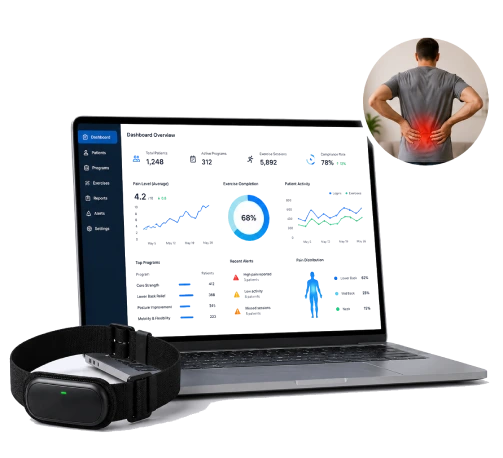
The wearable therapy device was being manufactured without firmware. The embedded software had to be engineered from the ground up to reliably coordinate sensor timing, battery consumption, and wireless communication. A scheduling conflict or missed sensor reading could compromise therapy data or drain the battery during a session.
Clinicians relied heavily on patients' subjective descriptions of lumbar movement and recovery. Without objective movement data, it was difficult to determine whether patients were performing exercises correctly or making measurable progress.
COVID-19 restrictions disrupted in-person physical therapy sessions. The pandemic left patients without consistent access to coaches and doctors.
Coaches and doctors lacked a centralized way to monitor therapy adherence across multiple patients. In addition, the platform also needed secure, low-friction authentication and flexible payment processing.
We built an IoT-enabled digital back pain therapy platform spanning embedded firmware, connected sensors, cloud infrastructure, and clinician-facing applications. Our team developed the device firmware from the ground up, while the software platform transformed the resulting movement data into a connected digital therapy experience.
The solution was engineered across the device and application layers, creating a continuous data path from sensor hardware to the therapy platform and clinician dashboard.
Our team combined the following elements:
Together, these hardware and software technologies create a unified digital therapy experience.
The firmware provided the real-time foundation needed to reliably capture movement data during therapy sessions and transmit it to the connected platform. It had to minimize missed readings and manage power efficiently enough to support therapy sessions without unexpected battery depletion.
Sensors captured relevant movement data during therapy exercises, while the embedded firmware coordinated sensor timing and wireless communication. This created a reliable connection between the physical therapy device and the digital platform.
Therapy activities were wrapped in gamified experiences to encourage patients to complete prescribed exercises consistently. Notably, the patients could engage comfortably with their recovery programs.
A centralized dashboard gives coaches and doctors visibility into patient activity. The professionals could also assess therapy adherence and movement-related data across their complete patient list.
SMS-based authentication simplified account access for patients. It also provided a secure authentication mechanism without adding unnecessary friction to the therapy experience.
The platform supported payment workflows across multiple gateways. This way, it accommodated different regional requirements and patient groups without disrupting the core therapy journey.
When a patient performs a prescribed therapy exercise, the wearable's sensors capture movement data while the embedded firmware manages sensor timing, device power, and wireless communication. The firmware then passes the relevant data through the real-time sensor-to-API pipeline and into the digital therapy platform.
The platform processes the incoming data and makes relevant movement information available to the digital therapy experience, replacing purely subjective descriptions with measurable activity data.
Patients complete their therapy programs through an engaging, gamified experience designed to encourage consistent participation and adherence.
Coaches and doctors can then use the centralized dashboard to monitor multiple patients, review therapy activity, and identify patients who may require additional attention or intervention.
The client transformed a traditionally subjective back pain therapy process into a connected digital rehabilitation ecosystem. This tech spanned wearable hardware, embedded firmware, cloud infrastructure, and clinician-facing software. The firmware enabled reliable real-time movement tracking, while the platform provided patients with structured therapy programs and clinicians with centralized visibility.
74% of patients reported significant relief in their back pain, while the solution reached the market two months ahead of schedule. Following launch, patient onboarding improved by 21%, device sales increased by 12%, and manufacturer support overhead decreased by 17%.
The connected architecture also laid the foundation for expanding remote rehabilitation capabilities, improving patient monitoring, and using movement data to make digital therapy increasingly personalized and measurable.
Tell us about your project and we'll match you with the perfect team
One of our consultants will get back to you within 2 hours
Please share the details and we will get back to you within 1 business day.
By submitting, you agree to our Privacy Policy and Terms of Service


