
 Book a Meeting
What is AIOps, and Why Does Your Business Need It?



IT infrastructure is complex. You need to manage data and tackle unpredictable hiccups. However, the concept of AIOps can bring order to this unpredictability and offer cutting-edge AI-powered solutions.
Gartner predicts that by 2026, over 80% of organizations will be using AIOps platforms to automate IT operations. This surge highlights the growing reliance on artificial intelligence in managing complex IT operations.
In this blog post, we’ll delve into the core concepts of AIOps, explore its importance, and discuss the key stages. We’ll also cover the real-world use cases of this strategy.
So, are you ready to automate your AI-driven IT operations? If the answer is yes, just scroll ahead!
Want to implement AI to streamline your operations? Fill out the short form and allow us to assist you in the same!
What is AIOps?

Simply put, AIOps (Artificial Intelligence for IT Operations) is a strategy that encompasses how organizations manage their IT infrastructure. At its core, AIOps leverages machine learning (ML), big data analytics, and automation to enhance IT operations.
This strategy provides:
- Deeper insights
- Proactive problem detection
- Automated remediation
It moves beyond traditional monitoring and alerting by employing AI to understand patterns, predict anomalies, and optimize performance.
Through the effective use of AI, you shift from reacting to individual problems to understanding and optimizing the entire performance of your IT environment.
The Importance of AIOps
You must be aware that your IT infrastructure is the backbone of your business. It’s constantly generating tremendous data. Due to this overabundance of information, it is challenging to keep it running smoothly.
That’s where AIOps proves invaluable. This philosophy is about preventing challenges, optimizing performance, and gaining insights that drive better decisions.
Here’s why AIOps is so crucial:
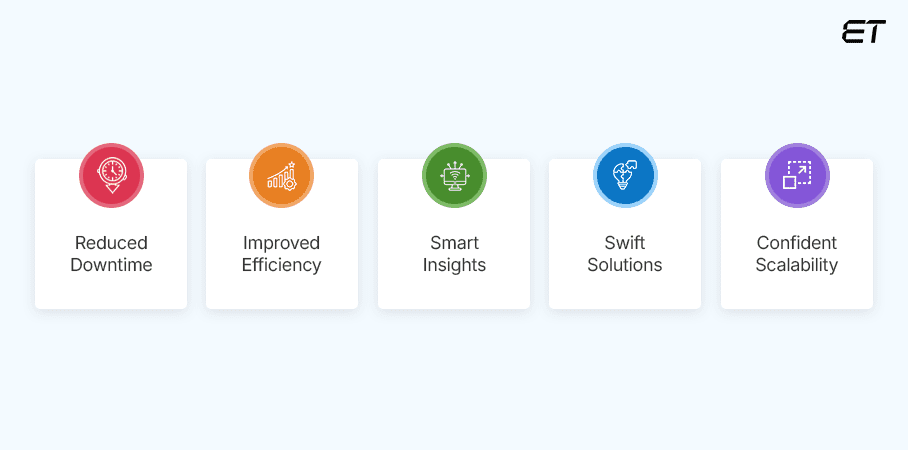
- Slash DowntimeImagine your website crashing during a major sales event. AIOps predicts and prevents these disasters, keeping your critical systems online.
- Boost EfficiencyInstead of wasting time on manual tasks, your IT team can focus on strategic projects. AIOps automates routine work, freeing up valuable resources.
- Get Smarter InsightsAIOps sifts through mountains of data, revealing hidden patterns and trends. This gives you a clear picture of your IT health to make informed decisions.
- Faster Problem ResolutionWhen issues arise, AIOps pinpoint the root cause quickly so you can fix them faster and minimize disruptions.
- Scale with ConfidenceAs your business grows, your IT infrastructure becomes more complex. AIOps helps you manage this complexity, ensuring smooth scalability.
Essentially, AIOps transforms your IT from a reactive team to a proactive, data-driven force.
Curious to unravel the utility of AI in DevOps? Read our informative blog that covers vital details on this topic.
The Main Components of AIOps
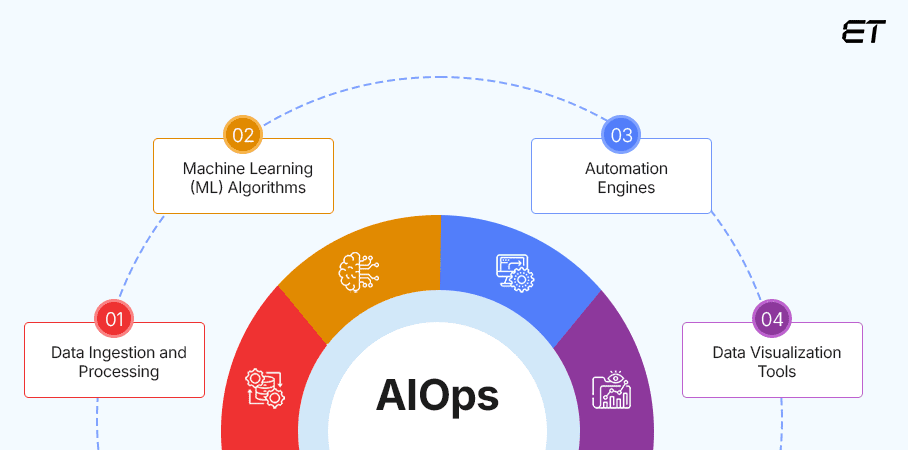
AIOps is a powerful framework built on specific components that work together to deliver intelligent IT operations. Understanding these components is crucial for grasping how AIOps transforms raw data into actionable insights and automated solutions.
These are the main components that power AIOps:
- Data Ingestion and Processing
- Machine Learning (ML) Algorithms
- Automation Engines
- Data Visualization Tools
Here’s a quick look at the function of each component.
| AIOps Component | Description |
| Data Ingestion and Processing | This component gathers and processes large volumes of data from various IT systems, applications, and devices. It cleans, normalizes, and prepares data for analysis. |
| Machine Learning (ML) Algorithms | ML algorithms analyze historical and real-time data to identify patterns, detect anomalies, and predict potential issues, enabling proactive management of IT operations. |
| Automation Engines | These engines automate routine tasks and responses based on insights from AIOps. They help resolve issues automatically, reduce manual intervention, and improve efficiency. |
| Data Visualization Tools | Visualization tools present data insights in graphical formats like dashboards and reports. They help IT teams understand complex data, monitor performance, and make data-driven decisions. |
Are you curious to know all these components in depth? Then, just scroll ahead.
1. Data Ingestion and Processing

Data ingestion and processing in AIOps involves collecting and preparing large volumes of IT data from diverse sources, such as servers, applications, and cloud services.
The process is as follows:
- Raw data is gathered in real time or at regular intervals.
- This data is then pre-processed to clean, normalize, and transform it into a consistent format, removing noise and handling missing values.
- Data enrichment can add context, such as metadata or external data, to make the data more valuable for analysis.
- Finally, data integration combines information from different sources into a unified view, enabling better correlation and insights.
This prepared data forms the foundation for AIOps platforms to apply machine learning and automation for proactive IT operations management.
2. Machine Learning Algorithms

Machine Learning (ML) algorithms analyze historical and real-time data to identify patterns, detect anomalies, and predict potential issues. These algorithms are trained on vast IT operational data, learning to recognize normal behaviors and flag deviations.
ML models, such as supervised learning for classification or unsupervised learning for anomaly detection, enable AIOps platforms to anticipate problems before they impact performance. By continuously learning from new data, these algorithms improve over time, becoming more accurate in detecting issues.
Overall, ML in AIOps helps automate decision-making processes, allowing for proactive problem resolution, reducing manual intervention, and improving overall IT efficiency and system reliability.
Wondering how to build AI software? Here’s a step-by-step guide that can solve all your queries.
3. Automation Engines

Automation engines streamline IT operations by reducing manual effort and accelerating responses to incidents.
They use specialized algorithms to detect, analyze, and remediate issues automatically. These engines can execute predefined workflows, arrange tasks across IT environments, and trigger corrective actions without human intervention.
By integrating with monitoring tools, they help in:
- Anomaly detection
- Root cause analysis
- Predictive maintenance
This component minimizes downtime, improves efficiency, and enhances system reliability. Additionally, automation engines enable intelligent ticketing, automated incident resolution, and self-healing capabilities. They also support continuous learning, adapting to new patterns, and optimizing responses over time.
4. Data Visualization Tools

Data visualization tools transform complex IT data into intuitive, graphical representations, enabling faster insights and decision-making.
These tools aggregate and analyze vast amounts of data from multiple sources, presenting it in the following forms:
- Dashboards
- Graphs
- Heatmaps
- Anomaly detection charts
These tools help IT teams identify performance issues, root causes, and potential risks by highlighting patterns, trends, and correlations. They also support real-time monitoring, ensuring proactive incident management. With interactive and customizable dashboards, teams can drill down into specific metrics, improving observability and troubleshooting efficiency.
Looking for the top 10 generative AI tools? We have the best options curated just for you!
The Key Stages of AIOps
AIOps leverages AI and machine learning to automate and optimize IT operations. While the exact phrasing of the stages may vary slightly, the core concepts remain consistent. Here’s a breakdown of the key stages:
- Observe
- Engage
- Act
- Optimize
Now, we will explain these stages in a simple tabular form.
| Stage | Description | Key Activities | Primary Goal |
| Data Collection and Aggregation (Observe) | Gathering diverse IT data from various sources to create a comprehensive view of the IT environment. |
|
To achieve complete observability of the IT infrastructure. |
| Data Analysis and Correlation (Engage) | Analyzing collected data using AI and machine learning to identify patterns, anomalies, and dependencies. |
|
To derive meaningful insights and predictive analytics from the data.To automate IT operations and enable faster issue resolution. |
| Automation and Remediation (Act) | Automating responses to identified issues to improve efficiency and reduce downtime. |
|
To automate IT operations and enable faster issue resolution. |
| Continuous Learning and Optimization | Continuously refining AI algorithms and improving accuracy through ongoing learning. |
|
To ensure the AIOps system remains effective and efficient over time. |
Real-World Use Cases of AIOps
Here’s a quick look at some key use cases of AIOps.
Predictive Maintenance and Outage Prevention
AIOps analyzes historical and real-time data to predict potential system failures. This trait allows IT teams to perform proactive maintenance, preventing costly downtime. For example, in large data centers, AIOps can predict when a server or storage device is likely to fail, enabling replacement or repair before an outage occurs.
Automated Incident Resolution
When an incident occurs, AIOps can automatically analyze logs, metrics, and other data to identify the root cause and initiate automated remediation. This can include restarting services, scaling resources, or rolling back deployments, significantly reducing mean time to resolution (MTTR).
Enhanced Cybersecurity
AIOps can detect anomalous behavior that may indicate a security threat, such as unusual network traffic or unauthorized access attempts. By analyzing vast amounts of security data, AIOps can identify and respond to threats more quickly and effectively than traditional security tools.
Optimized Cloud Resource Management
In cloud environments, AIOps can analyze resource utilization patterns to identify opportunities for optimization. This can include automatically scaling resources up or down based on demand, reducing cloud costs, and improving performance.
Improved User Experience
AIOps can ensure a smooth and reliable user experience by proactively identifying and resolving performance issues. For example, AIOps can detect and resolve latency issues in web applications, preventing user frustration and improving customer satisfaction.
Network Performance Optimization
AIOps can monitor network traffic, identify bottlenecks, and optimize routing to improve performance. This is especially critical in large, complex networks where manual monitoring and optimization are impractical.
Capacity Planning
AIOps can analyze historical data to predict future resource needs, enabling IT teams to plan capacity accordingly. This helps prevent resource shortages and ensures that IT infrastructure can support future growth.
All in all, AIOps has the potential to transform IT operations from a reactive to a proactive approach.
Since we are talking about artificial intelligence, you cannot miss our blog on AI agents. We’re sure it will provide valuable information.
AIOps Benefits and Challenges
Several advantages make AIOps a worthy strategy for organizations like yours. However, you should also be aware of the critical challenges. The table below gives a quick glance at both these aspects.
| Benefits | Challenges |
| Reduced downtime | Integration complexity |
| Faster incident resolution | Data quality issues |
| Automated tasks | Initial setup costs |
| Improved performance | AI model accuracy |
| Optimized resource use | Skillset gaps |
| Enhanced security | Potential for alert fatigue |
| Proactive issue detection | Ensuring data privacy |
| Cost reduction | Resistance to change |
Endnotes
AIOps is a significant evolution in IT management. This strategy focuses on shifting from reactive troubleshooting to proactive optimization. By leveraging AI and machine learning, organizations like yours can utilize the power of their data to predict and prevent issues, automate resolutions, and enhance overall IT performance.
Implementing AIOps requires careful consideration of data quality, integration challenges, and the need for evolving skill sets. However, the benefits, including reduced downtime, improved efficiency, and enhanced security, make it a crucial strategy for steering through today’s complex IT landscapes.
We have vetted AI experts to guide in various implementation strategies. Fill out the form and connect for more details.
Frequently Asked Questions
1. How does AIOps impact DevOps workflows?
AIOps enhances DevOps by providing automated feedback loops and predictive insights, allowing for faster and more reliable deployments. It also helps identify and resolve issues earlier in the development lifecycle, improving overall release velocity.
2. Can we use AIOps in edge computing environments?
Yes, you can use AIOps in edge computing to manage the distributed nature of these systems by analyzing data closer to the source. This strategy enables real-time monitoring and automated responses, crucial for maintaining performance in remote locations.
3. What are the primary differences between AIOps and traditional IT monitoring?
Traditional IT monitoring mainly provides alerts based on predefined thresholds, while AIOps use AI to analyze data and predict issues before they occur. AIOps also automates responses and provides deeper insights through machine learning, going beyond simple alerting.
4. How does AIOps handle legacy systems within a modern IT environment?
AIOps can integrate data from legacy systems by using data connectors and APIs, enabling a unified view of the entire IT infrastructure. AI algorithms can then analyze this diverse data to identify patterns and predict issues, even in older systems.

RAG vs Fine-Tuning: Which Strategy Scales Your AI Effectively?
Your AI assistant is live, but it’s either pulling outdated information or producing inconsistent responses. The real question is: do…


RPA vs AI: The Real Difference and Where Each Fits in Enterprise Operations
Key Takeaways: RPA vs AI serve different roles- RPA handles structured, rules-based execution, while AI interprets, analyzes, and makes decisions.…


