
 Book a Meeting
Generative AI in Software Development | What CTOs Shouldn’t Miss in 2026



- Generative AI is already transforming software development by accelerating delivery, improving quality, and reducing costs.
- This utility is about augmenting developers with tools that generate code, documentation, and tests at scale.
- Strategic integration of Gen AI can drive productivity gains, improve developer retention, and modernize legacy systems.
- Risks exist but are manageable with the right governance, training, and developer involvement.
What if your engineering team could deliver high-quality software in half the time? That would be a great scenario, right? Well, generative AI in software development can convert this thought into practice.
Don’t get us wrong. By suggesting the use of Gen AI, we aren’t signifying replacing your developers with robots. We’re talking about augmenting your teams with tools that think, generate, and collaborate. In fact, according to McKinsey, generative AI could boost software engineering productivity by up to 45%!
So, it’s safe to say that this tech can become your strategic investment. From prototyping and testing to legacy code management, generative AI can enhance several activities.
If you’re still wondering whether this tech is worth your attention, you’re asking the wrong question. Our blog will explain what can happen if you neglect this gem of a technological asset.
Need an extended AI software development team? We have the best-in-class offerings for you.
What Is Generative AI in Software Development?
Here’s the ‘real’ thing to know. Generative AI in software development isn’t some magical box that spits out perfect software while your engineers sip espresso.
In fact, it’s a new class of AI models (like OpenAI’s Codex or Google’s AlphaCode) that can:
- Understand natural language
- Analyze context
- Generate actual code, documentation, test cases, and more
But the real USP of Gen AI is that it ‘collaborates.’ In other words, it becomes the decisive pair programmer.
This means your developers can describe a function in plain English, and the AI can write the first draft of the code or suggest improvements. Unlike traditional rule-based systems that require precise instructions, generative AI learns patterns from massive codebases and adapts instantaneously.
All in all, generative AI in software development can help your team think bigger, move faster, and build better.
Looking for generative AI tools for your next project. Get all the details in our blog.
Use Cases of Generative AI in Software Development

While many professionals are still busy debating whether generative AI is the future, leading tech teams are already building with it. The shift is happening right now, and it’s changing the process of software development.
The table below gives you a brief glance at the tremendous utility of Gen AI in software development.
| Use Case | Explanation |
| Rapid Prototyping | Generative AI can spin up functional prototypes in days. Your team focuses on logic and user experience, while the AI handles the repetitive groundwork. |
| Code Generation | From writing boilerplate to completing complex functions, AI models assist has a great potential to assist developers. |
| Automated Testing | Gen AI can write test cases and unit tests efficiently. |
| Bug Detection | Generative AI can spot errors, suggest fixes, and even explain why the code might break. |
| Legacy Code Modernization | AI helps make sense of dusty old codebases no one wants to touch. It can suggest refactors, translate between languages, and clean things up. |
Benefits of Generative AI in Software Development
Tell us one thing. Do you invest in technology just because it’s trending?
Probably not. You invest in tech or tools to drive growth, improve margins, and future-proof your business. Notably, Generative AI in software development checks all those boxes, and then some.
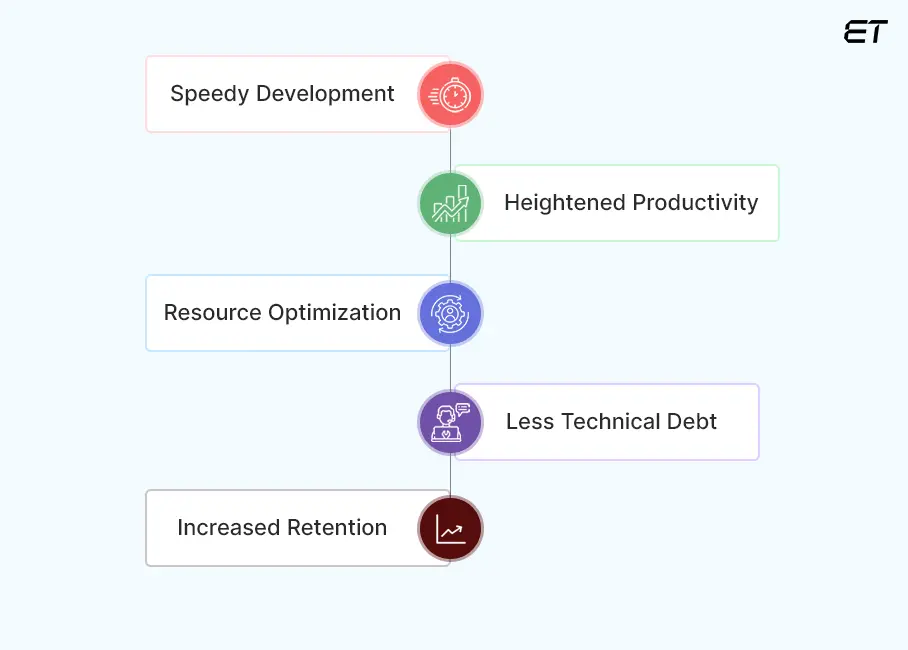
Understand how this type of artificial intelligence can be a gamechanger for your business:
- Faster Time-to-Market: Generative AI helps your teams build, test, and deploy products in record time.
- Increased Developer Productivity: By offloading routine tasks and surfacing intelligent suggestions, Gen AI empowers your engineers to focus on solving problems.
- Cost Optimization: Gen AI augments your existing talent, getting more output from the same headcount.
- Reduced Technical Debt: AI-assisted code reviews and legacy modernization help prevent tomorrow’s problems today.
- Stronger Developer Retention: When developers spend more time building and less time handling repetitive tasks, job satisfaction goes up.
Bottom line? Using Gen AI, you can turn development into a high-leverage growth function.
The Risks of Using Gen AI in Software Development
Is generative AI the ideal answer to all your programming woes? In a word, nope.
Like any high-impact technology, it comes with its share of challenges. So, here are the key things to keep in mind:
| Challenge | Explanation |
| Code Quality | Without proper review and oversight, you risk introducing bugs, vulnerabilities, or bad architecture. |
| Intellectual Property (IP) Concerns | Depending on the tool and its training data, it’s unclear who owns the AI-generated code. |
| Security Risks | AI-generated code might not follow your organization’s security protocols by default and lead to compliance violations. |
| Impact on Critical Thinking | When developers start to lean too heavily on AI, critical thinking can take a back seat. |
| Regulatory and Ethical Hurdles | There’s an unclear governance framework for using AI in software development. |
TL; DR? Use Gen AI, but wisely. The ROI is real, but only when paired with human oversight and strategic governance.
How You Can Integrate Generative AI in Your Software Development Lifecycle?
So, you’re sold on the value. You’re aware of the risks.
Now the question is, how do you actually bring generative AI into your software development ecosystem? Here’s all you should know.
1. Start with a Pilot Project

Start small and surgical.
Pick a well-defined, low-risk area of your software development pipeline where AI can shine without putting mission-critical systems at stake.
Good examples are:
- Automated unit test creation
- Bug tracking
- Boilerplate code generation
This way, you’ll be able to gather real-world feedback, fine-tune your integration strategy, and show measurable ROI.
2. Involve Your Developers Early
Deploying Gen AI without skilled developers is like launching a spaceship without telling the astronauts. In other words, don’t commit this mistake.
Your developers are the key stakeholders. Involve them in:
- Tool selection
- Pilot planning
- Policy shaping
Let them ask questions and voice their concerns. Frame Gen AI as their co-pilot, not competition. That framing can mean the difference between adoption and rebellion.
If you want dedicated AI experts, feel free to connect. We have resources that can help your team ASAP.
3. Establish Governance Guidelines
You need clear rules if you’re letting AI generate code, tests, or documentation.
So, it’s essential to set policies for the following:
- What tasks AI is allowed to handle
- The review and approval of AI-generated code
- Who owns the output (IP-wise)
- What tools comply with your internal and industry security standards
Without governance, you won’t achieve success. However, a systematic guideline can help build a safe, scalable framework that can expand intelligently over time.
4. Train Teams on AI Literacy

Your developers need to understand how generative AI thinks, where it stumbles, and how to interact with it effectively.
So, ensure you provide training to your programmers in the following areas:
- Prompt engineering
- Reviewing and validating AI-generated code
- Recognizing when to trust AI
The better your teams get at working with AI, the more value they’ll extract.
5. Monitor, Measure, Iterate
Finally, you’ll need to track what’s working and what’s not. This step is vital in effectively using generative AI in software development.
Here are the key metrics to monitor:
- Time saved on repetitive tasks
- Developer satisfaction and engagement
- Reduction in bugs and rework
- Speed to deployment
- Compliance incidents
So, what’s the goal? Make your Gen AI strategy as agile as your development process.
Did you know? Generative AI can modernize your legacy system!
Generative AI in Software Development: Practical Example
To elucidate the utility of gen AI in software development, we’ll use three tools:
- ChatGPT
- Gemini
- Grok
Let’s consider that you want to develop a mobile application to track international gold and silver prices. Here’s a simple prompt that can help you notice the utility of each tool.
Prompt: Write a code to develop a mobile app that tracks international gold and silver prices.
Here’s the output of each generative AI tool.
1. ChatGPT
        // Simple React Native app to track gold and silver prices
// We'll use the Metals-API (or similar) for price data
import React, { useEffect, useState } from 'react';
import { View, Text, StyleSheet, FlatList, ActivityIndicator } from 'react-native';
const API_KEY = 'YOUR_API_KEY';
const API_URL = `https://metals-api.com/api/latest?access_key=${API_KEY}&base=USD&symbols=XAU,XAG`;
const App = () => {
  const [prices, setPrices] = useState(null);
  const [loading, setLoading] = useState(true);
  const fetchPrices = async () => {
    try {
      const response = await fetch(API_URL);
      const data = await response.json();
      setPrices({
        gold: data.rates.XAU,
        silver: data.rates.XAG,
      });
    } catch (error) {
      console.error('Error fetching metal prices:', error);
    } finally {
      setLoading(false);
    }
  };
  useEffect(() => {
    fetchPrices();
    const interval = setInterval(fetchPrices, 60000); // Update every 60 seconds
    return () => clearInterval(interval);
  }, []);
  if (loading) {
    return (


        Fetching prices...

    );
  }
  return (

      Live Gold & Silver Prices
       item.name}
        renderItem={({ item }) => (

            {item.name}
            ${item.price.toFixed(2)} / oz

        )}
      />

  );
};
const styles = StyleSheet.create({
  container: {
    flex: 1,
    padding: 20,
    backgroundColor: '#fff',
  },
  centered: {
    flex: 1,
    justifyContent: 'center',
    alignItems: 'center',
  },
  title: {
    fontSize: 24,
    fontWeight: 'bold',
    marginBottom: 20,
    textAlign: 'center',
  },
  card: {
    backgroundColor: '#f9f9f9',
    padding: 16,
    marginVertical: 10,
    borderRadius: 12,
    elevation: 2,
  },
  metalName: {
    fontSize: 18,
    fontWeight: '600',
  },
  price: {
    fontSize: 16,
    color: '#555',
  },
});
export default App;
Do you know the process of ChatGPT API integration? If the answer is no, fret not.
2. Gemini
import requests
import json
def get_metal_prices():
    api_url = "https://api.example.com/metals"  # Replace with the actual API endpoint
    try:
        response = requests.get(api_url)
        response.raise_for_status()  # Raise an exception for bad status codes (4xx or 5xx)
        data = response.json()
        return data
    except requests.exceptions.RequestException as e:
        print(f"Error fetching data: {e}")
        return None
def display_prices(prices):
    if prices:
        timestamp = prices.get("timestamp")
        gold_prices = prices.get("gold")
        silver_prices = prices.get("silver")
        print(f"Current Prices ({timestamp}):")
        print("Gold:")
        for currency, price in gold_prices.items():
            print(f"  {currency}: {price}")
        print("Silver:")
        for currency, price in silver_prices.items():
            print(f"  {currency}: {price}")
    else:
        print("Could not retrieve metal prices.")
if __name__ == "__main__":
    prices = get_metal_prices()
    display_prices(prices)
Talking about Gemini, you need to understand how it compares with ChatGPT (to take the right call).
3. Grok
import 'package:flutter/material.dart';
import 'package:http/http.dart' as http;
import 'dart:convert';
void main() {
runApp(const PreciousMetalsApp());
}
class PreciousMetalsApp extends StatelessWidget {
const PreciousMetalsApp({super.key});
@override
Widget build(BuildContext context) {
return MaterialApp(
title: 'Gold & Silver Tracker',
theme: ThemeData(
primarySwatch: Colors.blue,
visualDensity: VisualDensity.adaptivePlatformDensity,
),
home: const PriceTrackerScreen(),
);
}
}
class PriceTrackerScreen extends StatefulWidget {
const PriceTrackerScreen({super.key});
@override
_PriceTrackerScreenState createState() => _PriceTrackerScreenState();
}
class _PriceTrackerScreenState extends State {
double goldPrice = 0.0;
double silverPrice = 0.0;
bool isLoading = false;
String lastUpdated = '';
// Using Metal Prices API (you'll need to get your own API key)
final String apiKey = 'YOUR_API_KEY_HERE';
final String apiUrl = 'https://api.metalpriceapi.com/v1/latest';
Future fetchMetalPrices() async {
setState(() {
isLoading = true;
});
try {
final response = await http.get(
Uri.parse('$apiUrl?api_key=$apiKey&base=USD¤cies=XAU,XAG'),
);
if (response.statusCode == 200) {
final data = json.decode(response.body);
setState(() {
// Convert rates to per ounce (API returns price per kilogram)
goldPrice = 1 / (data['rates']['XAU'] / 31.1035);
silverPrice = 1 / (data['rates']['XAG'] / 31.1035);
lastUpdated = DateTime.now().toString().substring(0, 19);
isLoading = false;
});
} else {
throw Exception('Failed to load prices');
}
} catch (e) {
setState(() {
isLoading = false;
});
ScaffoldMessenger.of(context).showSnackBar(
SnackBar(content: Text('Error fetching prices: $e')),
);
}
}
@override
void initState() {
super.initState();
fetchMetalPrices();
}
@override
Widget build(BuildContext context) {
return Scaffold(
appBar: AppBar(
title: const Text('Gold & Silver Prices'),
centerTitle: true,
),
body: Padding(
padding: const EdgeInsets.all(16.0),
child: Column(
crossAxisAlignment: CrossAxisAlignment.center,
children: [
Card(
elevation: 4,
child: Padding(
padding: const EdgeInsets.all(16.0),
child: Column(
children: [
const Text(
'Gold Price (per oz)',
style: TextStyle(fontSize: 20, fontWeight: FontWeight.bold),
),
const SizedBox(height: 8),
Text(
'\$${goldPrice.toStringAsFixed(2)}',
style: const TextStyle(fontSize: 32, color: Colors.amber),
),
],
),
),
),
const SizedBox(height: 16),
Card(
elevation: 4,
child: Padding(
padding: const EdgeInsets.all(16.0),
child: Column(
children: [
const Text(
'Silver Price (per oz)',
style: TextStyle(fontSize: 20, fontWeight: FontWeight.bold),
),
const SizedBox(height: 8),
Text(
'\$${silverPrice.toStringAsFixed(2)}',
style: const TextStyle(fontSize: 32, color: Colors.grey),
),
],
),
),
),
const SizedBox(height: 20),
Text(
'Last Updated: $lastUpdated',
style: const TextStyle(fontSize: 14),
),
const SizedBox(height: 20),
ElevatedButton(
onPressed: isLoading ? null : fetchMetalPrices,
child: isLoading
? const CircularProgressIndicator(color: Colors.white)
: const Text('Refresh Prices'),
),
],
),
),
);
}
}
Now, let’s understand how each generative AI tool responded. You can view our observations in the table below:
| AI Model | Stack | UI/UX Level | Practicality | Best for |
| ChatGPT | React Native | Moderate | Deploy-ready MVP | Cross-platform apps, MVPs |
| Gemini | Python | Minimal | Developer Utility | Data pipelines, internal tools |
| Grok | Flutter | High | Full UI Experience | Consumer apps, demos |
It’s true that each generative AI tool can react distinctly to different prompts. However, our example gives us the following conclusion:
- ChatGPT built a complete cross-platform mobile app with real-time refresh logic. This approach is ideal for fast deployment with solid UX.
- Gemini delivered a concise backend script focused on fetching and displaying data. The code is great for internal use or API testing.
- Grok went full throttle with a polished Flutter app. The output is perfect for front-end delivery with thoughtful design and conversions.
Final verdict?
#1 Grok: Best for end-users (delivered a polished Flutter app with smart features and great UX).
#2 ChatGPT: Most practical (built a clean, cross-platform app ready for rapid deployment).
#3 Gemini: Great for backend logic (offered a functional script, but not app-ready).
Final Thoughts
Generative AI in software development is a strategic investment. When used right, it helps your teams ship faster, think bigger, and solve smarter. From reducing development time to modernizing legacy systems, Gen AI has tremendous potential.
However, the real magic happens when your developers and Gen AI tools collaborate seamlessly. So, you need to start small, scale smart, and implement generative artificial intelligence into your tech DNA.
To get customized guidance, our point of contact is ready to assist you. Notably, you can hire our AI developers, who can become an extended part of your team to implement generative AI in software development for your business.
Looking to turn generative AI into real software wins? Fill out a short form, and we’ll take it from there.
Frequently Asked Questions
1. Can generative AI produce production-grade code?
Yes. But with human oversight. Generative AI can generate accurate, scalable code, but your developers will still need to review, validate, and refine it for business-critical systems.
2. Will we need to replace our existing team to adopt Gen AI?
Not at all. Gen AI is meant to augment, not replace. It supercharges your current team’s productivity by automating repetitive work. So, there’s no need to replace any existing team member.
3. How secure is generative AI in software development?
Security depends on your implementation. With proper governance, vetted tools, and internal review processes, you can mitigate risks and stay compliant.
4. What kind of ROI can we expect from Gen AI adoption?
Companies using Gen AI in development report productivity gains, faster releases, and reduced technical debt. However, the exact ROI figure will depend on your implementation and support.


RPA vs AI: The Real Difference and Where Each Fits in Enterprise Operations
Key Takeaways: RPA vs AI serve different roles- RPA handles structured, rules-based execution, while AI interprets, analyzes, and makes decisions.…

MCP vs RAG: What Every Executive Should Know Before Choosing a Framework
Key Takeaways: MCP (Model Context Protocol) and RAG (Retrieval-Augmented Generation) solve different problems in enterprise AI. MCP connects AI models…


