
 Book a Meeting
The Mobile App Development Process Explained for Decision-Makers



The mobile app development process is an end-to-end framework that takes an idea from intent to a market-ready mobile application. It covers strategy, design, development, testing, deployment, and long-term optimization.
Basically, the process impacts your time-to-market, cost control, and user adoption.
Do it right, you join the ranks of Uber, Slack, and Spotify.
Overlook it, and you end up in the same boat as that of Quibi, Vine, and Google Plus.
That’s why understanding how each phase connects matters far more than the tech stack itself. And this blog delivers this crucial information for the busy folks out there.
Where Most Mobile App Development Processes Go Wrong

The mobile app development process rarely fails due to poor coding.
It fails because strategic mistakes occur long before designing a single screen. By the time engineering gets involved, many apps are already on a path toward higher costs, longer timelines, and underwhelming adoption.
Here’s where things commonly fall apart.
Confusing a Strong Idea With a Strong Business Case
A compelling app idea is not a business strategy. Most failed initiatives enter the mobile app development process with passion but without measurable outcomes.
For instance, you can approve builds based on instinct or internal assumptions. The result?
Apps that technically function but don’t solve a real, high-priority problem for users.
Skipping Validation to ‘Move Fast’
Speed is usually framed as a competitive advantage.
In reality, rushing into development without user validation turns the mobile app development process into an expensive experiment.
Your team can bypass prototyping, stakeholder alignment, or early usability testing in favor of rapid builds. When feedback finally arrives post-launch, fixing fundamental flaws costs exponentially.
Treating UX as Decoration, Not Strategy
You can treat design as a visual layer added after making core decisions.
That’s a mistake. In a modern mobile app development process, UX defines how users think, act, and stay engaged.
Poor navigation, unclear flows, or unnecessary complexity frustrate users quickly. No amount of backend sophistication compensates for a confusing or bloated user experience.
Overengineering Instead of Prioritizing
A common executive pitfall is approving ‘just in case’ features.
The mobile app development process becomes feature-heavy, timeline-heavy, and budget-heavy without increasing value.
Remember: Successful apps focus on a sharp core use case. Failed ones try to solve everything at once and end up solving nothing particularly well.
Underestimating Post-Launch Reality
Many teams treat launch as the finish line. In practice, it’s the beginning of the most expensive phase of the mobile app development process.
After launch, you need to handle:
- Maintenance
- User feedback
- Updates
- Security
Without a post-launch roadmap, apps stagnate. User expectations evolve. And what looked like a successful release quietly turns into a forgotten product.
The Foundation of a Successful Mobile App Development Process
The mobile app development process is a structured journey that transforms an idea into a market-ready app.
At a high level, the process has five core stages:
1. Strategy and Discovery: Define business goals, understand users, validate the idea, and set a roadmap.
2. Design: Translate strategy into user flows, wireframes, and intuitive interfaces.
3. Development: Build the app, integrate backend systems, and ensure performance, scalability, and security.
4. Testing and Quality Assurance: Identify and fix issues, optimize UX, and ensure reliability across devices.
5. Deployment and Post-Launch Optimization: Launch, monitor performance, collect user feedback, and iterate continuously.
Each stage is interdependent: misalignment early on can cascade into higher costs, longer timelines, or even product failure. Understanding this workflow gives you the insight to prioritize effectively.
Defining Clear Business Objectives

The first and most critical step in the mobile app development process is defining clear, measurable business objectives.
Without this, every subsequent decision (from features to design to marketing) is essentially a guess.
Why it matters
Many companies confuse an app idea with a business strategy. However, an app that ‘looks cool’ doesn’t become a business goal. Clear objectives align the team on what success looks like. This clarity also makes budgeting, prioritization, and ROI assessment far more precise.
Key considerations for defining objectives:
1.Identify primary business goals
Are you building the app to increase revenue, reduce operational cost, improve customer experience, or capture market share? The goal shapes the entire development process.
2.Set measurable KPIs
Define metrics like adoption rates, user retention, revenue targets, or operational efficiency gains. These KPIs allow the app development process to be managed like any other strategic investment.
3.Align stakeholders early
Misalignment between executives, product teams, and developers is a silent killer. By agreeing on objectives upfront, you prevent scope creep and conflicting priorities that often derail the mobile app development process.
4.Assess feasibility realistically
Ambition is important, but overpromising leads to delays and cost overruns. An experienced executive weighs objectives against resources, timelines, market readiness, and technical complexity.
5.Prioritize objectives
Not every goal can be achieved in a single release. Define what is non-negotiable versus what can evolve in later iterations.
Vital insight
Apps that fail almost always start with vague or aspirational goals. The smartest teams treat the mobile app development process as a strategic investment. They constantly refer back to the original objectives to make design, feature, and roadmap decisions.
Identifying the Target Audience and User Personas
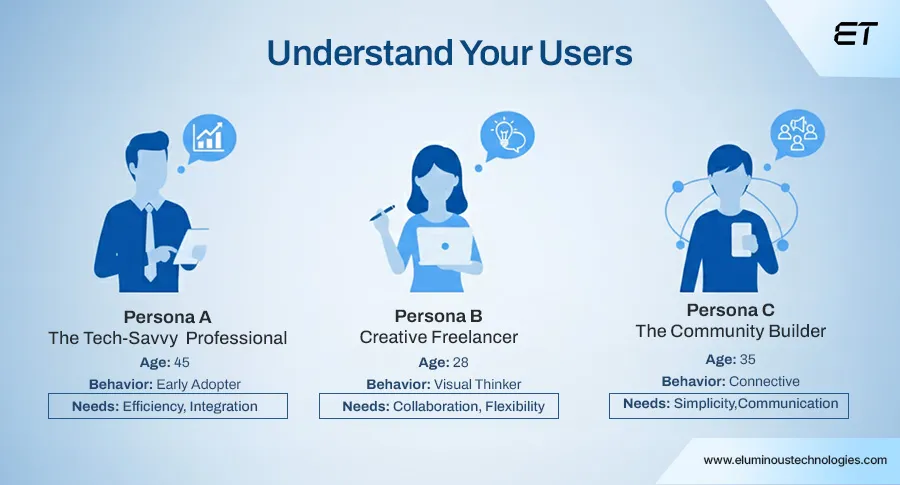
After defining clear business objectives, the next crucial step in the mobile app development process is understanding who you’re building the app for.
Many apps fail because they miss the mark on user needs. Knowing your audience becomes the foundation for design, functionality, and adoption strategy.
Why it matters
An app without a clear understanding of its users is a shot in the dark.
Every feature, every interaction, and every interface decision should answer a simple question: Does this serve our users’ needs and pain points?
Executives who ignore this step end up with apps that are technically sound but emotionally irrelevant to the people they’re trying to engage.
Key components to define your audience and personas:
1. Segment Your Users
Divide potential users into clear groups based on demographics, behavior, location, and usage patterns. For instance, an e-commerce app may target frequent online shoppers, casual buyers, and business clients separately.
2. Develop Detailed User Personas
Personas are narratives describing motivations, pain points, tech comfort levels, and daily habits. The more realistic the persona, the easier it is for developers and designers to anticipate decisions users will make in-app.
3. Map User Journeys
Identify the paths users take to achieve their goals. Where do they encounter friction? What steps delight them? Mapping journeys early in the mobile app development process prevents costly redesigns.
4. Prioritize Personas by Strategic Impact
Not all users are equal. Focus on personas that deliver the most strategic value first. Early wins with high-value users create advocacy, feedback loops, and proof-of-concept data for later expansion.
5. Incorporate Real Data
Don’t rely solely on assumptions. Use analytics from existing products, surveys, interviews, or focus groups. Data-driven personas reduce guesswork and ensure the mobile app development process is grounded.
Vital insight:
The most successful apps obsess over users before obsessing over features. They iterate around validated personas and user journeys, not gut feelings. This approach ensures that every sprint, design choice, and release decision aligns directly with real user value.
Conducting Competitive Analysis
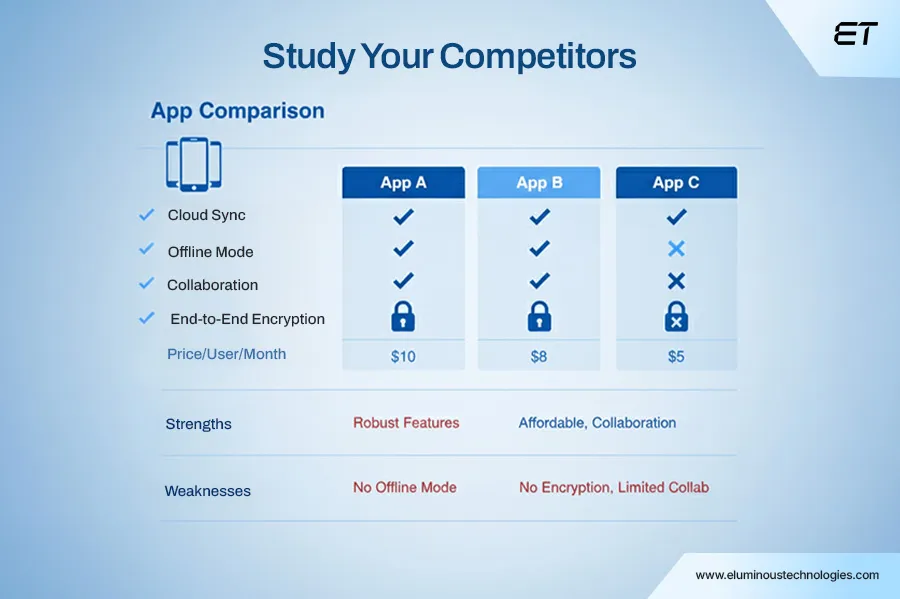
Once business objectives are clear and user personas are defined, the next stage in the mobile app development process is understanding the competitive landscape.
Too often, teams skip or superficially conduct this step, leading to apps that either replicate existing solutions or fail to seize unique opportunities.
Why it matters
Competitive analysis is about strategic differentiation.
Understanding what works (and what doesn’t) in your market helps prioritize features, design choices, and monetization strategies. It also identifies gaps that your app can exploit to deliver unique value.
Key steps for effective competitive analysis:
1. Identify Direct and Indirect Competitors
Direct competitors solve the same problem as your app. Indirect competitors may fulfill the same user need in a different way. Both types influence your strategy and feature prioritization.
2. Analyze Strengths and Weaknesses
Evaluate competitors on usability, design, features, pricing, and market traction. Identify patterns where users are satisfied and pain points where competitors fall short.
3. Benchmark Features Strategically
Compare features not to copy them blindly but to determine which are essential, which are optional, and which are unnecessary clutter. Prioritize features that align with your objectives and solve user pain points better than anyone else.
4. Understand Market Trends and Gaps
Look for emerging technologies, shifting user behaviors, or underserved needs. A thoughtful competitive analysis identifies opportunities to innovate, rather than forcing you to react to trends after the fact.
5. Assess User Feedback on Competitors
Reviews, ratings, and forums are treasure troves. They reveal what real users value and where competitors fail. Incorporating this intelligence into your mobile app development process reduces risk and increases adoption potential.
Vital insight
The most successful apps are the smarter, more user-focused, and strategically differentiated versions. By embedding competitive insights early in the process, you ensure your app is positioned to win rather than compete for scraps.
Validating the Core Idea Early

Even the clearest objectives, best-defined personas, and sharp competitive insights mean little without early validation.
Many apps fail because teams jump straight into design and development, assuming their idea will resonate. Veteran executives know: validation early is cheaper, faster, and strategic than fixing mistakes post-launch.
Why it matters
Validation prevents wasted resources. It ensures that the features, flows, and overall app concept meet real user needs and deliver tangible business value. Without it, even a technically flawless app can underperform or fail entirely.
Key approaches to validating your app idea:
1. Build a Minimum Viable Product (MVP)
Develop a stripped-down version of the app that focuses on the core value proposition. The MVP allows users to interact with your idea early, providing feedback without investing in full-scale development.
2. Conduct User Testing and Interviews
Engage real users from your target personas. Observe their interactions, ask questions, and document frustrations. Insights from these sessions often reveal hidden assumptions or overlooked pain points.
3. Use Surveys and Landing Pages
Before writing a single line of code, gauge interest through pre-launch campaigns, landing pages, or surveys. Collecting intent and interest metrics provides early evidence of market demand.
4. Iterate Rapidly Based on Feedback
Early feedback should directly inform decisions. Refine features, adjust flows, or even pivot the idea entirely if validation uncovers fatal flaws. This iterative mindset saves time and avoids expensive post-launch overhauls.
5. Align Validation With Business KPIs
Validation is about ensuring your app drives measurable business outcomes. Check whether early interactions map to retention potential, revenue models, or strategic objectives.
Vital insight
The teams that dominate markets tested, learned, and iterated relentlessly. Early validation transforms the mobile app development process from a risky gamble into a structured path.
Setting a Realistic Roadmap and Priorities

The final step in the strategy and discovery phase is creating a realistic roadmap. This step ensures the mobile app development process moves forward in a structured, achievable, and strategically aligned way.
Why it matters
A roadmap translates strategy into execution. Without it, even validated ideas can get lost in scope creep, missed deadlines, and feature overload.
A clear, prioritized roadmap allows teams to focus on high-impact initiatives first, ensuring early wins.
Key components of an effective roadmap:
1. Prioritize Features by Strategic Value
Not every idea makes the cut. Focus on features that directly serve the business objectives and core user needs identified earlier.
2. Define Phases and Milestones
Break development into clearly defined phases. Milestones provide visibility, motivate teams, and allow executives to track progress against business outcomes.
3. Set Realistic Timelines
Overambitious timelines are a major risk in the mobile app development process. Factor in validation cycles, design iterations, testing, and unforeseen technical complexities.
4. Allocate Resources Wisely
Align developers, designers, QA, and other stakeholders with the roadmap. Ensure critical tasks have the right skill sets and bandwidth.
5. Plan for Iteration and Feedback Loops
No roadmap is static. Build in checkpoints for user feedback, analytics review, and KPI assessment. The best apps evolve continuously based on real-world data, not assumptions.
Vital insight
Apps that deliver meaningful value don’t try to do everything at once. They sequence initiatives strategically, focus on high-impact outcomes, and maintain a clear link between every development sprint and overarching business goals.
Design: Translating Strategy Into User Experience

Once the strategy, discovery, and roadmap are in place, the mobile app development process moves into design.
Why it matters
A well-designed app transforms strategy into tangible user experiences. Poor design can nullify even the clearest business objectives and validated features.
Design decisions directly impact user retention, satisfaction, and conversion.
Key principles for effective design:
1. Align UX/UI With User Personas
Every screen, flow, and interaction should reflect the behaviors, expectations, and needs identified during the discovery phase. Design should reduce friction, anticipate decisions, and make value obvious.
2. Prioritize Core Features
Avoid feature overload in the first release. Focus on the features validated as high-impact. This ensures users experience value immediately and prevents confusion.
3. Prototype Before Building
Wireframes and interactive prototypes allow teams to test flows, gather feedback, and adjust before development. Early prototyping reduces rework and speeds up the overall mobile app development process.
4. Ensure Consistency and Brand Alignment
Consistent visual language, typography, and interaction patterns strengthen brand recognition and user trust. The design should feel seamless and professional across devices.
5. Plan for Scalability
Design should anticipate future enhancements without breaking existing flows. Modular, flexible designs save time and cost during iterative releases.
Vital insight
Apps that win in the market are the most intuitive and purposeful. Design is the first real touchpoint where strategy meets the user. Getting it right early makes the development, testing, and post-launch phases smoother.
Development: Building the App

With design finalized, the mobile app development process enters the construction phase.
This is where execution meets strategy, and poor choices here can erase months of prior planning.
Why it matters
Even a perfectly designed app fails if development is misaligned with objectives, roadmaps, or technical best practices.
Key principles for effective development:
1. Follow a Structured Development Approach
Agile methodologies, sprint planning, and milestone tracking keep the team aligned with the roadmap. Each development cycle should deliver testable, functional components.
2. Align Frontend and Backend
The user interface must seamlessly connect with backend systems to provide a smooth experience. Misalignment here leads to slow performance, errors, and frustrated users.
3. Focus on Scalability and Security
Building for current needs is not enough. Architect the app to handle growth, peak loads, and data security requirements from the start. Retrofitting these later is expensive and risky.
4. Continuous Communication Between Teams
Developers, designers, QA, and product managers must stay in sync. This prevents scope creep, reduces rework, and ensures features meet business objectives.
5. Code Quality and Documentation
Maintain clear, readable, and documented code. This accelerates future iterations, simplifies maintenance, and reduces dependency on specific developers.
Vital insight
Development is where the promises of strategy and design are realized. So, every line of code should support the overarching business goals identified in the earlier phases.
Testing and Quality Assurance
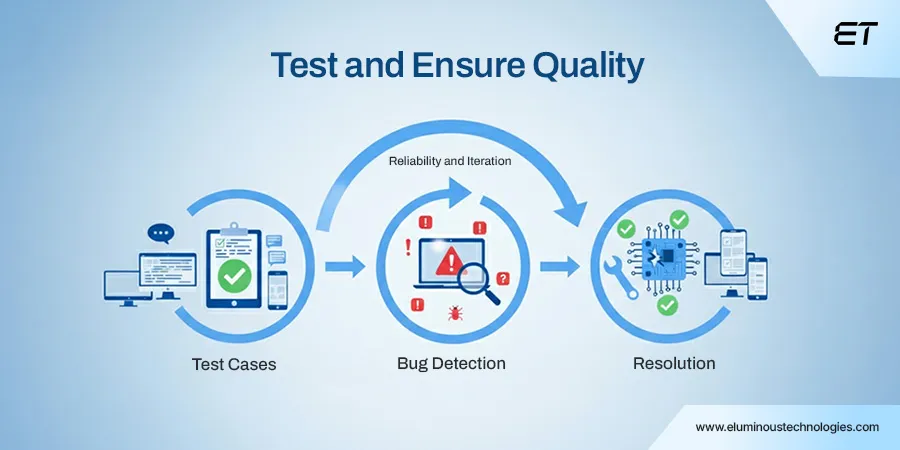
Once development delivers a functional app, the mobile app development process moves into testing and quality assurance (QA).
This stage ensures the app works reliably, meets business objectives, and provides a seamless user experience.
Why it matters
Even the most beautifully designed and well-coded app will fail in the market if it’s buggy, slow, or inconsistent. Testing validates that the app meets functional, performance, and security standards before reaching real users.
Key principles for effective testing and QA:
1. Define Clear Testing Criteria
Establish functional, usability, performance, and security benchmarks aligned with business objectives and user expectations.
2. Use a Mix of Automated and Manual Testing
Automated tests are essential for repetitive, large-scale checks, while manual testing catches nuanced user experience issues that automated scripts can’t detect.
3. Test Across Devices and Platforms
Ensure compatibility across operating systems, screen sizes, and device types. Mobile users are unforgiving. Poor performance on a single device can harm adoption and retention.
4. Early and Continuous Testing
QA should start during development, not after it ends. Early bug detection reduces costs, shortens timelines, and prevents post-launch surprises.
5. Iterate Based on Feedback
Testing isn’t a one-off activity. Continuous testing and iteration based on QA results and beta user feedback ensures the app evolves with real-world use.
Vital insight
The most resilient apps are tested relentlessly, refined consistently, and designed to anticipate user behavior under all conditions. Proper QA safeguards investments, maximizes user satisfaction, and sets the stage for a successful launch.
Deployment and Post-Launch Optimization

The final phase of the mobile app development process is where strategy, design, and development meet the real world.
Why it matters
A smooth launch alone doesn’t guarantee success. Real-world usage uncovers unforeseen challenges and opportunities.
Post-launch optimization ensures the app continues to deliver value, meets business KPIs, and evolves in line with user expectations.
Key principles for successful deployment and optimization:
1. Plan a Strategic Launch
Coordinate release timing, app store submissions, and marketing campaigns. Early visibility and first impressions matter. Ensure the app is ready to perform flawlessly from day one.
2. Monitor Performance Metrics Closely
Track KPIs such as user acquisition, retention, engagement, and conversion. Real-time analytics help detect issues quickly and guide decision-making.
3. Collect User Feedback Systematically
Encourage reviews, surveys, and direct feedback channels. Understanding how users interact with your app informs meaningful improvements.
4. Iterate and Update Regularly
Address bugs, refine features, and release enhancements based on data and feedback. Apps that evolve maintain relevance, grow adoption, and maximize ROI.
5. Maintain Scalability and Security
Post-launch optimization is about ensuring the app can handle growth securely. Proactive maintenance prevents crises and supports long-term success.
Veteran insight
The most successful apps treat launch not as a finish line, but as a starting point for continuous improvement.
To Wrap Up
The mobile app development process is a strategic journey. From defining clear objectives to understanding users, validating ideas, designing experiences, and executing development with quality assurance, every step impact ROI.
Skipping or misaligning any phase can turn a promising idea into an expensive failure, maximizes both value and growth potential.
The difference between apps that flourish and those that falter lies in strategic execution, user-centric design, and continuous iteration.
Whether you’re launching your first app or scaling an existing product, our developers combine technical expertise with a deep understanding.
Turn your app idea into a market-ready, high-impact product today.


Your Mobile App UI UX Design Workbook: How to Retain Users and Drive Revenue
Key Takeaways: Mobile app UI UX design directly impacts user retention, engagement, and revenue. Good UI/UX design works best when…


Mobile App Testing Strategies: 11 Battle-Tested Approaches to Deliver Flawless Apps
Your development team just pushed the latest build to production at 3 AM. By 9 AM, your inbox is flooded…


