
 Book a Meeting
Off the Shelf vs Custom Software: Comparing Two Popular Options


You walk into a cozy apparel store, looking to buy that perfect tuxedo. The tailor gives you two options – a ready-made suit and a bunch of luxurious fabrics. This scene pretty much sums up the off the shelf vs custom software concept.
Off the shelf, as the name suggests, is pre-built software. It’s standard and available for anyone. Custom, on the contrary, is tailor-made. It’s your order, your taste, and it fits your needs without much compromise.
Now, the main question is – why would you want to understand the differences?
Luckily, the answer is simple. The global software market is set to reach USD 742 billion this year. Lots of revenue implies loads of choices. And you need to make the right one.
Decoding the off the shelf vs custom software comparison can help plan your financial, operational, and competitive activities. So, scroll ahead to unravel the nuances without fluff.
With a 90% client retention rate, our team is confident to assist you in your custom needs.
Off the Shelf vs Custom Software: The Main Differences
On the whole, both software categories serve the same function – to help your business run better. However, off the shelf vs custom software differ in terms of five main factors.
| Sr. No. | Factor | Explanation |
| 1. | Development and Deployment | Off the Shelf is pre-built and ready to use; Custom is developed around your exact needs and takes longer. |
| 2. | Integration | Off the Shelf integrates with popular tools; Custom connects to any system you specify. |
| 3. | Scalability | Off the Shelf scales within vendor limits; Custom scales on your terms. |
| 4. | Security | Off the Shelf follows standard protocols; Custom lets you define security to match your risk profile. |
| 5. | Cost | Off the Shelf is cheaper upfront with recurring fees; Custom costs more initially but avoids licensing traps. |
Bottom line?
You need fast and predictable software, off the shelf is the best option. Need tailored boundaries and control? Choose custom software development.
Comparing Off the Shelf vs Custom Software in Depth
In this section, we will expand the five factors so that you can make an informed decision. Let’s go ahead without any delay.
1. Development and Deployment

When it comes to getting software into the hands of your team, Off the Shelf is the pre-fab building. It’s already constructed, inspected, and certified.
- All you do is sign the contract, plug it in, and start working.
- The speed is unbeatable.
- You can go from purchase to operational in days.
That’s why it’s a favorite for businesses that want to avoid lengthy IT projects.
But here’s the catch: you get what’s built. Every feature, button, and workflow reflects the vendor’s view. If your processes don’t match, you’ll either adapt your team to the software or pay for costly add-ons.
Custom Software, on the other hand, is like commissioning an architect to design your headquarters from the ground up.
- It starts with your blueprint: business goals, process maps, user needs, and compliance requirements.
- Then comes architecture design, coding, rigorous testing, and staged deployment.
Yes, it takes longer. But the result is software that fits your business with zero compromises.
In Essence
Off the Shelf gives you speed and predictability; Custom gives you precision and control. Choosing between them is deciding whether you want to move fast right now or move exactly right for the long term.
Deploying software needs careful execution of the key steps. Our blog serves as the master blueprint containing the tips, tools, and needs of smart software deployment.
2. Integration

Think of your business software ecosystem as a chain of gears. If one gear doesn’t fit, the whole system grinds or slows down. That’s where integration becomes a make-or-break factor.
Off the Shelf solutions come with pre-built connectors and APIs for platforms like Salesforce, Microsoft 365, Slack.
- For many businesses, that’s enough to get data flowing and teams collaborating.
- But if your tech stack includes legacy systems, proprietary databases, or niche industry tools, things can get messy.
You might need middleware, custom API development, or costly third-party connectors.
Custom Software flips the process. Integration is a core part of the blueprint.
- During development, the software is built to speak fluently with every system you use, whether it’s cloud-based or on-premises.
- This level of tailoring means fewer compatibility headaches, faster data flow, and better process automation.
It also reduces the patchwork effect of bolting new tools onto old systems over time.
In Short
Off the Shelf plays well with the usual suspects; Custom plays well with whoever you invite to the table. If your operations depend on seamless cross-platform communication, integration should be one of your top decision points.
Implement ChatGPT API integration to join the ranks of Instacart, Slack, and more.
3. Scalability
In the off the shelf vs custom software face-off, scalability becomes an underrated factor.
It’s easier to focus on features rather than thinking of long-term utility. But you should understand a few points.
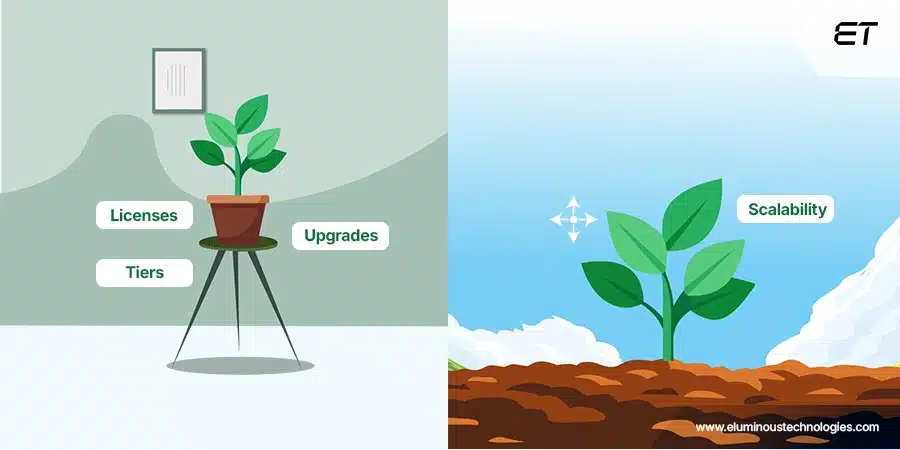
Off the Shelf software scales within the boundaries of the vendor.
- If you need more users, you need to upgrade your license.
- For higher data storage, it’s vital to move to a higher tier.
- If you want advanced functionality, get ready to pay for the premium package.
It’s predictable in terms of infrastructure, but also restrictive. In simple words, you’re growing on someone else’s terms and at someone else’s pace.
On the other hand, custom Software puts you in the driver’s seat.
- The architecture hovers around your growth roadmap from day one.
- You own the codebase, you can optimize performance, and expand the infrastructure.
- It’s possible to roll out new features exactly when you need them.
The Crux?
Off the Shelf offers convenience at the cost of flexibility; Custom provides flexibility at the price of a longer upfront build. So, it depends on whether you want software that grows at the vendor’s speed or yours.
4. Security

Our off the shelf vs custom software comparison moves to a crucial pointer. Here’s the main difference.
Off the Shelf solutions come with standard security protocols:
- Encryption
- User authentication
- Access control
- Compliances like ISO 27001, GDPR, HIPAA, or SOC 2.
On the surface, these protocols feel solid. But you’re sharing that security environment with your customers. So, if the vendor suffers a breach, you risk compromising your data.
Custom Software shifts the control and responsibility to you.
- You decide the encryption standards and multi-factor authentication methods.
- It’s also possible to grant access privileges, and the geographic location of your data storage.
What’s more?
You can design security to match your exact risk profile and industry mandates.
Simply Put
Off the Shelf provides tried-and-tested safeguards with shared responsibility, while custom offers bespoke protection. You own both the strengths and the blind spots in the latter.
Implement the top security practices to safeguard your front-end. Our blog lays out the threats and solutions concisely.
5. Cost
The final point in our off the shelf vs custom software face-off is an all-important one.
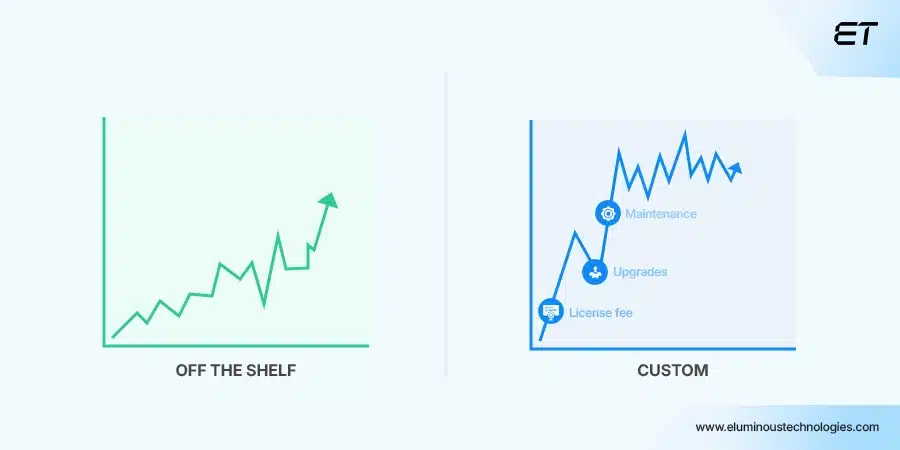
In this regard, cost is a timeline of spending. Notably, the curve looks very different depending on the path you choose.
Off the Shelf has the smaller starting line.
- You pay a license fee or subscription.
- You add onboarding and setup costs, and you’re up and running.
The appeal is clear: low upfront investment and immediate productivity. However, in the long term, you will need to face recurring fees, price hikes, paid upgrades, and integration costs. So, over a 3 – 5-year period, the total cost of ownership can creep higher than expected.
Custom Software demands a bigger check upfront.
- You’re paying for design, development, testing, and deployment before the first employee logs in.
- There are no licensing fees, no forced upgrades, and no paying for unused features.
- Maintenance is on your terms as well.
Over time, these factors can mean lower cost per user and better ROI, especially if the software drives competitive advantage.
The Verdict
For decision-makers, it’s about cash flow vs. capital investment: Off the Shelf spreads cost over time; Custom front-loads the expense but puts you in control of the expenditure.
Curious about the actual numbers of developing a custom software? Don’t worry. We got the right resource for you.
When to Choose Which Option
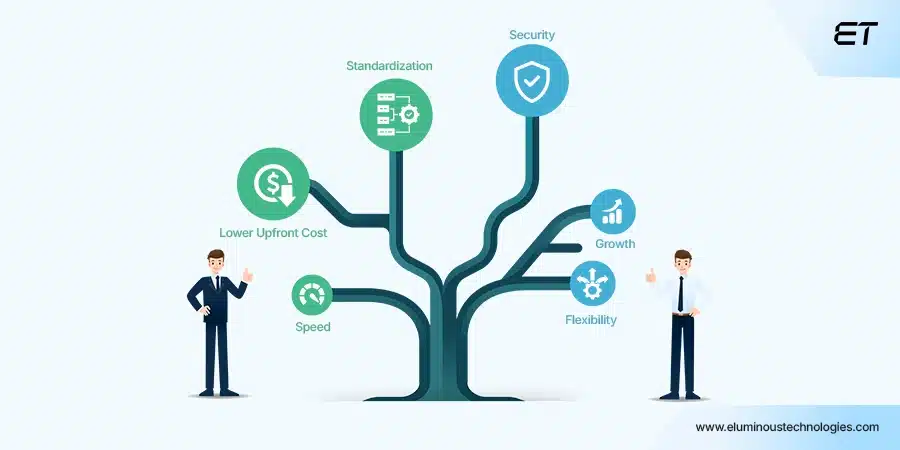
To simplify your decision, go through the following points. They give the final answer in the off the shelf vs custom software debate.
Pick Off the Shelf if:
- You need the software running right now.
- Your processes are pretty standard for your industry.
- You want a smaller upfront bill, even if there are monthly fees later.
- The built-in integrations and security are sufficient for your needs.
- You’re trying something new and don’t want to commit big money yet.
Pick Custom if:
- You need features that standard software doesn’t have.
- You expect your business to grow fast and don’t want software limits.
- You have unique systems that must work smoothly with it.
- You want to determine the exact level of security your software offers.
- You’d rather invest more now to save money and headaches later.
In short, Off the Shelf is quick and ready-made. Custom takes longer but is built just for you.
To Sum Up
The off the shelf vs custom software comparison is simple to understand. Choosing either of the two software is a strategic decision.
Off the Shelf delivers speed, reliability, and lower upfront costs. But you work within the vendor’s boundaries and pricing model. Custom
Software takes longer and costs more initially. But it matches your exact needs, integrates seamlessly with your systems, and scales at your pace.
What’s more? In the custom software option, you can develop the necessary security protocols on your terms. The right choice depends on your priorities, such as rapid deployment, predictable costs, precision, control, and long-term ROI.
For more details or hiring developers who can build custom software, note that we’re just one step away.
Your journey to developing the next custom software is just one click away. Send your details, and our POC will connect ASAP.
Frequently Asked Questions
1. Which is better in the Off the Shelf vs Custom Software face-off?
Off the Shelf works best when you need quick, standard features at a lower upfront cost. Custom is ideal if you need unique functionality, full control, and scalability. So, the final decision depends on your needs.
2. Is custom software worth the higher cost?
It can be, if you think long-term. While Custom Software costs more upfront, it can save money over time by avoiding licensing fees and reducing the need for workarounds. So, always consider the technical factors in the off the shelf vs custom software comparison.
3. Can I start with Off the Shelf and switch to Custom later?
Yes. Many businesses start with Off the Shelf for speed, then move to custom once they validate their needs, processes, and growth potential.
4. How long does custom software take to build?
It depends on complexity, but most custom builds take several months to a year. That’s because they go through requirement gathering, design, coding, testing, and deployment.

Monolithic vs. Microservices- A Deep Dive for Modern Architects
Every outage has an architecture behind it. The way a system is designed, how its components interact, scale, and recover,…

Top GitHub Repositories Every CTO Should Keep an Eye On
Overview: Staying updated with trending GitHub repositories is crucial for CTOs aiming to drive innovation and keep their tech stack…


