
 Book a Meeting
ServiceNow Adaptive Implementation Framework (SAIF): A Complete Guide
When you invest in major enterprise platforms, implementation risks are quite common. The larger your company, the greater is the exposure. Fortunately, a platform like ServiceNow exists that’s known for aligning governance with minimal disruptions.
ServiceNow naturally blends on top of ERP systems. Jonathan Alboum, Federal CTO for ServiceNow quotes it as the ‘connective tissue’ across systems.
However, if you use this enterprise solution, the challenge lies in deploying it on time and on budget. ServiceNow Adaptive Implementation Framework (SAIF) is an apt solution to overcome these bottlenecks. SAIF brings structure, discipline, and ensures scalable deployments when you implement it the right way.
In this blog, we will break down SAIF, explain how its core components reduce deployment risk and ensure governance discipline in your enterprise.
Deployment Risks Before Adopting the ServiceNow Adaptive Implementation Framework
In a large organization, technical hiccups during deployment isn’t astonishing.
Your teams face tasks like updating their products and keeping stable communication across various departments.
Without a well-defined framework, it’s hard to maintain and align a clear structure. This is where SAIF showcases its hold on AI-enabled services and streamlines operational bandwidth.
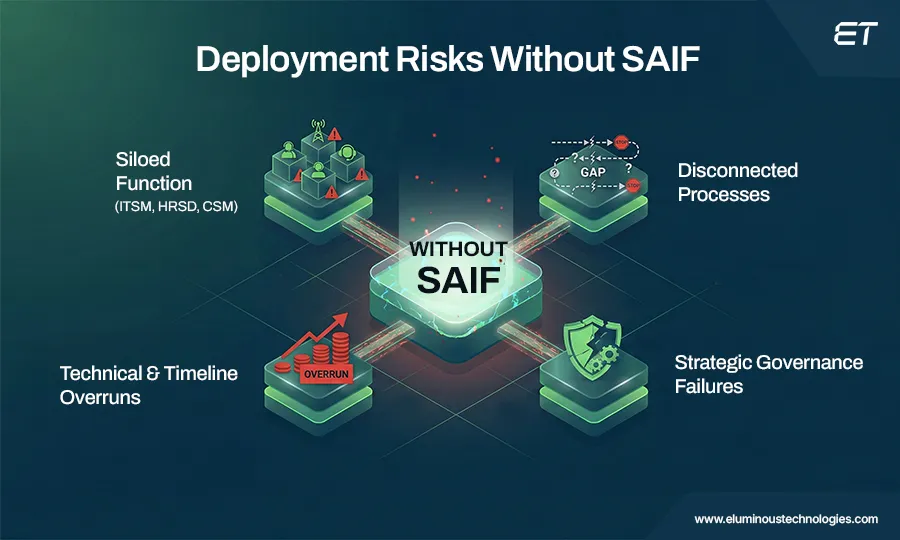
Let’s consider you have teams working across different ServiceNow modules. ITSM is deployed, HSRD is active, and you’re considering the omni-channel edge with CSM. With the absence of a robust framework, your team can end up underutilizing these modules.
In addition, you can also face common obstacles like over-dependency on integrations, technical debt, governance scrutiny, and the need to manage distributed platforms.
That’s when you need ServiceNow Adaptive Implementation Framework (SAIF).
What is ServiceNow Adaptive Implementation Framework (SAIF)
ServiceNow Adaptive Implementation Framework is an approach that includes risk mitigation, SIM (ServiceNow Implementation Methodology), and proven practices that ensure consistency and faster deployments. SAIF is designed to have a structured focus for eliminating ambiguity that any enterprise would face while deploying a high-risk implementation.
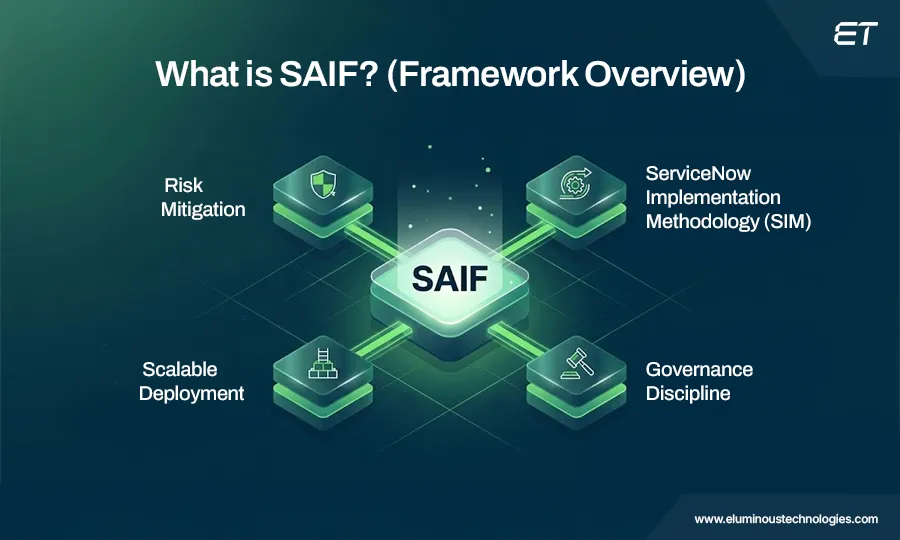
ServiceNow Adaptive Implementation Framework is not a monolithic deployment playbook. It is modular and flexible. It stands on well-defined pillars that help in transforming ServiceNow deployment into a governed and repeatable business capability.
The ServiceNow Adaptive Implementation Framework connects process and technology. Let’s go a little bit deep and understand how the four pillars of the Service Adaptive Implementation Framework help in speeding adoption, achieving higher ROI, and lower risk.
ServiceNow Implementation Methodology (SIM)
SIM is the operational core of the Service Adaptive Implementation Framework. ServiceNow Implementation Methodology is designed to realize value and focuses on governing the implementation lifecycle.
SIM is divided into six structured stages that behave as accountable checkpoints for project managers and implementation consultants.
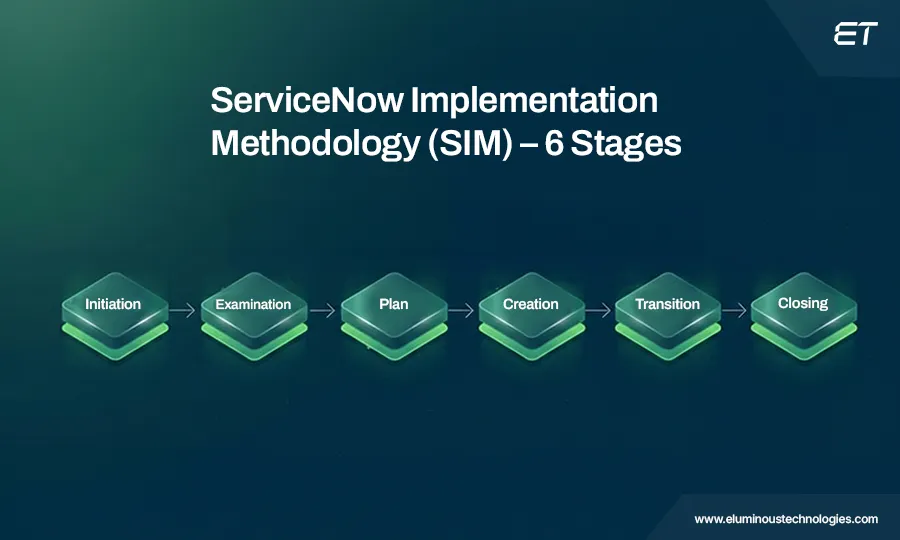
Stage 1: The Initiation
The initial stage of the ServiceNow adaptive implementation framework establishes the unambiguous starting point. This level defines objectives and success metrics through the requirement analysis. It contains focal points like stakeholder alignment, delivery team staffing, preparation for the groundwork, and engagement kick-off.
This stage ensures prevention of misalignment through the engagement cycle.
Stage 2: The Examination
After establishing the goals, this stage deploys a structured process for surfacing operational realities while identifying the platform requirements. This stage plays a crucial role as it exposes poorly built technical architecture and governance gaps before it impacts.
Stage 3: The Plan
At this stage, includes mapping out actionable roadmaps, configuring technical designs, and finalizing timelines. From customer business requirements to deployment, this stage serves as the last checkpoint before the plan is allocated to the respective teams.
Stage 4: The Creation
The operation on Agile Scrum methodology starts from this stage. This is where strategy starts transitioning into controlled delivery.
During this phase:
- Configurations are tested at intervals to validate performance.
- Risk is reduced by manageable releases, resulting in accelerated time-to-value.
- Real-time dashboards are responsible for giving clarity on the scope that aligns with strategic objectives.
- Misalignment is detected at this point.
This helps in making changes before they become technically expensive.
Stage 5: The Transition
This stage is crucial as it includes testing, end-user training programs, and going live preparations. All these take place in a structured sequence that is aligned with the business continuity.
Stage 6: Closing
The final stage formalizes the completion of the structured process. This marks the end of the implementation cycle where analysis, formal assessment, and institutional documentation are brought together. This stage of information typically serves as the knowledge transfer that makes each deployment efficient and improved.
Defining Factors of the ServiceNow Adaptive Implementation Framework
Below, we’ll explain crucial aspects that are interrelated with the ServiceNow implementation framework.
ServiceNow Technology
ServiceNow Adaptive Implementation Framework is tightly integrated with the core capabilities of the ServiceNow platform. They are inseparable and do not operate as a parallel methodology. It leverages built-in capabilities like Agile development, test management components, and project portfolio management. These components ensure alignment between defined objectives and actions taken.
This component is critical for executives as it provides structured sprint execution and measurable transparency.
ServiceNow Collateral & Assets
This pillar works with standardizing workflows and creating guidelines. Initially, one of the major costs in unstructured deployment is resource and time expenditure. This is worked on by processing blueprints, governing checklists, and reporting structures.
For CTOs, this stage works brilliantly as it reduces implementation risks.
ServiceNow Expertise
ServiceNow Adaptive Implementation Framework is run by a global team that has mastery in delivering assets and risk mitigation mechanisms. Frameworks fail if they are executed without skills. Being delivered by global and skilled professionals, this framework is disciplined and helps reduce execution volatility.
Why ServiceNow Adaptive Implementation Framework Outperforms Traditional Approaches
There are different levels of effective ServiceNow platform implementation.
The traditional implementations were a phased methodology, a guide to work for a different era. The one where requirements were quite stable and predictable. With the shift in companies experiencing organizational transformations and integration complexities, the consequences are immediately visible. This could look like no project recovery plan, budget variance, or timeline overruns.
ServiceNow Adaptive Implementation Framework was designed for responding to these vulnerabilities.
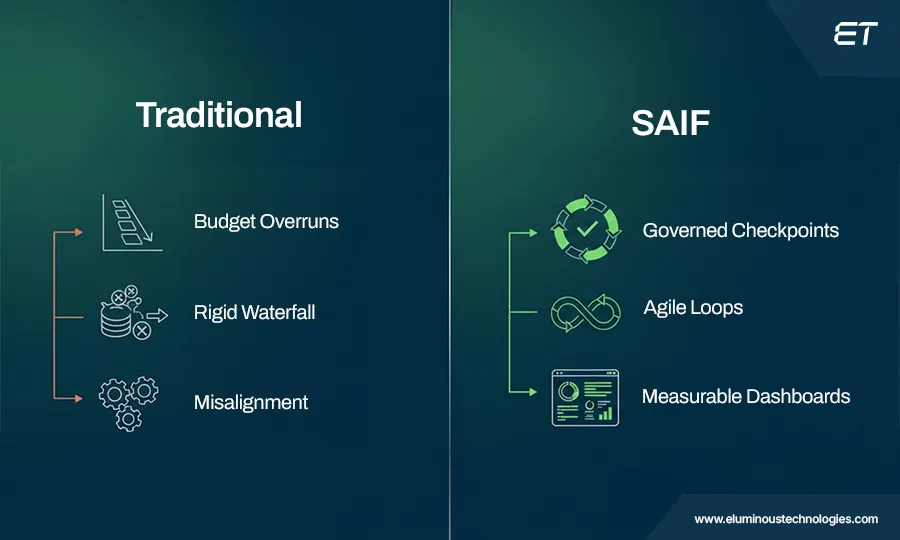
Below are some advantages that differentiate SAIF from conventional frameworks:
- Risk Mitigation: Deployment risk lies in the transition points. SAIF’s governance architecture is built to detect and address risk at transition points.
- Consistency: Organization inconsistency can prove to be a cost in enterprise deployment. This mostly happens when teams are working from different regions and have various channels for communication with different requirements. ServiceNow Adaptive Implementation Framework here helps in pre-validating templates, processing blueprints, and standardizing asset libraries. This actively removes key-person dependency.
- Adaptability: The primary goal of this framework is to complete projects without structural strain. SAIF is structured to manage intricacy with intensity to match multiple deployments without architectural compromise. This structure helps when there are sudden changes in the scope of the projects. Framework absorbs it and delivers with integrity.
- Faster time to value: This framework includes Agile delivery and iterative configuration. This directly accelerates outcomes.
This framework results in a proven way to reduce risk.
Final Thoughts
ServiceNow adaptive implementation framework has well-defined structures and a standardized approach for implementing the platform. It ensures that the implementation is controlled and predictable, aligning with the best practices.
Deploying ServiceNow is a commitment to precision. And like every other commitment, the outcome depends on the discipline behind it.
ServiceNow Adaptive Implementation Framework is that discipline.
Ready to govern your ServiceNow implementation with confidence? Schedule a SAIF strategy consultation with our POC today!

ServiceNow GenAI: What It Can Do for Your Company
Key Takeaways: ServiceNow GenAI brings generative AI directly into enterprise workflows, helping teams automate tasks efficiently. Built into the Now…


ServiceNow AI Control Tower: Is it Relevant for Your Business?
AI is everywhere. It’s in your customer service, operations, and across all departments. Is this good or bad? Maybe both.…


