
 Book a Meeting
AI Augmented Software Development: How to Move Faster Without Losing Control


AI adoption in software engineering is accelerating, but faster coding alone does not create better engineering outcomes. Many organizations invest in AI tools expecting productivity gains, only to discover that speed without governance can amplify technical debt, delivery risk, and operational complexity.
The real opportunity in AI augmented software development is not just automation. It is redesigning how software is planned, built, tested, and operated through intelligent workflows, stronger decision-making, and scalable engineering practices.
Organizations seeing the greatest value from AI are not treating it as a coding assistant, but as an operating model shift. They are combining AI capabilities with governance, architecture discipline, and delivery strategy to improve both speed and control.
This guide explores how AI-augmented development is reshaping the software development lifecycle, the metrics that matter, the risks leaders need to manage, and what it takes to scale AI adoption effectively.
AI-Assisted vs AI-Augmented Development
AI-assisted and AI-augmented development are used interchangeably, but they represent different levels of maturity. Understanding the distinction matters because many organizations mistake tool adoption for transformation.
AI-assisted development focuses on improving individual developer productivity. Tools like coding assistants help generate code, suggest fixes, automate documentation, or speed up routine tasks. The value is efficiency at the task level.
AI-augmented development operates at a broader systems level. It embeds AI across engineering workflows from planning and architecture to testing, deployment, and operations to improve decision-making, reduce delivery risk, and increase scalability. The value is not just faster execution, but stronger engineering outcomes.
The difference is less about automation and more about operating model impact:
- AI-assisted development improves how developers work.
- AI-augmented development improves how software gets built and delivered.
In practice, AI augmentation extends beyond code generation to support:
- Intelligent testing and defect prediction
- Architecture and design recommendations
- Automated quality and security checks
- Smarter deployment and monitoring workflows
- Continuous optimization across the software lifecycle
This is why AI augmentation is increasingly viewed not as a developer productivity layer, but as a strategic approach to scaling engineering performance.
Why Tech Leaders Are Investing in AI Augmented Development
Tech leaders are investing in AI-augmented development as a response to growing pressure on engineering organizations.
The value goes beyond developer productivity. When integrated strategically, AI can improve throughput, reduce technical friction, and strengthen decision-making across the software lifecycle.
For many organizations, the opportunity is less about doing the same work faster and more about changing how engineering operates at scale.
Here are some of the key drivers behind that investment.
Reducing Technical Debt at Scale
Technical debt remains one of the largest hidden costs in enterprise engineering, slowing delivery, increasing maintenance effort, and raising operational risk. In complex environments, these issues compound as systems scale.
AI augmented software development can help reduce that burden by identifying code quality issues earlier, surfacing legacy patterns, supporting refactoring efforts, and strengthening review workflows. Over time, this shifts technical debt from a growing liability into something engineering teams can manage more proactively.
Improving Engineering Economics
Tech leaders are also investing in AI augmentation to improve the economics of software delivery. By automating repetitive, high-volume tasks such as testing, code review, and defect detection, teams can reduce manual effort while improving delivery efficiency.
The impact extends beyond productivity gains. Smarter automation can lower rework, reduce rollback events, and free engineering capacity for higher-value innovation rather than ongoing maintenance.
Increasing Developer Productivity
One of the strongest arguments for AI augmentation is developer efficiency. Rather than simply helping teams produce more code, AI can reduce context switching, streamline routine work, accelerate problem solving, and support faster decision-making across workflows.
That allows developers to spend less time on repetitive execution and more time on architecture, optimization, and solving higher-value engineering problems.
How AI Augments the SDLC?
Integrating AI across different phases of the software development lifecycle can improve speed, quality, and decision-making throughout the process. It is important to distinguish AI-assisted coding from AI-augmented SDLC, as they are not the same. AI-assisted coding involves tools such as Copilot, Cursor, or Tabnine that help developers code faster.
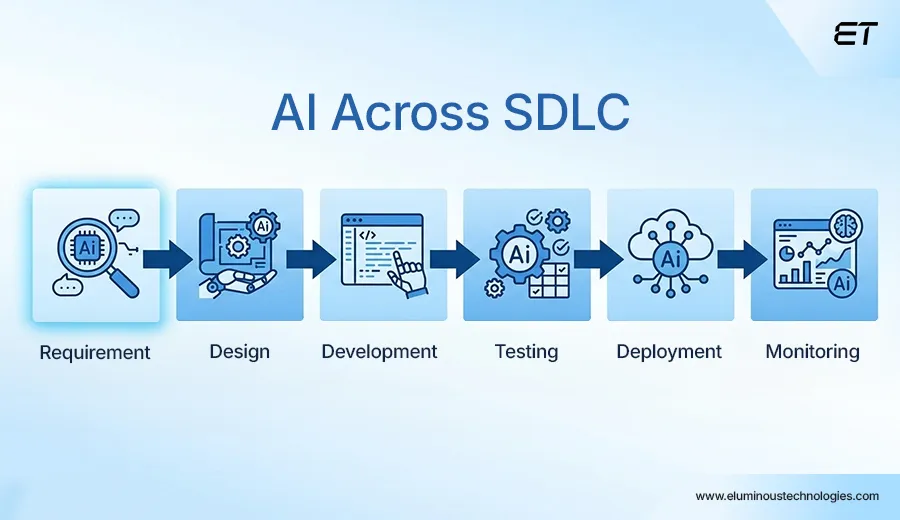
AI-augmented SDLC, by contrast, refers to the broader integration of AI across how software is planned, built, tested, deployed, and operated.
Below are some of the ways AI is applied across the lifecycle:
Requirement Analysis and Planning
Natural Language Processing tools can help identify contradictions, surface insights, and support the creation of stronger high-level briefs. AI models trained on complex information can help teams plan more realistically and reduce underestimation.
Analyzing large volumes of business data and identifying gaps early can also reduce ambiguity during the planning stage.
Design and Architecture
AI-assisted architectural decision-making can play a meaningful role in building resilient solutions from the start.
This is how it contributes:
- Tools can propose designs based on established patterns.
- They can recommend system structures and even generate infrastructure-as-code from architecture inputs.
- AI can help identify potential scalability issues earlier in the design phase.
From cloud architecture to system modeling, AI can help prevent expensive architectural complexity later.
Development
Development is one of the areas where AI integration is most visible. Today, large language models can generate functions, modules, and API integrations from natural prompts.
They can also help explain legacy code and support coding standards, security patterns, and project-specific conventions.
This shifts developers from writing everything manually toward reviewing, optimizing, and refining AI-generated outputs.
Testing and QA
AI can strengthen QA by improving how test coverage is created and prioritized. It can help ensure critical tests run first in CI pipelines, compressing feedback loops without sacrificing coverage.
AI can also support automated test generation, identify edge cases, and help predict defect-prone areas, reducing manual effort and improving testing efficiency.
Deployment and Monitoring
AI-enabled deployment systems can use historical data to detect configuration drift and support automated analysis.
Post-deployment, AI can help correlate signals across logs and metrics to trace root causes faster. It can also support deployment risk prediction, rollback decisions, and real-time monitoring.
This helps teams move from reactive firefighting toward more proactive engineering.
Overall, incorporating AI into the SDLC helps engineering teams focus on higher-value work while automating repetitive tasks and strengthening delivery processes.
Metrics That Matter in AI Augmented Software Development
Measuring the outcomes of AI investments is crucial for tech leaders. As AI adoption grows, these metrics help determine whether integration is improving delivery, reducing risk, and generating measurable business value.
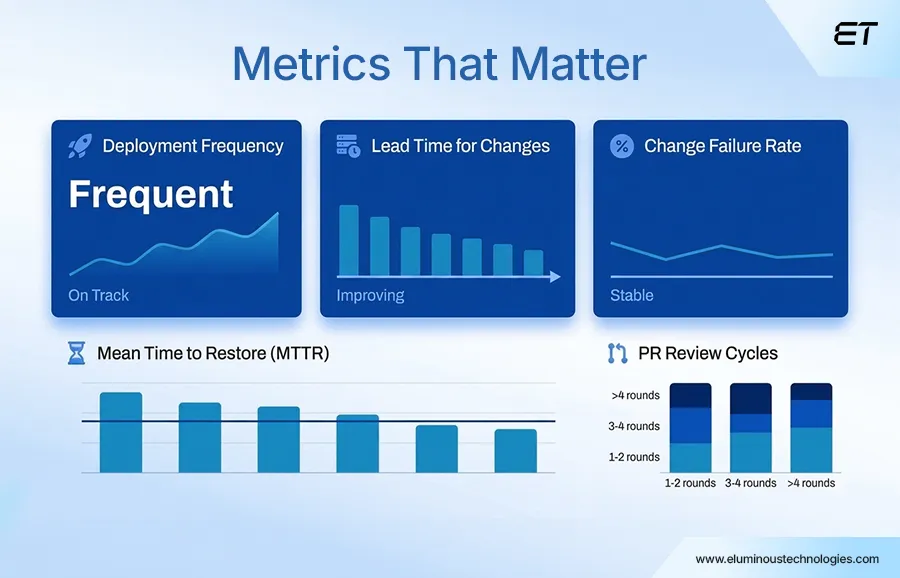
Consistently tracking the right metrics is important. Without clear measurement, organizations risk treating AI adoption as activity rather than impact, which can increase operational complexity instead of improving outcomes.
Below are some of the key metrics to track:
Change Failure rate
Change failure rate (CFR) measures the percentage of deployments that require rollback or immediate fixes. AI-augmented testing and release management can help identify changes likely to cause incidents and catch defects earlier in the process.
This helps reduce failures upstream and enables safer, more incremental releases.
Deployment frequency
Deployment frequency tracks how teams successfully release to production. As AI strengthens CI/CD pipelines and reduces manual bottlenecks, teams can increase release velocity without compromising stability.
High-performing teams use this metric to assess whether AI is contributing to more reliable, on-demand delivery rather than simply accelerating coding activity.
Lead time for changes
Lead time for changes (LTFC) measures the time from code commit to production deployment. AI can influence this metric through faster reviews, automated testing, and more intelligent delivery pipelines.
This helps teams reduce delays, improve delivery flow, and move changes into production faster without sacrificing quality.
Developer productivity benchmarks
Developer productivity metrics should go beyond lines of code and consider factors such as developer satisfaction, collaboration quality, and delivery flow.
Useful benchmarks may include AI code share, AI suggestion acceptance rates, and time saved across workflows. Tracking these metrics helps organizations move beyond experimentation, identify gaps early, and better align AI initiatives with measurable ROI.
Key Challenges in AI Augmented Software Development
As tech leaders adopt AI, they also face challenges that come with shifting engineering practices at scale. While AI augmented software development offers significant opportunities, successful adoption requires managing risks related to governance, integration, and execution.
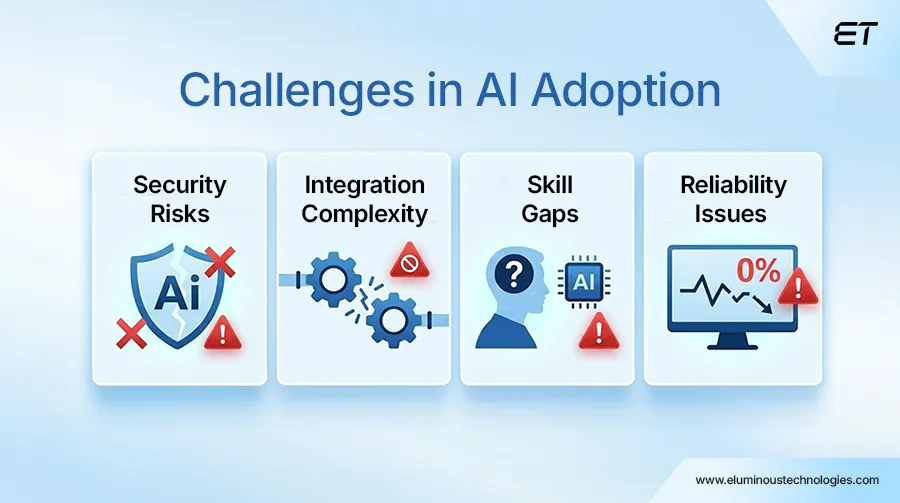
Some of the key challenges organizations need to address include:
Security & Compliance Risks
Code generated by AI can introduce security risks if not properly governed. If left unchecked, AI outputs may also raise intellectual property and licensing concerns, particularly when training data provenance is unclear.
Because AI systems may interact with sensitive data, organizations need clear policies around what information can be exposed to AI tools and how generated outputs are reviewed and used.
Without proper governance, these risks can scale quickly, creating security vulnerabilities, compliance exposure, and data privacy concerns.
Integration with Existing Systems
Integrating AI-augmented tools into enterprise environments requires significant upfront investment. This includes embedding them into existing CI/CD pipelines, legacy codebases, and broader engineering workflows.
The process can be technically challenging and resource-intensive, often requiring infrastructure updates and workflow adjustments. Organizations that treat this as a platform engineering challenge are often better positioned to succeed.
Skill Gaps and Change Management
Developers have spent years building expertise around established engineering practices, and adopting AI introduces new skills and ways of working.
This means AI adoption often requires upskilling teams, redefining workflows, and managing resistance to change. Prompt engineering, AI output validation, and critical thinking all play a role in reviewing and working with AI-generated code.
Investment in training and leadership that supports new ways of working is critical. More importantly, this shift is not only cultural, but also technical.
Quality and Reliability Issues
AI can speed-up development, but it still lacks full contextual understanding. Models can generate subtle logical errors, incorrect API calls, or misleading outputs if left unchecked.
Without human oversight, overreliance on AI can lead to inefficient code, inconsistencies, and hidden defects. That is why governance, validation, and careful review remain essential when integrating AI-generated outputs into production systems.
The Future of AI–Native Development Organizations
As AI moves from experimentation into everyday engineering workflows, its role in software development is expected to deepen. Beyond assisting individual tasks, AI is increasingly shaping how teams build, operate, and scale software.
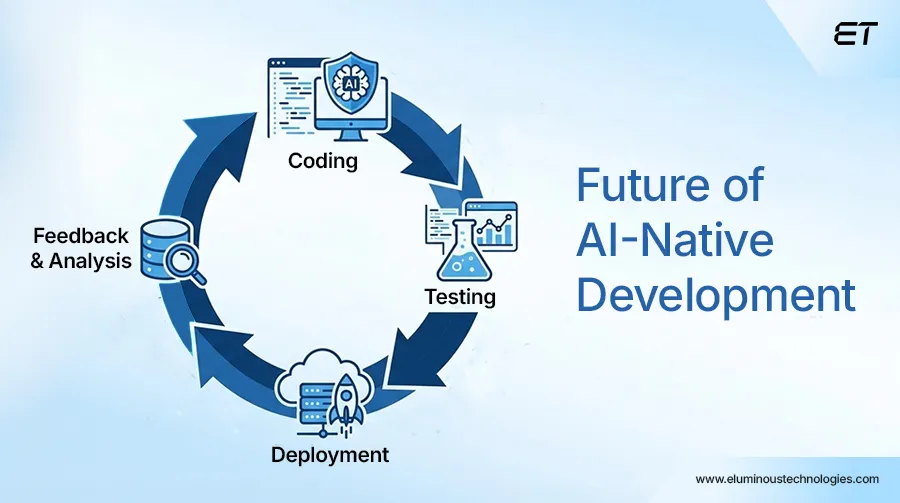
As tools continue to evolve, there integration across software development is likely to create new possibilities for engineering organizations.
Some of the development shaping this future include:
Rise of Autonomous Development Workflows
AI is expected to play a growing role across software development workflows, moving from coding assistance toward systems that can receive tasks, run tests, and help resolve failures with less human intervention. Some pioneering organizations are already exploring these models.
As these capabilities mature, the role of human engineers may increasingly shift toward specification, review, and judgment rather than routine execution.
AI-driven Engineering Teams
As AI capabilities evolve, they are likely to play a larger role across the development lifecycle, influencing everything from design support to deployment workflows.
This could also reshape team structures, with smaller, AI-enabled engineering teams potentially achieving greater speed and efficiency than traditional models.
Embedded AI may increasingly help predict issues, generate code from natural language prompts, and suggest improvements in real time.
Continuous Optimization Loops
One of the most promising applications of AI is building systems that can observe performance in production and feed those signals back into development workflows.
These systems can help identify where issues occur, why failures happen, and how similar problems may be prevented over time. Closing this feedback loop between operations and development can support faster iteration and more resilient delivery.
At scale, these kinds of workflows could reshape how software systems are continuously improved.
Wrapping Up
AI augmented software development is increasingly becoming a competitive reality. Enterprises that build the infrastructure, governance, and culture need to support AI adoption across the SDLC stand to gain meaningful long-term benefits.
As competition increases, the question for tech leaders is shifting from whether to invest in AI software augmentation to how to adopt it in ways that improve both speed and control.
Ultimately, the future will not be defined by organizations with the largest engineering teams, but by those who use AI to make software development scalable, resilient, and effective. Their biggest asset, in this journey will be an expert AI development team that could cover all the crucial bases.
Want to move faster without losing control of your engineering systems?

How to Make Power Apps Work Effectively For Your Business
Building apps without a lot of coding can feel enticing. Use drag-and-drop, experiment with a few features, and voilà! Your…

Top 12+ Programming Languages for Web Development in 2026
Don’t be surprised if I tell you that there are currently more than 700 web programming languages worldwide. But HTML,…


