
 Book a Meeting
Top Employer of Record (EOR) Companies for Enterprise Growth and Compliance
- Employer of Record companies allow enterprises to hire internationally without setting up local entities, eliminating legal, payroll, and compliance delays.
- With an EOR, enterprises can enter new markets and onboard talent in weeks, not months, while staying fully compliant with local labor and tax laws.
- A well-structured EOR helps mitigate permanent establishment (PE) risk, employment liability, and regulatory exposure across countries.
- Leading EOR providers manage contracts, statutory benefits, IP protection, tax filings, and audit-ready compliance, functioning as a global employment framework.
- The best Employer of Record companies differentiate themselves through legal assurance, scalability, system integrations, data security, and employee experience.
- From market testing and M&A integration to distributed talent hiring, EORs give enterprises the flexibility to scale globally without long-term structural commitments.
Expanding into new markets shouldn’t feel like a legal complexity.
Between entity setup, payroll headaches, and compliance risks, most enterprises waste months before hiring their first employee.
That is where Employer of Record (EOR) companies step in, simplifying global expansion from day one. They are a third-party organization that serves as the legal employer for your workforce in a specific country or region. While your company manages the employee’s daily tasks and performance, the EOR assumes all formal employment responsibilities.
The global Employer of Record (EOR) industry is on track to cross $8 billion by 2030, as enterprises worldwide adopt hybrid and borderless workforce models.
What began as a startup enabler has evolved into a strategic enterprise tool, utilized by Fortune 500 companies, consulting giants, and even government bodies to build global teams, test markets, and maintain compliance.
But selecting the right Employer of Record companies goes far beyond comparing feature lists. It’s about trust, legal assurance, scalability, and seamless integration, factors that directly shape your compliance posture and employee experience.
We’ve identified the top Employer of Record (EOR) providers of 2026 — those setting new benchmarks in compliance, scalability, and cross-border workforce management.
What Are Employer of Record Services?
Employer of Record (EOR) services enable companies to hire employees in foreign countries without establishing a legal entity in those countries. The EOR becomes the legal employer on paper, while the enterprise retains full operational and managerial control over the workforce.
At an enterprise level, EOR services are not just a workaround for international hiring—they function as a compliance and risk abstraction layer. Instead of each business unit dealing with country-specific labor laws, tax authorities, and payroll regulations, all employment obligations are centralized under the EOR’s legal infrastructure.
In practice, EOR services sit at the intersection of:
- Global HR compliance
- Payroll and statutory benefits administration
- Employment contracts and labor law adherence
- Local tax filings and social security contributions
For enterprises expanding across multiple regions simultaneously, EOR services act as a single global employment framework, dramatically reducing legal exposure and operational drag.
Why Enterprises Choose Employer of Record Companies
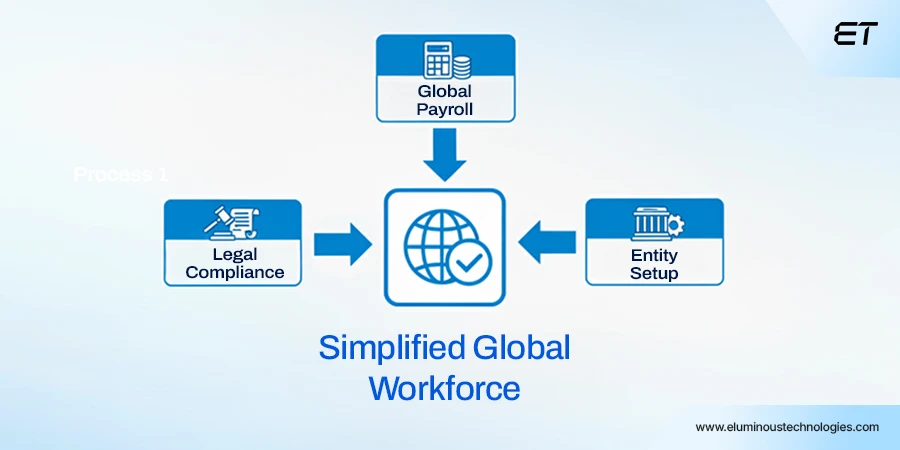
Before diving into the leaders, it is worth understanding why enterprise decision-makers are turning to EORs in the first place.
When hiring across borders, the legal and operational complexities multiply quickly, encompassing tax registrations, labor law compliance, IP ownership, and benefits administration. Setting up entities in 20 countries could take up to 18 months and cost well over $200,000 per country on legal, accounting, and administrative overhead.
An Employer of Record companies acts as the legal employer on your behalf. They hire, pay, and manage your team compliantly in the local market, while you retain full control over day-to-day operations. It is like having a global HR, payroll, and compliance engine, without the bureaucracy.
By selecting the top Employer of Record companies, you could enter six new markets in under a quarter, a feat that previously took us a full fiscal year.
That’s the enterprise promise of EOR: speed without risk.
Top Employer of Record Companies Leading in 2026
What sets the leading Employer of Record (EOR) companies apart in 2026 is their ability to go beyond payroll and compliance. They are delivering data-driven insights, integrated workforce platforms, and region-specific expertise that redefine global workforce management.
More than 56% of U.S. businesses plan to engage in cross-border business activities within the next three years, signaling a strong and sustained demand for global EOR-enabled workforce models.
1. Globalization Partners (G-P)
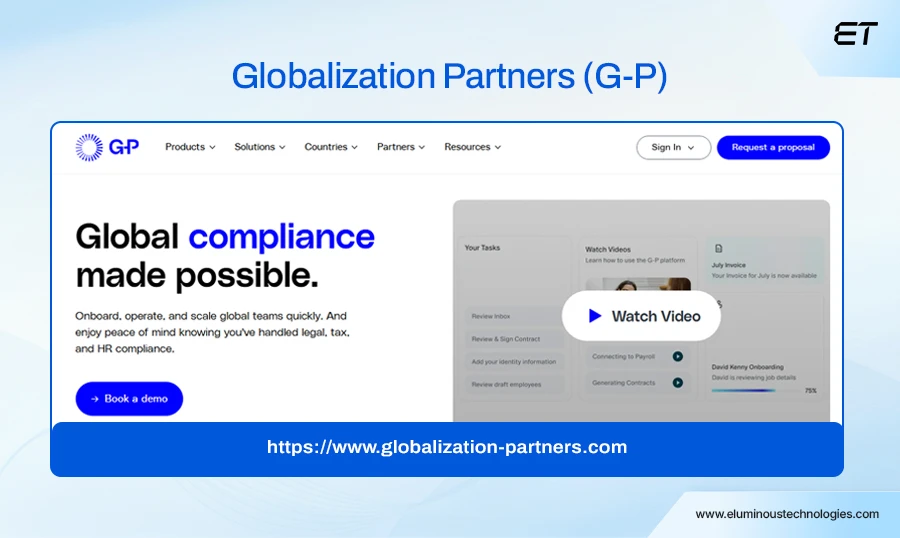
Best suited for: Large enterprises requiring comprehensive global coverage and demonstrated compliance maturity.
G-P continues to be a front-runner in the Employer of Record space, earning recognition from leading analyst firms for its global scale and reliability. Operating across 180+ countries with an extensive network of owned entities, G-P stands out as a trusted choice for data-sensitive and IP-intensive enterprises seeking secure international expansion.
Enterprises appreciate G-P’s focus on data security (SOC 2 and ISO 27001 certified) and its robust compliance framework. Its platform integrates with HR systems like Workday and BambooHR, making it enterprise-ready from day one.
What sets G-P apart is its balance of scale and stability. One multinational retailer, for instance, used G-P to onboard over 250 employees across 30 countries in 90 days, with zero compliance violations.
2. Deel
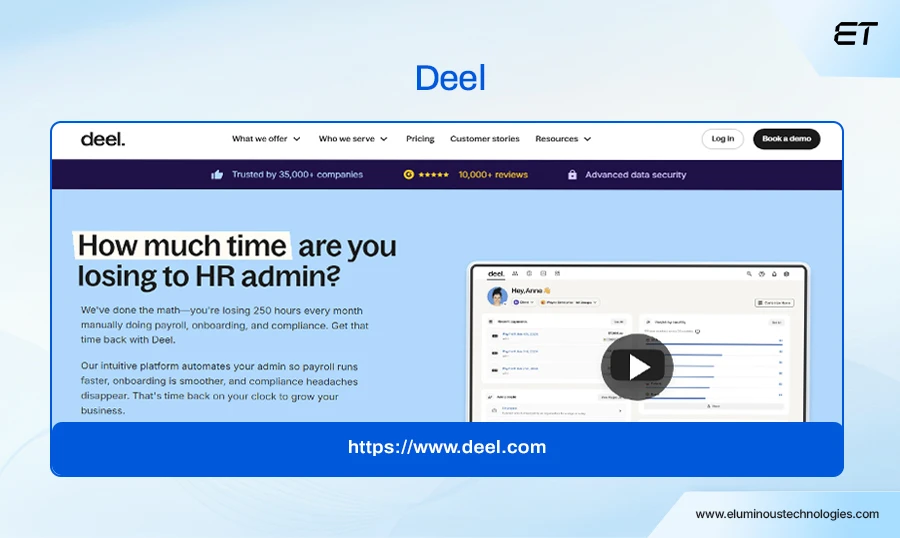
Best for: Technology-driven enterprises that value speed, product innovation, and flexibility.
Deel has become synonymous with agility. Known for its sleek platform and continuous product updates, Deel has evolved from a startup-friendly tool to an enterprise-ready solution trusted by companies such as Nike, Shopify, and Dropbox.
It supports EOR and contractor management in over 100 countries, offering features such as built-in expense management, equipment shipping, and localized benefits, all on a single dashboard.
Deel distinguishes itself through its seamless integration of automation and compliance. The platform automates background checks, contract generation, and tax adherence, enabling enterprises to onboard international employees in under two weeks on average.
From a CISO’s perspective, Deel’s alignment with SOC 2, ISO 27001, and GDPR makes it a strong partner for regulated industries such as fintech and healthtech.
3. Remote
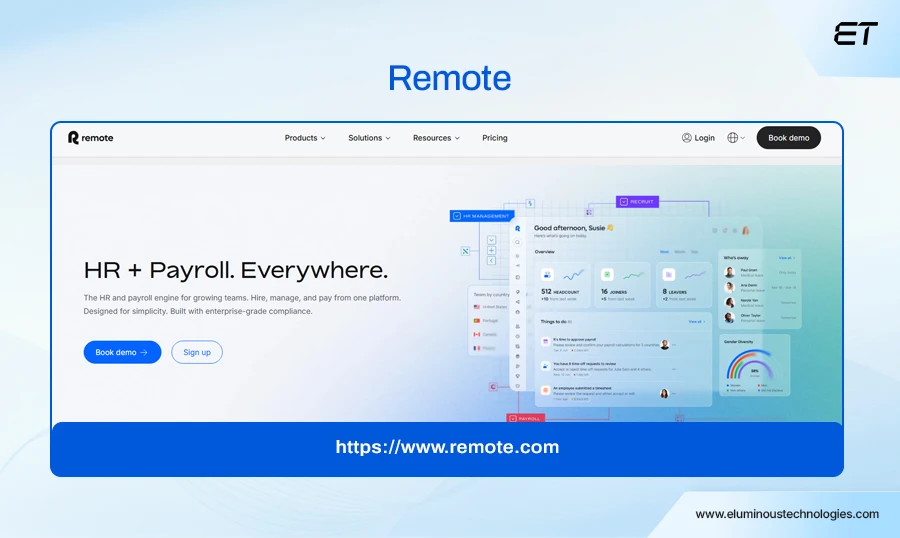
Best for: Transparent pricing, strong compliance documentation, and easy country expansion.
Remote stands out for its open-book approach. It is one of the few Employer of Record companies that publicly lists its country coverage, benefits details, and even local salary benchmarks.
That level of transparency resonates with enterprises that require clear audit trails and proof of compliance.
Remote owns its entities in most major hiring markets and offers competitive rates (starting at around $699 per employee per month in countries like India).
Beyond EOR, Remote also provides contractor management, equity support, and IP protection features, which enable it to scale from pilot projects to a permanent market presence.
Remote’s trust portal provides enterprise IT and legal teams with direct access to SOC 2 Type II and ISO certifications, strengthening transparency and compliance assurance. Its streamlined platform design reduces administrative overhead, enabling organizations to manage global hiring with minimal operational friction.
4. Velocity Global
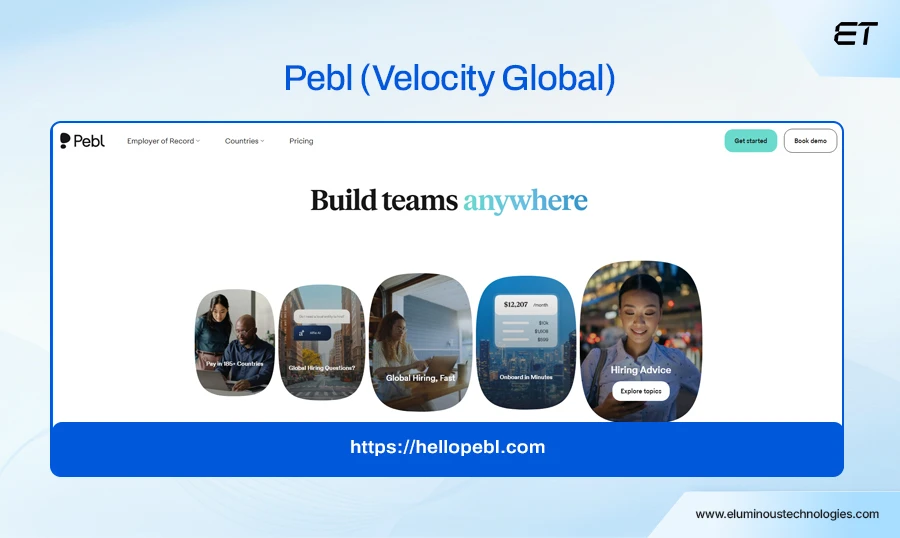
Best for: Enterprises prioritizing wide global reach and consultative onboarding.
Velocity Global coverage spans over 185 countries, and its service model focuses heavily on hands-on guidance for HR, legal, and finance teams.
This, among other Employer of Record companies, is especially valuable for enterprises expanding into less common or emerging markets. While some providers rely on partner networks,
Velocity Global’s mixed entity model ensures compliant hiring even in complex jurisdictions.
The company’s Employee Experience layer, including localized perks and 24/7 multilingual support, gives enterprises confidence in maintaining their global brand culture.
Pricing starts around $599 per employee per month, depending on the country, and its platform integrates seamlessly with enterprise HR systems. For companies expanding across Africa, the Middle East, or Latin America, Velocity Global offers the reassurance of deep regional expertise.
5. Papaya Global

Best for: Enterprises seeking unified payroll, payments, and EOR under one platform.
Papaya Global goes beyond Employer of Record companies; it is a full-fledged global workforce management system. The company operates in over 160 countries and is a favorite among CFOs for its end-to-end payment automation and real-time analytics.
Papaya’s platform consolidates payroll, benefits, and compliance in one place, providing finance teams with real-time visibility into international labor costs. For large organizations running hybrid setups (entity-based + EOR employees), Papaya’s unified dashboards make reconciliation effortless.
A recent case study revealed that a multinational saved 22% on administrative costs after switching to Papaya from a fragmented local vendor model. For large-scale operations, that’s not a rounding error; that’s margin protection.
6. Rippling
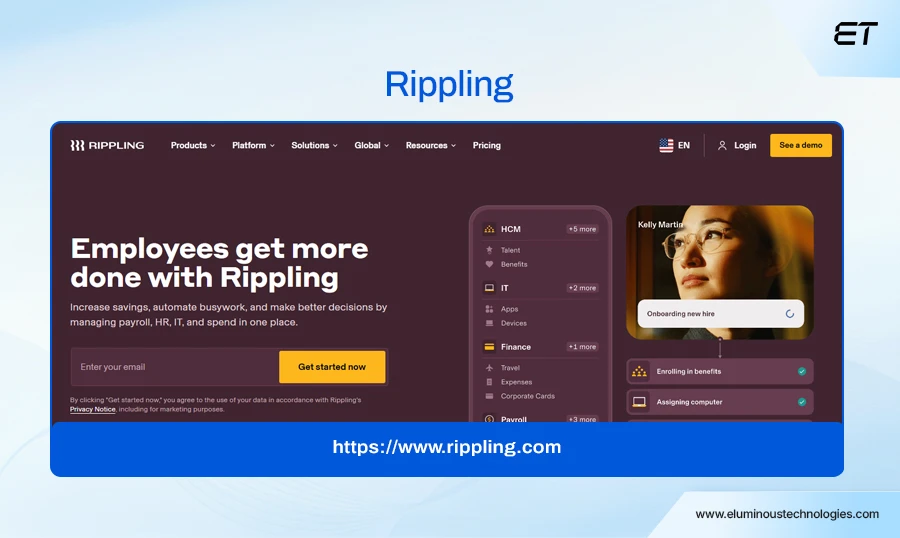
Best for: Enterprises wanting to integrate global HR, IT, and finance functions in one system.
Rippling, a newer entrant among leading Employer of Record providers, has quickly gained traction through its unified workforce platform that integrates HR, IT, and finance operations.
That means when you onboard an employee in Singapore, Rippling automatically sets up payroll, assigns benefits, provisions their laptop, and grants access to enterprise apps, all in minutes.
With coverage in 50 countries, Rippling is gaining traction with fast-scaling enterprises and security-conscious CIOs.
For organizations that value automation, auditability, and centralization, Rippling is not just an EOR tool; it is a strategic HR-tech foundation.
7. Safeguard Global

Best for: High-volume enterprise hiring and rapid international scaling.
Safeguard Global has deep roots in multi-country payroll and workforce management. Its EOR offering supports aggressive expansion timelines, onboarding hundreds of employees across multiple continents in weeks.
In one reported instance, a tech marketplace firm hired 150 employees across 30+ countries in under two quarters using Safeguard’s infrastructure. That kind of scale would usually require years to achieve through traditional methods.
Safeguard Global stands out for its in-country employment expertise, offering dedicated local specialists who manage end-to-end compliance and payroll on behalf of enterprises.
8. Oyster HR
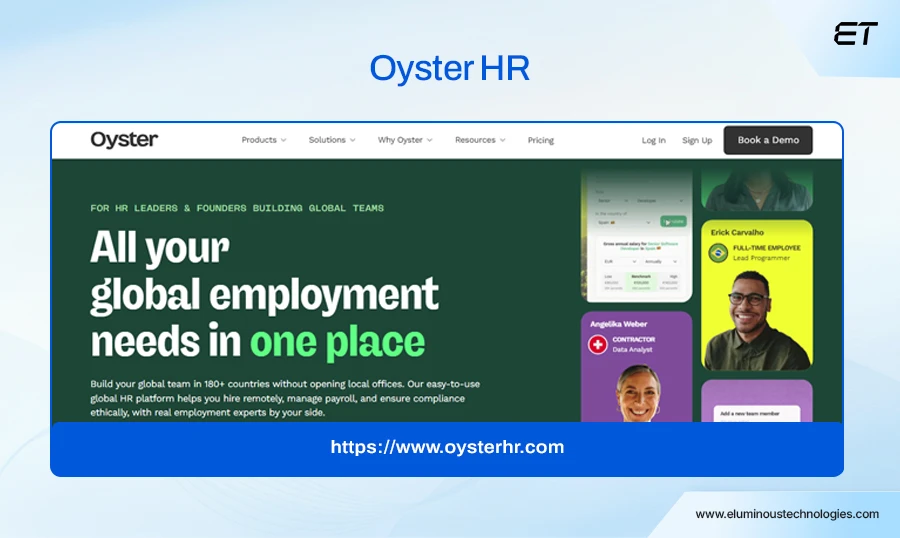
Best for: Mid-to-large organizations that prioritize employee experience and simplicity.
Oyster HR built its brand on empathy and design. Its platform focuses heavily on employee well-being, benefits, and a “people-first” experience. With support for over 130 countries, Oyster makes remote hiring approachable for enterprises that prioritize retention and culture.
While its feature set may not be as comprehensive as Rippling’s or Papaya’s, its value lies in ease of use; HR leaders can create compliant employment contracts in minutes without needing to consult legal advisors.
9. Atlas
Best for: Enterprises that require full control and assurance of entity ownership.
Atlas takes a different approach from other Employer of Record companies; it owns 100% of its entities, giving enterprises a direct legal chain and strong IP protection. This appeals heavily to regulated sectors such as defense, pharmaceuticals, and financial services, where ownership and compliance risks cannot be shared.
Atlas’s direct-entity model also enables faster resolution for employee disputes or benefits issues, as there are no third-party intermediaries. For organizations with strict compliance postures, Atlas offers control without compromise.
10. Multiplier
Best for: Cost-effective and APAC-focused enterprise expansion.
Multiplier is quickly gaining attention as an affordable yet powerful Employer of Record company, especially for companies hiring in Asia-Pacific and emerging EMEA markets.
With transparent pricing and country-specific insights, it is an excellent fit for enterprises testing new regions or managing a blended workforce of contractors and employees.
Its AI-driven dashboard simplifies compliance documentation and onboarding, helping HR teams manage multiple jurisdictions with minimal overhead. For enterprises optimizing global cost structures, Multiplier delivers efficiency without cutting corners.
Benefits of Using an Employer of Record (EOR)
Here are the benefits of using an Employer of Record (EOR) for international hiring and workforce management.
1. Faster Global Hiring Without Entity Setup
Employer-of-record companies enable organizations to hire employees in new countries within hours, eliminating months of legal entity formation, local registrations, and bank setup. This allows enterprises to respond immediately to market opportunities, talent availability, and competitive pressure, without long-term structural commitments.
2. Full Compliance With Local Labor & Tax Laws
Each country has its own employment rules covering contracts, notice periods, benefits, working hours, and tax filings. An EOR assumes responsibility for ongoing compliance, ensuring employment practices stay aligned with changing labor laws, payroll regulations, and statutory reporting requirements, reducing the risk of penalties or disputes.
3. Protection From Permanent Establishment (PE) Risk
Hiring employees abroad can unintentionally expose companies to corporate tax liability. A properly structured EOR acts as a legal buffer, helping prevent the creation of permanent establishment by ensuring employment and payroll activities are legally isolated from the parent entity.
4. Predictable and Transparent Employment Costs
Instead of managing fragmented local vendors and fluctuating compliance costs, enterprises receive a single consolidated invoice covering salary, statutory contributions, benefits, and EOR fees. This simplifies budgeting, forecasting, and financial reporting, especially across multiple countries and currencies.
5. Reduced Legal and Employment Liability
The EOR becomes the legal employer and assumes liability for:
- Employment contracts
- Payroll accuracy
- Statutory benefits
- Termination compliance
- This significantly lowers exposure to wrongful termination claims, labor disputes, and regulatory investigations.
6. Access to Competitive Local Benefits
EORs pool employees across regions, enabling access to market-aligned health insurance, retirement plans, and statutory benefits that would otherwise be difficult or costly to secure for small teams. This improves talent attraction and retention without building country-specific HR infrastructure.
What Does an Employer of Record Do?
A top-tier Employer of Record manages far more than payroll. It functions as a legal risk firewall between your enterprise and the complexities of local employment law.
Below are the core functions, with real-world implications for enterprises.
Employment Contract Localization & Statutory Alignment
Employment contracts are not globally standardized documents. Every jurisdiction has mandatory clauses, statutory benefits, and worker protections that override employer intent.
For example:
- In Italy, contracts must specify the employee’s Livello (seniority classification) under national collective bargaining agreements
- In France, fixed-term contracts are heavily restricted and require precise legal justification
- In Mexico, profit-sharing obligations (PTU) are mandatory and enforceable
An EOR ensures:
- Contracts comply with local labor codes, collective agreements, and court precedents
- Mandatory benefits, notice periods, and working hour limits are correctly defined
- Employment agreements remain legally enforceable, not partially void or challengeable
For enterprises, this eliminates the risk of invalid contracts, which can lead to retroactive fines, forced reinstatement, or employee claims.
Permanent Establishment (PE) Risk Mitigation
Permanent Establishment (PE) risk is one of the most underestimated threats in global hiring.
If your enterprise hires senior employees, such as country managers, sales directors, or revenue leaders without a legal entity, tax authorities may argue that:
- Your company is conducting “core business activities” in that country
- Your entire organization now owes corporate income tax locally
For example:
- Hiring a country lead in Germany or the Netherlands without proper shielding can trigger PE claims
- PE exposure can retroactively apply, resulting in years of back taxes, penalties, and audits
A robust EOR:
- Acts as the legal employer, breaking the direct tax nexus
- Structures, roles, reporting lines, and authority levels to reduce PE exposure
- Provides documentation and audit trails to defend against tax authority challenges
For CFOs and General Counsel, this function alone often justifies the EOR cost.
Payroll, Statutory Benefits, and Tax Administration
Payroll compliance is not merely about paying salaries on time. It involves:
- Correct tax withholding calculations
- Social security and pension contributions
- Mandatory bonuses (e.g., 13th or 14th month salary in many countries)
- Statutory leave tracking and payouts
Errors in payroll compliance can result in:
- Employee lawsuits
- Government penalties
- Criminal liability in certain jurisdictions
An EOR ensures:
- Payroll is processed in local currency, following country-specific cycles
- All employer and employee contributions are filed correctly
- Benefits are administered in line with statutory and market norms
For enterprises operating across 10–50 countries, this removes massive operational overhead.
Intellectual Property (IP) Chain of Custody
Intellectual Property ownership is not automatically transferred in many countries, even when an employee is paid to create IP.
This is especially critical for:
- Software development
- Product design
- R&D and data science teams
A compliant EOR structure ensures a “back-to-back” IP assignment:
1. The employee assigns IP rights to the EOR under local law
2. The EOR immediately assigns those rights to your enterprise
Without this structure:
- IP ownership may legally remain with the employee
- Future funding rounds, acquisitions, or IPOs can be delayed or derailed
This is why General Counsel teams scrutinize EOR IP clauses as closely as M&A documents.
EOR vs. PEO: How Does an EOR Differ From a PEO?
An Employer of Record (EOR) becomes the legal employer and manages compliance, payroll, and hiring without a local entity, while a PEO supports HR through co-employment and requires your business to have an existing local entity. See the table below for a quick comparison.
| Feature | Employer of Record (EOR) | Professional Employer Organization (PEO) |
| Legal Entity | No local entity required by you. | Mandatory: You must own a local branch/subsidiary. |
| Liability | The EOR is the “Employer of Record” for all legal claims. | Co-employment: You and the PEO share legal liability. |
| Payroll & Tax | Filed under the EOR’s Tax ID. | Filed under your company’s Tax ID. |
| Best For | International expansion (1–50 employees). | Domestic HR outsourcing (50–500+ employees). |
| Example | Hiring a dev in India from your US HQ. | Outsourcing HR for your 100-person Florida office. |
When Should You Use an Employer of Record Service?
Employer of Record (EOR) services are most effective when speed to market, regulatory certainty, and operational flexibility are more critical than establishing permanent legal entities.
Below are the most common enterprise scenarios where EOR adoption delivers clear value.
Market Entry Validation
Before committing capital and legal resources to entity setup, enterprises often use EORs to validate market demand and the feasibility of execution.
For example, a SaaS company entering Southeast Asia may hire a small local sales and customer success team via an EOR to assess:
- Revenue traction
- Customer acquisition costs
- Local sales cycle complexity
If the market proves viable, the company can later transition employees from the EOR to a local entity. If not, it can exit the market cleanly without liquidation costs or long-term compliance exposure.
This approach allows enterprises to treat global expansion as a phased investment, rather than a fixed commitment.
M&A and Post-Acquisition Integration
EORs are frequently used during mergers and acquisitions to stabilize employment relationships while legal, tax, and operational structures are harmonized.
For instance, when acquiring a company with employees spread across multiple countries, an enterprise may temporarily move acquired staff under an EOR to:
- Maintain uninterrupted payroll and benefits
- Avoid immediate entity restructuring
- Buy time to standardize employment contracts and policies
This reduces integration risk while giving leadership flexibility to decide which markets justify long-term entity ownership.
Distributed Talent Hiring
Enterprises increasingly hire highly specialized roles where talent availability, not geography- drives hiring decisions.
Examples include:
- AI and machine learning engineers in Eastern Europe
- Regulatory compliance experts in Singapore or Switzerland
- Clinical researchers or data privacy specialists in niche markets
In these cases, setting up a legal entity for one or two hires per country is neither economical nor operationally justified. An EOR enables compliant hiring at low scale, without sacrificing governance or IP protection.
Short- to Medium-Term or Regulated Projects
EORs are particularly valuable for time-bound initiatives or projects in heavily regulated environments.
Examples include:
- Deploying implementation teams for a 12–18 month ERP rollout
- Staffing a regulatory transformation or audit remediation program
- Launching pilot operations in industries such as healthcare, fintech, or energy
Because entity creation can take months and requires ongoing compliance even after the project ends, EORs allow enterprises to execute quickly and exit cleanly once objectives are met.
Wrapping Up
As global workforces evolve, EORs are becoming less of a stopgap and more of a strategic infrastructure. They are not just enabling cross-border hiring; they are redefining what it means to be a truly global enterprise.
By 2030, analysts predict that one in four global hires will be made through an EOR platform. For enterprises, this means greater flexibility, faster time-to-market, and a reduced compliance footprint, without compromising control or culture.
So, whether you are a multinational planning your next market entry or a scale-up transitioning into enterprise mode, the right EOR partner can make the difference between expansion headaches and global success.
The right development partner enables enterprises to scale globally through enterprise-grade solutions, from building EOR-integrated platforms and automation systems to designing secure, scalable digital infrastructures that simplify workforce and compliance management.
The future of work is borderless. Lead it with confidence and scale your global workforce today.
Frequently Asked Questions
1. Is using an Employer of Record legal in all countries?
Yes, EOR services are legal in most countries when structured correctly. A compliant EOR operates through registered local entities and follows country-specific labor, tax, and employment laws to ensure lawful hiring.
2. How much does an Employer of Record typically cost?
EOR pricing usually includes a monthly per-employee fee plus statutory employment costs. While costs vary by country, EORs are often significantly cheaper than setting up and maintaining a local legal entity.
3. Can an Employer of Record handle senior or leadership roles?
Yes. EORs can employ senior executives, managers, and specialized professionals, provided that the roles are structured to comply with local labor laws and avoid a permanent establishment or tax exposure.
4. What happens if labor laws change in a country?
The EOR continuously monitors regulatory changes and updates employment contracts, payroll calculations, and HR policies accordingly, ensuring ongoing compliance without requiring action from the client.
5. Can employees hired through an EOR be converted to full-time local employees later?
Yes. Most EORs support smooth transitions from EOR employment to a client-owned legal entity, including compliant contract transfers, payroll migrations, and, where permitted, continuity of benefits.

Choosing a Software Development Partner: A Practical Evaluation Framework
You’ve started shortlisting multiple vendors, and suddenly, every option looks the same. Polished portfolios, bold claims, similar tech stacks. It’s…

Staff Augmentation Best Practices for High-Performance Teams
Do you have a clear vision, but lack the bandwidth or skills to execute fast enough? Then it might not…


