
 Book a Meeting
GraphQL vs REST APIs: Differences, Performance, and When to Use Each


REST and GraphQL are two different approaches to designing APIs that allow applications to communicate with servers. GraphQL vs REST differ fundamentally in how clients request data, how servers deliver it, and how developers control it.
But did you know? APIs now power more than 83% of all internet traffic and modern applications. From mobile apps to SaaS dashboards, all depend on fast, flexible, and efficient data exchange.
Developers spend the majority of their time dealing with API-related issues. These issues include over-fetching data, under-fetching data, versioning, and performance bottlenecks.
This is exactly where the GraphQL vs REST debate becomes relevant. It is a real architectural decision that directly affects performance, scalability, developer experience, and product speed.
This discussion is especially for technical decision-makers who have experienced:
- Loaded a mobile app that felt slow even on good internet
- Built multiple endpoints just to support one UI screen
- Struggled with API versioning (/v1, /v2, /v3…)
Then the comparison matters to you.
This blog goes beyond a surface-level comparison. We will break down REST vs GraphQL in practical terms, so you can make the right choice for your application.
Why API Choices Matter for Business Outcomes
APIs are no longer just a technical implementation detail. They directly influence how fast products launch, how well systems scale, and how much it costs to maintain and evolve digital platforms.
The wrong API approach can lead to slow product iterations, rising infrastructure costs, and growing dependency between teams. The right approach enables faster time-to-market, smoother customer experiences, and long-term scalability without constant rework.
For leadership teams, GraphQL vs REST is ultimately a business architecture decision, not just a developer preference.
What is GraphQL?
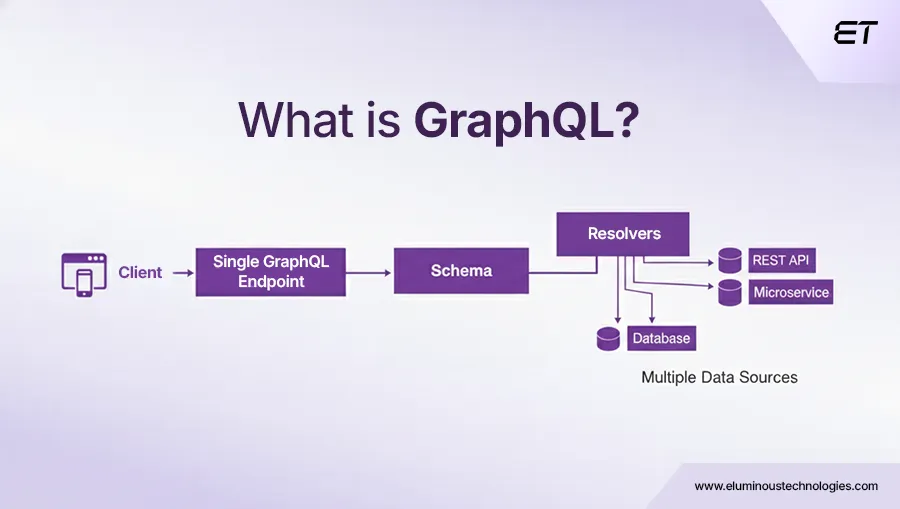
GraphQL is a query language and runtime for APIs that allows clients to request exactly the data they need.
Unlike REST, where the server decides the shape of every response, GraphQL shifts control to the client. It enables far more flexible and efficient data fetching.
Instead of exposing many endpoints for different resources and use cases, GraphQL typically exposes:
- A single endpoint
- A strongly typed schema that defines all possible data
- Client-defined queries that specify the exact response shape
GraphQL was created to address real-world problems that emerged as applications became more complex. Especially in mobile apps, single-page applications (SPAs), dashboards, and data-heavy UIs, where performance and flexibility are critical.
In short: REST asks, “Which endpoint should I call?” GraphQL asks, “What data do I need right now?”
Why GraphQL Was Needed
As frontends evolved, developers faced recurring challenges with REST:
- Too many API calls for one screen
- Large payloads with unused fields
- Frequent backend changes for small UI updates
This approach is especially valuable in environments where:
- Network conditions are unpredictable (mobile)
- Multiple clients consume the same API (web, iOS, Android)
- UI requirements change rapidly
GraphQL was designed to address these inefficiencies by allowing clients to explicitly describe their data requirements. While the server guarantees consistency and validity through a schema.
How GraphQL Works?
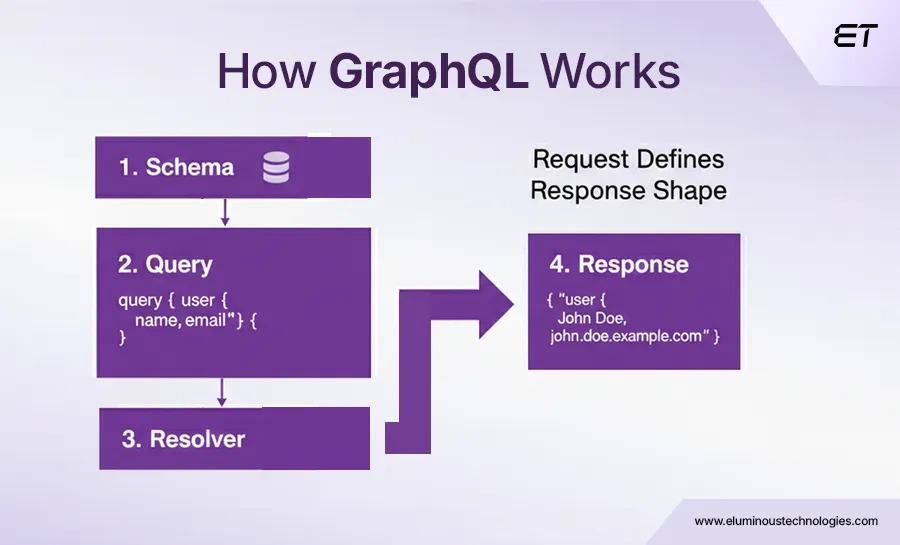
GraphQL operates on a clear separation of responsibilities:
- The server defines what data is possible: This is done through a schema that lists types, fields, and relationships.
- The client defines what data it wants: The client sends a query specifying exactly which fields it needs.
- The response mirrors the request structure: The shape of the response always matches the shape of the query.
This symmetry eliminates guesswork. Frontend developers don’t need to constantly inspect API docs. Now they can see the response structure directly from the query they write.
A Simple GraphQL Example
Instead of making multiple REST calls for product details, seller information, and reviews, GraphQL allows all required data to be fetched in a single request.
query {

product(id: 123) {

name

price

seller { name }

reviews { rating }

}

}
The API returns only the requested fields in a single response.
Business impact: fewer network calls, faster page loads, and quicker UI changes without backend rework. There are no extra fields, multiple round-trips, or backend changes needed for this query
This makes GraphQL particularly powerful for UI-driven development, where different screens and components require different slices of the same underlying data.
Core Building Blocks of GraphQL
To understand how GraphQL delivers this flexibility, it is important to know its core components.
1. Schema
The schema is the backbone of a GraphQL API. It defines:
- Data types (e.g., User, Product, Order)
- Relationships between types
- What operations are allowed
Think of the schema as a contract between the client and the server.
If a field exists in the schema, the client can request it. If it does not, the request will fail immediately. This strong typing enables better validation and safer frontend development.
2. Queries
Queries are used to read or fetch data, similar to GET requests in REST.
Key difference:
- REST decides the response shape
- GraphQL queries define the response shape
This means different clients can query the same resource in different ways without creating new endpoints.
3. Mutations
Mutations are used to create, update, or delete data, similar to POST, PUT, PATCH, and DELETE in REST.
Mutations:
- Are explicitly defined in the schema
- Clearly describe what data is being changed
- Return structured responses (often the updated object)
This makes state changes more transparent and predictable.
4. Resolvers
Resolvers are the functions that power GraphQL behind the scenes.
For every field in the schema, a resolver:
- Knows how to fetch or compute the data
- Can pull from databases, APIs, or microservices
- Can combine multiple data sources into one response
Resolvers give GraphQL its flexibility, but they also require careful design to ensure performance and security.
This shift is why GraphQL is often described as frontend-driven API design.
And this flexibility is exactly why GraphQL is best suited for certain use cases, which leads naturally into the next discussion: when to use GraphQL vs REST.
Strengths of GraphQL
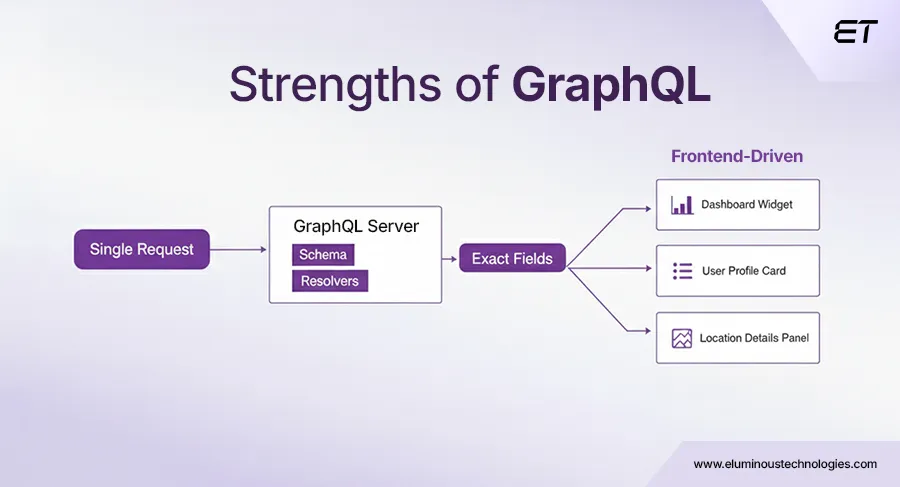
GraphQL gained adoption not because it was “new.” It solved very real and expensive problems that modern applications faced as they scaled across devices, teams, and data sources.
1. Precise data fetching (no over- or under-fetching)
One of GraphQL’s biggest strengths is that clients control the shape of the response. Instead of accepting whatever the server returns, the client explicitly asks for only the fields it needs.
This eliminates:
- Over-fetching (unused data bloating responses)
- Under-fetching (multiple requests to assemble one screen)
On mobile apps, especially in regions with slower or more costly internet, every extra kilobyte affects load time and user experience.
2. Faster frontend development and team autonomy
With GraphQL, frontend teams no longer have to wait for backend teams to:
- Create new endpoints
- Modify existing responses
- Version APIs for small UI changes
As long as the required fields are present in the schema, frontend developers can proceed independently.
In fast-moving product teams, backend bottlenecks slow down feature releases. GraphQL removes much of this friction.
3. Strong typing and introspection
GraphQL APIs are strongly typed, meaning every field, argument, and return value is explicitly defined in the schema.
This enables:
- Automatic API documentation
- Type-safe frontend code
- Early error detection during development
Through introspection, tools can query the schema itself to understand what’s available without any separate documentation.
Developers spend less time reading docs and more time building features.
4. Ideal for complex, data-rich UIs
GraphQL excels where UIs need to:
Combine data from multiple sources
Display nested or relational data
Adapt to different user roles or permissions
Dashboards, analytics tools, admin panels, and SaaS products often benefit the most.
Instead of orchestrating multiple REST calls on the client, GraphQL acts as a data orchestration layer.
Challenges of GraphQL
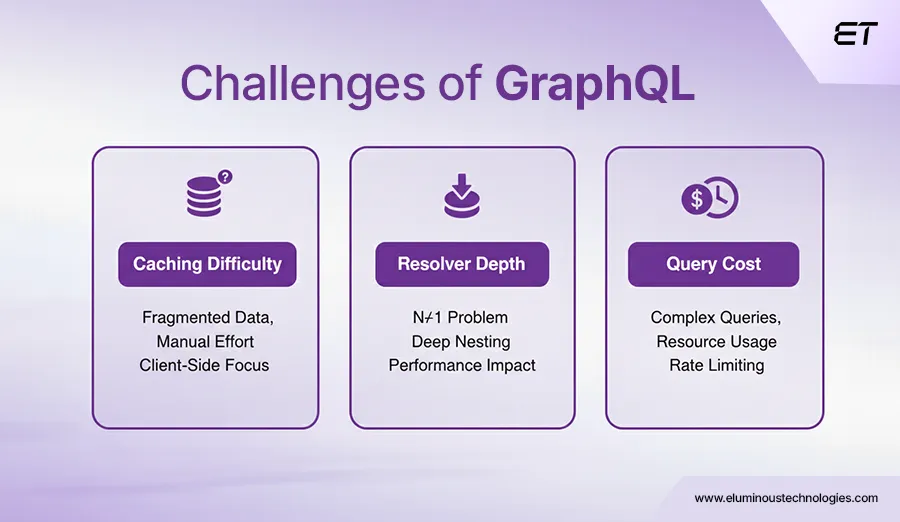
Despite its strengths, GraphQL is not the enterprise’s main highlight. Its flexibility introduces new responsibilities and trade-offs that teams must understand.
1. Caching is harder
REST works naturally with HTTP caching and CDNs. GraphQL, with its single endpoint and dynamic queries, does not.
Caching in GraphQL often requires:
- Query-based caching
- Persisted queries
- Application-level caching layers
Why this matters:
For public, read-heavy APIs, implementing caching in GraphQL can be significantly more complex than REST.
2. More complex backend setup
GraphQL introduces additional backend concepts:
- Schema design
- Resolver logic
- Query optimization
- Authorization at the field level
Without discipline, GraphQL servers can become difficult to maintain or optimize.
Why this matters: Small teams or early-stage products may find REST simpler and faster to implement initially.
3. Risk of expensive or abusive queries
Because clients can request deeply nested data, poorly designed schemas, or missing safeguards can lead to:
- Performance bottlenecks
- Excessive database queries
- Denial-of-service–like scenarios
Mitigation strategies include:
- Query depth limits
- Complexity analysis
- Rate limiting
GraphQL’s power must be controlled, not unrestricted.
4. Overkill for simple CRUD APIs
For straightforward use cases, such as basic user management or simple data storage, GraphQL can introduce unnecessary complexity.
If your API:
- Has stable data needs
- Serves a single client
- Performs basic CRUD operations
REST is often the more pragmatic choice.
GraphQL highlights when efficiency and frontend velocity matter most.
But it demands strong engineering discipline to avoid performance and complexity pitfalls.
Understanding the strengths and challenges of GraphQL vs REST is essential before choosing it. Because the best API architecture is the one that fits your product’s reality, not just its ambitions.
What is REST?
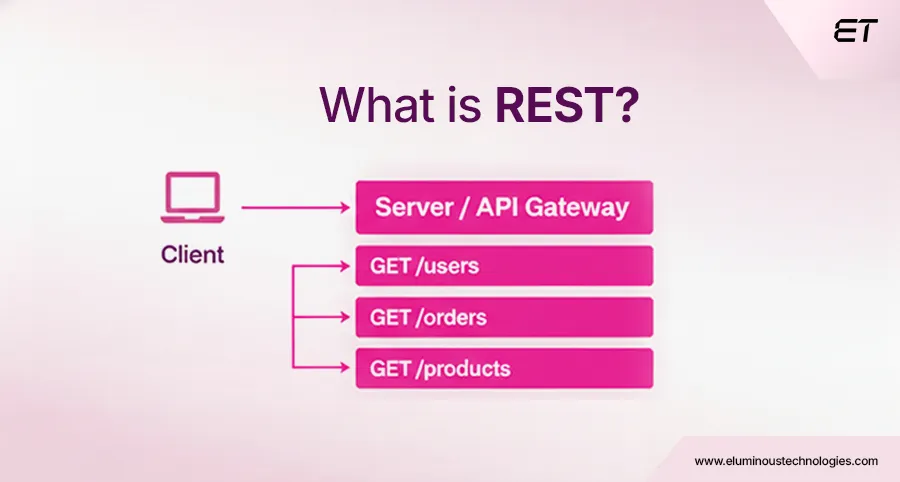
REST (Representational State Transfer) is an architectural style for designing networked applications, most commonly APIs over HTTP. It was formally defined by Roy Fielding in his 2000s doctoral dissertation and later became the foundation for modern web APIs.
It is simple to understand, predictable in behavior, and deeply aligned with how the web itself works.
Most of the APIs you interact with daily, such as social media, payments, and e-commerce, are powered by REST.
REST is not a framework or a protocol. It is a set of design principles that guide how clients and servers communicate in a scalable, maintainable way.
Core Idea of REST
The fundamental idea behind REST is resource-based communication. In REST:
- Everything is treated as a resource: A resource can be anything meaningful in your system, users, products, orders, invoices, comments, or files.
- Each resource has a unique URL (endpoint): The URL identifies what the resource is, not what action you are performing.
- Clients interact with resources using standard HTTP methods: The action is defined by the HTTP verb, not the URL itself.
For example: GET /users/42
This request simply means: “Give me the current representation of the user with ID 42.”
The server responds with a structured representation (usually JSON) of that user. Importantly, the client does not need to know how the server stores or processes the data. Only the contract defined by the API.
REST and HTTP Semantics
One of REST’s biggest strengths is its deep reliance on existing HTTP features rather than reinventing them. REST API development makes full use of:
- HTTP status codes
- 200 OK – Successful request
- 201 Created – Resource successfully created
- 400 Bad Request – Invalid input
- 404 Not Found – Resource doesn’t exist
- 500 Internal Server Error – Server-side failure
- Caching mechanisms
Headers like ETag, If-None-Match, and Cache-Control allow responses to be cached by browsers, proxies, or CDNs. It improves performance and reduces server load.
- Stateless communication
Each request contains all the information needed to process it. The server does not store client session state between requests, which makes REST APIs easier to scale horizontally.
A Practical REST Example
Imagine you are building an e-commerce application. To render a single product page, the frontend may need:
- Product details (name, price, description)
- Seller information
- Customer reviews
With a REST-based design, this often results in multiple endpoints:
GET /products/123
GET /products/123/seller
GET /products/123/reviews
Each endpoint:
- Serves a specific resource
- Returns a fixed data structure defined by the backend
- Is optimized for a particular use case
This approach is clear and easy to reason about. However, it also means the client must orchestrate multiple requests and accept the response structure as-is. Even if it only needs a small subset of the data.
Strengths of REST APIs
REST did not become the dominant API style by accident. Its strengths are practical, proven, and battle-tested across some of the world’s largest digital platforms.
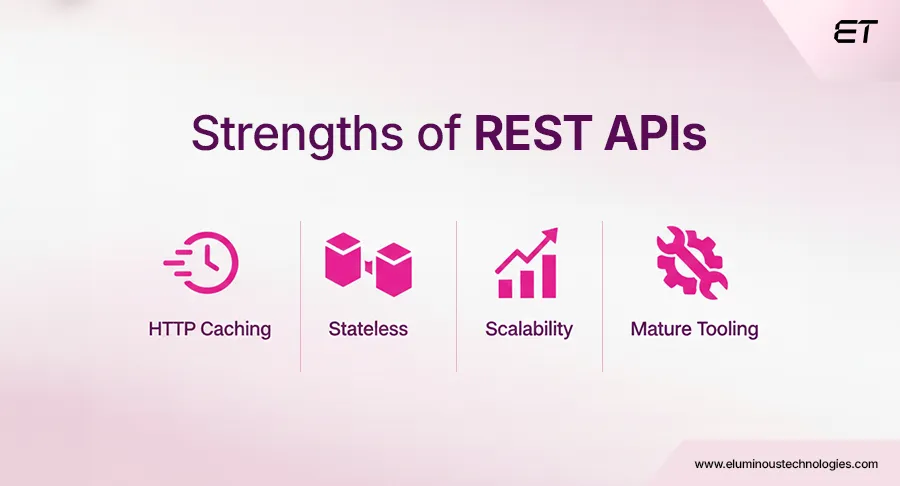
1. Simplicity and familiarity
REST is intuitive by design. If you understand HTTP, you already understand REST. This low learning curve is one of the biggest reasons REST has been widely adopted across industries.
Developers can:
- Inspect requests directly in the browser
- Debug APIs using tools like Postman or cURL
- Document endpoints clearly using Swagger / OpenAPI
Because each endpoint maps to a resource, onboarding new developers is easier and faster.
GitHub’s REST API, for instance, is highlighted for its clarity and predictability, which is critical when thousands of external developers rely on it.
2. Strong caching support
REST works naturally with HTTP caching mechanisms, which is a major advantage for performance-critical applications.
Using headers like:
- Cache-Control
- ETag
- If-Modified-Since
Servers can reduce unnecessary data transfer, and clients can reuse cached responses efficiently. This makes REST ideal for read-heavy systems such as:
- Content platforms
- News portals
- Product catalogs
- Public APIs
Many enterprises rely heavily on REST for product and catalog data. This caching plays a huge role in handling massive traffic spikes, especially during events like sales and product launches.
3. Clear separation of concerns
In REST, each endpoint is designed to do one thing well. This encourages clean system design and clear ownership.
For example:
GET /orders
POST /orders
GET /orders/{id}
Each endpoint has:
- A specific responsibility
- A predictable response
- A well-defined contract
This clarity makes REST especially effective for:
- Microservices architectures
- Internal APIs between teams
- Long-lived enterprise systems
REST structured approach aligns well with regulated, process-driven environments where clarity and auditability matter.
4. Mature ecosystem and tooling
REST has been around for over two decades, which means:
Every major backend framework supports it
Monitoring, security, and testing tools are widely available
Best practices are well documented
Whether you are using Java, Node.js, Python, .NET, or Go, REST is supported out of the box.
Limitations of REST
As applications became more dynamic and frontend-driven, REST’s limitations started to surface. And that too, especially in modern web and mobile experiences.
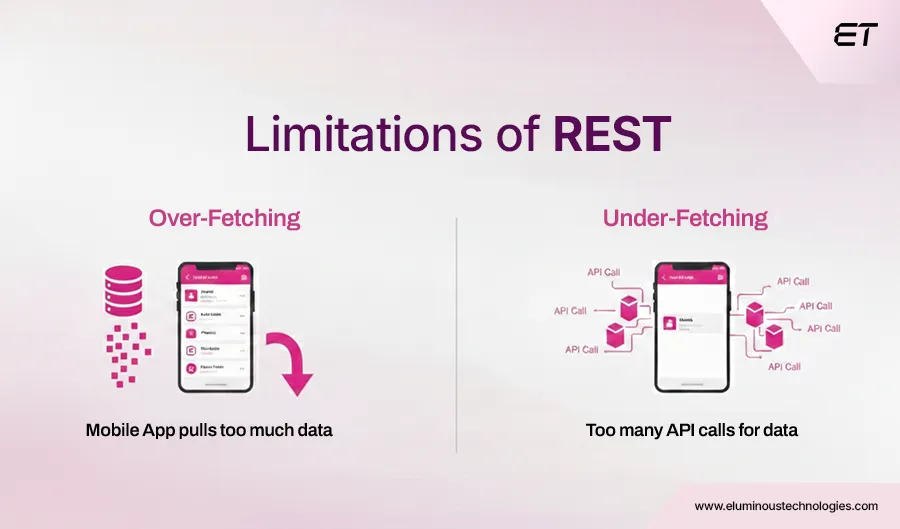
1. Over-fetching data
REST endpoints return a fixed response structure, whether the client needs all of it or not. Example: GET /users/42
Response:
{

"id": 42,

"name": "Alex",

"email": "alex@example.com",

"address": "...",

"preferences": "...",

"createdAt": "...",

"lastLogin": "..."

}
If your UI only needs the user’s name, you are still paying the cost of transferring unnecessary data.
Why this matters: On mobile networks or low-bandwidth environments, over-fetching directly affects load time and user experience.
Many enterprises faced this issue early on when building mobile apps for global markets, where network speeds and data costs varied drastically. This inefficiency was one of the key reasons GraphQL was created.
2. Under-fetching data
The opposite problem is just as common. A single screen often requires multiple API calls, increasing latency and complexity.
Example:
GET /products/123
GET /products/123/reviews
GET /products/123/seller
Each request:
- Adds network overhead
- Increases page load time
- Complicates error handling
For large e-commerce platforms or SaaS dashboards, assembling a single UI view from many REST endpoints can slow down performance. Especially on mobile devices.
3. Tight coupling between frontend and backend
In REST, the backend controls the response shape. If the frontend needs:
- A new field
- A different data structure
- Additional relationships
The backend often has to:
- Modify existing endpoints
- Add new endpoints
- Introduce breaking changes
This creates dependency friction between frontend and backend teams.
As companies scale, teams working on mobile, web, and partner integrations often need different data shapes. REST can struggle to keep up without growing into a complex web of endpoints.
4. API versioning complexity
As APIs evolve, REST commonly relies on versioning strategies like:
/api/v1/users
/api/v2/users
/api/v3/users
While this prevents breaking changes, it also:
- Increases maintenance overhead
- Forces teams to support multiple versions
- Complicates documentation and testing
Large platforms with long-lived APIs often carry legacy versions for years, slowing innovation and increasing technical debt.
Why these challenges matter
REST works extremely well for stable, resource-driven systems. But today’s applications have become more UI-driven and mobile-first. Its limitations became more visible.
These limitations do not diminish the value of REST, but they do explain why organizations started exploring alternative API patterns to better support modern user experiences and faster iteration cycles.
When to Use GraphQL vs REST
This is the most important part because the best API choice is contextual.
GraphQL vs REST solve fundamentally different data-access problems. One optimizes for stability and predictable contracts. While the other optimizes for client-specific data shaping and UI iteration.
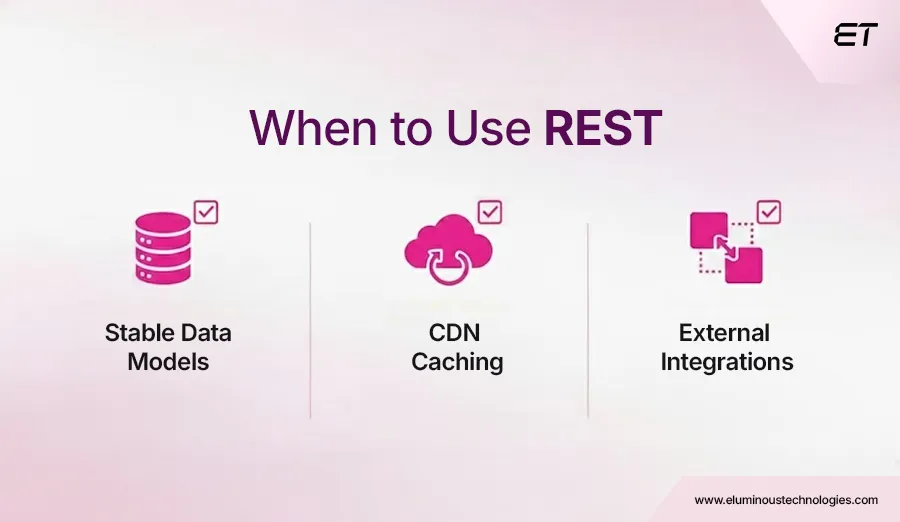
Use REST:
-
When Your Domain Models Map Cleanly to Endpoints
REST is the right choice when your backend exposes clear domain entities such as users, payments, orders, or files, and those entities rarely change shape. In systems where endpoints such as GET /orders/{id} or POST /payments can remain stable, REST provides strong guarantees.
-
When HTTP-Level Caching Is a First-Class Requirement
REST excels when responses must be aggressively cached at the HTTP layer, using CDNs or edge networks. APIs serving static or semi-static content such as catalog data, public datasets, or documentation. This model allows traffic to be absorbed by infrastructure rather than application servers.
-
When Operational Simplicity Matters More Than Query Flexibility
REST minimizes infrastructure overhead by avoiding runtime query parsing, resolver execution, and schema validation. This makes it well-suited for teams that prioritize observability, debuggability, and predictable performance.
-
When You Are Publishing APIs for External Consumers
Third-party developers expect stable URLs, predictable HTTP methods, and versioned endpoints. REST fits naturally into this expectation. Public APIs, partner integrations, and enterprise connectors benefit from REST’s compatibility.
Use GraphQL
-
When UI Components Define the Shape of Data
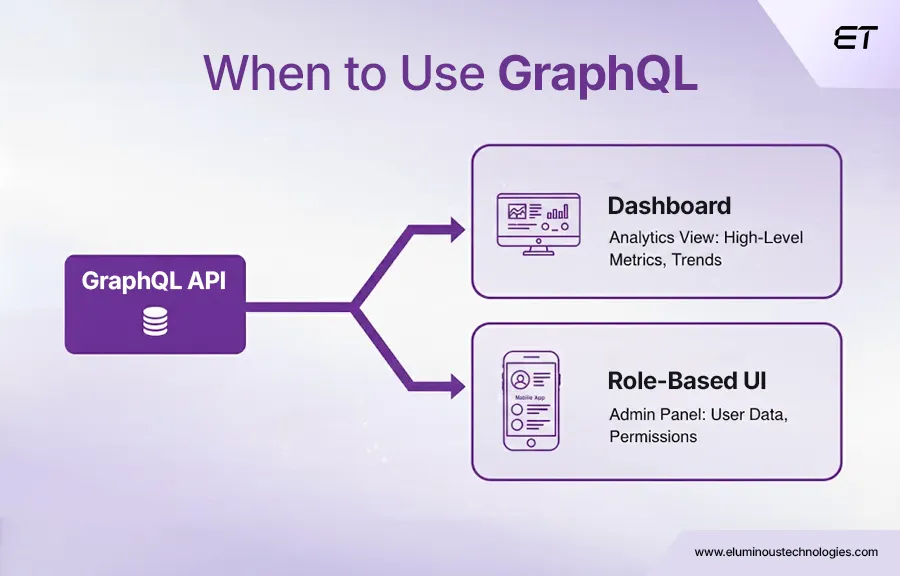
When comparing GraphQL vs REST, GraphQL is a better fit when frontend components determine which fields are required and those requirements change frequently. Instead of creating multiple endpoints or expanding response payloads, GraphQL allows clients to request only the fields they need.
-
When a Single Backend Serves Multiple Client Experiences
When the same API supports web applications, mobile apps, admin panels, and partner dashboards, REST often leads to endpoint duplication or bloated responses. GraphQL solves this by letting each client define its own query shape while sharing a single schema.
-
When Data Comes from Multiple Services or Data Stores
GraphQL acts as an aggregation layer over microservices, databases, and third-party APIs. Instead of forcing the frontend to orchestrate multiple requests, GraphQL composes data at the API layer.
-
When You Want Frontend Teams to Ship Independently
In GraphQL vs REST architectures, GraphQL reduces coordination overhead between frontend and backend teams. Frontend developers can evolve queries without waiting for new endpoints, while backend teams can extend the schema without breaking existing clients. This decoupling helps parallel development and shorter release cycles, particularly in fast-moving SaaS organizations.
GraphQL vs REST: Quick Comparison Table
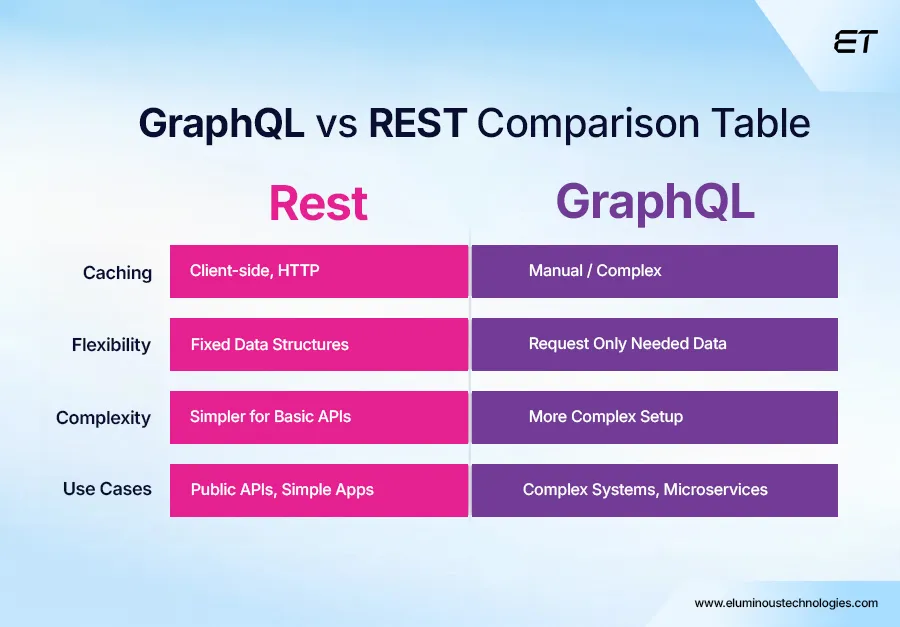
In production systems, the most effective GraphQL vs REST architectures often combine REST for stable services and GraphQL for client-facing aggregation.
| Dimension | REST | GraphQL |
| API contract | Endpoint-based | Schema-based |
| Response shape | Defined by the server | Defined by the client |
| Versioning strategy | URL or header-based | Schema evolution |
| Caching | Native HTTP and CDN | Application-level |
| Network behavior | Multiple requests | Single composed request |
| Runtime complexity | Low | Higher |
| Observability | Simple endpoint tracing | Requires query-level tracing |
| Frontend flexibility | Limited | Very high |
| Best fit | Stable, contract-driven APIs | UI-driven, data-rich products |
Final Thoughts: GraphQL vs REST APIs
The GraphQL vs REST debate is not about replacing one with the other. In fact, many modern systems use both.
If your biggest pain point is too many API calls, slow UIs, and rigid endpoints, GraphQL is worth serious consideration. If your priority is stability, simplicity, and caching at scale, REST remains a rock-solid choice.
The most effective teams don’t ask, “Should we use GraphQL vs REST ?”
They ask, “Which API design best supports how our product is built, used, and scaled?”
That answer often determines whether an application feels fast and flexible or slow and constrained.
Turn the right API decisions into high-performance mobile apps
Frequently Asked Questions: GraphQL vs REST APIs
1. Which is better for business: GraphQL or REST?
There is no universal winner in the GraphQL vs REST API debate. REST supports stability and predictable costs, while GraphQL supports faster product evolution. The right choice depends on how fast your business needs to change.
2. Is GraphQL a long-term investment?
In the GraphQL vs REST API comparison, GraphQL remains widely adopted for modern SaaS platforms. It remains valuable for organizations building complex, user-driven digital platforms.
3. Does adopting GraphQL increase risk?
No. GraphQL vs REST API is not a replacement debate. Without limits and monitoring, GraphQL may introduce performance and cost risks. With the right controls, it becomes a strategic advantage.
4. Should enterprises replace REST with GraphQL?
No. Most enterprises benefit from a hybrid approach, using REST for core systems and GraphQL for customer-facing experiences.

How Enterprise Web Portal Development Supports Multi-Plant Operations
I once spoke with an operations leader at a US-based manufacturing firm. They had grown from two plants to seven…

Decoding the Future: Software Development Industry Trends 2026
Key Takeaways: Agentic AI tools will continue automating complex tasks with contextual reasoning. Low-code platforms will empower faster builds and…


