
 Book a Meeting
ServiceNow ATF: When to Use It and Where It Delivers the Most Value

- ServiceNow ATF is a native testing framework that automates regression testing.
- It helps teams validate changes faster and with less manual effort.
- By reducing manual testing, ATF helps organizations shorten release cycles, lower deployment risks, and maintain better test documentation.
Your team completed a ServiceNow platform update, and you’re proud of it.
And why not? Everything looks good until the first support tickets start coming in.
There it is. You see a service catalog request that doesn’t follow the correct approval workflow. Also, there’s an automated notification that fails to trigger, and an integration stops working as expected. None of these issues appeared during manual validation, but they quickly begin affecting day-to-day operations.
Fret not. These are (surprisingly) common ServiceNow challenges for companies that continuously customize their environments. As your applications grow more complex, manually validating every change becomes time-consuming.
That’s where the ServiceNow ATF (Automated Test Framework) comes in. Built into the Now Platform, ATF helps you automate regression testing and identify issues beforehand.
However, simply implementing ATF isn’t enough. You must first understand where it fits within your testing strategy. In this blog, we’ll explore the key use cases, implementation best practices, and business benefits of ServiceNow ATF.
When to Start with ATF: Strategic Entry Points
ServiceNow ATF (Automated Test Framework) delivers the greatest value when manual testing begins to slow down platform changes.
As you add custom workflows, business rules, integrations, and scoped applications, manually validating every change becomes time-consuming.
The good news is you don’t need to think about a separate infrastructure or a 3rd-party framework. ATF operates natively within the ServiceNow platform. With ServiceNow ATF, you can automate common validation scenarios and confirm that your workflows continue to function as expected after platform upgrades.
Let’s consider you perform a ServiceNow platform upgrade.
Instead of manually validating every workflow after the upgrade, you can execute predefined ATF test suites to:
- Verify incidents
- Change requests
- Modify service catalog items, approvals
- Alter other key processes
This gives your team greater confidence before deploying changes to production.
The right time to implement ATF, however, depends on your ServiceNow maturity. An organization with minimal customization may require only a handful of automated tests. On the other hand, an enterprise managing multiple business units and frequent releases will benefit from a continuously maintained ATF strategy.
So, understanding where your organization stands is the first step toward building an effective testing framework.
| ServiceNow Stage | When ATF Becomes Valuable | Why It Matters |
| Early Customization | Business rules, catalog items, or workflows become more complex, and manual validation starts taking longer. | You can catch defects early and build reusable test cases as the platform evolves. |
| Platform Upgrades | Before upgrading to a new ServiceNow release. | It’s possible to validate critical workflows and reduce regression risks before deployment. |
| Enterprise Scale | Multiple teams, scoped applications, integrations, and frequent releases are involved. | You can standardize testing, improve release confidence, and reduce manual testing effort. |
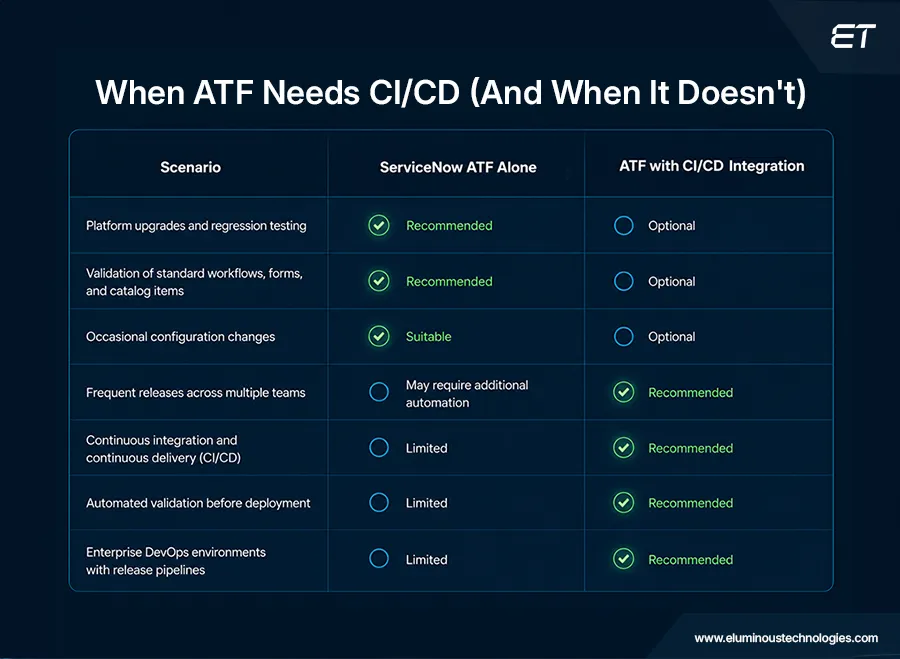
When Is ServiceNow ATF Enough, and When Should You Integrate It with CI/CD?
ServiceNow Automated Test Framework (ATF) is designed to automate testing within the ServiceNow platform. For many businesses, its native capabilities are sufficient to validate platform upgrades, regression scenarios, and other core workflows without requiring additional testing tools.
But as ServiceNow environments become more complex, testing needs to become part of a broader software delivery process.
For instance, if you manage multiple development teams, frequent releases, or DevOps practices, integrating ATF into your CI/CD pipelines can be beneficial.
The following table provides a practical way to determine which approach best aligns with your organization’s needs.
When ServiceNow ATF Alone Is the Right Choice
If your primary objective is to:
- Validate ServiceNow upgrades
- Confirm workflows continue to function correctly
- Automate repetitive regression testing
The native capabilities of ServiceNow ATF are often sufficient. So, if your company has relatively stable release cycles, you can function well without introducing additional testing infrastructure.
When CI/CD Integration Adds More Value
As release frequency increases, testing needs to keep pace with development. Integrating ATF into a CI/CD pipeline enables automated test execution as part of the deployment process.
For example, after developers submit approved configuration changes to the source repository, the pipeline can automatically execute predefined ATF regression test suites.
If critical tests fail, you can pause the deployment until you resolve identified issues.
Rather than replacing ServiceNow ATF, CI/CD integration extends its value by embedding automated validation into your software delivery workflow.
Best Practices for Implementing ServiceNow ATF Successfully
You want to implement ServiceNow ATF successfully? Then you need to think beyond creating automated test cases.
There needs to be a scalable testing strategy in place. We’ve compiled a few best practices below that we think will make life easier for you and your team.
1. Organize Test Cases into Logical Test Suites
Instead of managing individual test cases in isolation, group related tests into logical suites. These suites can be based on:
- Business processes
- Applications
- Release objectives
For example, one suite may validate incident management workflows, while another focuses on service catalog requests.
Well-structured test suites make it easier to execute targeted regression testing. You can even prioritize business-critical functionality during platform upgrades and maintain consistent test coverage as your environment evolves.
2. Execute Tests Using Appropriate User Roles
Many ServiceNow workflows behave differently depending on a user’s roles and permissions.
So, when you create automated tests, configure them to execute under user accounts that accurately represent the intended business role. These roles can be:
- Employee
- Fulfiller
- Administrator
This tactic helps verify that users can access the correct functionality while reducing false test failures caused by incorrect permissions.
Note: Develop and execute ATF tests in development or testing environments rather than production to avoid unintended changes to live business data.
3. Schedule Automated Test Execution Strategically
Large regression test suites can consume platform resources. This happens a lot when you’re validating multiple workflows.
So, you can schedule routine test execution during maintenance windows or periods of lower system activity. This tactic helps minimize the impact on active users.
It also ensures that you validate business processes continuously before deployments and platform upgrades.
Also, instruct your teams to segregate tests that depend on shared data from the ones that can run in parallel. This way, you reduce the likelihood of test conflicts.
4. Build Reusable Test Components
Many automated tests share common actions. These include:
- Logging in
- Navigating to records
- Completing forms
- Validating expected outcomes
Creating reusable test templates for these common actions can reduce long-term maintenance.
Think of it as organizing your closet by type of apparel and items. When you want to discard a specific lot of similar items, you simply replace them without going through each item one by one.
Similarly, when forms, workflows, or business logic change, updating a reusable component is more efficient than modifying individual test cases. This approach improves consistency and makes automated testing easier to scale.
The Risks of Skipping ServiceNow ATF
As ServiceNow environments become more customized, relying solely on manual testing increases both operational and business risk.
While manual validation may be sufficient for smaller implementations, it becomes difficult to maintain consistent test coverage. The risks below are among the most common challenges that you can face when automated testing is not part of your ServiceNow strategy.
1. Increased Regression Risk
Every new customization, workflow enhancement, or platform update has the potential to unintentionally affect existing functionality. Without automated regression testing, validating these changes depends on repetitive manual effort. The caveat?
Defects can go unnoticed until after deployment.
2. Higher Upgrade Risk
ServiceNow regularly introduces platform updates and new releases.
If you rely exclusively on manual testing, you may struggle to verify every business-critical workflow before deployment. This traditional approach increases the likelihood that you discover issues affecting catalog items, approvals, integrations, or custom applications only after the upgrade is complete.
3. Reduced Testing Visibility and Audit Readiness
In most cases, you need clear evidence that critical business processes have been validated before releasing changes.
Automated testing generates consistent execution records and test results, simplifying troubleshooting. So, if you don’t consider a framework like ServiceNow ATF, this risk can keep lurking around.
4. Greater Time Investment for Skilled Teams
Manual regression testing often requires the involvement of developers, administrators, QA engineers, and business stakeholders.
These folks need to execute the same validation steps before every release. Automating routine testing allows these teams to spend more time on implementing new capabilities and addressing higher-value initiatives rather than repeating manual verification tasks.
Basically, you ensure your best resources focus on high-priority tasks that need human intervention.
To Wrap Up
The ServiceNow ATF helps automate regression testing and reduce the effort you need to verify platform changes before they reach production.
But implementing ATF successfully involves more than creating automated test cases. You should establish a well-defined testing strategy, build reusable test suites, and align automated testing with your release and governance processes. That’s how you maximize the long-term investment in ATF.
If you’re looking to implement or optimize automated testing within your ServiceNow ecosystem, our ServiceNow consulting experts can help you develop a scalable testing strategy.
Improve Confidence in Every ServiceNow Release.


What Is ServiceNow AIOps and How Does It Work
Summary: ServiceNow AIOps helps IT teams turn operational data into actionable insights by correlating events, logs, metrics, and service context.…


ServiceNow Workflow Automation Readiness Checklist: 8 Areas to Validate Before You Automate
Summary: ServiceNow workflow automation coordinates enterprise processes across HR, IT, security, finance, and customer service. But this automation works effectively…


