
 Book a Meeting
Meet Strapi: The Flexible, Scalable CMS for Digital-First Businesses
- Strapi is a flexible, open-source headless CMS built on Node.js and JavaScript.
- It allows full customization and content delivery via REST or GraphQL APIs.
- Business teams and developers can manage content efficiently across multiple platforms.
- Strapi’s active community and plugins accelerate development and content workflows.
Launching a multi-platform campaign shouldn’t feel like a tech nightmare. But if you’re using a traditional CMS, you’re probably going to lose some sleep.
Managing and delivering content across multiple platforms via a traditional CMS is challenging. The process is also time-consuming.
There’s a smarter, calmer way forward – Strapi.
It’s a headless CMS for creating custom APIs, content management, and delivering the output effortlessly. If you aim to reach customers across various touchpoints like websites and smart devices, Strapi makes the process simple.
Read on to know what is Strapi, its benefits, applications, and why it’s becoming a go-to option for modern digital teams.
Craft a better CMS strategy with tailored assistance
What is Strapi?
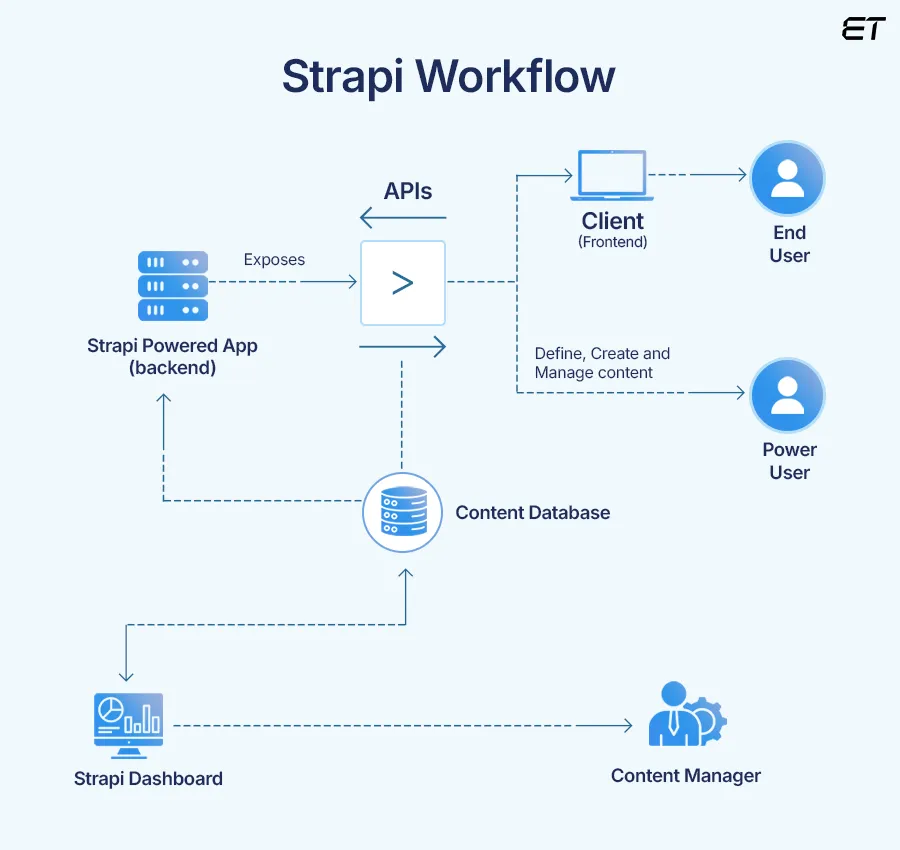
Strapi is a free, open-source headless CMS (Content Management System) built on Node.js. It stores and manages content but doesn’t control how it’s displayed.
The CMS delivers content via APIs, allowing developers to present it on any website, app, or device.
So, developers can create APIs using Strapi for content delivery on almost any platform, like websites or smart devices. They can create without an extensive database or backend knowledge.
Here are the key features of Strapi that make it ideal for modern CEOs and teams.
| Feature | Description | Benefit |
| Headless Architecture | Decouples frontend from backend, enabling content delivery across web, mobile, IoT, and more. | Developers can use any front-end framework to create a tailored user experience. |
| API Customization | Auto-generates RESTful or GraphQL APIs with complete flexibility to customize endpoints. | Speeds up app development and simplifies integration with other tools. |
| Role-Based Access Control | Defines user permissions to manage who can create, edit, or publish content. | Enhances security and streamlines team workflows. |
| Content Types Builder | Visually create and manage structured content types without coding. | Allows fast prototyping and easy scaling as content grows. |
| Plugin Ecosystem | Ready-made and custom plugins for adding functionalities. | Integrate analytics, SEO, workflows, and more without changing the core code. |
| Self-Hosted & Open-Source | Full control over data, infrastructure, and customizations. | Suitable for businesses with strict compliance or unique customization needs. |
| Internationalization (i18n) | Manage multi-language content efficiently for global audiences. | Scale your brand across regions without duplicating content. |
| Media Library | Centralized system for managing images, videos, and files with drag-and-drop support. | Makes uploading and reusing media across projects simple and efficient. |
How Does It Work?
In Strapi, you get the freedom to define your content types and relationships. It serves as the backend content hub, delivering data to any frontend through APIs.
Let’s understand how it works through an example.
Imagine you’re building a fitness app for both iOS and Android. Instead of creating separate content systems for each platform, your team uses Strapi for content management. The content types include workout videos, trainer bios, schedules, and blog posts.
- Developers can define content types, such as “Trainer” or “Workout Plan”. The CMS automatically generates REST or GraphQL APIs.
- These APIs feed real-time content to both mobile apps and your website.
- This ensures users see the latest information, without manual updates or duplication.
- Marketers can easily update content through Strapi’s user-friendly dashboard, without developer assistance.
- Developers have complete flexibility to build and customize the frontend using frameworks like React Native or Vue.
All these features allow your app to stay up-to-date across all channels, without burdening developers or marketers.
Curious about the best development frameworks for your next app?
Why Smart Leaders Must Choose Strapi for Business Growth?
Currently, Strapi has more than 1,171 customers worldwide, with over 5.5 million NPM downloads. NPM (Node Package Manager) lets you download and extract files from different sources within Node.js apps.
Such a growing customer base shows the software’s effectiveness and the increasing preference for a headless solution among companies.
Still wondering whether to choose Strapi CMS? Here are five ways the platform can level up your business.
1. Reduced Developer Workload with auto-generated APIs

Strapi CMS reduces developer workload by automatically generating RESTful and GraphQL APIs for every content type. No need to manually write boilerplate code or build complex endpoints.
Developers can focus on building features and user experiences rather than backend infrastructure. Plus, setting up and using the CMS is convenient, saving time.
As a business leader or CEO, this helps you:
- Speed up iteration cycles and deployment, reducing the time-to-deploy from weeks to hours
- Decrease development costs and accelerate project delivery
- Ensuring team productivity while the product hits the market sooner
- Gain a competitive edge and boost overall company efficiency
So, you can respond to market changes faster and innovate with confidence. Your digital strategies will produce better ROI eventually.
2. Better Content Management for Consistent Experiences
The CMS offers an intuitive content management system that simplifies content creation, editing, and organization. Its management functionalities include:
- Custom Content Types – Create structured content models tailored to your business needs.
- Visual Editor – Intuitive interface for content creation and editing, without coding.
- Role-Based Permissions – Control who can create, edit, publish, or delete content.
- Media Library – Central hub for uploading, organizing, and reusing media files.
- Content Localization – Manage multilingual content for global audiences like English, French, and Japanese.
Overall, Strapi helps you create content once and reuse it across various portals like mobile apps and websites. Editors and marketers can update these digital touchpoints without relying on developers. Thus, it minimizes bottlenecks and keeps campaigns agile.
For business leaders, these benefits result in faster execution, consistent user experiences, and empowered non-tech teams.
3. Complete Flexibility to Store and Secure Data

Tired of CMS platforms that lock you into third-party servers and pre-defined systems?
Strapi solves these problems by offering the flexibility to deploy the CMS on your own servers or cloud infrastructure. The self-hosted architecture provides you with more control over data, security, and performance.
The improved flexibility can benefit your business in several ways:
- Customize the CMS to match internal workflows, integrate seamlessly with proprietary systems, and safeguard sensitive data.
- Reduced vendor dependency gives you the freedom to scale on your terms.
- Ensures compliance with regulations like GDPR or HIPAA.
- Self-hosting is cost-effective as you choose your hosting environment and optimize for performance. You can adjust the hosting strategy according to evolving business needs.
- Strapi Cloud Backups offer scheduled backups, data security, complete database code, and asset backups.
As a result, you get a secure and resilient content infrastructure that minimizes downtime.
Planning for a complete cloud migration?
4. Strong Open-source Community for Continuous Innovation

One of the key Strapi CMS benefits is its powerful open-source community, with over 22,600 members. The community comprises developers, tech partners, and contributors globally.
So, the CMS continuously improves with new features, plugins, security patches, and best practices that the members offer.
Besides, you can find the various community resources on Strapi’s official website:
- Step-by-step tutorials and The Complete Strapi Course
- A forum for open discussions
- Showcase for displaying Strapi-based apps, websites, and other products
- The Strapi Weekly newsletter
- Online and offline meetup scheduling
Here’s how such a collaborative community and resources can help you:
- Easily tap into integrations, templates, and extensions built by a global developer base.
- Access to community-built plugins and tools lowers custom development costs.
- Continuous community-driven updates keep your CMS up-to-date.
- Community starters and boilerplates help launch MVPs faster.
Plus, if you need to hire Strapi developers for projects, the community is the ideal source.
5. Enhanced SEO and Organic Traffic

Be it an e-commerce store or a standard corporate website, you’ll need visibility to reach your target audience. This means better SEO rankings.
Strapi offers better control over your site’s SEO strategy via flexible content modeling and advanced customizations. Enhance your online visibility with these features:
- SEO-Friendly URLs – Design clean, descriptive slugs to boost link clarity and search engine rankings.
- Advanced Metadata Control – Define custom data fields for meta titles, descriptions, and keywords for each page.
- Flexible API Integration – Connect with SEO tools, plugins, and automatically generate dynamic sitemaps, via the API-first design.
- Rich Snippet Readiness – Add structured data in JSON-LD to improve search engine comprehension and enrich snippets.
- Smart Content Linking – Connect related content through relational fields to strengthen internal linking and user navigation.
This way, you enhance discoverability and brand authority while laying the foundation for better organic traffic.
Onboard skilled CMS developers within your budget. Scale faster.
Limitations of Strapi
Besides understanding the benefits of Strapi for businesses, you must consider the platform’s drawbacks before choosing it. We’ve noted them in this table along with solutions.
| Disadvantage | Explanation | Solution |
| Initial Setup Requires Technical Expertise | Setting up self-hosted Strapi or custom configurations needs backend development skills. | Involve a developer during setup, or use Strapi Cloud for simplified hosting. |
| Plugin Ecosystem Still Maturing | Fewer ready-to-use plugins compared to legacy CMS platforms. | Explore open-source plugins or build custom features using Strapi’s extensible architecture. |
| User Interface Can Seem Tricky | For beginners, the UI has too many clicks to complete tasks and can seem clunky. | Customize the admin panel with plugins or use guided onboarding. |
| Limited Native Analytics | It doesn’t offer built-in content or user analytics. | Integrate with Google Analytics, Matomo, or other BI tools for insights. |
Strapi in Action: Real-World Use Cases

Over the years, Strapi has elevated brands across various domains like tech, finance, FMCG, and other sectors. Here are some of those real-world case studies to demonstrate the software’s effectiveness.
How Strapi Unified Delivery Hero’s Partner Experience
Delivery Hero needed a scalable solution to power their B2B Partner Portal. This was a mobile-first web application used by nearly 100,000 partners in over 25 languages.
Their goal? Create a localized, self-service training center with content like text and videos. They wanted local teams to manage the content independently without disrupting the app’s design.
After evaluating traditional and commercial CMS options, Delivery Hero chose Strapi. These are the benefits they received from the CMS platform:
- The headless architecture allowed seamless content integration without altering the app’s visual consistency.
- They could deliver dynamic content while maintaining UI integrity, essential for a better partner experience.
- Strapi’s compatibility with Delivery Hero’s JavaScript stack made the implementation smooth.
- This feature enabled internal teams to quickly build and launch the first FAQ module.
- They trained the local teams in just 30 minutes to manage the admin panel.
For Delivery Hero, Strapi was a strategic move toward scalable and localized content delivery with consistent branding.
Strapi Boosted Yuka’s Global Presence and Content Management
With nearly 50 million users across 12 countries, Yuka’s mobile app helps users analyze food and cosmetic products. They needed a powerful engine to manage dynamic, scientific data at scale, as the business was growing rapidly.
The team faced a dual challenge – maintaining an evolving knowledge base and making it accessible to both developers and non-technical experts.
That’s when they chose Strapi Cloud, which took their business up a notch:
- Strapi’s fully managed, customizable PaaS allowed developers to integrate custom plugins and APIs.
- Yuka addressed infrastructure headaches such as CDN caching, backups, and auto-scaling efficiently.
- The granular role-based access control strengthened governance and enhanced collaboration across teams.
- With structured content modeling, content updates became faster, more secure, and more reliable.
Choosing Strapi helped Yuka improve content management for product detection and analysis. Setting up API-based connectors also helped the technical teams.
Summing Up
Strapi isn’t just a CMS, it’s your content engine for growth. It empowers your content delivery across web, mobile, and connected devices.
With its API-first design, self-hosted flexibility, and unmatched customization, you control precisely how your content appears. Plus, whether you’re scaling globally or localizing fast, Strapi adapts to your needs.
However, frequent training will help your team become well-versed with Strapi. Hiring expert developers will enable you to leverage the CMS effectively.
Build better content systems. Contact us for Strapi CMS support.
Frequently Asked Questions
1. What language does Strapi use?
Strapi is built using JavaScript/TypeScript and runs on Node.js. It also supports REST and GraphQL APIs, making it ideal for modern web and mobile development workflows.
2. Is Strapi free to use?
Strapi CMS is free to use under the MIT open-source license. You can scale, customize, self-host, or combine it with Strapi Cloud.
3. Does Strapi use SQL?
Yes, Strapi supports SQL databases. By default, it uses SQLite in development, but also supports PostgreSQL, MySQL, and MariaDB in production.
4. Is Strapi like Firebase?
Strapi and Firebase serve different purposes.
Strapi is a headless CMS that helps you manage and deliver content via custom APIs. However, Firebase is a backend-as-a-service offering real-time databases, authentication, and hosting.

ServiceNow GenAI: What It Can Do for Your Company
Key Takeaways: ServiceNow GenAI brings generative AI directly into enterprise workflows, helping teams automate tasks efficiently. Built into the Now…


ServiceNow Adaptive Implementation Framework (SAIF): A Complete Guide
When you invest in major enterprise platforms, implementation risks are quite common. The larger your company, the greater is the…


