
 Book a Meeting
Agentic AI Implementation Consulting for Enterprise Businesses


- Agentic AI can interpret context, make decisions, and integrate across enterprise workflows
- The real advantage of integrating AI agents lies in connecting core systems such as CRM, ERP, and ITSM, coordinated together
- Using integrated layers, context, memory, and tools strengthens the agentic AI
- Data readiness contributes to performance as agentic AI depends on well-structured data for making reliable decisions.
AI is becoming an integral part of business operations, with the potential to transform processes across departments. As adoption grows, organizations are expected to improve speed, optimize operations, and reduce costs.
Traditionally, automation has delivered significant value, but it has limitations. This is where agentic AI introduces a new operating model.
Agentic AI can execute tasks and handle multiple steps under changing conditions. For enterprises operating across multiple platforms, this represents not just a marginal improvement, but a structural shift in how workflows are managed.
Therefore, agentic AI implementation consulting for enterprise is becoming increasingly important. In this blog, we will explore how companies are using agentic AI in their operations, along with best practices and future considerations.
What is Agentic AI in an Enterprise Context
Agentic AI refers to systems designed to pursue goals, take actions, and adapt based on feedback. These systems focus on efficiency and operate through goal-directed behavior, often combining reasoning, planning, and execution.
A key distinction is that traditional AI assistants are largely reactive, they respond to prompts and provide information. In contrast, agentic AI systems are designed to be more proactive, with the ability to plan and execute tasks with a degree of autonomy. You can also use the best AI agent frameworks for this purpose.
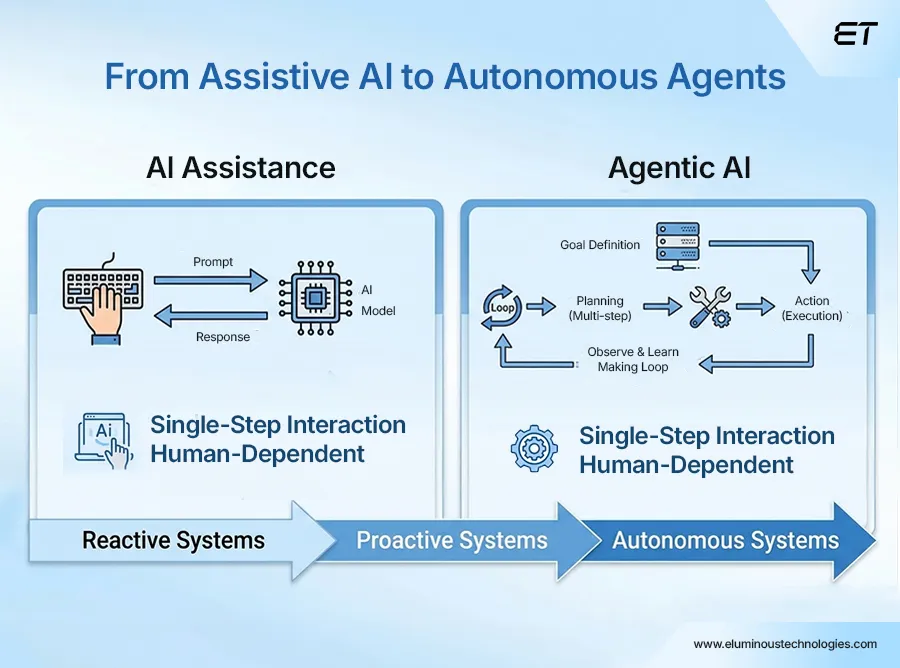
They can break down objectives, create workflows, and use tools to execute complex tasks. In well-designed systems, agentic AI can determine next steps, handle multi-step processes, and escalate when additional input or human intervention is required. Organizations pursuing agentic AI implementation consulting for enterprise initiatives can prioritize these qualities to improve workflow adaptability.
In enterprise environments, an AI agent can:
- Monitor ITSM systems by classifying tickets, retrieving relevant knowledge, and attempting initial resolution.
- Work with CRM systems by combining data from ERP platforms, generating account summaries, and alerting sales teams, reducing the need for manual coordination.
The bottom line is that enterprise workflows are not isolated. Processes operate across multiple systems and environments, often requiring coordination between tools. Agentic AI is designed to reduce this complexity by connecting workflows and enabling more seamless interactions across platforms in near real time.
Agentic AI does not replace systems like ERP or CRM. Instead, it interacts with them, reading system states and triggering actions. Architecturally, these systems typically operate across integration layers, memory and context management, tool access, and human-in-the-loop interfaces.
In this model, AI is integrated into operational workflows, enabling systems to act as part of day-to-day processes. This results agentic AI implementation consulting for enterprise environments heavily focusing on governance and inter adaptability between platforms.
Why Enterprises are Moving Towards Agentic AI Now
Businesses across industries are increasingly exploring agentic AI. The focus is shifting from isolated AI use cases to workflow-level automation, often leveraging platforms such as Salesforce that incorporate predictive and automation capabilities.
Agentic AI has the potential to support functions across departments such as finance, HR, customer service, and sales. While results vary by implementation, organizations are seeing improvements in efficiency and responsiveness. Below are some of the key challenges driving this shift:
- Real-time decision-making: Enterprises are expected to respond quickly while maintaining accuracy. Agentic AI systems can assist by generating timely responses, resolving routine issues, and providing better visibility to operational teams. However, human oversight is still required for critical decisions.
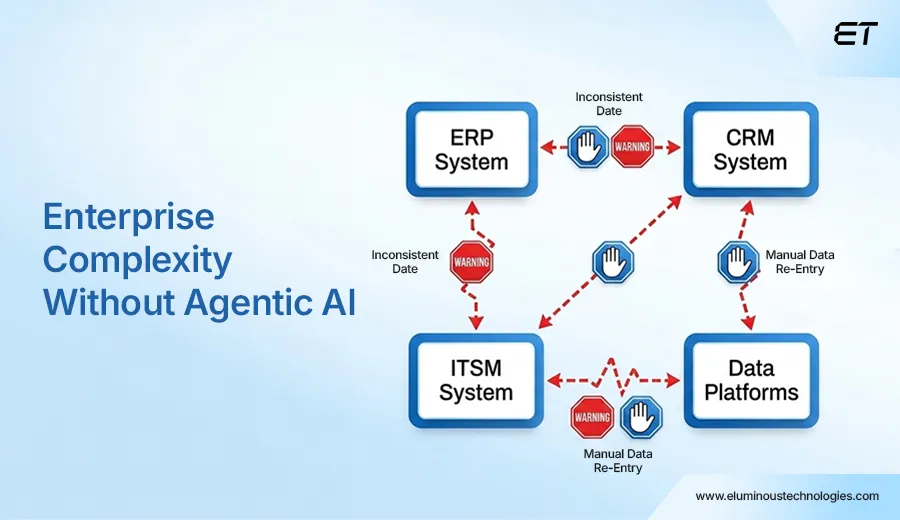
- Operational complexity: Many organizations operate across a complex ecosystem of tools such as CRM, ERP, and other data platforms, which were often built or implemented independently. As a result, these systems are not always well-integrated and rely on manual coordination to function effectively and stay in sync with real-time data.
- Customer personalization: Delivering relevant, timely responses across multiple customer touchpoints is difficult to achieve through manual processes alone. Agentic AI can help automate parts of this workflow, enabling more consistent and context-aware interactions.
Reducing operational costs while scaling without significantly increasing team size is a key priority for many technology leaders. Agentic AI can contribute to this by improving process efficiency and reducing manual effort. This is achieved not simply by adding more AI tools, but by enabling systems to take coordinated actions across workflows.
Best Practices for Implementing AI in Enterprise Analytics
Implementing agentic AI in enterprise operations requires a structured and strategic approach. Organizations often work with experienced teams to better align these systems with business goals and ensure they can scale effectively.
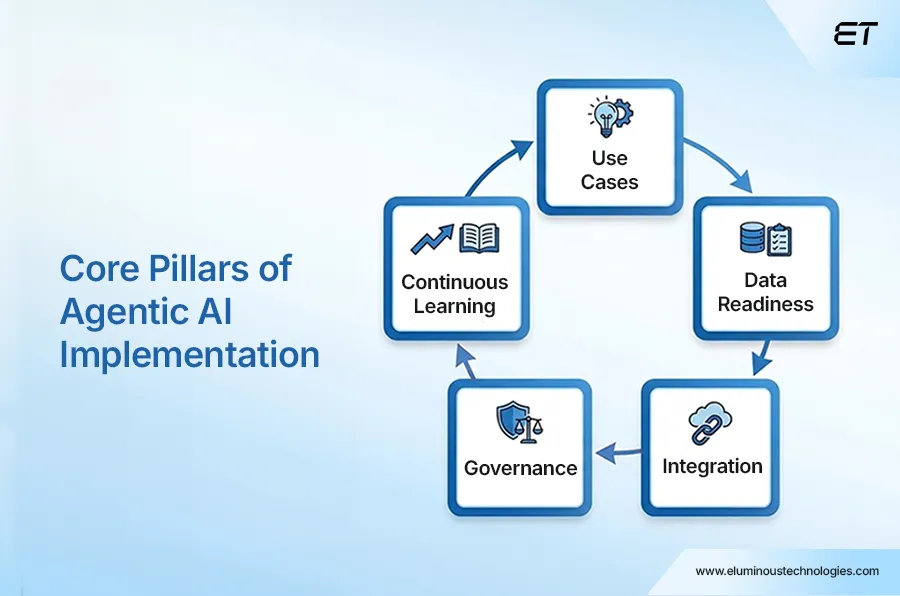
Technology alone is not enough to make agentic AI successful. Several foundational elements need to be in place for these systems to deliver value.
Build Suitable Use Cases for your Organization
Understand your workflows and identify areas where agentic AI can be applied effectively. Avoid experimenting without clear direction, as it can lead to wasted time and resources. Focus on scenarios where decisions are repetitive, data is available, and outcomes are measurable. For example, organizations may automate customer service workflows, streamline financial reconciliations, or optimize marketing processes. Organizations engaging in agentic AI implementation consulting for enterprise projects slowly begin with these high impact workflows.
Ensure Data Readiness
Agentic AI systems rely heavily on the quality and accessibility of data. While they can support proactive decision-making, their effectiveness depends on the data they are given. Ensuring that data is accurate, well-structured, and accessible is critical for reliable outcomes.
Build for Integration, not Isolation
As AI becomes part of core operations, it must work seamlessly with existing systems. This requires selecting tools and architectures that support integration across platforms. Engaging with experienced teams for agentic AI implementation consulting for enterprises can help establish a scalable and well-integrated foundation.
Invest in Governance
Establishing a governance framework is essential when adopting AI. This includes compliance, data security, and responsible use of AI systems. Defining policies, controls, and boundaries before deployment helps reduce risk and ensures better oversight as systems scale.
Developing a strong understanding of how AI agents operate, along with defining clear instructions and boundaries, helps organizations maintain control while enabling systems to improve over time within controlled limits.
The Future of Enterprise Workflow with Agentic AI
Enterprises investing in agentic AI are not only focused on solving current operational challenges but also preparing for more adaptive and scalable systems as AI capabilities evolve. In many cases, this involves building platforms that can support continuous improvement over time.
As organizations develop agent capabilities with strong governance and oversight, the scope of autonomous actions can expand. Today, agents can support proactive tasks such as monitoring systems, assisting across customer lifecycle processes, and generating business insights on demand. However, these capabilities still depend on system design, data quality, and defined constraints.
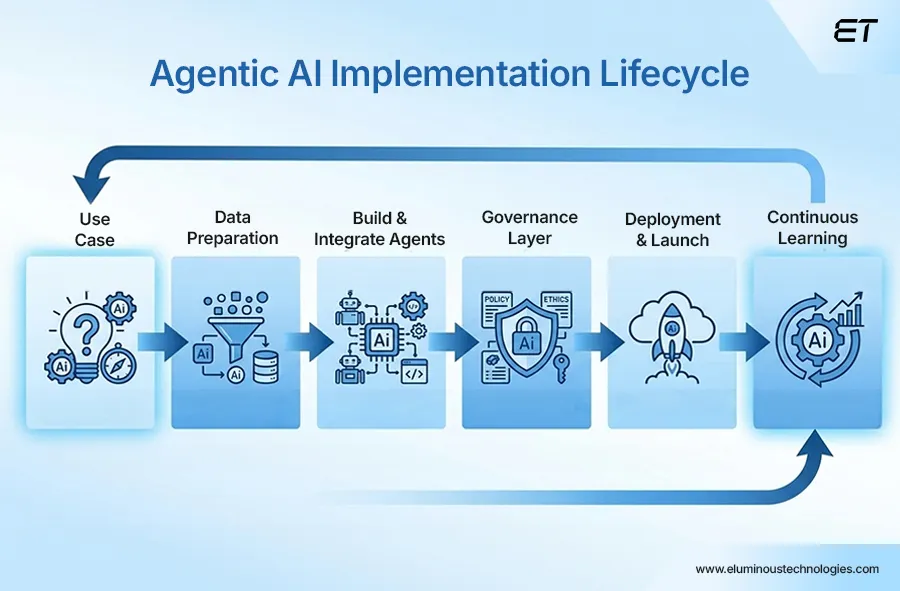
In this context, investing in agentic AI is better viewed as a long-term initiative rather than a one-time project. As systems evolve, they require ongoing data refinement and adjustments, while agents take on more complex tasks within controlled environments. Companies adopting agentic AI implementation consulting for enterprise framework are more likely to build scalable systems that grow along with changing business requirements.
Organizations that invest early in architectural capabilities are better positioned to scale these systems effectively. This can help improve operational efficiency and responsiveness over time, while enabling more flexible and connected workflows.
To Wrap Up – Agentic AI Implementation Consulting for Enterprise
Agentic AI represents a distinct category of technology, not just large language models (LLMs). It has the potential to influence both system architecture and enterprise operations, rather than simply enhancing individual tools.
Adopting agentic AI requires building a strong foundation, including architecture, governance, and clearly defined use cases. Organizations that approach this thoughtfully are better positioned to scale responsibly, while understanding where autonomous actions are appropriate and where human judgment remains necessary.
For organizations looking to move beyond the pilot stage, a practical starting point is assessing their current architecture and working with experienced AI teams. By evaluating system readiness and identifying gaps, enterprises can prioritize high-value use cases and design governance frameworks that align with their business objectives. A well-structured agentic AI implementation consulting for enterprise roadmap can help organizations to transition from experimentation to operational transformation.
Find out where agentic AI fits in your organization and how to implement it the right way.
Frequently Asked Questions – Agentic AI Implementation Consulting for Enterprise
1. What is Agentic AI Implementation?
Agentic AI implementation refers to integrating AI systems into workflows that can make decisions and take actions with a degree of autonomy. These systems can analyze inputs, identify next steps, and execute tasks, often reducing the need for constant human intervention.
2. What is the difference between agentic AI and traditional workflow?
Traditional workflows operate on predefined rules and execute tasks under fixed conditions. Agentic AI, on the other hand, can interpret context, plan actions, and adapt workflows based on changing inputs, while escalating to humans when necessary.
3. Where should enterprises start with agentic AI implementation?
Enterprises can start by identifying repetitive and operationally significant tasks where data is available and outcomes are measurable. For example, customer support routing, procurement approvals, or IT service ticket handling.
4. What are the best examples of agentic AI?
Examples of agentic AI include AI-driven systems within platforms like Salesforce for workflow automation and customer engagement, as well as emerging AI assistants used in hiring and operations. However, fully autonomous enterprise-grade agentic systems are still evolving, and most current implementations operate with human oversight.
5. What is the future of agentic AI?
Agentic AI is evolving towards more capable, long-running systems that can handle multi-step workflows and collaborate with other systems. However, these systems will continue to operate within defined constraints, with governance and human oversight remaining critical for reliable enterprise use.

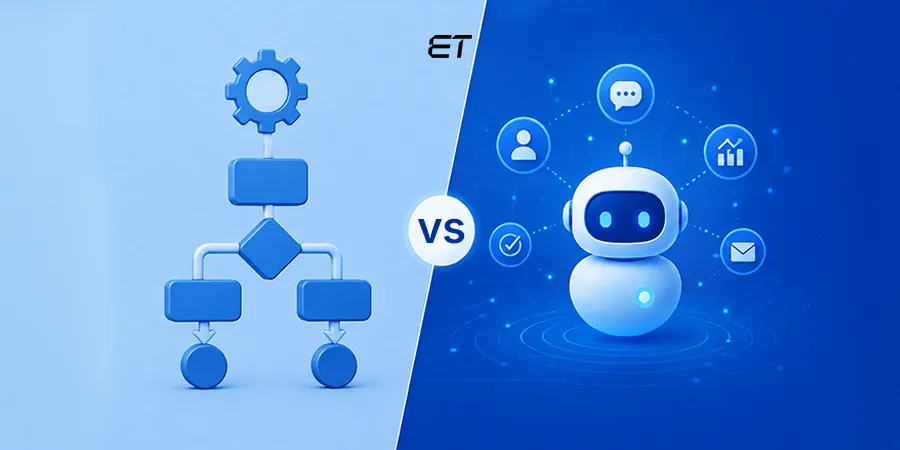
AI Agents vs Traditional Automation: Choosing the Right Approach in 2026
Summary: Traditional automation remains the most effective choice for repetitive, structured workflows where consistency and control are critical. AI agents…

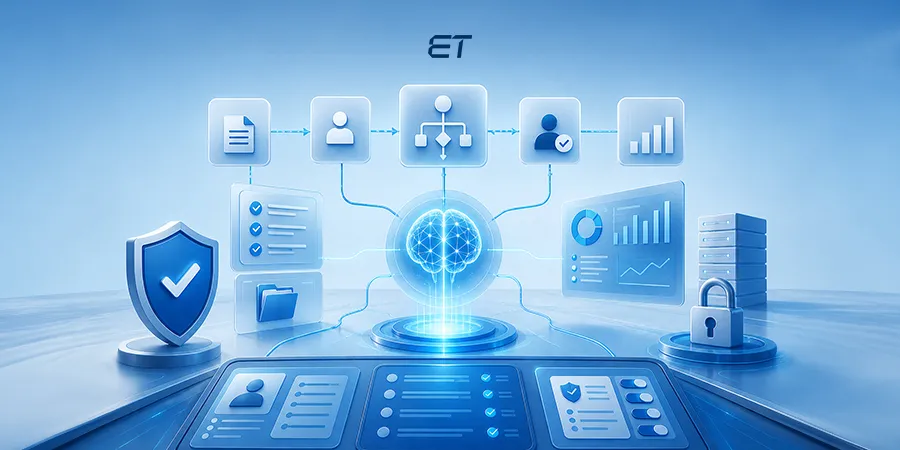
AI Governance Best Practices for Enterprise Workflow Automation
Quick Summary AI is being integrated with workflow automation at a rapid pace. This means they are embedded into customer…


