
 Book a Meeting
AI Agents vs Traditional Automation: Choosing the Right Approach in 2026


Key Takeaways:
- Traditional automation remains the most effective choice for repetitive, structured workflows where consistency and control are critical.
- AI agents and traditional automation are not competing models; the strongest enterprise approach combines deterministic automation with AI-driven decision-making.
- AI agents can interpret context, handle exceptions, and coordinate workflows across multiple systems.
- In 2026, successful enterprise automation depends less on experimentation and more on governance, observability, and measurable business outcomes.
- Enterprises evaluating AI agents vs traditional automation, should focus on learning their workflow complexity, and governance before implementation.
Enterprise automation is entering a new phase. Over the last decade, organizations invested heavily in workflow automation, RPA, and cloud platforms to improve efficiency and reduce manual effort.
However, as business environments become more dynamic, rule-based systems alone are no longer enough. Many enterprise workflows now depend on contextual decision-making, exception handling, and coordination across multiple systems.
This shift is driving interest in AI agents; systems capable of interpreting inputs, adapting to changing conditions, and supporting more flexible workflow execution. At the same time, traditional automation continues to play a critical role in structured, repetitive processes where consistency and predictability matter most.
Understanding the AI agents vs traditional automation face-off is becoming increasingly important for enterprises evaluating long-term automation strategies.
In this blog, we explore the core differences between the two, along with their use cases, limitations, architectural considerations, and future role in enterprise workflows.
Core Comparison: AI Agents vs Traditional Automation
AI agents are autonomous software systems capable of interpreting inputs, reasoning through tasks, interacting with APIs, and executing actions to achieve defined business objectives.
Unlike traditional automation, AI agents are designed to handle multi-step workflows and adapt to changing inputs with minimal human intervention. Their underlying architecture may include large language models (LLMs), machine learning systems, natural language processing (NLP), and retrieval-based frameworks that help them process information and respond dynamically.
In enterprise environments, AI agents extend beyond basic chatbot functionality. They can analyze requests, make contextual decisions, coordinate actions across systems, and manage workflows within defined operational boundaries.
This allows AI agents to operate effectively in environments where inputs vary, exceptions are common, and workflows require contextual understanding rather than fixed rule execution. However, their effectiveness depends heavily on proper governance, system integration, and workflow design.
Traditional automation remains highly effective for repetitive, rule-driven tasks with predictable outcomes. However, AI agents are better suited for workflows that require contextual understanding, flexible decision-making, and cross-system coordination.
AI agents deliver the most value when integrated within enterprise systems, governance controls, and operational workflows rather than operating as standalone tools.
AI agents vs traditional automation depends more on fixed outcomes or adaptive reasoning.
AI Agent vs Traditional Automation: How are They Different
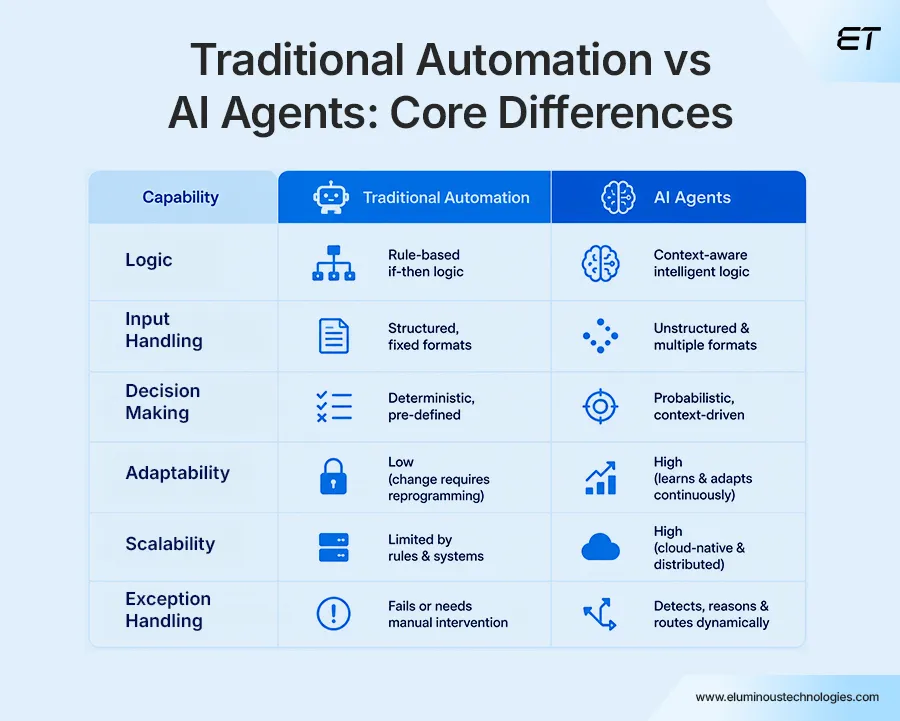
AI agents and traditional automation differ in how they process information, execute workflows, and respond to changing inputs. While traditional automation relies on predefined rules and structured workflows, AI agents are designed to interpret context, adapt to variability, and support more dynamic decision-making. The table below highlights the key differences between the two approaches.
| Feature | Traditional Automation | AI Agents |
| Logic | Rule-based and deterministic | Context-aware and adaptive |
| Input Handling | Best suited for structured inputs | Can process structured, semi-structured, and unstructured inputs |
| Scalability | Scales through predefined workflows and configurations | Scales through dynamic orchestration and contextual execution |
| Decision-Making | Follows predefined business rules | Evaluates context and supports dynamic decision-making |
| Exception Handling | Typically escalates exceptions to human intervention | Can interpret exceptions and recommend or execute next actions within defined boundaries |
| Maintenance | Requires manual updates when workflows change | Requires monitoring, evaluation, and governance to maintain performance |
| Cross-System Orchestration | Depends on configured integrations and workflows | Can coordinate actions across multiple systems based on contextual inputs |
| Adaptability | Limited flexibility when business rules change | Better suited for evolving workflows and variable conditions |
Another important difference is how both systems interact with interfaces and changing environments. Traditional automation tools typically depend on predefined UI paths and structured workflows, making them sensitive to interface changes. AI agents, particularly those integrated with modern browser or interface models, can interpret screen elements, analyze contextual signals, and adapt more flexibly when workflows change.
The distinction is one of the key reasons why AI agents vs traditional automation has become an major strategic discussion for tech leaders and enterprise architects. AI agents and traditional automation serve different operational purposes. Traditional automation is ideal for predictable, rule-driven execution, while AI agents are better suited for workflows that require contextual understanding and adaptive decision-making. Choosing the right approach depends on workflow complexity, governance requirements, and the level of variability involved in the process.
Where Traditional Automation Still Delivers Strong Business Value
Traditional automation remains a reliable solution for repetitive, rule-based workflows that sit at the core of enterprise operations.
Many organizations assume AI agents should replace existing automation systems, but in practice, that approach often introduces unnecessary complexity.
Even as AI adoption increases, traditional automation continues to deliver strong value in workflows that are:
- Stable and predictable
- Repetitive
- High-volume and transaction-driven
- Governed by deterministic business rules
Common examples include payroll processing, procurement approvals, compliance workflows, and scheduled system integrations.
Traditional automation excels at executing routine workflows consistently, accurately, and at scale. In highly predictable environments, introducing AI agents may increase operational complexity and governance overhead without providing meaningful additional value. For organizations assessing AI agents vs traditional automation, predictable workflows often bend towards traditional automation for cost efficiency and reliability.
When AI Agents Become More Effective Than Traditional Automation
AI agents create the most value in environments where workflows are dynamic, inputs vary frequently, and operational decisions cannot be fully predefined.
Unlike traditional automation systems that depend on fixed rules, AI agents can interpret context, manage exceptions, and support decision-making across changing business conditions. This makes them particularly useful in workflows involving unstructured data, variable user inputs, or cross-system coordination.
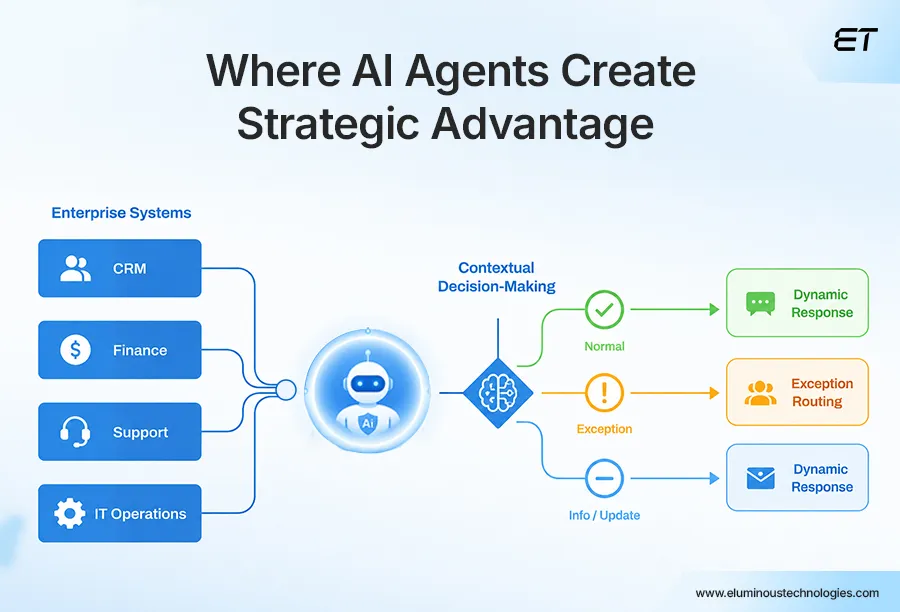
However, deploying AI agents in enterprise environments also introduces additional architectural requirements. Organizations need governance controls, permission boundaries, observability, and evaluation mechanisms to ensure agents operate reliably and within defined policies.
As AI agents become more integrated into operational workflows, maintaining visibility into agent behavior, outputs, and system interactions becomes critical for long-term reliability and risk management. This is where the comparison around AI agents vs traditional automation becomes more about operational responsibilities than theoretical.
Use Cases
AI agents and traditional automation both support enterprise operations, but they are suited for different types of workflows. Their differences in execution, adaptability, and decision-making determine where each approach delivers the most value. Understanding AI agents vs traditional automation through practical use cases helps enterprises identify the right automation models for distinct workflow layers.
Traditional Automation
Traditional automation follows predefined rules and executes workflows along fixed paths. It performs best in environments where processes are repetitive, structured, and predictable. With stable workflows and minimal exceptions, traditional automation delivers consistent execution and operational efficiency.
Given below are a few common use cases for traditional automation:
- System-to-system synchronization, where schemas are stable: Enterprise applications often exchange data through fixed schemas and predefined mappings. Traditional automation can reliably move information between systems without requiring contextual interpretation during execution.
- Invoice processing: Invoice workflows usually follow structured formats and predefined approval rules. Once the process path is clearly established, automation can handle repetitive processing tasks with high accuracy and consistency.
- Data entry: Data entry workflows rely on rule-based execution with clearly defined fields and fixed destinations. Since these tasks involve limited variability, they are well suited for traditional automation.
- Backend API integration: Traditional automation works effectively with predictable APIs, predefined payload structures, and known response patterns where workflows remain stable over time.
- IT operations: Routine IT tasks such as scheduled maintenance jobs, backups, monitoring workflows, and system updates operate on predefined operational rules and benefit from consistent automated execution.
- Finance and accounting: Recurring workflows such as payroll processing, reconciliations, and approval routing require accuracy, consistency, and controlled execution, making them ideal candidates for traditional automation.
In general, workflows that are repetitive, stable, and governed by fixed business rules are strong candidates for traditional automation.
AI Agents
AI agents are better suited for workflows that involve changing inputs, contextual interpretation, exception handling, or decision-making across multiple systems. Unlike traditional automation, AI agents can support workflows where rules are not always fixed and operational conditions vary over time.
Here are some common enterprise use cases for AI agents:
Finance
- Fraud detection: Fraud signals are rarely identified through a single fixed trigger. Detection often depends on analyzing unusual transaction behavior, account activity patterns, and cross-system signals that require contextual evaluation.
- Compliance monitoring: Compliance workflows frequently involve evaluating transactions and records against changing regulatory requirements. AI agents can assist by interpreting information across multiple systems and identifying potential compliance risks.
- Audit trail analysis: Enterprises generate large volumes of operational activity across financial systems. AI agents can help correlate events, identify anomalies, and surface patterns that may require investigation.
- Financial forecasting: Forecasting depends on changing business inputs, historical trends, and operational assumptions. AI agents can support adaptive analysis by identifying patterns and generating data-driven insights.
Human Resource (HR)
- Employee onboarding workflows: AI agents can coordinate onboarding activities across HR systems, documentation, approvals, and employee support workflows while adapting to role-specific requirements.
- Policy assistance: AI agents can retrieve and interpret internal policies, helping employees access relevant information across large and evolving knowledge bases.
- FAQ resolution: AI agents can respond to recurring employee queries while understanding conversational context and routing more complex issues when necessary.
- Candidate screening: Recruitment workflows often involve evaluating resumes, qualifications, and role-specific criteria across large candidate pools, making them suitable for AI-assisted analysis.
Customer Operations
- Customer history synchronization: AI agents can consolidate customer interactions and operational data across multiple systems to provide better workflow context.
- Issue analysis: Incoming support requests often vary in urgency, complexity, and intent. AI agents can help classify issues and prioritize responses based on context.
- Urgency detection: AI agents can evaluate customer language, historical interactions, and operational signals to identify high-priority cases faster.
Sales Operations
- Lead qualification: AI agents can analyze customer intent, engagement signals, and CRM activity to help prioritize qualified leads.
- Opportunity prioritization: Sales workflows often involve multiple contextual signals such as deal stage, engagement history, and account activity that AI agents can evaluate dynamically.
- Contextual follow-ups: AI agents can generate personalized follow-up recommendations based on customer interactions, buying behavior, and workflow history.
IT Operations
- Incident interpretation: AI agents can analyze alerts, logs, and operational signals together to help teams identify likely causes and prioritize incidents more effectively.
- Automated runbook execution: AI agents can assist in coordinating operational workflows by selecting appropriate actions based on changing incident conditions.
- Escalation workflow automation: AI agents can evaluate incident severity and route issues dynamically based on operational context and predefined policies.
- Alert correlation: AI agents can connect related alerts across systems to reduce noise and improve operational visibility.
Supply Chain and Operational Workflows
- Anomaly interpretation: AI agents can help identify irregular operational patterns across inventory, logistics, and procurement workflows.
- Dynamic workflow coordination: Supply chain conditions often change rapidly due to demand fluctuations or operational disruptions. AI agents can help workflows adapt based on real-time inputs.
- Exception routing: AI agents can evaluate exceptions and direct workflows toward the appropriate teams or resolution paths based on contextual analysis.
The primary advantage of AI agents lies in their ability to reduce the gap between signal detection, contextual analysis, and operational response in complex enterprise environments.
As organizations scale intelligently, the role of AI agents vs traditional automation becomes crucial in operational planning.
Questions to Ask Before Choosing AI Agents and Traditional Automation
Choosing AI agents vs traditional automation depends on the nature of the workflow, operational complexity, governance requirements, and the level of decision-making involved.
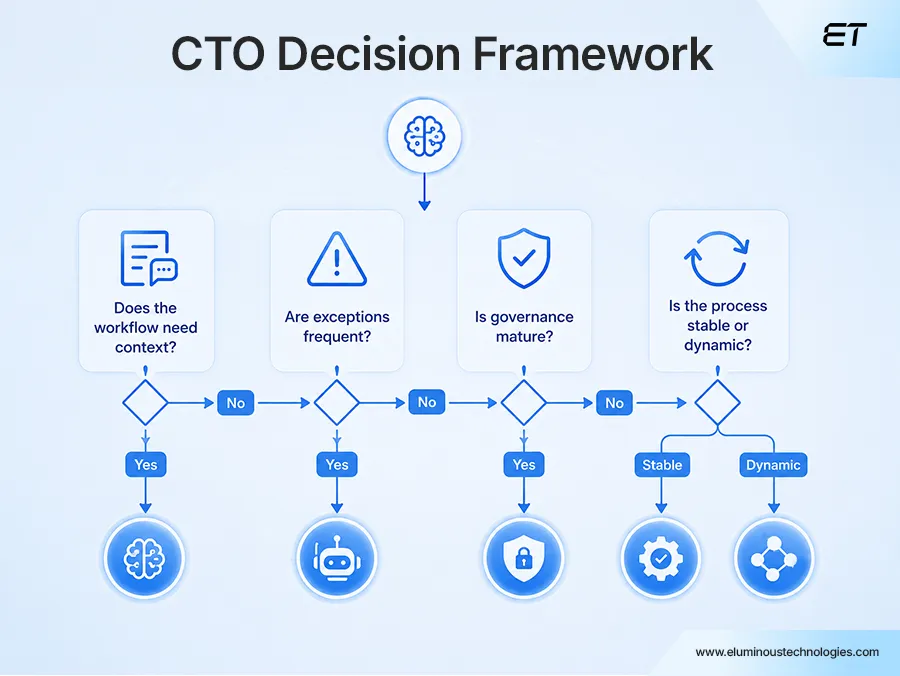
Before adopting either approach, enterprises should evaluate questions such as:
- Does the workflow require contextual interpretation?
- How frequently do exceptions occur?
- Is the workflow stable or constantly changing?
- Does the process require repeated human judgment?
- Does the workflow span multiple systems or teams?
- Are governance and monitoring controls mature enough to support AI-driven execution?
Organizations introducing AI agents should begin with workflows where contextual decision-making creates measurable operational value, such as fraud analysis, customer support triage, or incident interpretation.
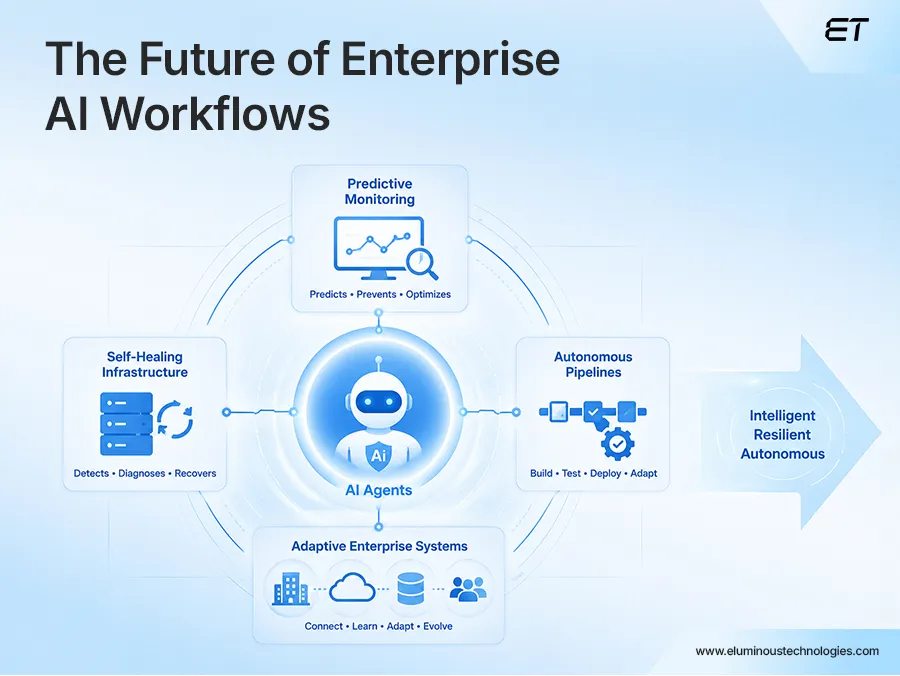
Rather than replacing existing automation systems entirely, many enterprises are integrating AI agents into specific stages of workflows where flexibility and contextual reasoning are required. Traditional automation can continue managing deterministic execution, while AI agents support decision-making, exception handling, and workflow coordination.
As adoption scales, enterprises also need stronger governance practices, including monitoring, evaluation frameworks, permission controls, and audit visibility to ensure reliable and policy-aligned execution.
To Wrap Up : AI Agents vs Traditional Automation
The AI agents vs traditional automation comparison solves different operational problems within the enterprise.
Traditional automation remains critical for structured, repetitive workflows that require consistency, predictability, and controlled execution at scale. At the same time, AI agents extend automation capabilities into workflows that involve changing inputs, exception handling, and contextual decision-making.
For most mid-market enterprises, the long-term opportunity lies in combining both approaches rather than replacing one with the other. Traditional automation can continue managing deterministic execution, while AI agents support more adaptive and decision-oriented workflows.
As enterprise workflows become more complex, organizations will need automation strategies that balance operational stability with flexibility and intelligence.
If your organization is exploring AI-driven automation or enterprise AI agent adoption, the team at eLuminous Technologies can help you evaluate, implement, and scale the right approach for your workflows.
Ready to Explore AI-Driven Automation for Your Enterprise?

Agentic AI Implementation Consulting for Enterprise Businesses
Key Takeaways: Agentic AI can interpret context, make decisions, and integrate across enterprise workflows The real advantage of integrating AI…

AI Governance Best Practices for Enterprise Workflow Automation
Quick Summary AI is being integrated with workflow automation at a rapid pace. This means they are embedded into customer…


