
 Book a Meeting

Overview: Python and Julia are powerful programming languages, each with unique strengths. Choosing the right one impacts productivity and efficiency. To assist you in making an informed choice, let’s run a comprehensive comparison of Julia vs Python, looking at their key features, use cases, and performance.
Since its launch in 1991, Python has emerged as one of the most widely used programming languages. Python was most frequently employed in data analysis and web development in 2022, accounting for 46% and 54% of all Python applications, respectively. (Source: Statista)
The Julia programming language has become more well-known in recent years due to its quick computation and simple code conversion. Known for combining performance with ease of use, Julia has become a preferred choice for developers seeking efficiency, especially in data science, numerical computing, and machine learning applications.
What is Julia, and why is it gaining popularity among data scientists? How does it compare to Python in terms of similarities and differences?
This comprehensive blog post on Julia vs. Python will provide you with all the answers you need. Just read through to the finish!
With millions of users and an uncountable number of third-party packages, Python is a mature language. Python enthusiasts claim that since new languages always manage to integrate with it, it won’t be replaced anytime soon.
On the other hand, Julia is gaining popularity rapidly and attracting more developers!
The use of the Julia language has increased dramatically despite its novelty in the programming world because of its lightning-fast execution speed. As of January 2022, Julia’s popularity has grown significantly, as seen by an increase in downloads, GitHub stars, YouTube views, and website visits.
Julia and Python are both valuable languages, although they are excellent in several respects. Your particular requirements and project objectives guide your decision. Moreover, knowing the best features, advantages, and disadvantages of each language can help you make an informed choice that supports your learning goals.
Let’s start with an overview of both languages!
Hire top-notch developers today! Get a high-quality product with the features you need for success. Build your Dream Team now!
Introduction of Julia
Julia is a high-performance, dynamic, and high-level programming language. Greek characters are supported in this programming language. Here, instead of translating mathematical formulas into a coding language, the code can use them directly.
It is used in mathematical programming and scientific computation. Although it is a hybrid of Python and C, it does not actually replicate any of the functionality of either language. This combo has the advantages of Python’s flexible code development and C’s high execution speed.
According to the expert developers, the primary reason Julia was created was its speed in programming; it executes code far more quickly than R and Python. This language supports big data analytics by handling intricate tasks like cloud computing and parallelism.
History of Julia
| 2009 | Development of Julia began by Jeff Bezanson, Stefan Karpinski, Viral B. Shah, and Alan Edelman. |
| 2012 | Julia was publicly announced, aiming to combine Python’s ease of use with C’s speed. |
| 2018 | Julia 1.0 was released, ensuring stability for production use. |
| 2019-2021 | Rapid adoption in data science, machine learning, and high-performance computing. |
| 2022-Present | Julia continues evolving, gaining traction in finance, bioinformatics, and AI research |
Features of Julia
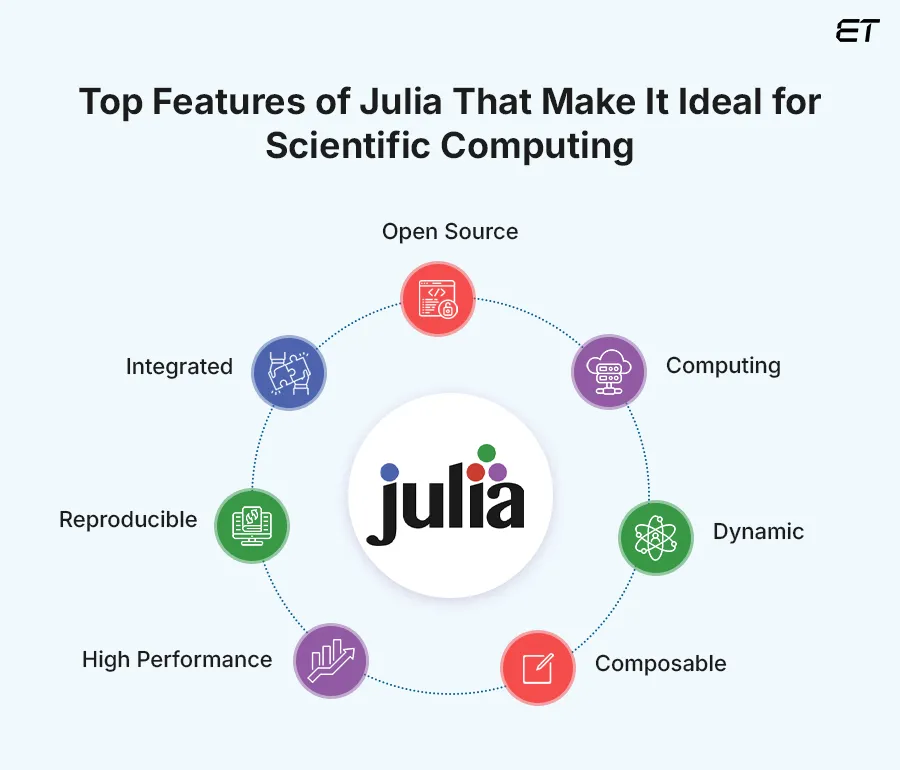
Here are the outstanding features of this programming language that developers admire.
1. Open Source
With more than 1,000 contributors, Julia is an open-source project. Anyone can use, alter, and distribute it without restriction because it is released under the MIT license. The source code is openly accessible on GitHub, enabling developers from all around the world to contribute to its advancement.
2. Integrated
Julia is an integrated language that supports seamless interoperability with other programming languages like Python, C, R, and Fortran. Furthermore, Julia incorporates several programming paradigms, such as functional, object-oriented, and procedural programming, giving it great adaptability for various uses.
3. Reproducible
Julia ensures reproducibility by enabling users to recreate identical environments across systems, crucial for scientific computing, data science, and machine learning. It supports containerization (Docker, Conda). It maintains consistent dependencies via Project.toml and Manifest.toml, enabling identical environments and results across platforms with pre-built binaries. This consistency enhances collaboration, accuracy, and reliability in research and development.
4. High Performance
Julia is a JIT-compiled language that uses the LLVM to convert code to machine code at runtime for optimal efficiency. Its execution efficiency surpasses that of Python, R, and MATLAB by combining the simplicity of Python with the speed of C.
5. Composable
Julia’s multiple dispatch paradigm makes expressing a wide range of functional and object-oriented programming patterns simple. Functions are inherently compatible with new types, guaranteeing adaptability, modularity, and effectiveness across a range of applications and programming paradigms.
6. Dynamic
Due to the dynamic typing feature of Julia, variables don’t need explicit type declarations. Static typing is an optional feature, though, which allows both flexibility and performance improvements. It also has a comprehensive debugging suite and an interactive command-line called REPL (Read Eval Print Loop), which allows you to add short instructions and scripts that will read, execute, and print out the results of those commands in a loop.
7. Computing
Because Julia is designed for parallel computing, it supports distributed computing, GPU, multi-threading, and instruction-level parallelism. It provides great precision for research, simulations, and large-scale computations with inherent efficiency, and it excels in numerical computing, linear algebra, and differential equations.
Introduction of Python
Python is a dynamic, object-oriented, high-level programming language. This multi-paradigm, high-level, interpreted language was first released in 1991. It has a plethora of libraries and tools devoted to software and web development, artificial intelligence (AI), and machine learning (ML).
Python’s beginner-friendly syntax makes it a top choice for new programmers. Its readability, versatility, and power drive its popularity. Developers use Python for sentiment analysis, NLP, and efficient, concise coding.
Python vs JavaScript: Choosing the Best Language in 2026.
Python’s easy-to-learn syntax encourages readability, which lowers software maintenance costs. In addition, the interpreter and the large standard library are freely distributable and available in source or binary form for all main systems. NumPy, TensorFlow, PyTorch, Pandas, and Matplotlib are among the most popular libraries.
History of Python
| 1980s | Guido van Rossum started developing Python as a successor to the ABC language |
| 1991 | Python 1.0 was released, emphasizing simplicity, readability, and code efficiency. |
| 2000 | Python 2.0 introduced key features like garbage collection, list comprehensions, and Unicode support. |
| 2008 | Python 3.0 was launched, improving performance, fixing inconsistencies, and removing outdated elements. |
| 2010s | Python gained widespread adoption in web development, automation, data science, AI, and machine learning. |
| 2020 | Python 2 was officially discontinued, making Python 3 the standard version. |
| 2020 | Python remains one of the most popular programming languages, supported by a vast ecosystem of libraries and frameworks. |
Features of Python
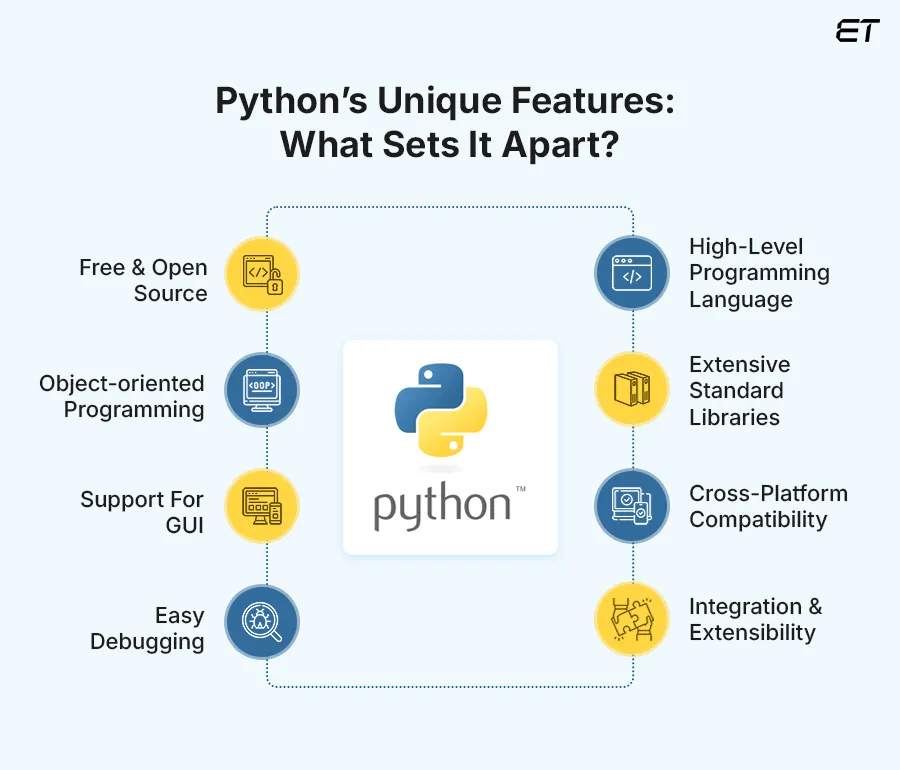
Here are some of the key features that make Python a preferred choice among developers:
1. Free & Open Source
Python is freely available on its official website, and as an open-source language, its source code is accessible to the public. This allows developers to use it for commercial applications at no cost while enabling customization to enhance functionality and reduce development time.
2. Object-oriented Programming
Python is one of the top object-oriented programming languages. It supports object-oriented programming with features like classes, inheritance, encapsulation, and polymorphism. These enable efficient, reusable, and organized code, making it easier to build complex applications while improving maintainability and scalability over time.
3. Support For GUI
One of the most crucial aspects of any programming language is support for the Graphical User Interface (GUI), which makes code more aesthetically pleasing. Python makes it simple to construct user-friendly desktop applications by supporting GUI programming using libraries like Tkinter, PyQt, and Kivy. These libraries include widgets and tools for creating cross-platform, interactive graphical user interfaces.
4. Easy Debugging
Once you know how to interpret Python’s error traces, you will be able to rapidly find and fix most of your program’s bugs. Additionally, it has integrated debugging tools like PDB and clear error messages, which facilitate the identification and resolution of issues.
End-to-End Testing vs Integration Testing: In-Depth Comparison.
5. High-Level Programming Language
Being a high-level programming language, Python saves dedicated developers from worrying about the architecture, memory management, or code structure of the programs they create. It enables developers to focus more on solving problems than on the finer points of hardware architecture or memory management.
6. Extensive Standard Libraries
Python has a large standard library with built-in modules for regular expressions, networking, data processing, file handling, and mathematical functions. This is one of the main features of this programming language. This speeds up development and lessens the need for external dependencies.
7. Cross-Platform Compatibility
Python is cross-platform; it means the same codebase can be run on different operating systems (Windows, macOS, Linux, and even mobile platforms) without modification. This enables coders to write code only once and execute it in any location without changing it.
Choosing the right cross-platform framework: .NET MAUI vs Flutter.
8. Integration & Extensibility
Python’s ability to be readily integrated with other languages, such as C, C++, and others, makes it an integrated language. It is ideal for web development, data science, and machine learning applications because it also provides database connectivity.
Is Python Development Outsourcing Still a Smart Move?
9. Interpreted Language
Python is an interpreted language, which means that instead of having code compiled beforehand, it is run line by line. This streamlines testing and debugging, improving the development process.
Discover the cost to hire dedicated developers in 2026! Get a detailed pricing breakdown and hire top talent within your budget.
Julia vs Python: A Detailed Analysis for Developers and Researchers
Let’s begin the head-to-head fight of Python vs Julia and find the winner.
-
Julia vs Python: Which is More Readable and Beginner-Friendly?
Both Python and Julia are made to be easy for beginners to learn. Still, Python is often seen as being more beginner-friendly because of its simple and easy-to-understand syntax, which lowers the learning curve and makes it a great option for novices. Python code is frequently easier to maintain and more readable by humans.
Despite being accessible, Julia has a more difficult learning curve, particularly for people who have no experience with mathematical computing. Though Julia’s syntax is likewise quite simple, it might not be as user-friendly for beginners as Python’s.
With all factors considered, Julia is superior in performance-focused fields, whereas Python is better for novices.
-
Julia vs Python: Which Language is Faster and More Efficient?
When writing code, code execution speed is very important. Julia, which was created for high performance with JIT compilation utilizing the LLVM framework, is just as quick as C. While Python is versatile, it falls short in computational jobs that demand great speed. Out of Python vs Julia, Julia shines in scientific computing and huge data processing, delivering near-C-level performance.
Julia is quick by design, whereas Python requires third-party JIT (Just-in-time) compilers (PyPy), external libraries, and optimizations. In terms of speed and performance, Julia outperforms Python.
Also, unlike Python, Julia does not require profiling and optimization techniques. This is why Julia is a well-liked option for big data, cloud computing, data analysis, and statistical computing issues. In terms of speed and performance, Julia is the winner.
-
Julia vs Python: Which Offers Better Tooling Support?
When working on a software development project, you want to choose a programming language with excellent tool support. Python offers stronger tool support than Julia. Numerous tools for troubleshooting and performance issues are available in Python.
However, compared to Python, Julia’s performance tools are limited. Additionally, Julia is more likely to have risky interfaces because it has native APIs. Python prevails over Julia because Julia’s tooling support is still being developed.
Mastering API Development: A Comprehensive Guide.
-
Julia vs Python: Which Handles Parallelism Better?
Python and Julia, both programming languages, can execute operations concurrently. The overhead of serializing and deserializing data between threads is a problem for Python. Julia, on the other hand, employs more complex parallel strategies. Additionally, Julia’s parallelization grammar is less applicable than Python’s since it is less top-heavy.
With built-in support for distributed computing and multi-threading, Julia excels at parallelism, enabling smooth execution across multiple cores. Despite its capabilities, Python depends on third-party libraries such as Dask and multiprocessing, and it frequently encounters issues because of the Global Interpreter Lock (GIL). Compared to Python, Julia’s design improves the efficiency and scalability of parallel processing.
-
Julia vs Python: A Syntax Comparison for Developers
Julia and Python are dynamically typed and incredibly simple to write and comprehend. Although the syntax of the two languages is similar, there are some significant differences.
Due to its general-purpose nature, Python lacks some essential features that are useful to this community; however, this is compensated for by the abundance of libraries that make creating high-performance algorithms simple.
Those who use scientific computing languages and environments such as Matlab, R, Mathematica, and Octave will find Julia’s syntax easier to use. This is because math operations in the language’s syntax are more like math formulae outside the programming domain.
As Julia requires fewer hardware resources to get high-performance computing results, data scientists are drawn to it because they can employ their scientific formulas as code.
-
Julia vs Python: Performance and Efficiency in Data Science
Julia is superior to Python in the field of data science. As we covered in the previous section, Julia is a perfect language for scientific programming because its syntax for mathematical operations is identical to that of mathematical formulas.
Python is capable of handling almost anything thanks to its abundance of libraries, but complex calculations require assistance from programs like NumPy. Julia is gaining ground with its focused toolkit, but Python is still in the lead thanks to its extensive ecosystem and easy collaboration with other technologies.
While Python is undoubtedly a more approachable programming language, Julia is probably the better option if you’re a member of the scientific programming community. This scientific community is one of the important segments of Julia’s target audience. Due to its exclusive focus on mathematics-based programming, this group differs greatly from the application programming community.
Turn your data science ideas into reality! Partner with expert developers for cutting-edge solutions. Start building your data-driven project with top professionals today!
-
Julia vs Python: Which Indexing Approach is More Intuitive?
The indexing strategies used by Julia and Python vary, which affects how users work with arrays. Python and most other languages use zero-based indexing, which accesses the array’s first element with a zero.
In contrast, Julia follows a one-based indexing system where the first element is indexed as 1. This approach is more intuitive for mathematicians and scientists familiar with traditional mathematical notation, making it easier to understand and work with numerical computations.
Python’s zero-based indexing is common in computer science, but Julia’s one-based structure makes numerical computation easier. The user’s preferences and the particular application domain will determine which option is best.
-
Julia vs Python: Code Conversion Challenges and Solutions
Code conversion from Python and/or C to Julia is simpler. However, it is not so simple the other way around. It is far more challenging to convert code from Python to C or C to Python. Because of the differences in syntax, indexing, and library support, converting code between Julia and Python can be difficult.
Python employs zero-based indexing, which necessitates modifications to loops and array management, whereas Julia uses one-based indexing. Furthermore, several Python libraries have dependency problems because they don’t have direct Julia equivalents.
Some solutions are using Julia’s metaprogramming capabilities, progressively moving important code segments, and utilizing wrapper libraries. Developers may use both languages with a hybrid method, maximizing Julia’s performance while preserving Python’s broad ecosystem support. These solutions are quite helpful for our dedicated development team while doing code conversion.
-
Julia vs Python: Which is Better for Machine Learning?
Python and Julia both provide robust machine learning tools. Python is the most popular choice among developers because it leads the industry with packages like TensorFlow, PyTorch, and Scikit-learn. In order to provide a strong and quick programming language for machine learning, Julia’s developers made sure it could handle linear algebra and all the equations required to advance the field.
Julia is perfect for large-scale numerical computing because of its JIT compilation, which offers higher speed and performance. Its efficiency and inherent support for parallel processing provide advantages for high-performance applications, even though Python boasts a larger environment and community. Julia is becoming popular for workloads requiring a lot of performance, but Python is ultimately better for widespread ML adoption.
Case Study: Building a Scalable Machinery Price Prediction Platform Using Advanced Machine Learning Algorithms for Trade
-
Julia vs Python: Which Language Has a More Active Community?
Support from a large and vibrant community is crucial for every programming language. Let’s see which programming language is backed by community support.
Because Julia is a new language, it has a tiny community; there aren’t many resources available to address questions and issues. Julia’s programming community is still in its infancy.
On the other hand, Python has a large community supporting it because it has been around for a long time. Developers benefit greatly from the big Python community since it provides a wealth of resources to address issues and questions.
Therefore, Python should be your first pick if you’re seeking for community support between Julia and Python.
-
Julia vs Python: Which Language Has the Best Libraries for Development?
There are a number of libraries in Python that you may easily import and utilize for their features. Julia has a limited library ecosystem but can integrate with C and Fortran libraries to handle plots, enabling extended functionality despite its smaller native library collection.
Python comes with a robust library that makes coding easier. These kinds of libraries can be imported and used as functions in Python code. Python supports a vast range of third-party libraries, making it highly compatible for developers. This extensive ecosystem is essential for web and app development, providing numerous packages that enhance functionality and streamline coding for various applications and projects.
Julia’s poor package maintenance is one of its key disadvantages. Initial data plotting is very time-consuming, but Julia can directly interface with C libraries. Though it still needs more libraries of its own, Julia is actually helpful for machine learning and deep learning thanks to some of its libraries, such as Flux and Knet.
7 Best Tools for High-Class Software Development.
-
Julia vs Python: Which Language Is More Versatile?
Python is a flexible language because it makes reading and coding simple. Python’s ease of use makes it a flexible language. This is the reason it’s so popular for applications like programming, game development, artificial intelligence, machine learning, and data analytics, to name a few.
Even if Julia is excellent at handling scientific programming challenges, Python is still more flexible, especially when it comes to solving problems with scientific programming.
Web development, automation, and web scripting are all possible with Python. Python is therefore a superior option if you’re searching for a general-purpose language, and hiring a dedicated Python developer could help you achieve your goal.
-
Julia vs Python: Understanding Their Typing Systems
Python and Julia are both dynamically typed programming languages, meaning that developers are not required to define variables. Moreover, Python allows duck typing, in which actions rely on object behavior as opposed to explicit types.
Conversely, Julia retains its dynamic characteristics but can be statically typed if desired. In addition to supporting multiple dispatch, which chooses function implementations according to argument types, it permits type annotations for speed optimization.
Particularly for numerical computing, Julia’s type system improves speed and efficiency. On the other hand, Python puts user-friendliness ahead of raw performance, distinguishing their type systems in both application and design.
Julia vs Python: Which One Fits Your Needs?

Let’s find out which programming language best fot in your unique project requirements!
Best Top Julia Use Cases
- Machine Learning/AI: Julia, designed for scientific machine learning, excels in parallelism and speed. It enhances training times, reduces deployment costs, and efficiently handles complex scientific data challenges, making it ideal for machine learning tasks.
- Graphics: Julia provides robust graphics libraries with diverse visualization and interactive features. Notable packages include Luxor.jl for vector graphics, Javis.jl for animations, Flux3D.jl for 3D rendering, and Vulkan.jl for high-performance graphics processing.
- Web Development: A number of excellent Julia web development tools are at the user’s disposal. One noteworthy example that contains everything you need to create full-stack applications and APIs is the Genie.jl framework (Genie). Additionally, it provides an ORM (Searchlight), no-code UI plugins (Genie Builder), and allows you to create interactive data applications (Stipple).
Building a Web Development Team Structure – Tips for Success.
- Parallel Computing: Julia is designed for parallelism, offering built-in multi-threading, multi-processing, and distributed computing. Key packages like LoopVectorization.jl, Dagger.jl, and DistributedArrays.jl enhance performance for handling large-scale computational tasks efficiently.
- Statistics: Julia is excellent for statistics, offering high-performance computing, precision, and specialized packages like DataFrames.jl, StatsBase.jl, and Turing.jl for data analysis, statistical modeling, and Bayesian inference, making it a strong choice.
- Numerical Computing: Julia programmers have access to various packages for numerical computing, including LinearAlgebra.jl for linear algebra, NonlinearSolve.jl for root-finding, and ForwardDiff.jl or Enzyme.jl for automatic differentiation, enhancing computational efficiency and accuracy, thus making it a perfect choice for numerical computing.
- Data Science & Visualization: Julia is ideal for data science, offering efficiency and powerful visualization tools. Key libraries include Plots.jl, Makie.jl, UnicodePlots.jl for terminal plotting and CSV.jl for handling CSV files. The JuliaPlots GitHub hosts additional resources.
Top Python Use Cases
- Web Development: Python is widely used in AI and machine learning due to its simplicity and robust libraries like TensorFlow, PyTorch, Keras, and scikit-learn, enabling efficient model training, evaluation, optimization, and deployment.
- Game Development: With the gaming industry’s rapid growth, Python has become a top choice for game development. Popular games like Pirates of the Caribbean and Battlefield 2 use it, supported by powerful libraries like pygame, panda3D, and Cocos2D.
- Audio & Visual Applications: Python excels in audio and video applications, powering Netflix, Spotify, and YouTube with libraries like Dejavu, Pyo, Mingus, SciPy, and OpenCV, ensuring seamless media processing and functionality.
- AI & Machine Learning: Python is widely used in AI and ML for its simplicity, stability, and powerful libraries. Key frameworks like TensorFlow, Keras, Scikit-Learn, and Pandas support model training, neural networks, and data analysis, driving advancements in NLP, computer vision, and predictive analytics.
- Data Analytics: Python provides robust tools for statistical analysis, data manipulation, and cleaning using libraries such as Pandas, NumPy, and SciPy. It supports various data formats, including CSV, TSV, and SQL databases, making it highly versatile for data analytics and insights extraction.
- Cybersecurity: Python’s ability to automate security tasks, analyze vulnerabilities, and build security tools makes it a top choice for ethical hackers, security analysts, and cybersecurity professionals. Python excels in cybersecurity with its simplicity, flexibility, and powerful libraries like Scapy, PyCrypto, and Nmap.
- Scientific & Numeric Computing: Python is widely used in scientific computing and data analysis, offering libraries like SciPy, Pandas, and IPython for numerical computing, modeling, and visualization. Real-world applications like FreeCAD and Abaqus showcase its strength in engineering and research.
- Desktop GUI: Python enables efficient GUI development with libraries like PyQT, Kivy, and wxWidgets, offering built-in tools for creating secure, fully functional user interfaces with ease and flexibility.
Julia vs Python: Weighing the Pros & Cons for Your Project
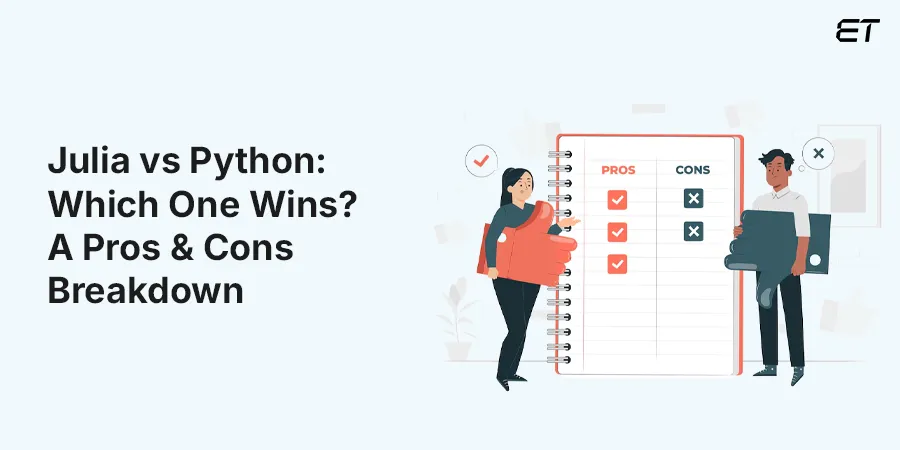
Pros & Cons of Julia
| Pros | Cons |
| Julia is a compiled language designed for speed, often rivaling C and Fortran in numerical computing. | While growing, Julia’s ecosystem lacks the extensive libraries found in Python. |
| It allows efficient function overloading based on argument types, optimizing performance. | Fewer companies use Julia compared to Python or R, leading to fewer job opportunities. |
| It has built-in support for multi-threading and distributed computing, enhancing scalability. | Compared to Python, Julia has a smaller user base and fewer third-party libraries. |
| Its syntax is intuitive and similar to Python, making learning easier for beginners. | Initial compilation of functions can be slow due to Just-In-Time (JIT) compilation. |
| It supports both dynamic and static typing, offering flexibility in development. | Some libraries are still in development and may lack long-term stability. |
| It can easily call C, Python, R, and Java functions. |
Pros & Cons of Python
| Pros | Cons |
| It is widely used in AI, ML, and deep learning using frameworks like PyTorch and TensorFlow. | It is not ideal for memory-intensive tasks due to dynamic typing. |
| Due to its cross-platform compatibility, it runs on Windows, macOS, and Linux without modification. | It is less commonly used for mobile applications compared to Java or Swift. |
| It offers robust libraries like NumPy, TensorFlow, Django, Flask, and Pandas for diverse applications. | Python is an interpreted language, making it slower than compiled languages like C or Java. |
| It is ideal for automating repetitive tasks and building scripts. | It limits multi-threading performance in CPU-bound tasks. |
| A vast global community provides tutorials, documentation, and third-party modules. | Handling multiple packages can be complex in large projects. |
| Python’s simple syntax makes it beginner-friendly and highly readable. |
Final Verdict: Is Julia better than Python?
With all the above-mentioned points, the battle between Python and Julia is hard.
Both Python and Julia are open-source, useful programming languages for data management and software development.
Python is a widely used, user-friendly, and versatile programming language that can be used for both small and large software projects. This high-level interpreted language is one of the best choice for machine learning and data processing.
Is Python development outsourcing a smart move?
Julia is a quick and high-performance programming language used for scientific computation and application development. It is a high-level, open-source technology that facilitates distributed, concurrent, and parallel computing.
Choosing between Python and Julia depends on your project’s needs. Both these languages are easy to learn and have a lot of common features. So choose the one that best fits your specific objectives and goals.
- Python offers a vast ecosystem, ease of learning, and strong community support, making it ideal for general-purpose tasks.
- Julia excels in high-performance numerical computing with a specialized user base.
Combining both—using Julia for performance-critical tasks and Python for broader functionality—can often be the best approach.
What? Sounds strange!
At eLuminous Technologies, our leading developers leverage both Python and Julia to optimize performance and flexibility. They use Julia for computationally intensive tasks like numerical simulations and machine learning model training, benefiting from its speed and efficiency. Python, with its extensive libraries and ecosystem, handles data preprocessing, visualization, and integration with web applications.
This hybrid approach balances Julia’s high-performance computing with Python’s versatility, enabling seamless workflows in AI, finance, and scientific research. In this way, our dedicated development team achieves optimal performance without sacrificing Python’s rich ecosystem.
Connect with Development Experts and find better ways to enhance your project’s efficiency!”
Frequently Asked Questions
1. Is Julia faster than Python?
Yes, Julia is generally faster than Python, particularly for numerical computing, scientific simulations, and machine learning. Unlike Python, which is interpreted, Julia uses Just-In-Time (JIT) compilation, optimizing execution speed and outperforming Python in performance-critical tasks, especially those involving complex computations.
2. Which Industries Benefit the Most from Python?
Python is widely used in AI, machine learning, data science, finance, healthcare, cybersecurity, automation, web development, and scientific research. Its versatility, extensive libraries, and ease of use make it ideal for industries requiring data analysis, automation, and complex computations.
3. Which Industries Benefit the Most from Julia?
Julia is widely used in scientific computing, data science, finance, artificial intelligence, machine learning, engineering, and high-performance computing. Its speed, scalability, and numerical accuracy make it ideal for industries requiring complex simulations, mathematical modeling, and large-scale data processing.
AI Programming Languages to Know: Choose the Best for Your Project
4. Is Julia dynamically or statically typed?
Julia is dynamically typed, allowing variables to change types at runtime. However, it also supports optional static typing, enabling type annotations for better performance and code clarity. This hybrid approach balances flexibility and efficiency, making Julia powerful for scientific computing.
5. Which is more popular—Python vs Julia?
Python is far more popular than Julia, thanks to its versatility, extensive libraries, and large community. While Julia excels in scientific computing and high-performance tasks, Python dominates fields like AI, data science, web development, and automation.
Hire expert Python developers today! Get top talent for web development, AI, automation, and data science.

Web Application Architecture for Enterprises: Components, Types, and Best Practices
Web application architecture is the structural blueprint that defines how a web application is designed, built, deployed, and scaled. It…


How to Conduct Technical Due Diligence for Offshore Software Companies
You’re on a Zoom call with a potential offshore software partner. The deck looks flawless; sleek UI mockups, confident faces,…


