
 Book a Meeting
The Complete Guide to Software Development Strategy for Long-Term Scalability


Before any code is written or sprint planned, one strategic decision decides whether your software scales smoothly or eventually breaks. That decision is your software development strategy.
A software development strategy is a system-level blueprint that defines how software is conceived, built, deployed, governed, and evolved. Every decision aligns with business goals, technical constraints, and long-term growth.
It is not documentation, not project management, and not a list of tools. It is the engineering philosophy that dictates trade-offs, priorities, and execution patterns across the entire software lifecycle.
Here is the uncomfortable truth decision-makers already know. Most software failures do not happen because teams lack skill. They happen because organizations start coding without deciding how the system must survive change.
What is often missing from the conversation is who this strategy is really for and why their viewpoint changes the outcome. For founders, CTOs, CIOs, and engineering leaders, software strategy is a business risk decision.
It determines whether growth introduces leverage or fragility, whether speed compounds value or technical debt, and whether innovation remains sustainable beyond the next release.
This blog takes a practical, and decision-maker-oriented view of software development strategy, grounded in real-world engineering outcomes rather than theory.
What is a Software Development Strategy?
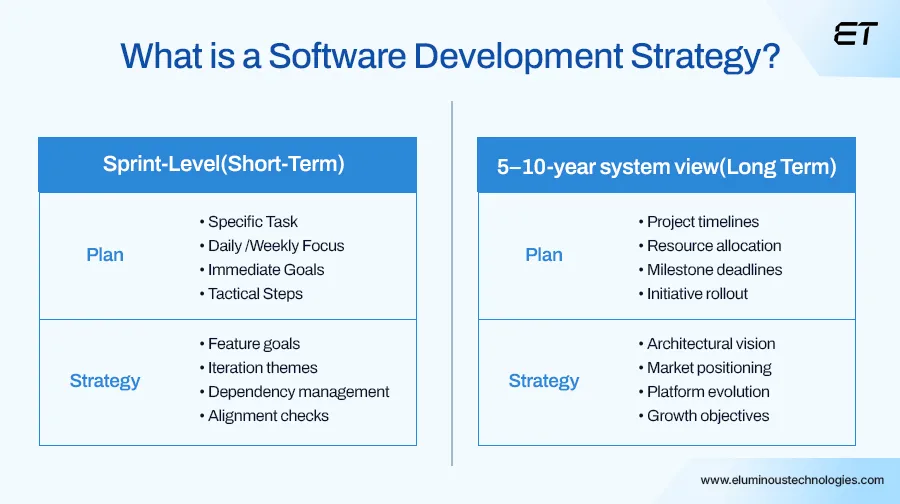
A software development strategy is a living, system-level roadmap guiding how organizations design, build, deploy, secure, and evolve software. It aligns architecture, delivery models, talent, and tooling with long-term business goals like speed, scalability, revenue growth, and risk reduction.
The key distinction lies in abstraction and intent.
- A plan answers: What are we building this sprint?
- A strategy answers: How do we consistently build software for the next 5–10 years without rewrites, instability, or runaway costs?
For example:
- A plan might be: “Build a login page by Tuesday.”
- A strategy is: “Make sure login won’t become a mess when we add more products, users, and teams.”
In short, a Software Development Strategy is the operating system of modern digital businesses. Without it, teams react.
With it, organizations compound value, release after release, year after year.
Why Your Business Needs a Software Development Strategy
Most businesses fail because they treat software as a series of projects rather than as a strategic system.
A software development strategy exists to resolve this. It sets the non-negotiables early: how systems communicate, how change is introduced safely.
How complexity is controlled, and how short-term delivery is balanced against long-term resilience. Let’s break this down with clear business reasons.
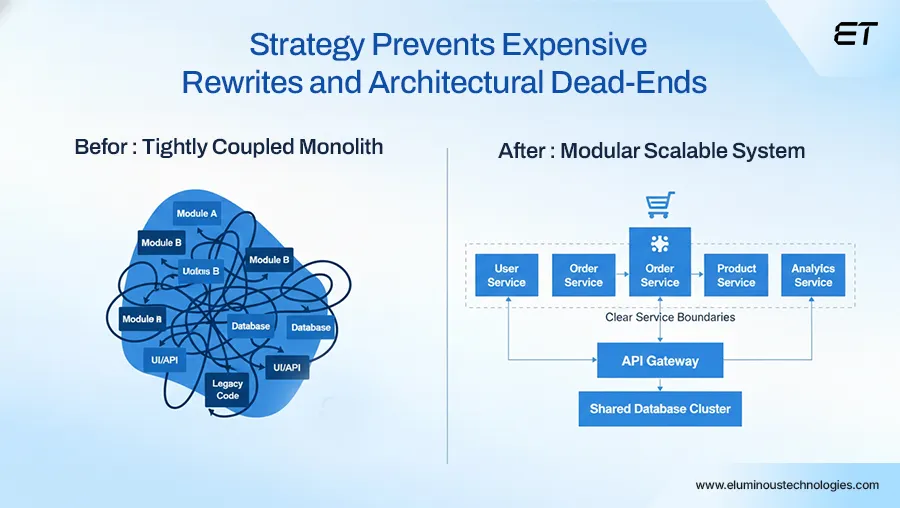
1. Strategy Prevents Expensive Rewrites and Architectural Dead-Ends
One of the most common mistakes happens at a very specific moment.
When a product moves from one team, one codebase, one environment, to multiple teams and real users.
At that stage, teams optimize for speed. They hard-code the configuration because it’s faster. They pick the database they already know, even if it won’t scale cleanly. They copy authentication logic into each service instead of centralising it. They deploy manually because “we’ll automate it later.”
Without strategy:
- Systems become tightly coupled
- Changes require touching multiple components
- Every new feature slows the entire organization
With strategy:
- Systems evolve incrementally
- Change becomes predictable, not risky
- Growth does not require rebuilding from scratch
Brand example: Twitter (early years)
Twitter’s early architecture struggled to keep pace with rapid user growth because scalability was not a foundational strategic priority.
The infamous “Fail Whale” wasn’t a coding problem. It was a strategic architecture gap. Only after rethinking data models, service boundaries, and infrastructure strategy did Twitter stabilise its platform.
Business lesson: A software development strategy protects you from success-related failures. Growth without strategy breaks systems.
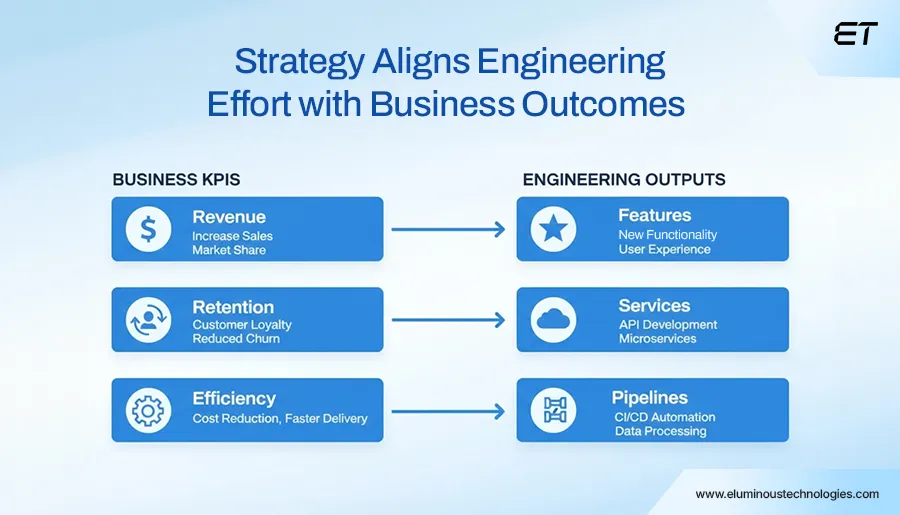
2. Strategy Aligns Engineering Effort With Business Outcomes
In many organizations, engineering teams are busy, but leadership still asks, “Why aren’t we seeing results?” That disconnect happens when:
- Features are shipped without a measurable impact
- Technical priorities are detached from revenue, retention, or efficiency
- Teams optimise for output, not outcomes
A software development strategy closes this gap by making trade-offs explicit. It defines which metrics matter, which constraints cannot be violated, and how technical decisions are evaluated before work begins.
- Business KPIs (growth, churn, margins)
- Technical decisions (architecture, tooling, delivery speed)
Brand example: Spotify
Spotify’s squad–tribe–chapter model is a strategic alignment mechanism. Each squad owns a business outcome (discovery, playlists, payments), not just a codebase. All this ensures engineering velocity translates into user engagement and retention.
What’s often missed when this model is copied is the strategy underneath. Without clear ownership of outcomes, shared architectural standards, and strong platform governance, squads become silos. Teams move fast locally, but systems fragment, duplication increases, and coordination costs explode.
Business lesson: Strategy ensures that every sprint moves the business forward, not just the backlog.
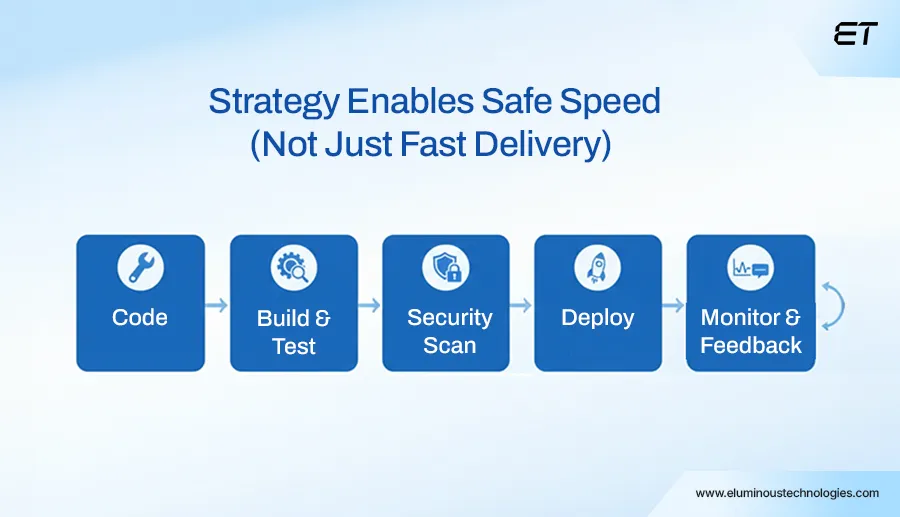
3. Strategy Enables Safe Speed (Not Just Fast Delivery)
Shipping fast without a strategy is dangerous. Shipping fast with a strategy is a competitive advantage. Without strategy:
- Releases cause regressions
- Teams fear deployments
- Innovation slows due to risk
With strategy:
- CI/CD pipelines are designed to limit blast radius, enforce quality gates, and make failures reversible.
- Security, testing, and compliance are integrated early, not added after incidents.
- Speed increases because deployments become predictable, repeatable, and low-risk.
The intent is controlled change, where every release can be shipped, observed, and rolled back without error.
Brand example: Netflix
Netflix deploys thousands of times per day. This isn’t because they “use DevOps tools well.” It is because their software development strategy prioritizes resilience, observability, and automation.
Practices like Chaos Engineering exist to validate strategic assumptions about failure, not to impress engineers.
Business lesson: Speed without strategy creates fragility. Strategy turns speed into a repeatable asset.
4. Strategy Controls Long-Term Cost and Technical Debt
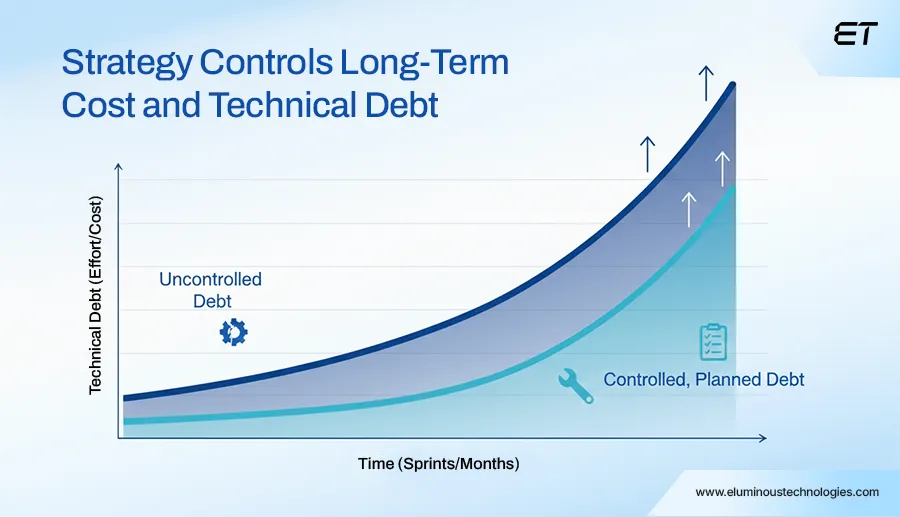
Technical debt is not inherently bad. Unmanaged technical debt is. When there is no strategy:
- Short-term shortcuts pile up
- Maintenance costs silently increase
- Engineering effort shifts from innovation to firefighting
A software development strategy introduces:
- Explicit debt management policies
- Clear refactoring thresholds
- Economic trade-off thinking (cost of delay vs cost of change)
Brand example: Airbnb
As Airbnb scaled across countries, devices, and product teams, frontend work became disproportionately expensive. Small UI changes required coordination across multiple frameworks, and design inconsistencies crept in.
Teams spent more time maintaining components than shipping features. Velocity slowed even as headcount increased.
The strategic response was a unified design language system and shared component architecture, lowering long-term maintenance overhead across teams.
Business lesson: Strategy doesn’t eliminate cost; it decides when you pay it—early through standardisation, or later through friction and rework.
5. Strategy Future-Proofs the Business Against Market and Technology Shifts
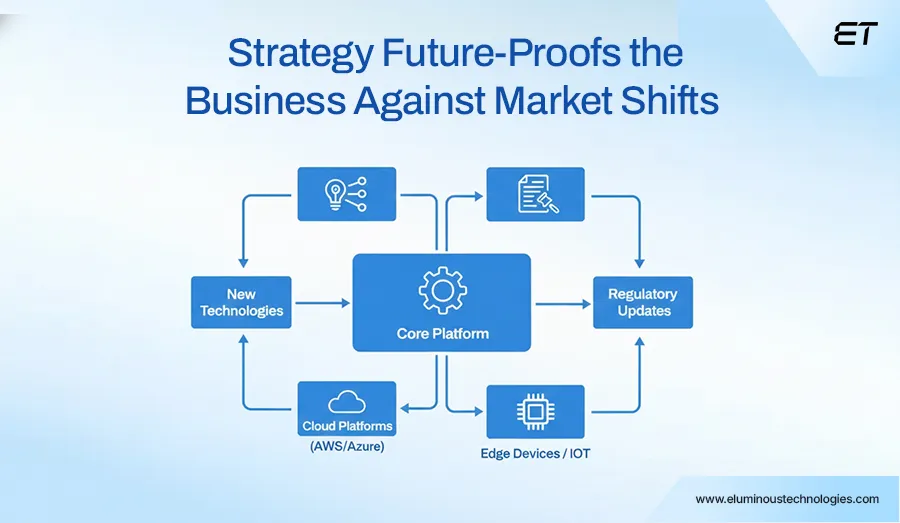
Markets change faster than roadmaps. Regulations, platforms, customer expectations, and technologies evolve constantly.
Without strategy:
- Every change triggers disruption
- New initiatives take months to integrate
- Legacy systems block innovation
With strategy:
- Domain boundaries are explicit (payments, identity, pricing, analytics evolve independently)
- Interfaces are stable (APIs and contracts protect teams from upstream churn)
- Infrastructure is replaceable (vendors, clouds, and frameworks can change without re-architecting the core)
Brand example: Amazon
Amazon’s early decision to enforce API-first development was a long-term software strategy.
That single decision enabled internal scalability and external partner integrations. And all this ultimately led to the creation of AWS, now a multi-billion-dollar business in its own right.
Business lesson: Strategy is what allows software to adapt when the market doesn’t wait.
6. Strategy Strengthens Security, Compliance, and Trust
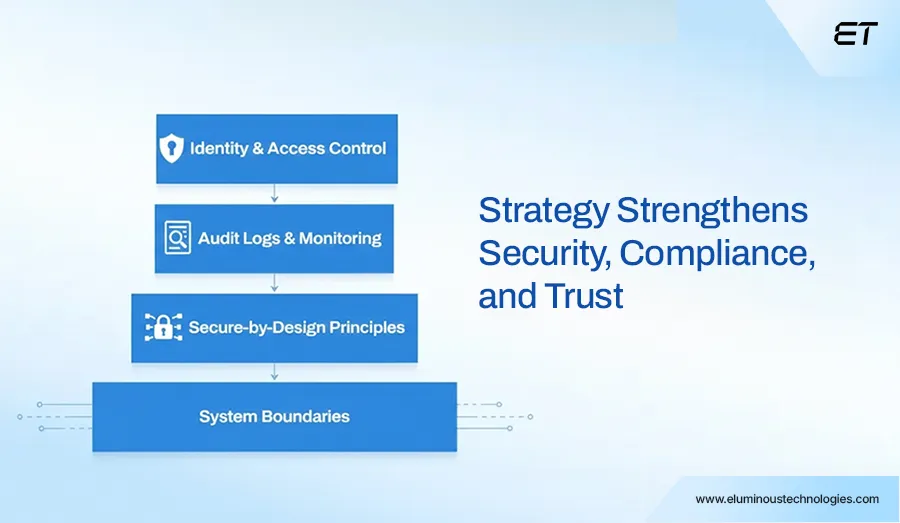
Security breaches and compliance failures are rarely caused by missing tools. They happen due to a missing strategy.
A software development strategy defines:
- Identity and access models
- Data ownership and boundaries
- Auditability and traceability
- Secure-by-design workflows
Brand example: Google
Google’s Zero Trust model (BeyondCorp) is a strategic shift in how software, identity, and infrastructure interact.
This approach enables secure access at scale without relying on traditional network perimeters.
Business lesson: Security added later is expensive. Strategy makes security invisible and effective.
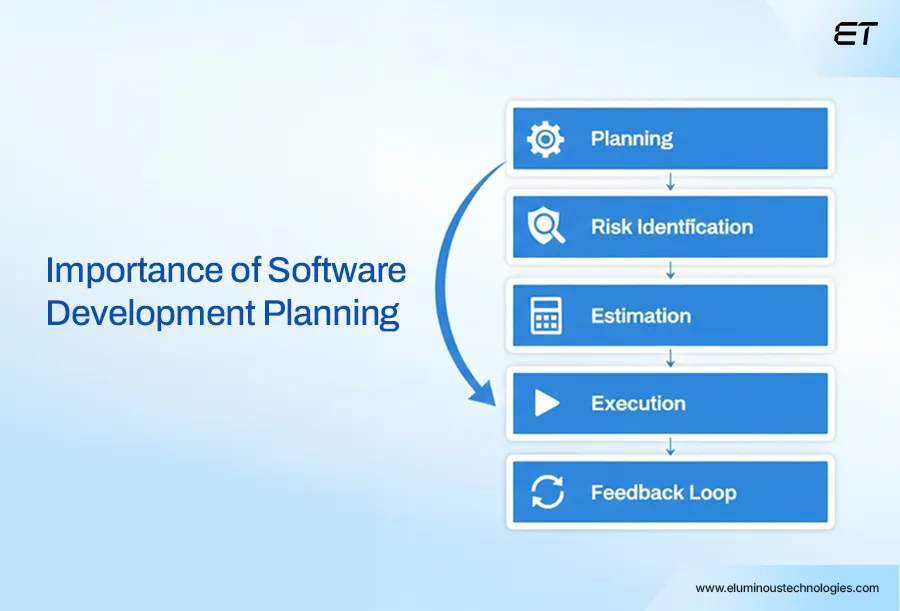
Importance of Software Development Planning
While a software development strategy defines direction, planning translates that direction into coordinated, measurable, and technically feasible actions.
In high-performing organizations, planning is a continuous, feedback-driven process that reduces uncertainty, manages risk, and protects business value.
Poor planning multiplies cost, erodes trust, and increases technical debt.
Strong planning, on the other hand, creates clarity across engineering, product, security, and business teams.
Below are the core reasons software development planning is critical, with real-world examples.
Clear Problem Definition and Technical Scope
Software development planning is where ideas stop being abstract and start becoming buildable systems.
It answers a critical question every technical team faces: What exactly are we building, and under what constraints?
When scope and constraints are unclear, teams make assumptions. Assumptions turn into mismatched components, performance gaps, late-stage rework, and delays that no amount of execution can recover from.
Integrations break because boundaries were never agreed upon. Environments drift because deployment expectations were implicit rather than defined.
A clear problem definition prevents this. It creates shared constraints early, so teams build compatible systems, estimate realistically, and deliver without last-minute surprises.
Without this step, teams don’t just move fast; they move in different directions.
Early Identification of Technical Risks
One of the most underrated truths in engineering is this: one hour of planning can save weeks of rework.
Planning forces teams to examine assumptions early, about data models, concurrency, infrastructure, and dependencies.
For example, thinking through request volume, peak load, and failure scenarios before implementation can prevent painful redesigns once the system is already live.
Improved Estimation and Delivery Predictability
Complexity grows unnoticed until planning exposes it early enough to protect delivery timelines. It highlights hidden dependencies, cross-team handoffs, and architectural pressure points.
Important phrase to remember: If complexity is not visible in planning, it will surface in production.
When teams map workflows, system interactions, and data flows during planning, they uncover risks that would otherwise surface during production incidents.
Architectural Consistency and Technical Alignment
Planning in a software development strategy is about structural coherence. It establishes shared architectural principles, system boundaries, and non-negotiable constraints that guide independent teams toward compatible decisions.
When these constraints are explicit, teams align on how systems evolve, not just what gets built. Trade-offs are made against architecture, not urgency. Risk is understood in terms of long-term system health, not short-term delivery pressure.
A strategic roadmap makes clear:
- Which changes reinforce the architecture
- Which introduces managed risk
- Which violate core system assumptions
This is what creates alignment at scale—not coordination meetings, but a common technical direction that persists beyond individual projects.
Quality, Security, and Reliability by Design
Without planning, quality and security are often treated as post-development concerns. Planning integrates them into the system design from the beginning.
For example, defining authentication flows, authorization boundaries, data encryption requirements, and test strategies early. It ensures that these concerns are embedded into the architecture rather than patched in later.
Controlled Technical Debt and Maintainability
Technical debt is unavoidable, but unmanaged debt is destructive. Planning allows teams to consciously decide where shortcuts are acceptable and where long-term maintainability matters.
By identifying refactoring points and cleanup windows early, debt stays visible and controlled. Rule of thumb: Planned debt is leverage. Unplanned debt is interest.
For instance, planning may allow rapid prototyping with simplified persistence models while clearly defining refactoring milestones before scaling.
Key Elements of a Successful Software Development Strategy
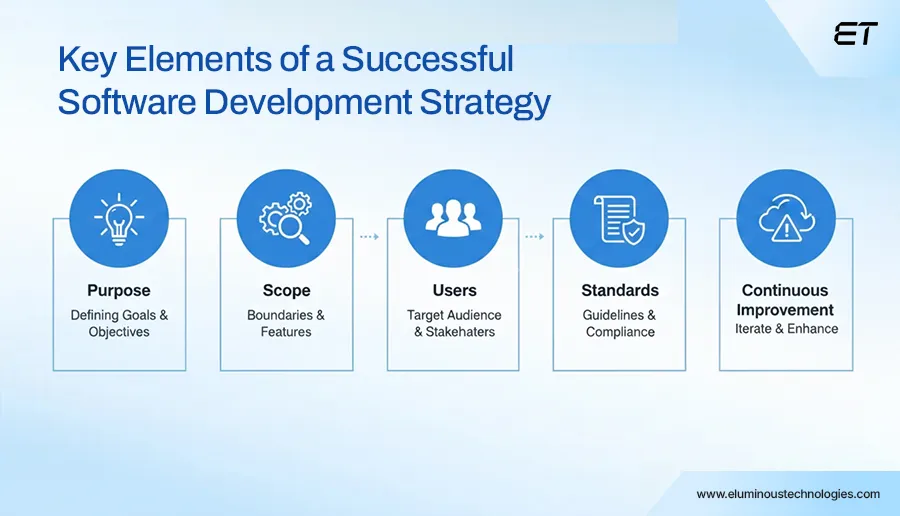
A successful software development strategy is built on multiple foundational elements that work together to guide development efforts and decision-making. This section breaks down the core elements that determine how software is designed, built, scaled, and sustained over time.
1. Clear Purpose and Business Relevance
Every software initiative needs a clearly articulated purpose, because purpose is what constrains complexity. The strategy should explain why the software exists and which problem it is explicitly designed to solve.
When the purpose is unclear, a predictable failure pattern emerges: the system slowly becomes a catch-all. Teams add features to satisfy edge cases, stakeholders optimize for visibility, and the original objective fades. The result is software that is expensive to maintain, lightly used, and difficult to evolve.
Example: An internal system designed to reduce manual paperwork should prioritize automation and accuracy rather than advanced visual features that add little value.
2. Well-Defined Scope and Boundaries
At a strategic level, scope defines where coupling is allowed and where it is forbidden. Clear boundaries prevent a system from becoming a tightly twisted set of features that cannot evolve independently.
Without this discipline, teams optimize locally. By sharing databases, reusing internal APIs for convenience, and embedding cross-domain logic, a single change ripples unpredictably across the system.
Example: In an early-stage learning platform, the strategy may limit features to content delivery and assessments, postponing social interaction features to later phases.
3. Balanced Focus on Users and Systems
Successful strategies balance user needs with technical constraints. While user satisfaction is critical, the system must also be maintainable, secure, and scalable.
Example: A public service portal must be easy to navigate for non-technical users while maintaining robust backend validation and security controls.
4. Technical Standards and Architectural Consistency
Establishing coding standards, architectural guidelines, and documentation practices ensures consistency and long-term maintainability.
This is especially important for projects involving multiple developers or systems that are expected to evolve over time. Standardization reduces confusion, simplifies collaboration, and makes future enhancements easier.
Example: In a multi-developer system, using common naming conventions and a shared architectural pattern allows new team members to understand and modify the codebase without introducing errors.
5. Risk Awareness and Contingency Planning
A strong software development strategy anticipates potential risks such as schedule delays, integration failures, or skill shortages.
Identifying these risks early and preparing contingency plans helps minimize disruption and project failure.
Example: When a project depends on external system integration, having backup workflows or phased integration plans allows development to continue even in the event of delays.
6. Continuous Evaluation and Improvement
Software development strategies should be regularly reviewed and refined to remain effective. Continuous evaluation ensures alignment with changing requirements, technologies, and user expectations, supporting long-term success.
Example: After release, feedback and usage data may lead to adjustments in features, performance improvements, or changes in development practices to better meet user needs.
The 5-Step AI Software Development Strategy
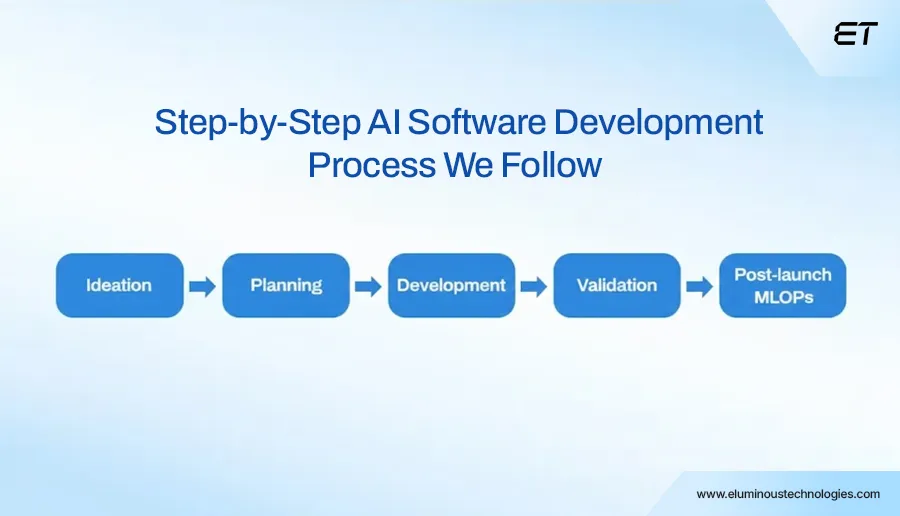
Building high-performance AI systems requires a strategy to address the complexities of model degradation. This 5-step lifecycle ensures that AI remains a scalable asset rather than a technical debt.
1. The Feasibility Audit (Ideation & Discovery)
A successful strategy begins with a technical deep dive into the existing data infrastructure. Before committing to development, stakeholders must conduct a “Data Readiness” assessment.
This involves evaluating whether raw datasets possess the volume, variety, and velocity required to fuel advanced modules such as Deep Learning or Predictive Analysis.
- Strategic Outcome: Move beyond guesswork to determine if the business case requires a ground-up custom model. If a seamless AI integration of existing Large Language Models (LLMs) can achieve the desired utility with a faster time-to-market.
2. Architectural Blueprinting (Planning & Documentation)
In this phase, the strategy shifts from conceptual ideas to a concrete tech stack definition. Choosing between environments such as Python, Ruby on Rails, or Node.js and selecting deployment infrastructure is critical for long-term stability.
- Strategic Outcome: Blueprints must be architected for Global Compliance. Embed security protocols for GDPR, HIPAA, and SOC 2 at the foundational level. This strategy de-risks the transition from a localized pilot program to a scalable, multi-country deployment.
3. AI-Augmented Engineering (Agile Development)
The core of modern AI software development is Accelerated Engineering. By utilizing an Agile framework augmented by “AI in Action” tools, such as SQL Boost for query optimization, development cycles are significantly accelerated.
This allows developers to focus on high-level system logic rather than repetitive testing and low-value implementation work.
- Strategic Outcome: Incorporating Copilot and Generative AI coding assistants can cut delivery cycles by up to 35%. This efficiency allows the engineering team to dedicate more resources to the architecture rather than repetitive code.
4. Logic Validation & QC (Launching & Analysis)
Unlike traditional software, where “if-then” logic is predictable, AI requires a rigorous model validation phase. This involves observing how the AI behaves in a live environment. This ensures how it handles real-world “edge cases” without producing hallucinations or biased outputs.
Strategic Outcome: This stage is critical for Robotic Process Automation (RPA) and autonomous modules. The goal is to ensure the AI’s decision-making logic aligns with business growth objectives before a full-scale rollout.
5. MLOps & Model Maintenance (Post-Launch Support)
The strategy does not end at deployment. AI systems are susceptible to “Model Drift,” a phenomenon in which accuracy decreases as underlying real-world data patterns evolve. A robust strategy treats AI as a living system that requires MLOps (Machine Learning Operations).
- Strategic Outcome: Continuous performance monitoring and 24/7 developer support ensure the system remains relevant. Whether it is optimizing IoT data flows or refining Generative AI responses. Our technical strategy ensures the software evolves with the enterprise AI trends rather than becoming stagnant.
Software Development Strategy Examples
Software development strategies vary depending on project goals, risk levels, and operational context.
The following examples show diverse strategic approaches, each addressing different challenges without relying on a single development pattern.
| Strategy Type | When It’s Applied | Strategic Choice | Resulting Outcome |
| Gradual Feature Expansion Strategy | B2B SaaS, startups, and internal enterprise platforms with uncertain early adoption | Release only core capabilities initially and expand features after validating production stability and user value. | Lower technical debt and architecture informed by real usage patterns |
| Risk-Driven Strategy | Healthcare, fintech, banking, insurance, and government systems handling sensitive data | Establish security architecture, compliance controls, and access governance before feature development. | Faster compliance approvals and minimal post-launch remediation |
| Process Automation Strategy | Manufacturing, logistics, operations, BPO, and back-office heavy industries | Replace human-dependent processes with deterministic, system-driven workflow. | Improved accuracy, operational efficiency, and scalable processes |
| Modular Development Strategy | Enterprise software, platforms, marketplaces, and multi-team engineering environments | Decompose the system into independently deployable, loosely coupled modules. | Faster release cycles and reduced system-wide failure impact |
| User Feedback–Centered Strategy | Consumer apps, SaaS products, EdTech, and e-commerce platforms | Use production analytics and feedback loops to guide prioritisation and iteration. | Higher adoption and reduced investment in low-value features |
Summing Up
Scalable software is not the result of speed alone. It is built through a clear strategy, disciplined planning, and systems designed to absorb change without breaking.
Organizations that invest in software strategy early avoid costly rewrites, reduce risk, and turn engineering effort into sustained business value. As technologies, markets, and user expectations evolve, strategy becomes the difference between software that adapts and software that holds the business back.
The most successful teams treat software as a long-term capability, guided by intentional architectural and delivery decisions.
If your organization is ready to move from reactive development to purposeful execution, the time to act is now.
Is your data AI-ready? Schedule an audit with our lead architects to assess how the development strategy aligns with your goals.


Why Every Manufacturing Plant Needs a Digital Backbone
It’s a complex phase for manufacturing companies. Industry 4.0 is up and running, AI is showing operational gains, but the…


Zero UI Explained: How Technology is Becoming Invisible
Key Takeaways: In Zero UI, users interact with voice, gestures, and motion instead of traditional input methods. The devices understand…


