
 Book a Meeting
Top Manufacturing Web Development Mistakes Companies Make


- Manufacturing websites are not just static digital brochures; they are operational platforms.
- Industrial buyers are looking for detailed information and faster access to technical specifications, certifications, and RFQ workflows.
- Poor product information architecture creates friction for engineers, procurement teams, and distributors.
- Technical SEO and website information directly affect discoverability and buyer engagement.
- Manufacturing web development mistakes often occur when they are approached as short-term marketing assets rather than as long-term digital infrastructure strategy.
Manufacturing companies are investing heavily in automation, ERP modernization, connected supply chains, and digital transformation initiatives. Yet many still operate websites that function as online brochures.
This creates a gap between how the business operates internally and how buyers experience it externally.
Today’s industrial buyers expect far more than basic company information. Engineers need access to technical specifications, certifications, and product documentation. Procurement teams want quick access to supplier information and RFQ processes. Distributors require accurate product data and streamlined communication channels.
When manufacturing websites fail to support these requirements, buyers are forced into manual email exchanges, lengthy phone calls, and additional research before they can make informed decisions.
In this blog, we’ll examine some of the most common manufacturing web development mistakes and explore how you can build websites that better support modern industrial buying journeys.
1. Treating the Website as a Static Digital Brochure
Landing a website that has functions only as an informational brochure is just like reading a traditional printed pamphlet. Here, the primary goal of the website is to validate business credibility rather than building consumer experience.
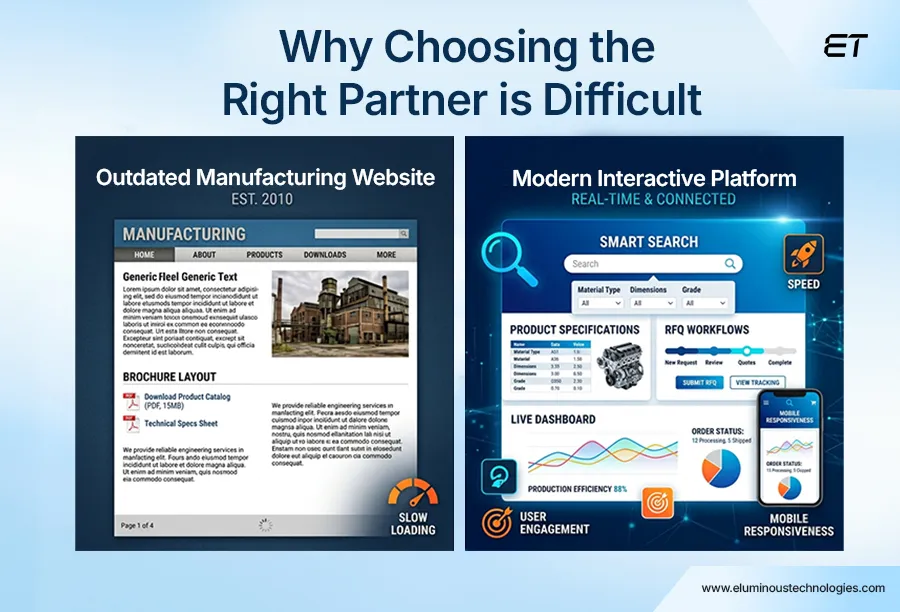
The layout, with a large hero banner and a brief company overview, often focuses on key elements such as downloadable PDFs, contact forms, and corporate branding. This traditional approach to website manufacturing is no longer sufficient. Poor web portal designs limit the ability of buyers to interact with information efficiently.
Today’s manufacturing buyers are expecting more. They are no longer just looking for basic information about your business, but they arrive with the intent of acquiring detailed knowledge about:
- Technical specifications
- RFQs communication with distributors
- Independent resolution of queries
- High-speed performance
- Mobile-first responsiveness
If these needs are not met, they are ready to move on. Now, manufacturing websites are not just isolated marketing assets; they are extensions for sales, customer service, and operations. One of the common manufacturing web development mistakes is assuming consumer needs on a surface level of information.
Companies moving beyond a brochure mindset are seamlessly operating as connected operational ecosystems rather than resorting to manual workarounds via email chains and disconnected sales coordination. They are upgrading their views to measurable analytics and improving lead capture through newsletters or quick sign-ups.
Recognizing these changes at an early stage helps companies to build a platform for a frictionless buyer experience and increase their sales efficiency.
2. Failing to Support Complex B2B Buying Journeys
It is no surprise that manufacturing purchases rarely follow a clean, linear path. Modern purchasing is a non-linear process that includes multi-stakeholder reviews and sometimes months, as the procedure involves layers of compliance verification, financial approvals, and technical reviews.
This buying journey requires input from engineers, plant managers, technical consultants, compliance officers, financial decision-makers, and procurement teams. This signals different perspectives on how to interact with the website’s information at each stage.
An engineer looking for material compatibility data would have a different idea of the website than a procurement officer’s expectation. Yet, most manufacturing websites are designed following the same path from awareness to conversion.
For example, an engineer evaluating industrial pumps may need access to material compatibility information, operating temperature ranges, certifications, and installation documentation before shortlisting a vendor. Meanwhile, a procurement manager may be looking for pricing discussions, lead times, supplier details, and RFQ processes.
When a website cannot support these different information requirements, buyers are forced into back-and-forth emails and scheduled calls simply to gather basic information. This friction slows decision-making and increases the overall cost of sales.
A well-structured website can solve this issue in minutes. It must be designed around the full buying journey, supporting information accessibility, distributor coordination, RFQ workflows, and all other technical needs required for decision-making.
3. Poor Product Catalog and Technical Information Architecture
Poor technical information architecture is one of the most significant challenges that is faced in manufacturing.
It is likely that manufacturing businesses manage thousands of SKUs, region-specific documentation, regulatory certifications, compatibility requirements, and installation manuals. The availability of technical content is enormous. This information often includes CAD files, technical datasheets, compliance certificates, installation manuals, product specifications, compatibility information, and region-specific documentation. When these assets are difficult to find, buyers spend more time searching for information than evaluating products.
And yet, most enterprises fail to organize this information and navigate it in a simple manner for their customers to easily digest the details and search effectively.
This information often includes CAD files, technical datasheets, compliance certificates, installation manuals, product specifications, compatibility information, and region-specific documentation. When these assets are difficult to find, buyers spend more time searching for information than evaluating products.
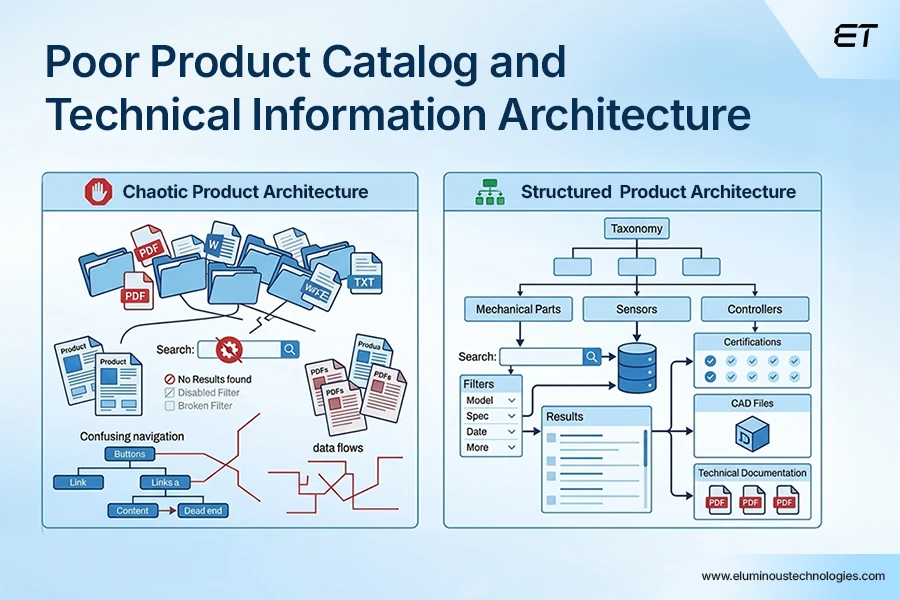
The symptoms of poor architecture are orphaned content, inconsistent product categorization, unstructured technical documentation, feature overload, and a broken filtering system. These become a real breaking point for an engineer trying to find a solution under time pressure.
Further, these loopholes act as a friction in major decision-making. It is not a surprise that many manufacturing web development mistakes emerge because organizations underestimate the complexity of industrial product data management.
Today, manufacturing websites need to treat technical content as an operational infrastructure, and not just a static website. This means investing in a searchable database. Structure specification management, centralized documentation systems, and intelligent categorization.
Addressing these issues requires structured product taxonomies, centralized documentation management, advanced search capabilities, filtering systems, and product information management (PIM) solutions. The goal is to make technical information easily accessible regardless of how large or complex the product catalog becomes.
When technical information becomes easy to find, buyers move fast, and decisions are made. With less friction and easy information availability, consumers don’t need to bury themselves in finding and lifting the heavy weight.
4. Ignoring ERP, CRM, and Legacy System Integrations
Keeping this part of the system in place is going to have major operational impacts. One of the costliest manufacturing web development mistakes is building a website in total isolation, which does not deliver the right information for running the business.
Mostly in enterprises, during the creation of a website, it is developed independently from CRM systems, inventory databases, production management tools, and vector management systems.
The result is inconsistent information across systems. Product availability may be outdated, customer information may exist in multiple databases, RFQ requests may require manual processing, and order status updates may not be visible to customers. These inefficiencies create additional administrative work and negatively impact the buyer experience.
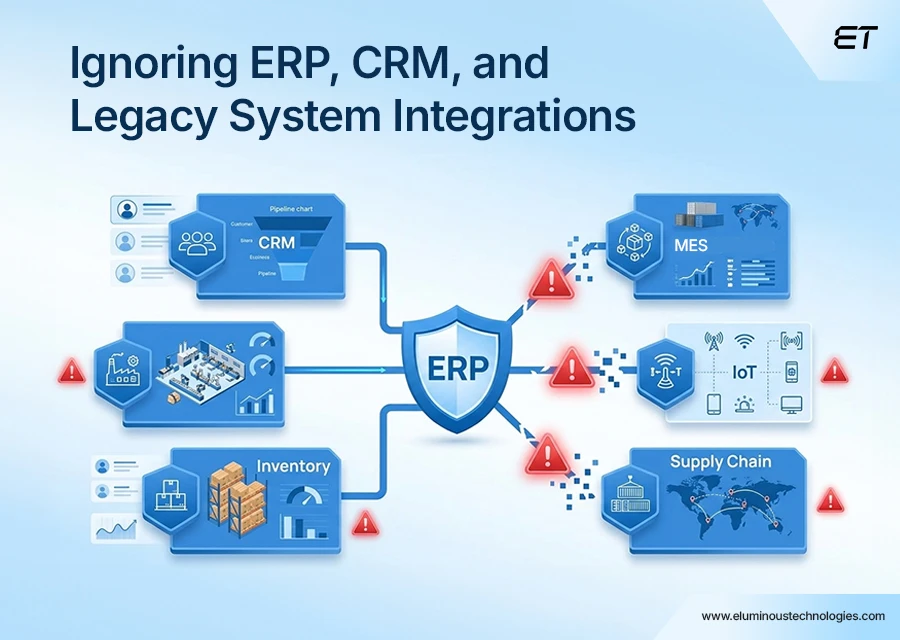
This also impacts stifled innovation, customer disconnects, order and fulfilment bottlenecks, and higher administrative costs.
With changing times and technology, today’s web platforms are capable of building with integration as a base. This leads to real-time data synchronization, centralized operational visibility, API-based architecture, and cross -system interoperability across all customer-facing and backend processes.
The final goal of a manufacturing website should be creating operational continuity and not just working with a system that is connected on a technical level. This helps the buyer to interact with the website and have a seamless experience that supports the organization’s operational infrastructure behind it.
5. Designing for Aesthetics Instead of Industrial Usability
There is an imperative attention in manufacturing web development to build a visually appealing and impressive website that shows the functional reality of how industrial buyers actually use it.
Many manufacturing websites heavily invest in large animations, immersive visual effects, marketing-forward interfaces, and minimalist layouts. These details may create a visual appeal for customers, but they do not necessarily create a usability barrier for professionals who are looking for effective information. This remains one of the most overlooked manufacturing web development mistakes across industrial sectors.
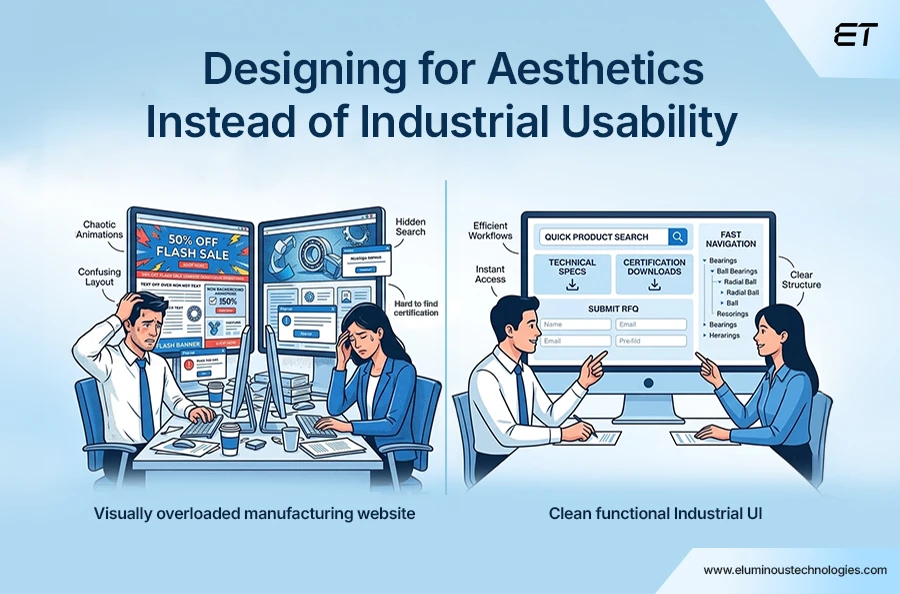
Engineers, procurement professionals, technical consultants, distributors, and operational teams visit manufacturing websites with a high intention of specific objectives. This can include locating a technical document, comparing specifications, verifying certifications, downloading a CAD file, and submitting an RFQ. These precision tasks require direct information with designs that do not break the user experience.
They are trying to complete specific tasks quickly, such as downloading a CAD file, comparing product specifications, verifying certifications, locating distributor information, or submitting an RFQ. Every unnecessary click, animation, or navigation obstacle increases friction and makes those tasks harder to complete.
Successful manufacturing web development innovates and achieves something deceptively simple. They are able to make things fast and easy for highly knowledgeable buyers who are looking for specific information. This simplicity, executed well, is a competitive advantage in an industry where even a small missing detail can prove to be expensive.
6. Building Non-Scalable Web Architectures
Investing in manufacturing web development without planning where the business will be in the next three to five years is a short-term mindset. Not preparing for digital infrastructures for long-term scalability is one of the biggest manufacturing web development mistakes.
This is an understandable instinct. In manufacturing, operations are continuously evolving alongside product diversification, market expansion, digital transformation, and global growth. A website created without consideration of the growth and changes factor becomes a liability faster than most organizations anticipate.
Some of the early signs that a website is not able to perform are increasing downtime, content management limitations, and broken integrations when the backend systems are updated. This can happen in cases when a new geographic location is added to the market or a dealer portal is added. Doing so leads to development teams spending on workarounds rather than on growth. It increases the time invested while technical debt accumulates quietly.
Today, manufacturing web development needs to prioritize API-first, modular, cloud-native architectures from the outset. These should be built with flexible CMS frameworks, integration-ready ecosystems, modern programming languages, and scalable database structures that can accommodate future complexity.
Here, the goal should not be only to meet current operational requirements, but to build an infrastructure capable of adapting to changes in the business. Doing so will directly help organizations to spend less on redevelopment.
Endnote: Manufacturing Web Development Mistakes
Manufacturing web development mistakes introduce friction throughout the buyer journey. This cycle starts from product discovery and technical evaluation and ends at RFQ submission and distributor communication.
Over time, that friction increases sales costs, slows purchasing decisions, creates operational inefficiencies, and limits the organization’s ability to scale digital initiatives effectively.
Manufacturers that view their websites as connected business platforms rather than standalone marketing assets are better positioned to support modern buyers, improve operational visibility, and create more efficient customer experiences.
At eLuminous Technologies, we help manufacturing companies build scalable, integration-ready digital platforms that align with operational goals and support long-term business growth.
Ready to Scale your Manufacturing Website?

MVP vs MLP: A Practical Framework for Product Teams
Summary Every successful product begins with a question: What is the smartest way to bring this idea to life? For product…


Monolithic vs. Microservices- A Deep Dive for Modern Architects
Every outage has an architecture behind it. The way a system is designed, how its components interact, scale, and recover,…


