
 Book a Meeting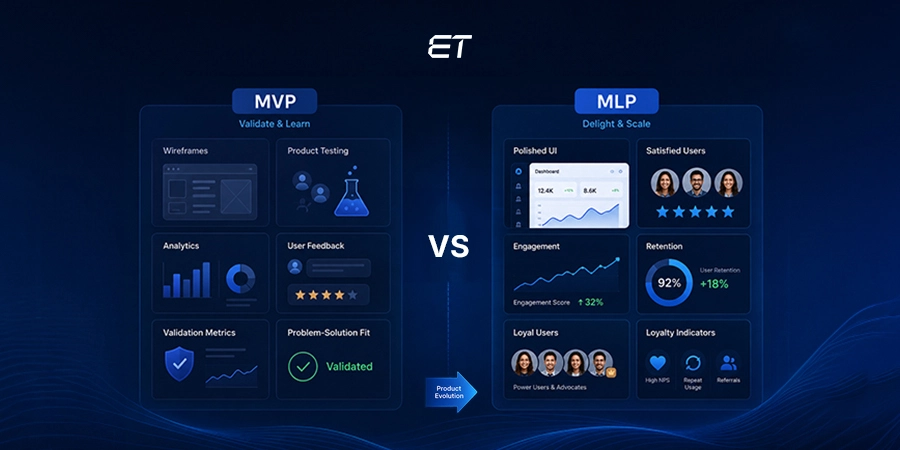
Every successful product begins with a question: What is the smartest way to bring this idea to life?
For product leaders, founders, and technology teams, the answer often comes down to two approaches: the Minimum Viable Product (MVP) and the Minimum Lovable Product (MLP). While the terms are frequently used together, they serve very different purposes.
An MVP helps teams test assumptions, validate demand, and reduce the risk of investing heavily in an unproven idea. An MLP, on the other hand, focuses on creating an experience that users genuinely enjoy. It’s the one that encourages them to return, engage, and recommend the product to others.
The choice between MVP vs MLP is about understanding what your product needs at a particular stage of its journey. In many cases, the most successful products begin as MVPs and gradually evolve into MLPs as market demand becomes clearer and user expectations grow.
Imagine you’ve identified a promising opportunity. The problem is real, the market appears attractive, and stakeholders are eager to move forward. Yet one critical question remains:
How much product should you build before putting it in front of users?
Build too little, and customers may fail to see the value. Build too much, and you risk investing months of time and budget into features nobody truly wants.
This is where two widely used product development approaches enter the conversation: the Minimum Viable Product (MVP) and the Minimum Lovable Product (MLP).
An MVP helps teams validate assumptions with the smallest functional version of a product. Its purpose is not perfection but learning. An MLP takes the idea a step further by delivering an experience that users not only find useful but genuinely enjoy using.
The debate between MVP vs MLP is misunderstood as a choice between two competing frameworks. But they solve different business problems. One helps answer whether a product should be built, while the other focuses on creating an experience that encourages users to stay, engage, and return.
Understanding the difference can help product leaders make smarter decisions about investment, risk, user expectations, and long-term growth. In this guide, we’ll explore how MVPs and MLPs work, where each approach fits, and how to choose the right strategy for your next product initiative.
What Is an MVP?
Every product idea begins with a degree of uncertainty.
A founder may believe customers need a solution. A product team may be convinced a feature will solve a pressing problem. Investors may see market potential. Yet until real users interact with the product, these assumptions remain assumptions.
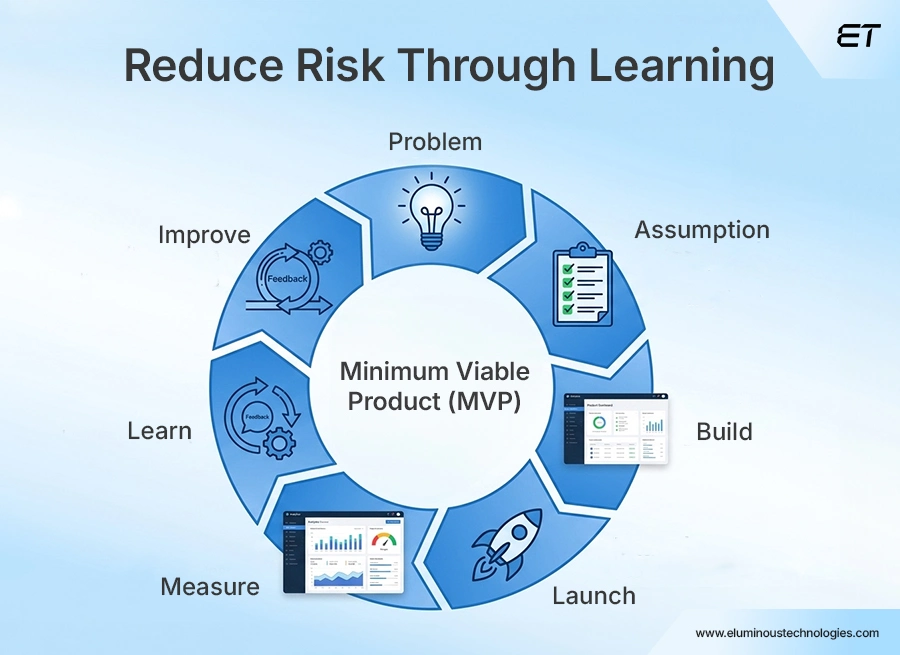
This is where a Minimum Viable Product (MVP) comes in.
| An MVP is the simplest version of a product that delivers core value to users while allowing teams to validate their assumptions with real-world feedback. Rather than building a fully featured product from the outset, teams focus on solving one important problem well and learning from actual user behavior. |
The purpose of an MVP is to answer critical business questions before making larger investments.
Questions such as:
- Will customers use this solution?
- Does the problem truly exist at the scale we believe?
- Which features create the most value for users?
- Is there a viable path to revenue and growth?
Think of an MVP as a carefully planned expedition rather than a final destination. Its role is to help teams explore unfamiliar territory, identify risks early, and gather evidence before committing significant resources.
For this reason, MVPs deliberately avoid unnecessary complexity. Every feature, workflow, and development decision serves a single purpose: learning what matters most to users.
A common misconception is that an MVP is simply a cheap or unfinished version of a product. In reality, an effective MVP must still solve a genuine problem and deliver enough value for users to engage with it meaningfully. The goal is to build only what is necessary to validate demand, reduce uncertainty, and guide future product decisions.
What Is an MLP?
Imagine walking into two cafés.
The first serves excellent coffee but offers an uncomfortable chair, poor service, and a forgettable atmosphere. The second serves equally good coffee, but the experience feels welcoming, thoughtful, and effortless from the moment you walk through the door.
Both cafés solve the same problem. Yet one is far more likely to earn your loyalty.
The same principle applies to digital products.
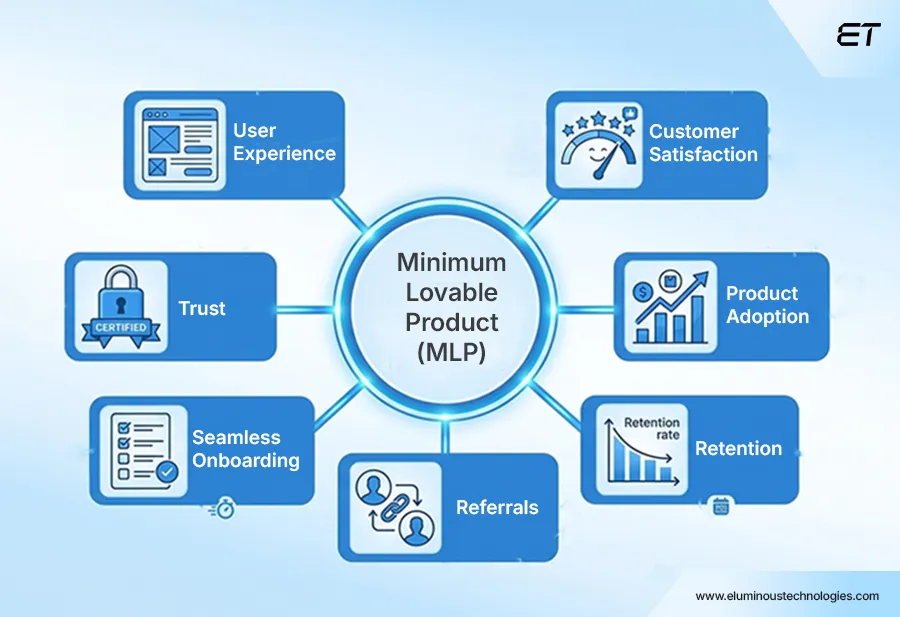
| A Minimum Lovable Product (MLP) is a product with the minimum set of features required to create meaningful value while delivering an experience users genuinely enjoy. Unlike an MVP, which focuses primarily on validating assumptions, an MLP places greater emphasis on adoption, engagement, and retention. |
The key question behind an MLP is not simply:
“Does this product work?”
Instead, it asks:
“Does this product create enough value and satisfaction for users to come back?”
This does not mean adding countless features or polishing every detail to perfection. In fact, successful MLPs remain remarkably focused. The difference lies in how thoughtfully the experience is designed: from usability and onboarding to responsiveness, design consistency, and customer delight.
As a result, teams evaluating an MLP often ask questions such as:
- Will users return after their first experience?
- Does the product solve the problem in a way that feels intuitive and enjoyable?
- Are users likely to recommend it to others?
- Does the experience encourage long-term engagement?
An MLP recognizes a simple reality: in many markets, functionality alone is no longer enough. Users have countless alternatives at their fingertips. If a product solves a problem but creates frustration along the way, adoption can quickly stall.
By focusing on both value and experience, an MLP helps organizations move beyond validation and begin building customer loyalty from the earliest stages of product growth.
MVP vs. MLP: Understanding the Core Difference
At first glance, MVPs and MLPs can appear remarkably similar. Both aim to bring a product to market without unnecessary complexity. Both focus on delivering value with a limited set of features. Yet the questions they seek to answer are fundamentally different.
An MVP asks:
“Should we build this product?”
An MLP asks:
“Will people love using this product enough to come back?”
This distinction may seem subtle, but it has a significant impact on product strategy, investment decisions, and user adoption.
Consider a B2B project management platform.
An MVP version might include only the essentials:
- Creating projects
- Assigning tasks
- Setting deadlines
- Tracking progress
The goal is not to impress users with sophisticated functionality. The goal is to validate whether teams actually need the solution and whether the product solves a meaningful problem.
Now imagine that early demand has been validated.
The next challenge is no longer proving the idea works. The challenge becomes encouraging users to adopt the platform as part of their daily workflow.
This is where MLP thinking begins to emerge.
The team may improve onboarding, simplify navigation, introduce smart task suggestions, enhance collaboration workflows, and create a more intuitive user experience. The objective is to make the product easier, faster, and more enjoyable to use.
The difference can be summarized as follows:
| Factor | MVP | MLP |
| Primary Goal | Validate assumptions | Drive adoption and retention |
| Core Question | Should we build it? | Will users keep using it? |
| Focus | Learning and validation | User experience and engagement |
| Success Metric | Evidence of market demand | User satisfaction and retention |
| Risk Addressed | Building something nobody wants | Building something users abandon |
| Ideal Stage | Early product discovery | Post-validation growth |
| User Expectations | Functional and valuable | Functional, valuable, and enjoyable |
Importantly, MVP vs MLP are not competing approaches.
In many successful products, they represent different chapters of the same story.
Teams begin with an MVP to reduce uncertainty and validate demand. Once confidence grows, they evolve the product into an MLP by refining the experience, strengthening engagement, and creating reasons for users to stay.
In other words, an MVP helps you discover whether a product deserves to exist. An MLP helps ensure it deserves to succeed.
A Real-World Example: How Dropbox Started with an MVP
One of the most frequently cited examples of MVP thinking is Dropbox.
Today, Dropbox serves millions of users worldwide and offers a polished experience across devices. However, the company did not begin by building a fully featured file-sharing platform.
Instead, founder Drew Houston faced a challenge: people were not convinced they needed another file storage solution. Before investing heavily in product development, he needed to validate whether the problem was significant enough to justify building the product.
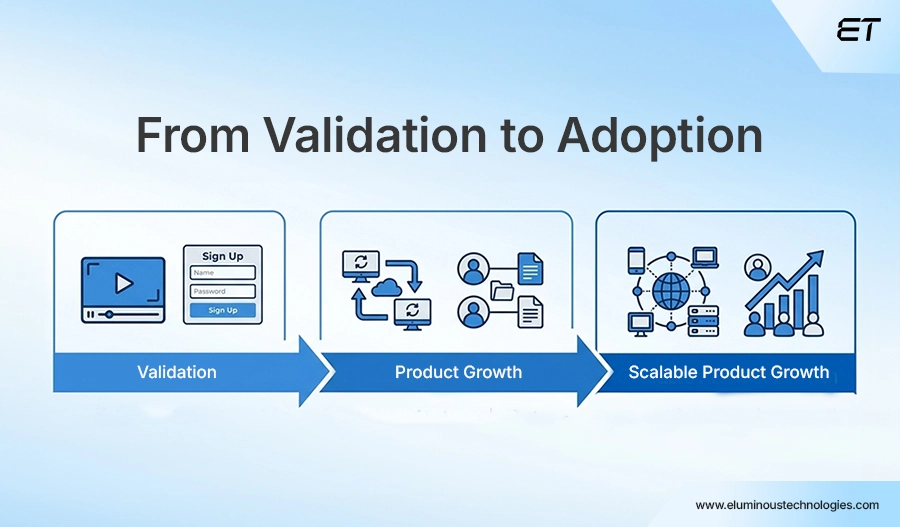
Rather than creating every feature from day one, Dropbox launched with a simple demonstration video that showed how the product would work and the value it would provide. The response was overwhelming. Interest surged, sign-ups increased, and the company gained valuable evidence that demand existed.
The lesson was clear: before perfecting the experience, the team first validated the problem.
As Dropbox matured, the focus gradually shifted. Features such as seamless synchronization, intuitive sharing, reliability, and ease of use became critical to customer retention and long-term growth. Validation alone was no longer enough. The product needed to become effortless and enjoyable to use.
In many ways, Dropbox followed the same journey many successful products take today: start by validating demand through MVP thinking, then evolve the experience using MLP principles as the product grows.
This highlights an important reality: MVP vs MLP are not competing strategies. They are different stages in building a product that customers both need and want to keep using.
Why MVPs Remain Essential and Why User Experience Matters More Than Ever
For more than a decade, the MVP has been one of the most influential concepts in product development.
The reasoning is simple. Before investing heavily in engineering, design, and go-to-market efforts, organizations need evidence that a real problem exists and that customers are willing to adopt a solution.
An MVP provides that evidence.
By releasing a focused version of a product, teams can observe how users behave, identify what truly matters, and avoid spending months building features that add little value. Instead of relying on assumptions, they can make decisions based on real-world feedback.
This approach helps answer important questions:
- Are we solving a problem worth solving?
- Do users understand the value of our product?
- Which features create the greatest impact?
- Where should we invest next?
For these reasons, MVPs remain a cornerstone of modern product strategy.
However, the environment in which products compete has changed dramatically.
A decade ago, users were often willing to tolerate clunky interfaces, confusing workflows, and rough edges if a product solved an important problem. Today, expectations are considerably higher.
Users compare every digital experience against the best products they use every day. Whether it’s a collaboration platform, a banking app, or a project management tool, people increasingly expect products to be intuitive, responsive, and easy to adopt.
Several factors have accelerated this shift:
- Rising user expectations across digital experiences
- Instant feedback through reviews, communities, and social platforms
- Increased competition in nearly every software category
- Lower switching costs between competing solutions
As a result, product success is no longer determined solely by functionality.
A product may solve a genuine problem and still struggle if the experience feels frustrating, confusing, or forgettable. Conversely, products that combine utility with a thoughtful user experience often gain stronger adoption and retention.
This changing landscape has not reduced the importance of MVPs. Instead, it has encouraged product teams to think more carefully about what happens after validation.
Once a product proves there is demand, the next challenge becomes creating an experience users choose to return to. And that is where MLP thinking begins to play a larger role.
When Does an MLP Make Sense?
Not every product needs to begin as a Minimum Lovable Product.
In many cases, teams benefit from validating demand through an MVP before investing heavily in experience design and product refinement. However, once the fundamentals are proven, the conversation begins to shift.
The question is no longer:
“Will people use this?”
Instead, it becomes:
“Why will they keep using this instead of a competitor’s product?”
This is where an MLP can create significant business value.
1. You’re Operating in a Competitive Market
When multiple products solve the same problem, functionality alone rarely creates a lasting advantage.
Customers gravitate toward products that are easier to learn, more intuitive to use, and more enjoyable to interact with. In crowded markets, user experience can become a powerful differentiator.
2. Retention Matters More Than Initial Adoption
Acquiring users is expensive.
Whether you’re investing in marketing, sales, partnerships, or customer success, every new customer represents a cost. If users abandon the product after their first few interactions, growth becomes difficult to sustain.
An MLP helps improve retention by creating experiences that encourage users to return and build long-term habits around the product.
3. Customer Experience Shapes Brand Perception
Every interaction contributes to how customers perceive your organization.
A confusing onboarding process, inconsistent workflows, or frustrating user experience can undermine even the most innovative product. Conversely, a thoughtful and intuitive experience can strengthen trust and credibility from the very beginning.
4. Network Effects Drive Growth
Some products become more valuable as more people use them.
Collaboration platforms, social applications, marketplaces, and community-driven products often rely on engagement and advocacy to grow. In these cases, creating a positive user experience is essential because satisfied users are more likely to invite others, share the product, and contribute to its growth.
Ultimately, MLP thinking becomes most valuable when product success depends not only on solving a problem, but on creating an experience users actively choose to return to.
Example: Why Notion Couldn’t Rely on Functionality Alone
Consider the rise of Notion.
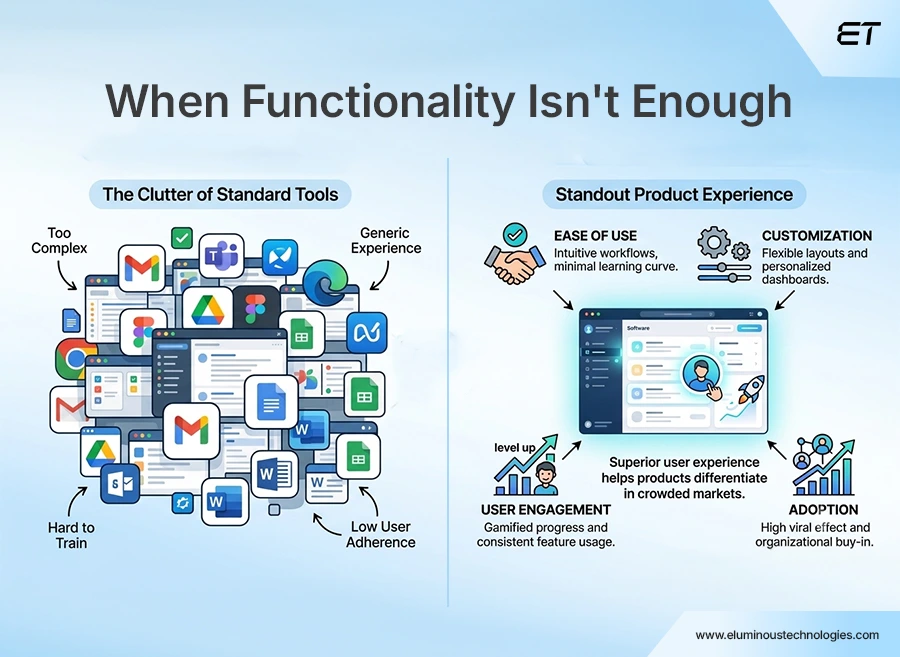
The productivity software market was already crowded when Notion entered the space. Users had access to note-taking tools, project management platforms, document collaboration software, and knowledge management systems.
Simply offering another productivity tool would not have been enough.
What helped Notion stand out was the experience it created. The product combined flexibility, simplicity, visual appeal, and ease of customization in a way that felt different from many alternatives. Users enjoyed building workflows, organizing information, and sharing their workspaces with others.
This illustrates an important MLP principle: when multiple products solve similar problems, user experience can become a competitive advantage.
The goal is creating an experience users prefer over available alternatives.
MVP vs MLP: How to Choose the Right Approach
By now, one thing should be clear: neither an MVP nor an MLP is inherently better.
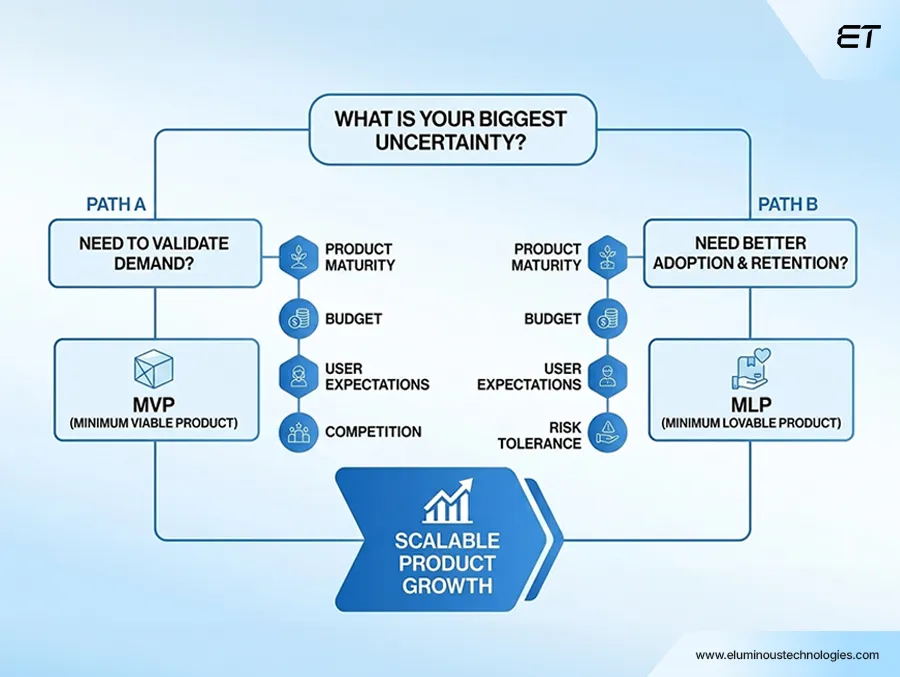
The right choice depends on what your business needs to learn, achieve, or de-risk at a particular stage of product development.
A useful way to think about the decision is to ask:
“What is our biggest uncertainty right now?”
If your greatest uncertainty is whether customers actually need the product, an MVP is usually the better starting point.
If your greatest uncertainty is whether users will adopt, engage with, and remain loyal to the product, an MLP may deserve greater consideration.
The following framework can help guide the decision:
| If Your Priority Is… | Consider an MVP | Consider an MLP |
| Validating a new idea | ✓ | |
| Testing product-market fit | ✓ | |
| Minimizing upfront investment | ✓ | |
| Entering an unproven market | ✓ | |
| Increasing user retention | ✓ | |
| Differentiating from competitors | ✓ | |
| Strengthening customer loyalty | ✓ | |
| Improving adoption and engagement | ✓ |
When making the decision, evaluate the following factors carefully:
Business Objectives
Are you trying to validate an idea or scale an existing opportunity?
Early-stage products often benefit from MVP thinking, while established products typically gain more value from MLP principles.
Customer Expectations
How tolerant are your users of imperfections?
Some markets prioritize functionality above all else. Others expect polished experiences from day one. Understanding your audience can significantly influence the right approach.
Budget and Timeline
Every product initiative operates within constraints.
An MVP helps reduce risk when budgets are limited or market uncertainty is high. An MLP often requires greater investment in user experience, design, onboarding, and refinement.
Competitive Pressure
In highly competitive markets, simply solving a problem may not be enough.
When users have multiple alternatives, experience can become a deciding factor.
Risk Tolerance
Organizations vary in how much uncertainty they are willing to accept.
If the cost of building the wrong product is high, MVPs provide a structured way to learn before making larger commitments. If demand is already proven, investing in an MLP can help maximize adoption and long-term growth.
The best approach is the one that aligns most closely with your business goals, customer needs, and stage of product maturity.
MVP vs MLP: The Cost of Choosing the Wrong Strategy
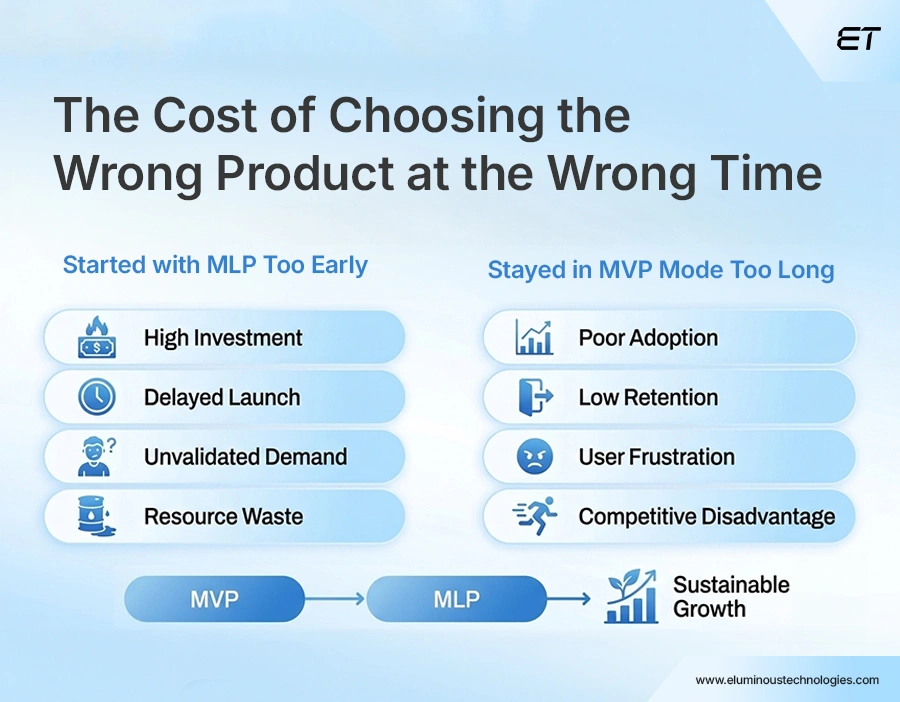
The real risk of MVP vs MLP comes from applying the wrong approach at the wrong stage of product development.
A team that focuses on validation when users are demanding a better experience may struggle with adoption. Conversely, a team that invests heavily in polish before validating demand may waste valuable time and resources.
Understanding these trade-offs can help organizations avoid some of the most common product development mistakes.
Overbuilding before Validation
One of the most expensive mistakes product teams make is assuming demand exists before proving it.
Organizations sometimes invest heavily in advanced features, sophisticated user experiences, and large-scale development efforts without first confirming that customers actually need the product.
When demand fails to materialize, the result is often months of wasted effort and significant financial loss.
This is precisely the type of risk an MVP is designed to reduce.
Underinvesting in User Experience
The opposite problem can be equally damaging.
A product may solve a genuine problem and still struggle in the market if users find it confusing, frustrating, or difficult to adopt.
In competitive markets, functionality alone is rarely enough. Users often compare experiences as much as features, and poor usability can lead to low retention even when the underlying solution is valuable.
Accumulating Technical Debt through Short-Term Decisions
Speed can be valuable, but reckless speed often creates long-term consequences.
When teams prioritize rapid delivery without considering scalability, maintainability, or future growth, technical debt begins to accumulate. Over time, this can slow development, increase costs, and make future enhancements more difficult.
The goal is not to build perfect architecture from day one, but to make thoughtful decisions that support future growth.
Rising Customer Acquisition and Retention Costs
Acquiring customers is only half the battle.
If users abandon the product shortly after signing up, organizations are forced to spend more on marketing and sales simply to replace lost customers.
Products that combine strong functionality with a positive user experience are generally better positioned to retain users, improve customer lifetime value, and reduce long-term acquisition costs.
Finding the Right Balance
Successful product development is rarely about choosing MVP or MLP exclusively.
Instead, it involves understanding what the business needs most at a particular moment.
When uncertainty is high, validation should come first.
When demand is proven, experience becomes increasingly important.
The most successful product teams know when to focus on learning, when to focus on delighting users, and how to balance both without overengineering or underdelivering.
To Wrap Up
Choosing between an MVP vs MLP is about understanding what your product needs most at a particular stage of its journey.
When uncertainty is high, an MVP helps reduce risk. It allows teams to validate assumptions, test market demand, and gather real-world feedback before making significant investments.
Once demand is proven, the challenge begins to change. Success is determined by whether users continue to choose it over competing alternatives. This is where MLP thinking becomes increasingly valuable, helping organizations improve adoption, engagement, and long-term retention.
The most successful products begin as MVPs, evolve through continuous learning, and gradually incorporate MLP principles as user expectations and business objectives mature.
For technology leaders, the goal is not simply to launch faster or build more features. It is to make informed decisions at every stage of product development: balancing validation, user experience, business value, and sustainable growth.
At eLumious Technologies, we help organizations navigate every phase of that journey. From product discovery and MVP development to user experience optimization and scalable product engineering, our teams work closely with businesses to transform ideas into products that customers value and continue to use.
Whether you’re validating a new idea or creating an experience users will love, success depends on making the right decisions at the right stage.

Top Manufacturing Web Development Mistakes Companies Make
Key Takeaways: Manufacturing Web Development Mistakes Manufacturing websites are not just static digital brochures; they are operational platforms. Industrial buyers…

Monolithic vs. Microservices- A Deep Dive for Modern Architects
Every outage has an architecture behind it. The way a system is designed, how its components interact, scale, and recover,…


