
 Book a Meeting
ServiceNow Change Management: How to Scale IT Without Increasing Risk


Uncontrolled IT changes are one of the most common causes of production outages. Whether it’s a failed security patch, an untested deployment, or a slow, manual approval process, even small changes can trigger cascading failures across interconnected systems.
As organizations scale, change management becomes a governance challenge. Teams are no longer dealing with isolated updates but with complex environments where every change carries downstream impact.
This is where ServiceNow change management brings structure. It standardizes how changes are requested, assessed, approved, and implemented while using CMDB insights to improve impact analysis, centralize communication, and support compliance requirements.
In this blog, we break down how the workflow operates, where enterprises struggle at scale, and the best practices to balance speed, control, and risk effectively.
What is ServiceNow Change Management?
ServiceNow Change Management is an ITIL-aligned application that provides a structured approach to managing the full lifecycle of IT changes from initial request and risk assessment to approval, implementation, and post-deployment review.
It ensures that changes are executed in a controlled manner, minimizing disruption to services while maintaining operational stability.
The primary goals of ServiceNow change management include:
- Standardizing change processes across teams
- Maintaining end-to-end visibility across the change lifecycle
- Assessing risk and impact before execution
- Enforcing governance through structured approval workflows
At its core, it helps organizations balance the need for speed with the need for control ensuring systems remain stable even as the business evolves.
How Does the Change Management Workflow Operate?
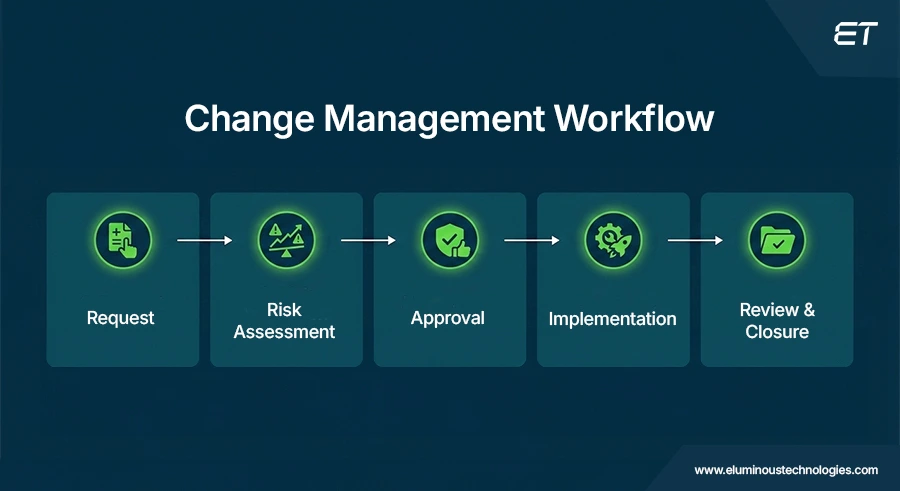
The ServiceNow change management workflow consists of defined stages that guide a change from request to closure in a controlled and auditable manner.
This structured process ensures that changes are not only implemented efficiently, but also aligned with business priorities, risk tolerance, and compliance requirements.
Here’s a breakdown of how a typical workflow operates:
Submitting a Change Request
Every change begins with a formal request that captures key details such as objectives, scope, affected systems, timelines, and business justification.
At this stage, the focus is on establishing context and dependencies early. This typically involves linking the request to related incidents or problems and reviewing CI relationships in the CMDB to understand potential downstream impact.
Assessing Risk & Impact
Once submitted, the change is evaluated for risk and impact using predefined criteria, historical data, and CI relationships.
This step determines how critical the change is and what level of scrutiny it requires. Key activities include validating the request, analyzing potential service impact, and routing it to the appropriate stakeholders for review.
Approval Workflow
Changes are routed through an approval process based on their risk level and type. High-risk or complex changes typically require review by the Change Advisory Board (CAB), while lower-risk changes follow streamlined or pre-approved workflows.
Stakeholders such as system owners, technical leads, and business managers review the change to ensure it aligns with operational priorities, risk tolerance, and compliance requirements.
Implementation
After approval, the change is executed according to predefined plans, timelines, and rollback procedures.
ServiceNow enables teams to track progress in real time, send automated notifications, and maintain detailed activity logs for audit and compliance purposes. The focus here is on controlled execution following approved steps while monitoring for unexpected issues.
Review & Closure
Once implemented, the change undergoes a post-implementation review (PIR) to evaluate its success, identify any issues, and capture lessons learned.
If the change fails or introduces risk, a rollback (backout) plan is executed to restore the previous state. All outcomes (successful or not) are documented to improve future change decisions and reduce repeat incidents.
Types of Changes in ServiceNow: Their Strategic Impact
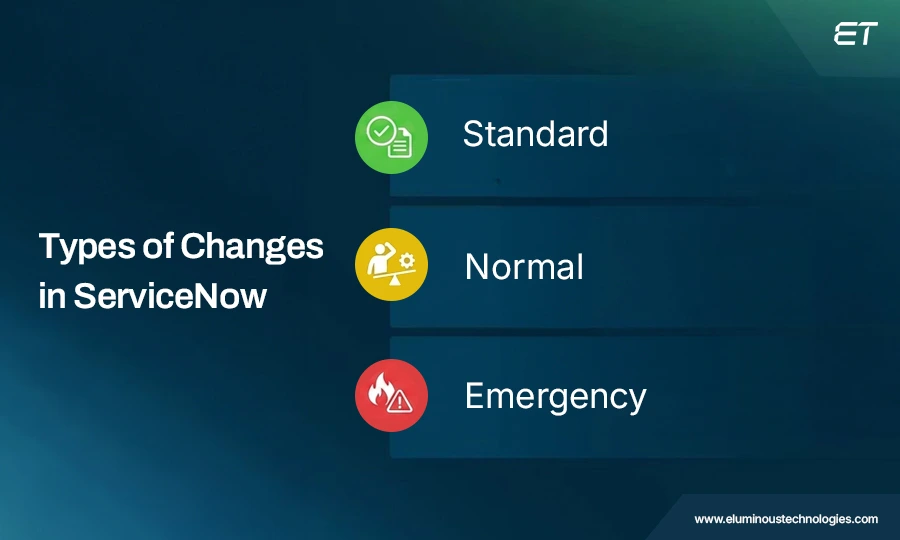
ServiceNow classifies changes into different types based on risk, urgency, and complexity. Each type follows a distinct workflow and approval model, making it critical for organizations to apply the right level of control without slowing down delivery.
Standard Changes
Standard changes are pre-approved, low-risk, and repeatable. Common examples include routine server reboots or predefined firewall updates.
Because these changes follow documented procedures and have predictable outcomes, they can be executed with minimal oversight. Strategically, increasing the volume of standard changes allows organizations to accelerate delivery while reducing operational overhead and approval bottlenecks.
Normal Changes
Normal changes require formal risk assessment and approval before implementation. These typically involve moderate to high complexity and potential impact on services.
Depending on the level of risk, they may require review by the Change Advisory Board (CAB) or other stakeholders. This category is critical for enforcing governance, ensuring proper impact analysis, and reducing the likelihood of service disruptions.
Emergency Changes
Emergency changes are executed in response to critical incidents where immediate action is required such as restoring a failed service or rolling back a faulty deployment.
While speed is prioritized, these changes carry higher risk due to limited time for assessment and testing. The focus here is on restoring service quickly, followed by thorough documentation and retrospective review to maintain compliance and prevent recurrence.
Why Change Management Fails at Scale?
ServiceNow change management breaks down at scale because organizations treat it as a tool to implement. As IT environments grow more complex with thousands of configuration items, legacy systems, and distributed teams, small gaps in process or data quickly turn into systemic failures.
Here are the most common points where change management starts to fall apart:
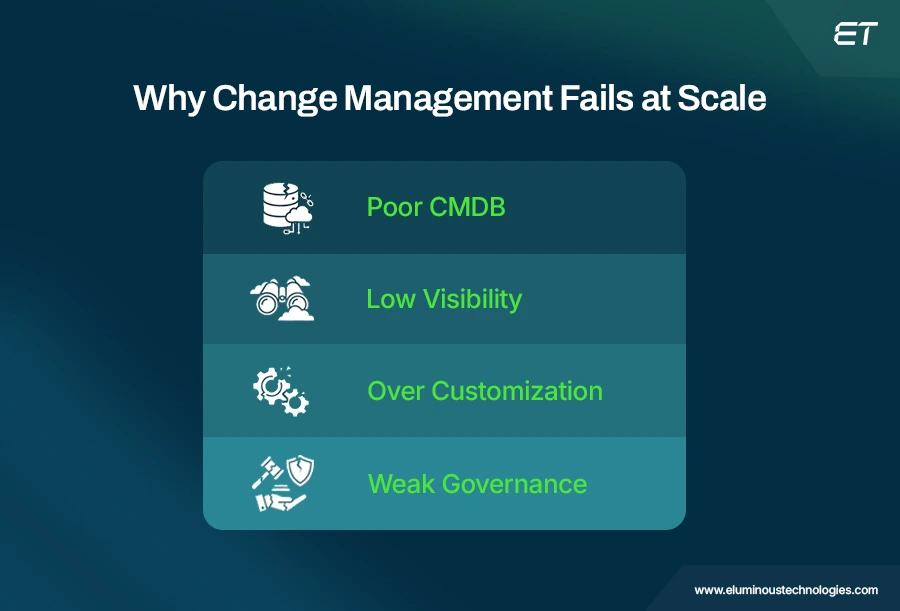
Lack of Governance and Workflow Discipline
Without clear ownership and governance, change workflows become inconsistent and difficult to manage.
Over-reliance on manual approvals slows down change velocity, while different departments (such as HR, security, or infrastructure teams) often introduce their own variations of the process. The result is fragmented workflows that are hard to standardize and even harder to scale.
Low CMDB Quality
Effective change management depends on accurate, reliable data. When the CMDB is incomplete, outdated, or poorly maintained, risk assessment becomes guesswork.
Inaccurate CI relationships and weak dependency mapping lead to flawed impact analysis resulting in change collisions, unexpected outages, and failed deployments.
Limited Operational Visibility
At scale, teams need real-time visibility into change status, risk levels, and outcomes across the organization.
Without centralized dashboards and reporting, leadership lacks the insight needed to make informed decisions. This creates delays, misalignment, and increased risk during execution.
Excessive Customization
While ServiceNow is designed to be configurable, excessive customization, especially early on, creates long-term complexity and technical debt.
Over-customized workflows become harder to maintain, upgrade, and standardize, ultimately slowing down change processes instead of improving them.
These challenges point to a broader issue: successful change management is about operationalizing it with the right processes, data, and governance in place.
Optimizing ServiceNow Change Management: Best Practices that Work
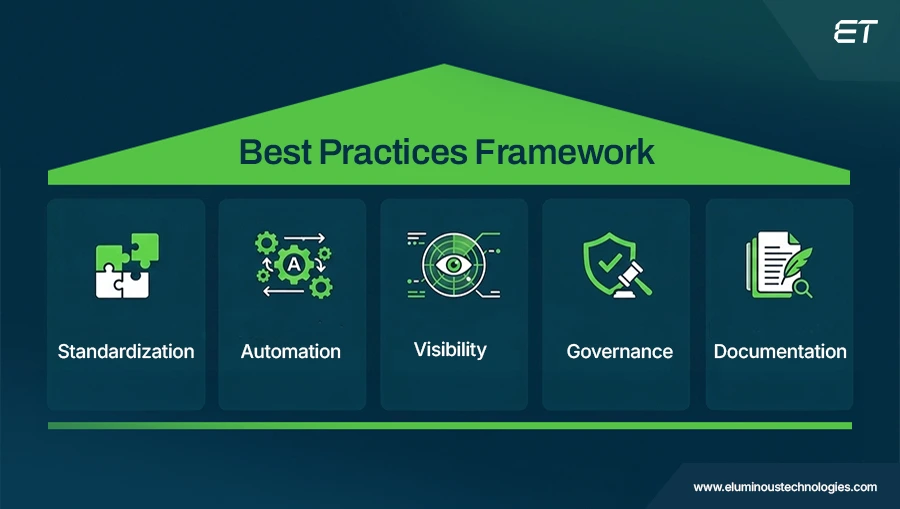
To move from basic implementation to high-performing change operations, organizations need to focus on consistency, visibility, and automation, while aligning change processes with business priorities.
Here are the key practices that make the difference.
Standardize Your Approach
Establish clear processes, roles, and documentation across the entire change lifecycle from request to review and approval.
Standardization ensures that every team follows a consistent approach, reducing ambiguity, improving accountability, and making change processes easier to scale.
Prioritize Changes Based on Risk and Impact
Not all changes require the same level of scrutiny. Some have minimal operational impact, while others carry significant business risk.
Classifying and prioritizing changes based on impact helps organizations allocate the right level of control and attention without slowing down delivery. Involving the right stakeholders early also ensures better decision-making and alignment.
Automate Low-Risk Changes
Automation plays a critical role in improving speed and efficiency.
By automating approvals, notifications, and routine tasks for low-risk changes, organizations can reduce delays, eliminate manual bottlenecks, and accelerate release cycles without compromising control.
Enable End-to-End Visibility
Real-time visibility into change status, risk levels, and outcomes is essential at scale.
Dashboards and reporting should provide actionable insights that help teams monitor performance, identify bottlenecks, and continuously improve change processes while reducing failure rates.
Maintain a Comprehensive Change Log
Accurate and detailed documentation of all changes ensures accountability, audit readiness, and traceability.
A well-maintained change log also helps identify patterns, recurring issues, and opportunities for process improvement over time.
Establish an Effective Change Advisory Board (CAB)
A well-structured CAB plays a key role in evaluating high-risk changes, ensuring alignment, and facilitating cross-team communication.
Rather than becoming a hurdle, the CAB should operate with clear guidelines and focus on decisions that truly require oversight.
Business Impact: What Tech Leaders Should Expect
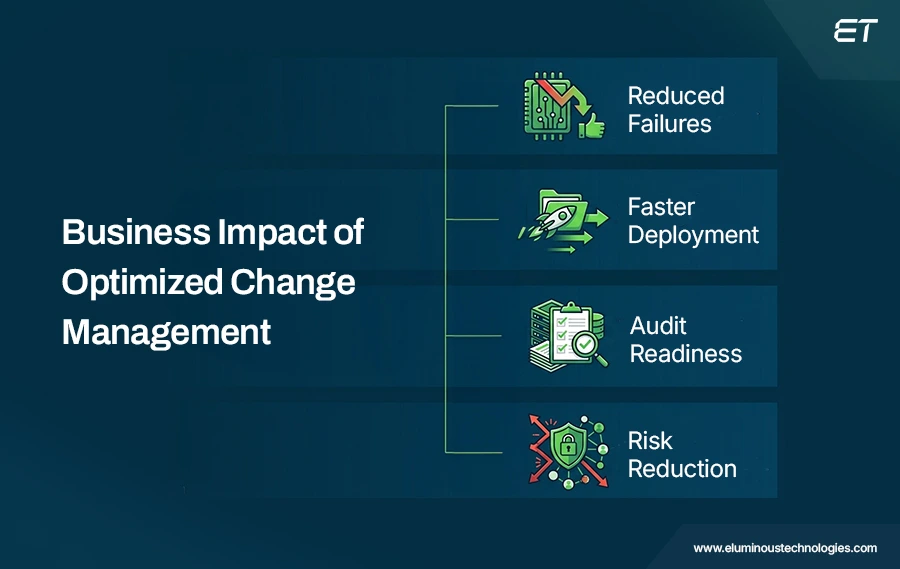
When implemented effectively, ServiceNow change management delivers measurable improvements across risk, speed, and governance. It transforms change from a manual, error-prone process into a structured and scalable operational capability.
For tech leaders, this translates into:
- Reduced change failure rates through better risk assessment, standardized workflows, and improved visibility into dependencies
- Faster deployment cycles by automating approvals and streamlining low-risk changes
- Stronger audit and compliance readiness with centralized tracking, detailed logs, and real-time reporting across all changes
More importantly, the focus shifts from simply managing changes to enabling controlled, scalable innovation. Teams can move faster without increasing risk because every change is backed by the right level of process, data, and oversight.
Final Thoughts
ServiceNow change management is a more-than-handy application for scaling IT operations without increasing risk. When implemented correctly, it brings structure, visibility, and control to how changes are planned, approved, and executed across complex environments.
In practice, the challenge is operationalizing it with the right processes, accurate CMDB data, and governance in place. Without this foundation, even well-defined workflows can break down at scale. Enterprises that treat change management as a strategic function (rather than a procedural requirement) are better positioned to balance speed, control, and compliance. They can reduce failure rates, accelerate delivery, and respond more effectively to evolving business demands.
For organizations looking to get this right, working with a experienced ServiceNow consulting partner can make a measurable difference. We help enterprises design, implement, and optimize ServiceNow change management frameworks ensuring they are aligned with business goals, scalable across teams, and built for long-term performance.
Want to scale change management without increasing risk?


.NET 10 Features and Enhancements: What’s New and Should You Upgrade?
Summary: .NET 10 is the latest LTS release of Microsoft’s .NET platform. It brings significant updates across the runtime, SDK,…


A Guide to ERP Integration: Why It’s Essential for Business Efficiency
Summary: Most organizations think of ERP Integration as interconnected systems for efficiency. It has been true for most enterprise efficiency…


