
 Book a Meeting
ServiceNow Implementation Roadmap: How to Build It Right from Day One


A ServiceNow implementation roadmap is where most enterprises get it wrong and they don’t realize it until the platform is already live.
Teams rush into configuration, workflows are built on top of broken processes, and ownership is never clearly defined. For a while, everything seems to work. Then complexity kicks in: duplicate workflows, unreliable data, and a system that’s expensive to maintain and difficult to scale.
A strong roadmap forces clarity before execution: what gets built, why it matters, and how it will scale across the organization.
In this guide, we break down the roadmap into three phases: pre, core, and post, so you can avoid early mistakes and build a platform that delivers long-term business value.
What a ServiceNow Implementation Roadmap Includes
Most enterprises treat a ServiceNow implementation roadmap like a standard IT project plan: define timelines, assign risks, and push toward a go-live date.
That approach is exactly where things start going wrong.
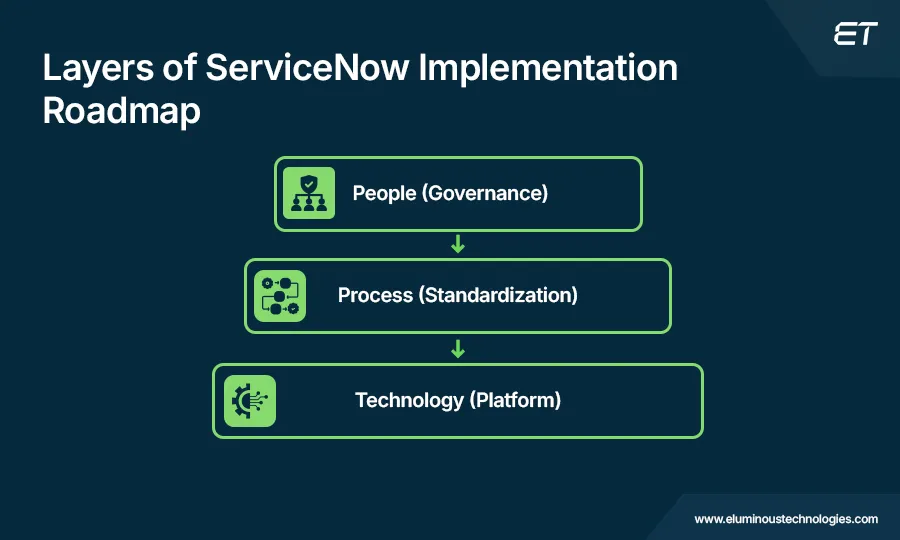
A real ServiceNow roadmap is about making the right decisions before and during implementation, so the platform doesn’t fall apart as it scales.
At its core, every successful roadmap gets three things right:
1. Ownership and Governance (Who controls the platform?)
Before anything is built, there needs to be absolute clarity on:
- Who owns the platform
- Who approves changes and architecture decisions
- Who is accountable when something breaks
Without this, teams start building in silos.
IT, HR, and operations create their own workflows and what looks like progress quickly turns into fragmentation.
This is how technical debt starts quietly, and early.
2. Process Standardization (Fix before you automate)
If your workflows are:
- Inconsistent
- Exception-heavy
- Dependent on manual workarounds
Automation will only make things worse.
A strong roadmap forces teams to:
- Identify redundant workflows
- Remove unnecessary complexity
- Align on a standard way of working
Before any configuration begins.
3. Technology and Architecture (Build for scale, not shortcuts)
This is where most teams get tempted to over-engineer.
ServiceNow is powerful but that doesn’t mean everything should be customized.
A good roadmap makes clear decisions on:
- when to use native capabilities
- when customization is justified
- how integrations will scale across systems
Because every unnecessary customization adds:
- upgrade risk
- maintenance overhead
- long-term cost
A ServiceNow implementation roadmap is a set of decisions that determine whether your platform scales cleanly or becomes harder to manage with every release.
Quick Summary
| Layer | What it solves | What goes wrong without it |
| Governance | Clear ownership and control | Fragmented platform, no accountability |
| Process | Clean, standardized workflows | Automation of broken processes |
| Technology | Scalable architecture decisions | Over-customization, integration debt |
Pre-Implementation Foundation: Where Most Implementations Are Won or Lost
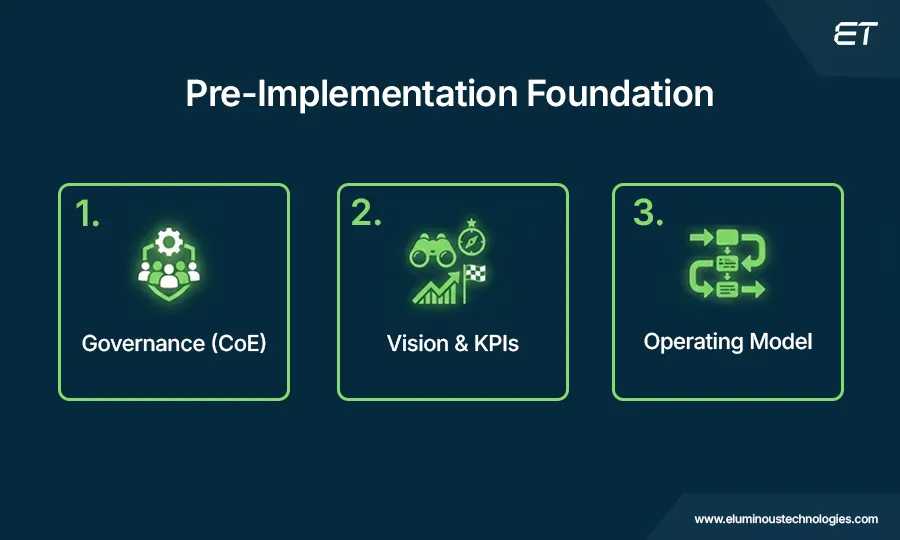
Most of the decisions that determine the success of a ServiceNow implementation are made before anything is built. But this phase is often rushed and treated like a short discovery exercise before the “real work” begins.
That’s a mistake.
This is where you:
- Align stakeholders on what success looks like.
- Uncover conflicting expectations across teams.
- Identify gaps in processes, ownership, and data.
If this foundation is weak, those gaps get built into the platform. And once that happens, fixing them becomes significantly more complex and expensive.
1. Governance and Center of Excellence (CoE)
Without a clear governance model, ServiceNow doesn’t stay enterprise for long.
Different teams start building what they need: IT defines one set of workflows, HR creates another, and other departments introduce workarounds to fill gaps. Over time, the platform drifts into multiple disconnected implementations that are difficult to manage and even harder to standardize.
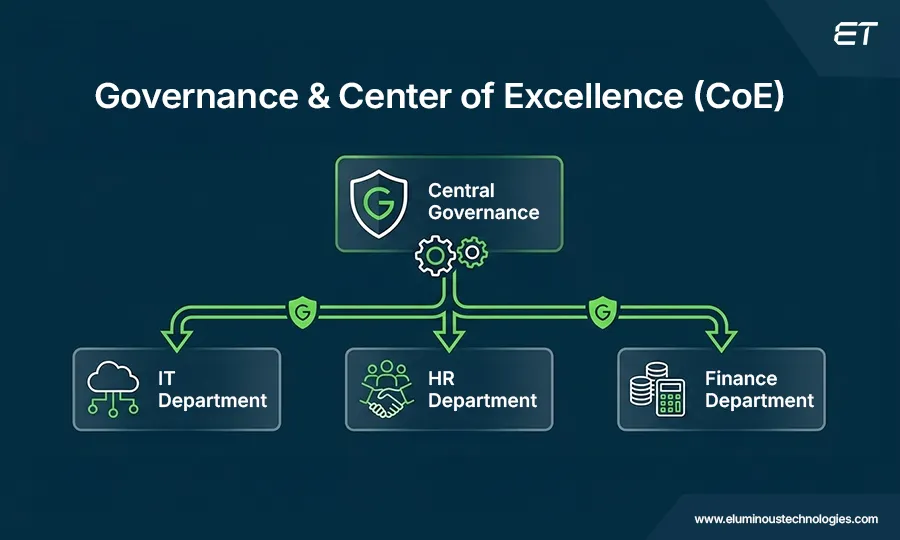
A Center of Excellence (CoE) exists to prevent that drift.
It acts as the central authority that:
- Defines workflow and data standards.
- Governs customization and integration decisions.
- Controls how new use cases are introduced into the platform.
This is about ensuring that everything being built can scale, integrate, and survive future upgrades.
Without governance, you typically see:
- Duplicated or conflicting workflows.
- Uncontrolled customization.
- Increasing effort during upgrades and releases.
With a CoE in place, the platform evolves in a controlled way where ownership is clear, decisions are consistent, and new implementations build on a stable foundation instead of creating more complexity.
2. Vision, Value, and Use Case Prioritization
ServiceNow delivers value only when its implementation is tied to clear business outcomes.
A well-defined roadmap starts by identifying:
- The outcomes the organization wants to achieve.
- The KPIs that will measure success.
- The stakeholders accountable for delivering those outcomes.
Once this is in place, prioritization becomes straightforward.
Instead of trying to implement everything at once, teams can focus on high-impact, high-visibility use cases first. These are the ones that deliver measurable value and create momentum for broader adoption.
This is why every module introduced into ServiceNow should be tied to a specific KPI.
3. Operation Model Design
ServiceNow is a platform that continuously evolves with your business. To manage that evolution, you need a clearly defined operating model.
This model determines:
- How new features and workflows are delivered.
- How platform teams are structured.
- How changes are tested, approved, and released into production.
Without this structure, teams start working independently, leading to conflicting updates, inconsistent configurations, and unstable releases.
A well-designed operating model ensures that:
- Development follows a consistent process.
- Releases are controlled and predictable.
- Multiple teams can work on the platform without creating conflicts.
Because as the platform scales, the challenge is managing change without breaking what already works.
The Core Implementation Roadmap
Once the foundation is in place, the focus shifts from planning to execution.
This is where most ServiceNow implementations start to struggle, and where structured ServiceNow consulting can help you align your roadmap with business outcomes.
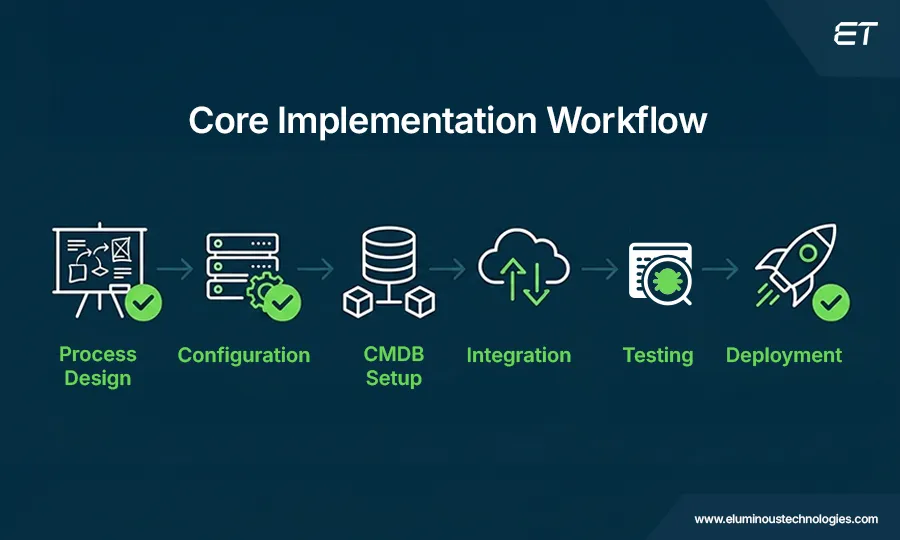
Processes that looked clear on paper begin to break under real conditions. Integrations expose gaps. And decisions made during planning are tested against actual operational needs.
This phase is about building them in a way that holds up under scale.
A structured, phase-driven approach helps teams:
- Implement in the right sequence.
- Validate each component before moving forward.
- Avoid introducing instability into the platform.
Because at this stage, the goal is to go live with a system that works in production.
Fix Your Processes Before You Automate Them
One of the most common mistakes in ServiceNow implementation is starting with configuration before fixing the underlying processes. If your workflows are unclear or inconsistent, automation will only make those problems harder to manage.
This phase focuses on getting your core processes right, especially incident, problem, and change management, which form the backbone of any ITSM implementation.
That means clearly defining:
- Inputs and outputs.
- Escalation paths.
- Approval workflows.
- Integration points with other systems.
Without this level of clarity, teams end up building workflows that behave differently across departments or rely on manual workarounds.
Data and CMDB Foundation
The CMDB is at the center of how ServiceNow understands your environment.
It stores information about your assets, services, and how they are connected. That data drives critical capabilities like change impact analysis, service mapping, and incident correlation.
If that data is incomplete or inaccurate, those capabilities stop being reliable.
This phase focuses on building a CMDB that teams can trust.
That means:
- Validating every configuration item (CI)
- Establishing accurate relationships between assets, services, and business functions.
- Ensuring visibility across your infrastructure.
It also requires setting up:
- Data governance policies (who owns and updates what).
- Discovery tools to keep data current and automated.
Because when the CMDB is poorly maintained, teams make decisions based on incorrect information leading to failed changes, unresolved incidents, and operational blind spots.
A well-structured CMDB enables better decisions across the entire platform.
Integration and Workflow Automation
ServiceNow becomes powerful when it connects with the systems your business already relies on such as ERP, CRM, cloud infrastructure, and security tools.
Solutions like AI control tower help enterprises detect anomalies and ensure they have operational consistency across the platform.
But integration alone isn’t the goal. The real value comes from what those integrations enable.
For example:
- A monitoring tool can automatically trigger an incident in ServiceNow.
- An HR system can initiate onboarding workflows across IT and access management.
- A security alert can trigger investigation and response workflows.
Without these connections, teams are forced to:
- Switch between systems.
- Manually transfer data.
- Operate with incomplete or conflicting information.
This leads to delays, duplication, and limited visibility across operations.
That’s why every integration should be:
- Designed with a clear purpose
- Properly documented
- Tested under real-world conditions
Because poorly designed integrations disrupt workflows and create inconsistencies across the entire platform.
Testing and Controlled Deployment
No ServiceNow implementation goes live without risk. But unmanaged risk is what causes failures. Testing is where you validate whether what’s been built works in real-world conditions.
This typically includes:
- User Acceptance Testing (UAT): Ensure workflows align with business expectations.
- Integration testing: Verify that connected systems exchange data correctly.
- Performance testing: Assess how the platform behaves under real usage loads.
- Regression testing: Ensure new changes don’t break existing functionality.
Without this level of validation, issues show up in production, where they are far more expensive to fix.
On the other hand, deployment also needs to be controlled.
Instead of pushing everything live at once, teams should:
- Use staging environments to validate releases.
- Roll out changes in phases where possible.
- Have rollback plans in place in case something fails.
Because the goal is to go live without disrupting operations.
Post–implementation Roadmap
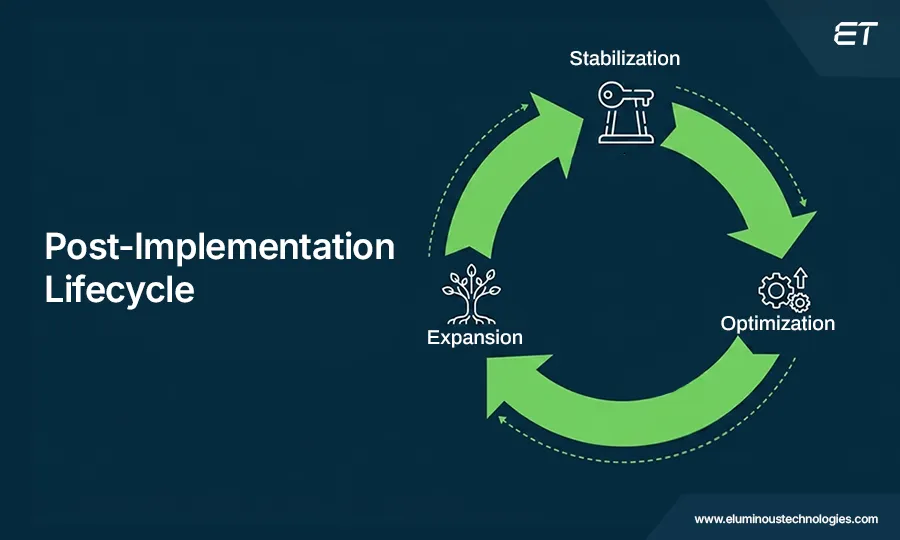
Going live is where the real work begins.
This is the phase where ServiceNow moves from a configured platform to an operational system used across the business. And this is also where gaps start to surface: workflows behave differently under real usage, integrations are tested at scale, and user adoption becomes visible.
Capabilities like AI-driven insights are becoming part of the roadmap, this is where solutions like ServiceNow GenAI delivers by enabling faster-resolution cycles.
What happens next determines whether the platform delivers long-term value or becomes difficult to sustain.
Stabilization
The period immediately after go-live is the most fragile phase of the entire implementation.
Users are interacting with the platform for the first time, workflows are running under real conditions, and integrations are being tested beyond controlled environments.
This is where issues surface quickly:
- Workflows not behaving as expected.
- Data inconsistencies across systems.
- Integration delays or failures.
- User confusion due to new processes.
A dedicated stabilization effort is critical during this phase.
Teams need to:
- Monitor system performance closely.
- Resolve high-priority issues in real time.
- Support users as they adapt to new workflows.
This is also where governance structures like the Center of Excellence (CoE) play a key role in controlling changes and preventing reactive fixes from creating long-term problems.
Stabilization is an active effort to ensure the platform operates reliably before moving forward.
Optimization
Once the platform is stable, the focus shifts from fixing issues to improving performance and efficiency. Tools like Assist in ServiceNow helps to automate routine further, streamlining user interactions.
This is where real usage data starts to matter.
Unlike pre-implementation assumptions, you now have visibility into:
- How users are interacting with workflows.
- Where delays or bottlenecks occur.
- Which processes are being bypassed.
This data becomes the basis for optimization.
Teams can start to:
- Refine workflows to reduce resolution times.
- Eliminate unnecessary steps or approvals.
- Improve user experience based on adoption patterns.
- Adjust configurations based on actual operational needs.
This phase also validates whether the original business goals are being met.
KPIs defined earlier such as incident resolution time, request turnaround, or change success rate should now be tracked, analyzed, and reported.
Because without this feedback loop, optimization becomes guesswork.
Expansion
Once the core platform is stable and optimized, the focus shifts to extending ServiceNow across the organization. This means expanding into areas where the platform can deliver clear, measurable value.
In practice, this could include:
- Extending IT workflows into HR service delivery.
- Integrating security operations into the platform.
- Bringing additional business units onto standardized workflows.
The key is to build on what already works.
Proven workflows, governance models, and data structures should be reused and adapted, rather than rebuilding from scratch for every new use case.
However, expansion needs to be controlled.
Scaling too quickly can lead to:
- Inconsistent implementations across teams.
- Reduced adoption in new departments.
- Increased complexity in managing the platform.
That’s why expansion should follow the same discipline as the initial implementation: clear prioritization, defined KPIs, and alignment with business outcomes.
Because the goal is to expand it in a way that remains scalable and sustainable.
Key Challenges in the ServiceNow Implementation Roadmap
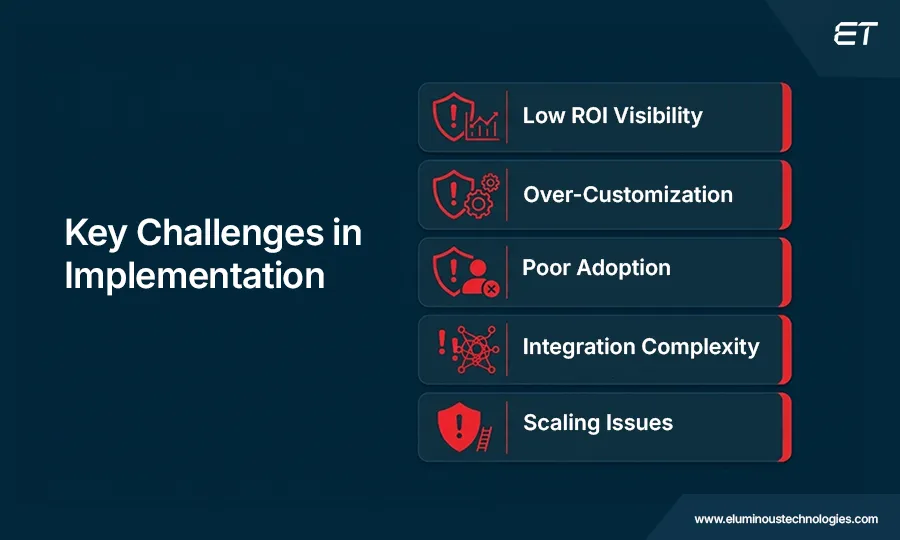
The difference between a successful and a struggling implementation is how early you identify and address these risks.
Here are 5 challenges that consistently derail enterprise ServiceNow programs.
1. Lack of ROI Visibility: Without clearly defining KPIs and performance baselines, you can struggle to measure the platform’s business impact. This becomes a core problem when your stakeholders don’t realize the value of investment in the platform.
2. Over-Customization: Excessive customization increases complexity, creates upgrade challenges, and leads to long-term technical debt. The platform then becomes harder to scale and maintain.
3. Poor Adoption: If users don’t adopt the platform due to unclear workflows, lack of training, or resistance to change, even a technically sound implementation fails to deliver value.
4. Integration Complexity: Poorly designed integration can cause data inconsistencies, broken workflows, and increased manual effort. (This is a huge hiccup if the connected systems in your org keep growing).
5. Scaling Challenges: If you design an architecture for immediate needs, it becomes difficult to extend the platform across new teams and use cases. Then you face fragmentation and governance issues.
These challenges often stem from early decisions (or the lack of them). Bottom line – proactive planning and strong governance should be the key ingredients to bake a robust roadmap.
ServiceNow Implementation Roadmap: Best Practices
Strong ServiceNow implementations are guided by clear principles that ensure consistency, scalability, and long-term value. Here are some of the best tactics to consider.
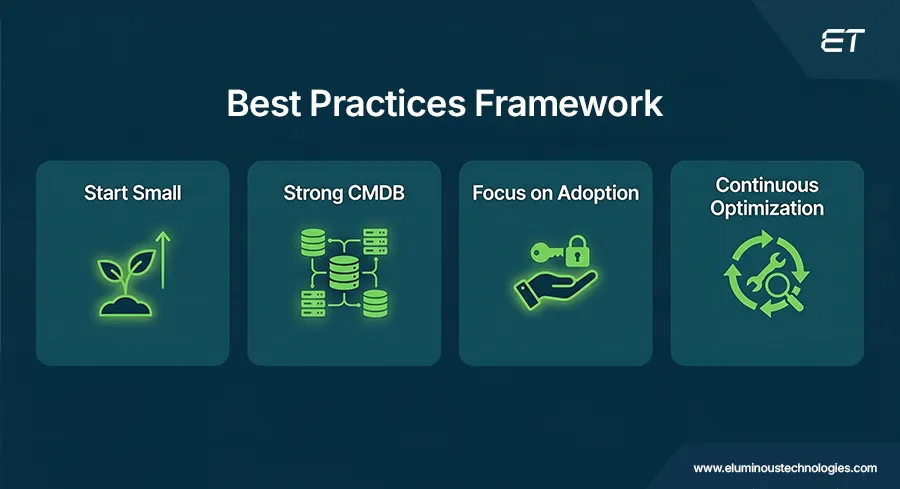
Start Small and Scale in Phases
Trying to transform everything at once often leads to complexity and failure. Focusing on a high-impact use case such as incident or request management helps deliver early wins, validate the approach, and build confidence before scaling further.
Invest in CMDB and Data Quality
The CMDB provides the foundation for key capabilities like impact analysis and service mapping. If the data is incomplete or inaccurate, workflows and decisions based on it become unreliable making data quality a critical priority.
Focus on User Adoption, Not Just Deployment
A technically successful implementation delivers no value if users don’t adopt it. Adoption should be actively measured and improved through clear workflows, training, and user-focused design.
Continuously Optimize Post Go-live
The platform should evolve based on real usage data, user feedback, and performance metrics. Continuous optimization ensures that workflows remain efficient and aligned with changing business needs.
To Sum Up: ServiceNow Implementation Roadmap
ServiceNow implementation roadmap requires structure, governance, and long-term thinking. Organizations that treat it as a quick rollout end up maintaining a system that struggles to scale. In contrast, those that approach it strategically build a platform that continuously improves, adapts to new requirements, and delivers measurable value over time.
The difference comes down to the quality of the roadmap guiding each decision: from planning and implementation to post-go-live optimization and expansion.
With the right approach, ServiceNow becomes a core operational capability that drives efficiency, visibility, and better decision-making across the business.
If you’re looking to implement ServiceNow with a clear strategy and scalable approach, eLuminous can help you get there.
Get expert guidance on building a roadmap that delivers long-term value.


AI Agent Development Cost: Pricing & Cost Drivers
Summary: AI agent development costs vary widely between projects that look similar in stages, scope, or integrations. A focused proof…

ServiceNow Governance Framework: A Guide to Consistent Multi-Team Workflows
Summary: Different teams using ServiceNow have unique priorities, but they compete on a shared ServiceNow platform. Such a conflict can…


