
 Book a Meeting
ServiceNow Governance Framework: A Guide to Consistent Multi-Team Workflows
Different teams using ServiceNow have unique priorities, but they compete on a shared ServiceNow platform. Such a conflict can lead to inconsistent decisions, conflicting changes, and duplicated capabilities. To avoid it, enterprises need effective governance that translates business priorities into decisions, sets the right technical standards, and defines escalation paths. Through a ServiceNow governance framework, you can define practical guardrails considering evidence from demand, backlogs, exceptions, cycle times, and release quality. It’ll help avoid friction in decisions, reduce execution delays, and support teams to collaborate across departments. In this guide, you will explore why ServiceNow governance is necessary and how to integrate it from preparation to improvement.
Enterprise teams use ServiceNow in coordination. HR, security, customer service, and IT may need simultaneous changes to shared workflows, data, integrations, and delivery capacity.
Each request makes sense on its own, but they can affect the others.
Without clear shared decision rules, teams start duplicating capabilities, defining data differently, or disrupting each other’s workflows. As the enterprise and integrated capabilities scale, these conflicting priorities become increasingly difficult to manage.
To avoid that, a ServiceNow governance framework is essential.
This article explores how organizations can define guardrails for shared workflows by aligning teams, protecting platform standards, and preserving flexibility to adapt.
ServiceNow Governance Framework and Its Importance
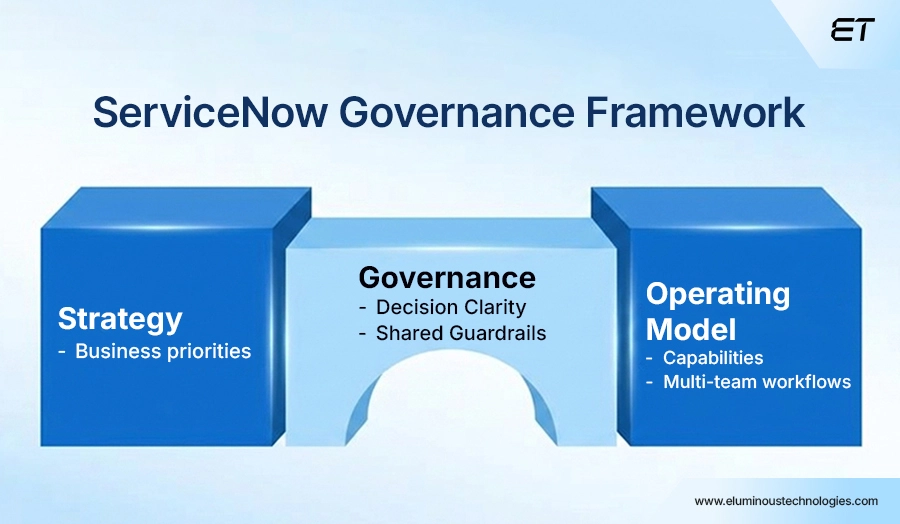
ServiceNow governance framework is the system of decision rights, policies, and guardrails that guides how teams use a shared ServiceNow platform. It clarifies who makes platform decisions, how teams prioritize demand, and which standards apply to workflows, data, integrations, security, and architecture.
The framework acts as an intermediary between enterprise strategy and platform operations. Management defines the strategic objectives, organization priorities, and the risks involved, while the team manages workflow, integration, data management, and releases.
The ServiceNow governance framework translates the strategy and priorities into decision standards, rights, and escalation paths. It enables teams to make changes while routing only high-risk or cross-team decisions to leaders for broader review.
Through decision guardrails and frameworks, teams can adapt local workflows while preserving compatible architecture, data, and controls. This is all the more important today in the face of constant adaptation and digital transformation.
Crucially, this framework addresses five questions:
1. What outcomes must ServiceNow deliver?
2. Which requests need investments or re-routing?
3. How should the team develop, secure, test, and roll out workflows?
4. Whose data is required by the workflow?
5. How will the leaders be informed about governance helping or hindering?
Clarity to this extent allows decisions to be made at the level of the team actually performing the task, while executives keep control of the enterprise’s guardrails. Almost two-thirds of firms struggled to alter decision rights. At the same time, cross-functional firms with empowered decision-making achieved an extra 10.4 percentage points of revenue growth.
CIOs, CTOs, and tech leaders still have the final say based on the business priorities. The ServiceNow governance framework layer ensures that these priorities align with platform investments across departments. The objective is to make decisions compatible across departments without giving the same multi-team workflow to each.
What are the Three Decision Areas for the ServiceNow Governance Framework?
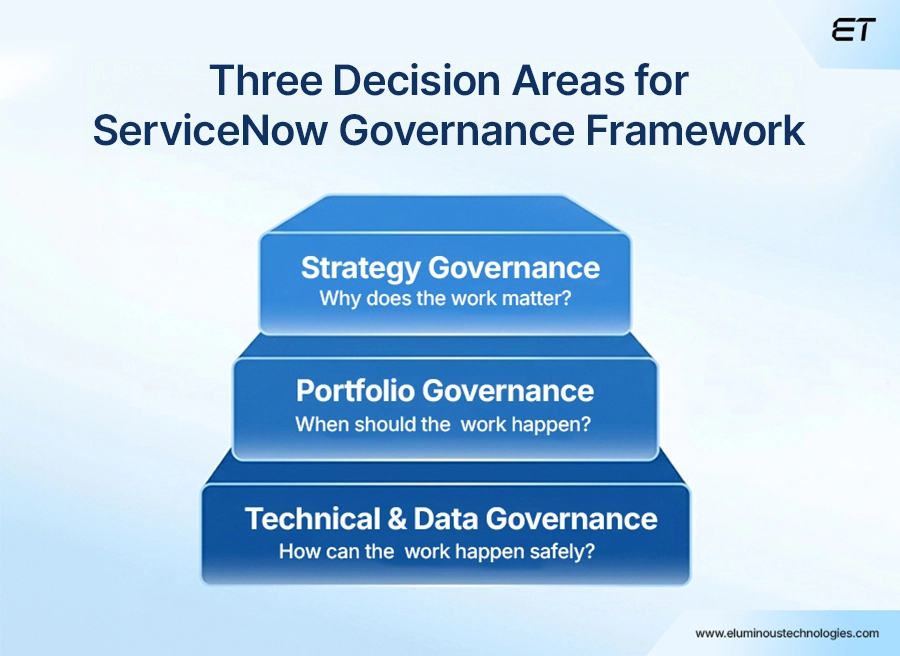
In the ServiceNow governance framework, applications across departments have three decision rule areas:
- Strategy Governance
- Portfolio Governance
- Technical and Data Governance
Each is responsible for a unique kind of decision.
The three areas provide those rules at different levels. They also guide ServiceNow process consulting by helping teams translate enterprise priorities into consistent workflows.
Take a look at how they work together.
Consider an organization that wants to implement a new onboarding workflow for employees in ServiceNow. The HR department wants consistency. The IT department needs to provide devices and access. The Security department needs to give its permission. Finally, the Facilities department will have to prepare workplaces for employees.
Firstly, in strategy governance, it would be checked if the onboarding process helps the company to reach one of its key goals. Then, in portfolio governance, the process would be compared to other processes.
Lastly, technical and data governance check the approved process in terms of integrations, data ownership, security, reuse, and maintenance.
Strategy determines why the process is needed, portfolio – when it needs to happen, and technical and data – how it can happen.
The table below will help you understand it concisely.
| Strategy governance | Typically CIO, CTO, executive sponsor, business leaders | Why the enterprise is using ServiceNow and which outcomes matter | “We want one consistent employee onboarding experience across regions.” |
| Portfolio governance | Platform owner, PMO, product owners, finance, business representatives | Which initiatives should be funded, prioritized, sequenced, or declined | “Should onboarding come before procurement automation?” |
| Technical and data governance | Enterprise architects, ServiceNow architects, security, data owners, integration leads | How approved work should be designed, secured, integrated, and maintained | “Which HR system owns employee data, and how should ServiceNow connect to it?” |
Core Components of a ServiceNow Governance Framework
The decision layers show where the authority lies and for what. The ServiceNow Governance Framework stages explain how the program is established and operated: prepare, build, define, and improve.
1. Prepare the governance program
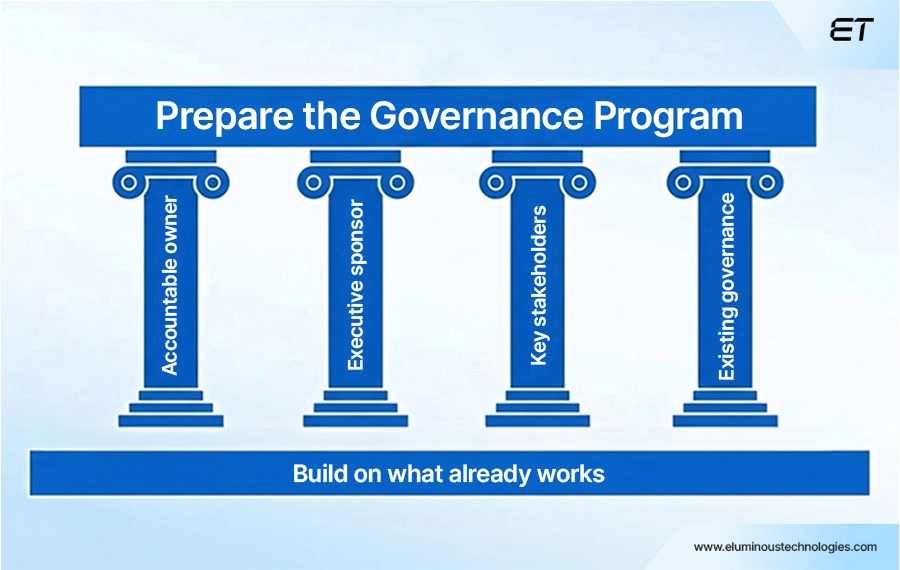
Every decision involving shared platforms needs an owner. The platform owner usually coordinates the program, project plan, stakeholders, and implementation scope. The team members need clarity on who makes the decision, who participates in the decision, and who implements it.
This role must also connect ServiceNow governance with existing architecture, security, compliance, demand, and technology governance. A ServiceNow-specific model must strengthen those structures, not compete with them.
This avoids double approval processes and ownership issues. This also brings the decision-making process closer to the teams executing the decision.
Sponsorship is also a part of preparation for the ServiceNow Governance Framework. The leaders need a business case for the expected benefits and the costs of making decisions without proper structure. You can build this business case on previous delays, escalations, and duplicated efforts.
2. Build the Decision System
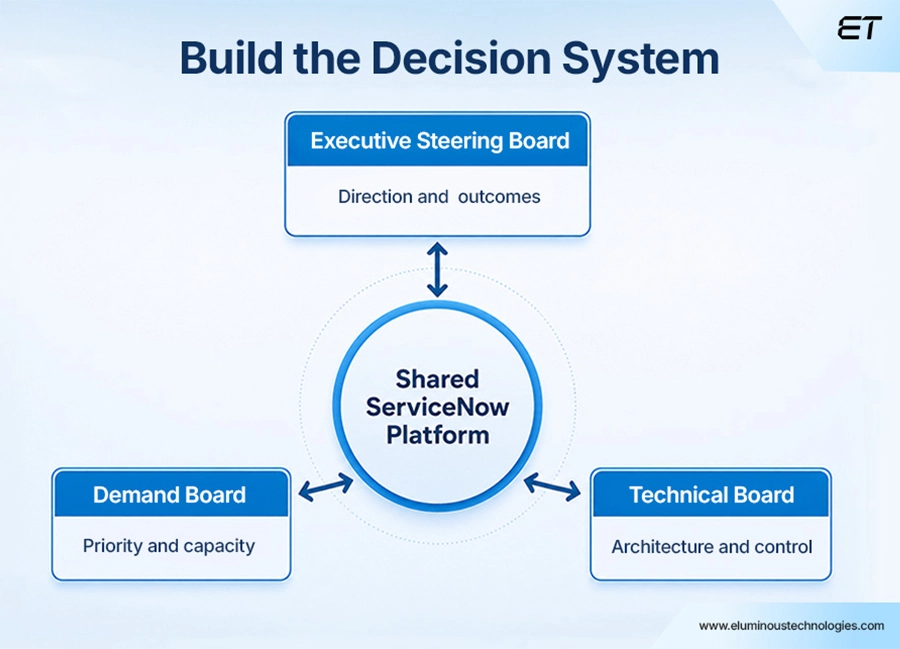
The workbook has three boards for the organization to set up their governance framework for ServiceNow.
- Executive Steering Board that aligns the roadmap with business results.
- Demand Board that prioritizes initiatives and improvements.
- Technical Board that oversees platform architecture, integration, customization, and stability.
These boards work best with defined charters, information flows, escalation processes, decision-making criteria, and decision logs. Their value lies in their relationships, not their meeting frequency.
3. Define Policies and Guardrails
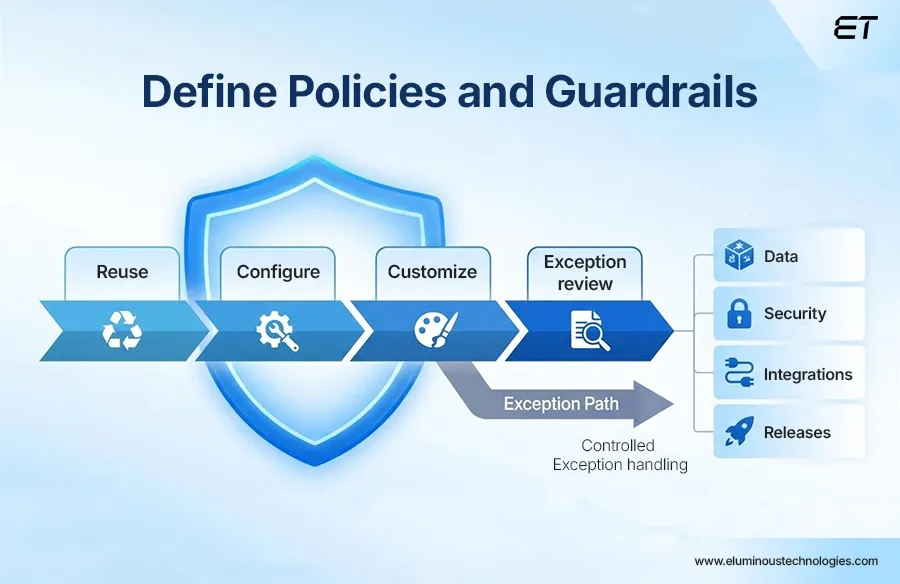
The goal is to make decisions repeatable. A clear set of policies makes these decisions replicable within teams. The ServiceNow workbook recommends establishing guiding principles or “golden rules,” along with policies and standards.
These rules indicate when teams can use out-of-the-box functionality, when to consider customization, and when reusability applies. They should map out development standards, integration, security, data management, upgrade, release, and technical debt. These policies should also define a ServiceNow data governance framework covering data ownership, quality, access, lifecycle, and authoritative sources.
As teams adopt capabilities such as Now Assist or an AI Control Tower, the same guardrails will help in defining approved use cases, data access, human review, and exception handling.
Guardrails are not a be-all and end-all, so they don’t need to become the ultimate barrier to preventing all possible exceptions. They should indicate the permissible path and when teams can request an exception. So, each exception should capture its rationale, owner, risk, approval, and review date.
This way, delivery teams have actionable guidance. Moreover, this approach gives the board a basis for evaluating design, integration, customization, plugin, and platform-level changes.
4. Measure and Improve Governance
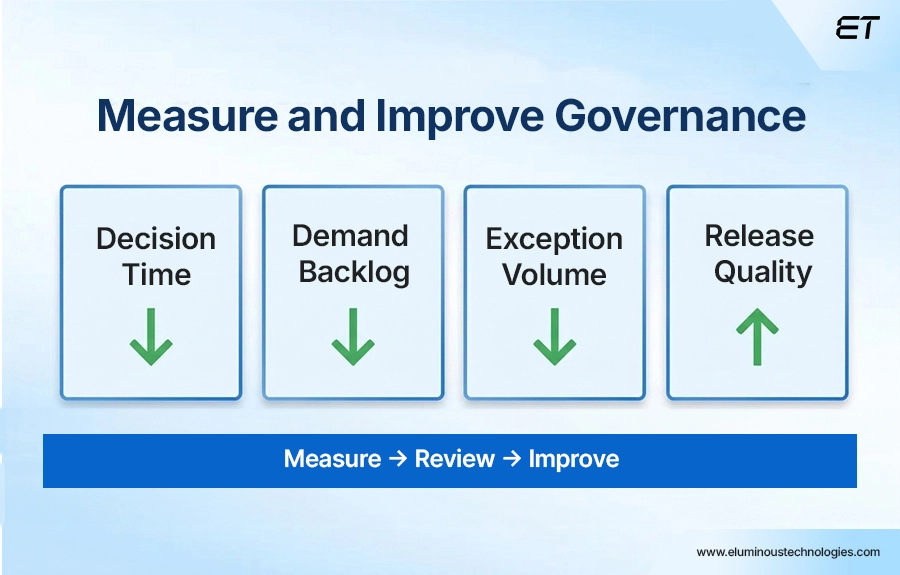
Continuous, business-aligned improvement is part of the ServiceNow governance framework.
Leaders need to track authority, make decisions more quickly, ensure demand gets its rightful priority, and ensure teams understand the policies. Some useful indicators you can look for are decision cycle time, demand backlog age, escalation numbers, exception rates, re-use, quality of release, and stakeholder feedback.
During the improvement phase of the ServiceNow governance framework, you’ll likely find gaps between the expected outcome and the current stage. You can use existing performance dashboards, decision logs, and meeting backlogs to determine areas of friction.
Signals like unresolved approvals suggest that the decision path might be ambiguous. Persistent exceptions imply impractical policies. Governance bypass reflects excessive overheads.
Use such findings to refine the framework and apply proportionate oversight, delegating low-risk decisions while giving complex or platform-wide changes additional review.
What Does ServiceNow Governance Look Like at Scale
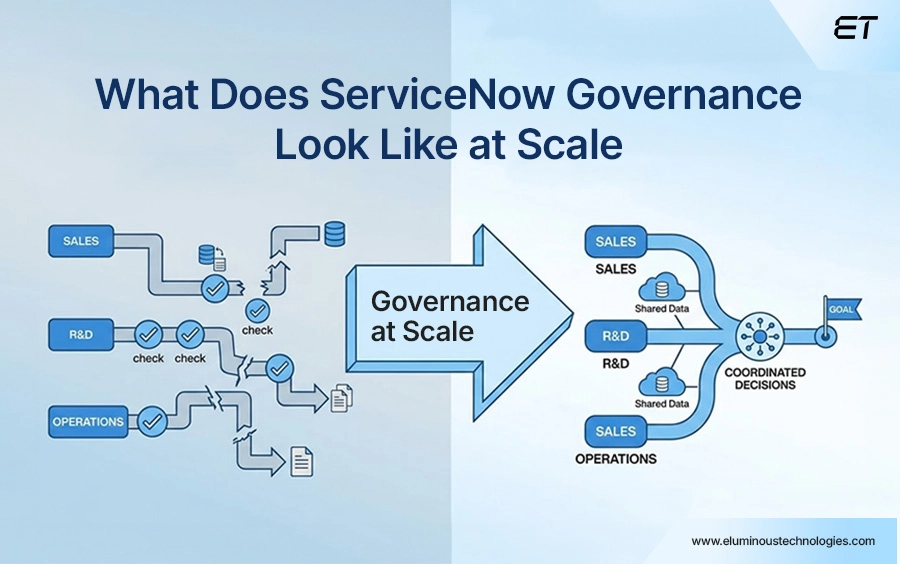
ServiceNow governance framework at the enterprise level is a multi-tiered operational system. It involves assigning decision-making authority, directing work to the right reviewer, and capturing the rationale behind key decisions.
In a multi-team or multi-business-unit environment, governance typically works through four connected practices:
| Governance practice | What it looks like in practice |
| Local decision-making | A team can adapt a workflow that affects only its own operations, provided the change follows approved design, data, security, and release standards. |
| Shared-impact review | Changes involving common data, integrations, architecture, security controls, or platform-wide configuration receive broader review before implementation. |
| Demand prioritization | New requests are assessed against business value, strategic value, risk, delivery capacity, and ServiceNow platform impact. A documented decision then records whether the request is approved, deferred, sequenced, or rejected. |
| Exception management | An exception records its rationale, owner, risk, approval, and review date. Repeated exceptions may show that the policy needs to be revised. |
For instance, the HR team might wish to include a new approval process in an employee onboarding process. In this case, if the change only affects HR’s form, the team implements it based on the approved standards.
But if the change affects the employee data or identity integration, the data and security teams review the process design before implementation.
If the request competes with security or customer service work for delivery capacity, the demand group prioritizes it. The team checks it against business value, risk, dependencies, and available capacity.
Any deviation from an approved standard is a time-bound exception with a named owner and review date so future processes and decisions can be flagged.
In a multi-team and/or multi-business ecosystem, the level of review depends on the change’s impact on shared platform capabilities. It has less to do with the department submitting the request.
Final Thoughts
The ServiceNow governance framework enables stakeholders to make decisions aligned with current enterprise priorities and existing technological capabilities. The framework links organizational strategy with day-to-day platform operation. It gives leaders insight into current demand, potential risks, investments, available architecture, data, and, more importantly, delivery capacity. Once the framework is established, it allows team autonomy to adapt and innovate without coming into conflict with each other.
Clear ownership, structured governance, replicable policy, and protected data enable better decision-making for leaders.
That’s what positions ServiceNow to move beyond stand-alone IT automation to workflows that integrate HR, finance, security, customer support, and operations, while maintaining its unique expertise.
For leaders in an enterprise, governing ServiceNow is essential, but how you lay out the governance framework matters more. A well-structured framework keeps eyes on the competing demands before the conflict becomes apparent. It gives leaders visibility into ownership, delivery capacity, and risk and provides teams flexibility to resolve issues without unnecessary escalation requests.
This supports multi-team execution by assigning decisions to the respective stakeholder and, if need be, making changes through broader review.
So, with the right ServiceNow governance framework, enterprises get the best of both worlds: control and agility.
Aiming to Improve ServiceNow Governance in Your Workflows?


AI Agent Development Cost: Pricing & Cost Drivers
Summary: AI agent development costs vary widely between projects that look similar in stages, scope, or integrations. A focused proof…


ServiceNow Predictive Intelligence: How IT Leaders Can Automate Smarter
Summary: IT leaders today are expected to improve both operational efficiency and deliver measurable ROI on AI investments. However, talent…


