
 Book a Meeting
AI agent development costs vary widely between projects that look similar in stages, scope, or integrations. A focused proof of concept may begin at $15,000, while a complex enterprise or a MAS agent can exceed $400,000.
The core difference comes down to what the agent must do: its role, data, workflow, autonomy, security, usage, and production goals. This guide helps you compare costs by project stage, identify requirements that inform project estimates, and plan a realistic budget aligned with the agent’s deployment goals and its role in the business.
“Why are vendor costs so different for AI agent development?”
Every leader who has ever dipped their toe in creating a custom AI agent for their ventures has found themselves plagued by this question. One vendor may propose $20,000 while another suggests $100,000 for what seems like the same solution.
The difference in total cost of ownership is rarely about the AI model alone. The AI agent development costs come down to the agent’s workflow scope, the level of autonomy given, hidden operating costs, data-quality issues, and systems for integration.
As more and more organizations start integrating AI agents into their workflows, the pressure to keep pace increases. 62% of businesses are currently experimenting with AI agents.
So, should you just dive head-on into AI agent development?
Not until you can answer the query—can this pilot be taken into production?
A pilot is a testing ground, as much as it’s a demo. It gauges if an agent can handle a real business workflow, existing system integrations, manage exceptions, and deliver value before moving into production. Scaling it needs reliability in real business processes.
Even similar AI agent projects can have very different costs. It varies because of their scope, data, integrations, autonomy, security, testing, and deployment requirements.
Through this guide, you can understand its costs across stages (from proof of concept to multi-agent system), key drivers, and budget planning from pilot to production.
How Much Does AI Agent Development Cost
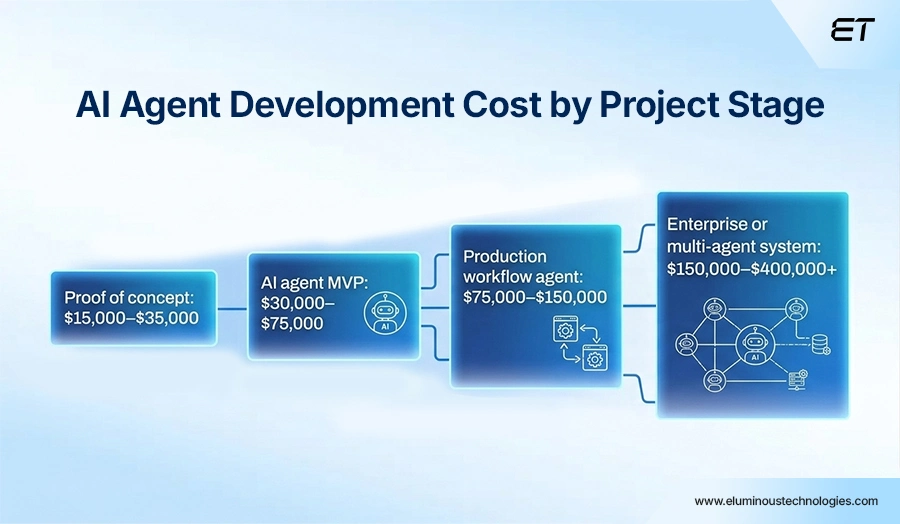
To give you a quick overview, the cost of developing an AI agent can range from $15,000 (PoC, basic agent, or chatbot) to $400,000+ (complex enterprise or multi-agent systems). Since the scope, complexity, integrations, and production requirements differ, you can see why the development cost varies and can’t be a single, universal number.
This range becomes much easier to understand if you view AI-agent development as a progression, rather than a single project.
Do you want an agent for a single workflow function, or expand to a system spanning multiple business functions?
The final estimate depends on:
- Agent’s scope
- Data
- Autonomy
- Integrations
- Security
- Operational risk exposure
- Frequency of usage
- Production requirements
Here’s a table to help you understand easily.
| AI Agent Project Type | Indicative Development Cost (USD) | Typical Timeline | Typical Scope |
| Proof of concept | 15,000-35,000 | 4–8 weeks | One defined use case, controlled data, limited integration, and feasibility testing |
| AI agent MVP | 30,000-75,000 | 8–14 weeks | A usable agent with selected tools, memory or RAG, core integrations, and evaluation |
| Production workflow agent | 75,000-150,000 | 3–6 months | Multi-step execution, several integrations, monitoring, access control, human approvals, and deployment |
| Enterprise or multi-agent system | 150,000-400,000+ | 6–12+ months | Complex orchestration, legacy systems, advanced security, auditability, scale testing, and ongoing optimization |
A proof of concept tests whether a defined workflow is feasible. In continuation, an MVP introduces the agent to controlled users and systems. Production deployment adds reliability, security, monitoring, exception handling, and ongoing support.
A chatbot or RAG implementation is a different project with a different cost profile than an AI agent that reasons, calls tools, executes multi-step workflows, and interacts with live business systems. You shouldn’t estimate the two on the same scale of AI agent development cost.
What is the Difference Between a Chatbot, RAG Assistant, and an AI Agent?
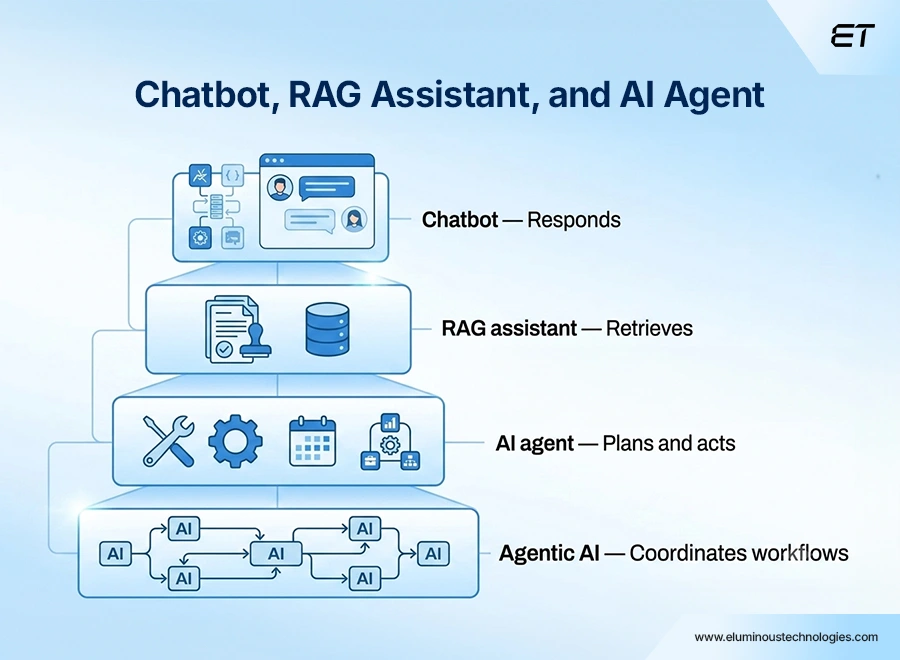
Not every AI-powered conversational interface implies AI agent functionality.
A basic chatbot is designed to respond. It answers FAQs, generates texts, or guides users through predefined conversational paths. But it’s reactive. That means it waits for an input to produce a desired or predetermined output. It relies mainly on the predefined flows, prompts, and whatever context the model is given in that conversation.
A Retrieval-Augmented Generation (RAG) assistant includes a knowledge layer. Instead of relying solely on its model, it retrieves relevant information from approved documents and databases before responding. Doing this improves its context and accuracy. But in the larger scheme, the system remains reactive.
AI agents are made for proactive action. Many can operate within predefined tools, policies, and human approval gates. But even within those bounds, they can plan, call tools, execute multi-step tasks, and adjust their next step based on what logically follows.
When given a goal, they break it into steps using their own logic. It includes:
- Calling APIs
- Retrieving business data
- Executing tasks
- Checking outcomes for verifiability
- Escalating exceptions
Agentic AI takes it even further. Instead of one agent handling everything, it coordinates multiple specialized agents across tools and workflows. It also keeps shared memory and context consistent between them while built-in human approval points at the steps that need them.
To make it clear, think of a RAG system as a memory library, an AI agent as a worker, and a chatbot as a user-facing front. An advanced system stacks these technologies together. It uses a chatbot interface for queries, backs it with RAG assistance, and empowers it with AI agents’ capabilities.
Now you know why development costs vary widely.
A chatbot with predefined flows sits at the lower end, while AI agent development costs are at the higher end due to the scope, autonomy, integrations, and production requirements (not the LLM alone). The core difference lies in what the system can access, decide, and do, not simply in which large language model it uses.
What Does an AI Agent Development Project Include?
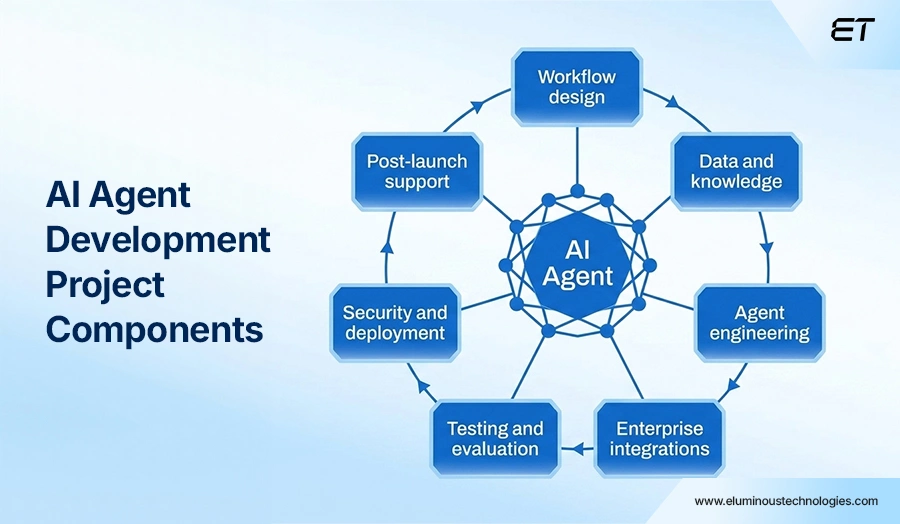
When budgeting for AI agent development costs, it’s convenient, even tempting, to focus on the model first. Should you use GPT, Gemini, Claude, or a completely different alternative, such as an open-source solution? The model matters, but it is only part of the project. Most development work revolves around making the agent useful for the business case.
Factoring all of these in, a well-developed AI agent project has the following components:
1. Discovery and Workflow Design
This establishes the business objective, the current process, the user groups, and the automation boundaries. At this stage, you need to decide whether an agent is the right solution or whether simple integration or workflow automation would be more cost-efficient.
2. Data and Knowledge Preparation
It involves collecting documents, cleaning, classification, access permissions, metadata, indexing, embeddings, and evaluation for retrieval. This stage determines the quality of action taken by an AI agent. So, if the data is fragmented, incomplete, or outdated, it can delay production readiness and increase development costs.
3. Agent Engineering
Agent engineering is a core build phase. This stage decides your model prompts, reasoning flows, tool selections, task planning, and model integration. It also factors in memory, guardrails, evaluation logic, and orchestration.
Teams design how the agent will execute a task by using available tools, retaining context, following business policies, managing failures, and evaluating the output. The complexity at each step directly affects the development effort and overall cost.
4. Enterprise Integration
The depth of the agent’s integration into the business process also changes the AI agent development costs. At this point, your agent system connects to CRMs, ERP workflows, ticketing platforms, payment systems, calendars, and other internal APIs. Each integration adds authentication, error handling, testing, monitoring, and maintenance requirements.
5. Testing and Evaluation
This stage checks what the agent retrieves, how it retrieves it, and what it does with the result. So, this process validates the task completion, the tools used, the business rules implemented, request refusals, and escalations. The idea is to assess how the agent behaves not only in typical business processes but also in ambiguous and unexpected scenarios.
6. Security, Governance and Deployment
At this stage, businesses need to be clear about who can access the system, how data is protected and monitored, and how incidents are reported and handled. This becomes especially important when the agent can change records, trigger transactions, or handle personal or regulated data.
AI Agent Development Cost by Project Stage
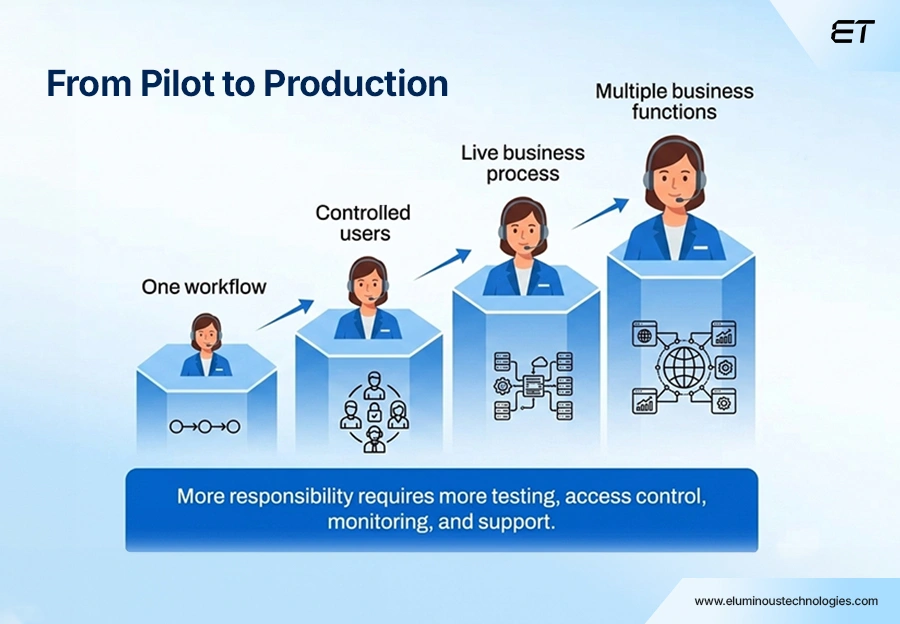
Cost doesn’t just depend on what components a project holds. It also depends on how deeply each one has to be engineered for the stage you’re deploying to. That depth deepens as you move from proof of concept to full production.
1. Proof of Concept: Averages Around $25,000
A proof of concept exists to answer one question:
Can this agent help the business solve a valuable problem and is reliable enough to justify further investment?
It should start by focusing on one workflow, a controlled data set, and a limited range of integrations. Here, you test the agent’s feasibility, workflow performance, and integration constraints. It includes teams identifying technical gaps and determining whether the use case is worth advancing to the MVP stage.
Note that a PoC is not the final production-ready system. You won’t find complete monitoring, advanced permissions, high availability, or every edge case. The agent has not yet been proven reliable enough for an uncontrolled live process.
Knowing all of this is important. It helps you set the expectations right with the AI agent and understand the budget allocation for production readiness. The primary purpose is to avoid investing in a whole system before confirming that the use case is worth pursuing.
2. AI Agent MVP: Averages Around $52,000
An MVP takes the agent beyond testing and introduces it to a limited group of real users. It includes:
- Core workflow
- Approved data sources
- Essential API integrations
- Authentication
- Basic monitoring
- User feedback
The aim is to validate the agent in a controlled real-world environment without building the full production feature set upfront.
Let’s say you have built a customer-support agent. In the beginning, it may first classify tickets and draft responses. Once those tasks are performed reliably, you can connect it with CRM to fetch customer details and add escalation rules. Only after this do you give it access to process refunds or update records.
The testing becomes more structured during AI agent MVP development. Instead of judging the agent based on a few successful demos, teams build repeatable evaluations for accuracy, response quality, task completion, and failure handling. Many teams use evaluations on test sets in a layered manner, combining offline and online methods.
This staggered approach helps organizations keep the initial investment focused and controlled before exposing the agent to a larger user base.
3. Production Workflow Agent: Averages Around $112,000
This is where the agent becomes part of a business’s live operational process.
For instance, a customer support agent may capture a ticket, retrieve order details, apply company policies, update the CRM, and then look for exceptions to escalate.
The AI agent development costs surge at this point because you are no longer paying for greater user-base exposure. It does so because the stage demands production-grade reliability, resilient integrations, security, observability, exception handling, testing, and operational controls.
With agent logic, the production workflow agent stage calls for:
- Regression tests for quality drops
- Response-time and performance requirements
- Safeguards for actions that can affect customers or business records
- Observability into what happened during an agent’s run, including input revisions, info retrieved, APIs or tools called, output time, and where it failed.
- Auditability of agent decisions and actions
- Structured failure handling for when something goes wrong
It’s significant because when MVP is small, teams can choose to inspect manually. But at a business-wide scale, the process becomes time-consuming and error-prone. 94% of organizations with agents in production have implemented observability for the same reason.
So, the added AI agent development costs amount to three aspects: agents’ predictable behavior, integration resilience, and operational visibility. It’s because of this visibility/observability that the agent course-corrects when a model, API, or data source misbehaves or works unpredictably.
Note that observability tells you what happened. Course correction is the separate work of acting on it by updating a prompt, a tool, or a fallback when a model, API, or data source misbehaves.
4. Enterprise or Multi-Agent System: Averages Around $275,000, With Complex Builds Exceeding $400,000
Extending an agent across multiple workflows, teams, or business functions introduces more integrations, permissions, governance, testing, and operational dependencies. Therefore, the costs climb.
Where the use case requires it, it can also incorporate specialized agents to coordinate tasks across CRM, HR, ERP, finance, or customer service departments.
Depending upon the use case, a sophisticated or multi-agent system (MAS) may also need:
- Orchestration
- Detailed tracing
- Deployment model
- Communication protocols
- Human oversight
- Multilingual or multimodal support, and
- A formal process for updating models and business rules
With this expansion in scope comes advanced access controls, detailed auditability, cross-agent testing, high and frequent availability, latency and performance requirements, and clear ownership. These requirements increase development and operational costs by adding more controls, dependencies, testing, and infrastructure.
Such clarity in determining the scope of each AI agent is vital. Without it, multiple agents can end up with overlapping responsibilities, take conflicting actions, or leave ownership of a decision unclear. Frameworks including AutoGen can enable agent orchestration, tool use, and inter-agent communication with or without a human. But they do not remove the need for system architecture. Teams still need to decide agent roles, shared state, human handoffs, and evaluation logic. This additional adoption requires its own integrations, which leads to higher costs.
Organizations running AI agents at this level are paying for dependable operations across critical systems and decision points.
Note: These cost ranges are indicative. Your actual number will depend on your specific scope, data readiness, integration complexity, and the AI model you choose.
The Main Factors That Affect AI Agent Development Costs
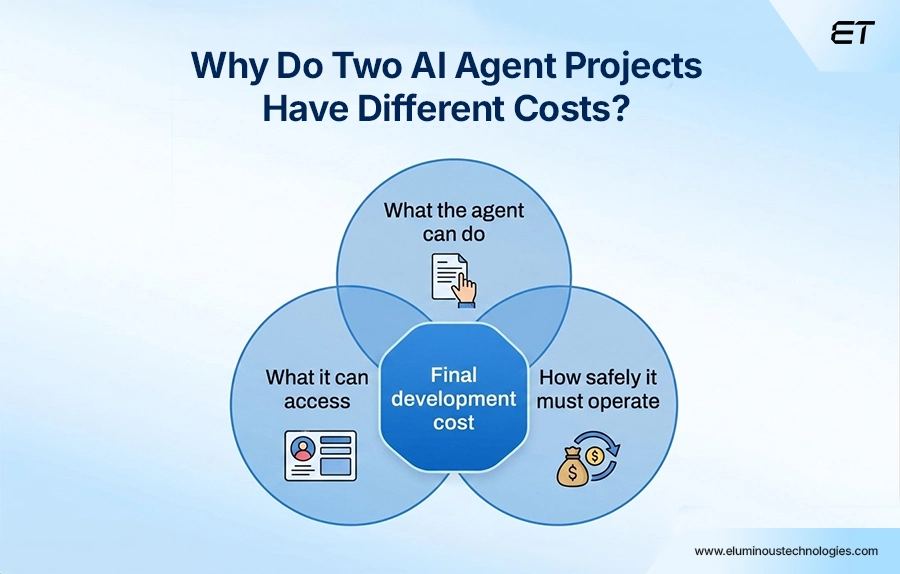
You might come across a situation where two similar projects are at the same stage but have very different AI agent development costs. The difference comes down to what the agent is expected to do, access, and manage. Here’s how each factor moves the estimate.
Autonomy
Consider an agent that drafts a reply for approval. It’s much simpler in nature, so that it will cost less. An agent that drafts a reply for approval has a narrower action boundary and typically costs less to build. On the other hand, an agent with greater autonomy to send, update a record, and issue a refund will require more planning, permission, fallbacks, and testing.
Integration
Connecting an agent to a single well-documented API is different from integrating with several legacy systems that use inconsistent data and have strict authentication requirements. Every additional connection adds development, testing, error handling, and maintenance work.
Data
Fragmented, duplicated, incomplete, or poorly governed data increases the effort for preparation, integration, access control, and evaluation for the agent to perform reliably.
The cleaner and more accessible your data going in, the less of that work you’re paying for.
Model
Model choice affects the initial build cost and what you’ll pay to operate the agent afterward. The model you choose shapes implementation and testing effort during the build. Once live, prompt length, output volume, reasoning depth, tool calls, and traffic shape the recurring bill. Providers, such as Gemini API, may charge separately for tokens, caching, storage, and grounding requests.
Security
If the agent handles sensitive information or takes consequential actions, it needs stronger cybersecurity, monitoring, logging, testing, and human approval controls.
There’s no universal number for what AI agent development costs a company. Cost depends on the use case, data sensitivity, level of autonomy, integrations required, and risk requirements. Each project needs to be scoped against these factors before a meaningful estimate can be produced.
How to Estimate Your AI Agent Development Cost
Before you look for a quote, you can narrow the range yourself by working through the same factors a development partner would, such as:
- What would the workflow be like — one task, or a system spanning multiple functions?
- Is your data accessible, up to date, and consistently governed, or fragmented across your systems?
- Is the agent autonomous enough to act or update records on its own, or does it draft for approval?
- How many system integrations will there be, including legacy or well-documented ones?
- What monitoring, security, and compliance does this workflow require in production?
- How often will the agent run and carry, and at what volume?
When you find yourself answering these questions, you land toward the PoC end of the range or the enterprise side. Walking through them makes it easier for you to compare quotes on the same criteria when a vendor presents one.
End Thoughts
AI agent development costs vary across stages, projects, integrations, and models, but the pattern is consistent.
Start by defining the agent’s role, then look at the scope of use, integrations, autonomy, and operational reliability. Each aspect you cater to affects the overall costs.
Focus on the business workflow first, not on the model you wish to use. RAG handles knowledge retrieval, while agentic behavior concerns planning and action. Many production systems use both together in their workflows rather than treating them as an either-or choice.
With the workflow choice clear, you can go for scope-based consulting from AI experts. A clear lifecycle plan helps you select the right partner, prepare for monitoring and production needs, and avoid underestimating the total investment.
Get a Scope-Based Estimate for Your AI Agent Project

ServiceNow Governance Framework: A Guide to Consistent Multi-Team Workflows
Summary: Different teams using ServiceNow have unique priorities, but they compete on a shared ServiceNow platform. Such a conflict can…

ServiceNow Predictive Intelligence: How IT Leaders Can Automate Smarter
Summary: IT leaders today are expected to improve both operational efficiency and deliver measurable ROI on AI investments. However, talent…


