
 Book a Meeting
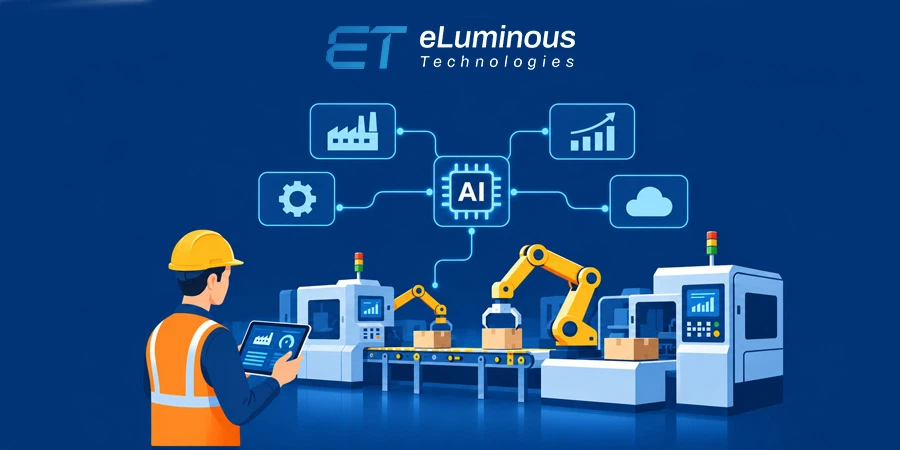
Agentic AI in Manufacturing: Use Cases, Business Benefits, and Adoption Strategy
Your manufacturing operations generate enormous amounts of data every day. Production schedules, machine reports, inventory levels, and supply chain disruptions – all these require quick decisions.
But here’s the catch: having access to all this information doesn’t automatically mean you can act on it efficiently. You may already use predictive analytics, but many decisions still need manual intervention.
That is where agentic AI in manufacturing comes in.
Unlike conventional AI systems, agentic AI can do much more. It can pursue defined goals, plan multiple steps, interact with connected tools, and execute approved actions within established boundaries.
So, what does this mean for your manufacturing business? Let’s explore the applications, business benefits, adoption challenges, and strategic decisions you should consider before investing.
What Is Agentic AI in Manufacturing?
Agentic AI in manufacturing refers to AI-powered systems that pursue specific goals by interpreting data, planning actions, and adapting their approach based on feedback.

Unlike conventional automation, agentic AI can handle workflows that require contextual interpretation and decisions.
For example, consider a production facility experiencing an unexpected machine breakdown.
An agentic AI system could:
- Retrieve the machine’s operating data and maintenance history.\
- Assess the potential impact of the breakdown on production commitments.
- Check spare-part availability and maintenance team schedules.
- Recommend an appropriate intervention.
- Initiate approved maintenance and scheduling workflows.
- Monitor task completion and flag unresolved issues.
Instead of stopping at an alert or recommendation, an agentic system can coordinate several activities toward a defined objective.
Still, this doesn’t mean you should give an AI agent unrestricted access to factory equipment or production systems. You need predefined permissions, validation mechanisms, and human approval for decisions related to operational safety.
Why Should You Consider Agentic AI for Manufacturing Operations?
Manufacturing is no longer just about maintaining production capacity.
You also need to balance:
- Costs
- Product quality
- Equipment performance
- Inventory availability
- Delivery commitments
The problem? These factors are interconnected.
A delay in raw material procurement can affect production scheduling.
A machine failure can disrupt delivery commitments.
A quality issue can increase rework, waste, and operating expenses.’
You need a way to coordinate decisions across these interconnected workflows. Here are a few reasons agentic AI deserves your attention.
1. Increasing Operational Complexity
As your manufacturing operations expand, coordinating production, procurement, maintenance, and inventory becomes difficult.
Agentic AI can help connect these activities by gathering information from different systems.
2. Pressure to improve operational margins
Rising energy costs, maintenance expenses, material waste, and labor requirements can pressure your margins.
Agentic AI can help identify inefficiencies and coordinate corrective actions across eligible workflows.
3. Growing demand for faster decisions
You cannot always afford to wait for multiple teams to exchange reports before responding to an operational disruption.
With access to relevant business data, AI agents can analyze changing conditions, evaluate options, and help you respond faster.
4. The need to maximize existing infrastructure
Replacing your entire manufacturing technology stack isn’t always practical.
Agentic AI can interact with existing enterprise applications and connected systems through suitable integration layers. This allows you to explore intelligent workflows without treating a complete infrastructure overhaul as a prerequisite.
7 Business-Critical Applications of Agentic AI in Manufacturing
Where should you actually apply agentic AI?
The answer depends on your operational issues, available data, existing systems, and business priorities. However, the following applications offer useful starting points.
1. Predictive Maintenance and Asset Management
Unexpected equipment failures can disrupt production schedules, increase maintenance expenses, and affect delivery commitments.

Traditional predictive maintenance systems analyze equipment data to identify unusual patterns and estimate potential failures. Agentic AI can extend this capability by coordinating the activities required to respond.
For example, an AI agent could:
- Monitor equipment performance and identify abnormal operating conditions.
- Retrieve historical maintenance records.
- Assess the urgency of the issue.
- Check spare-part inventory.
- Review maintenance team availability.
- Recommend an intervention window.
- Initiate approved maintenance requests.
Business impact: You can reduce unplanned downtime, improve maintenance coordination, and use available resources more effectively.
However, remember that predictive accuracy depends on sensor coverage, data quality, and suitable failure models. Agentic AI cannot compensate for unreliable equipment data.
2. Intelligent Production Planning and Scheduling
Production schedules rarely remain unchanged throughout the day.
A delayed material shipment, equipment breakdown, unexpected order, or workforce shortage can force you to reconsider production priorities.

Agentic AI can help you manage these changes by evaluating multiple operational constraints.
Consider a scenario where one production line becomes unavailable.
An AI agent could retrieve the current production schedule, identify affected orders, check alternative production capacity, review material availability, and suggest a revised schedule.
After receiving the necessary approval, it could update the relevant planning workflows and notify the teams involved.
Business impact: You can improve schedule responsiveness, reduce manual coordination, and use available production capacity more effectively.
The important consideration is that scheduling decisions must respect real-world constraints such as equipment capabilities, material availability, workforce requirements, and contractual delivery commitments.
3. Quality Assurance and Defect Management
Quality problems can quickly translate into higher scrap rates, rework expenses, customer complaints, and production delays.
You may already use computer vision systems, inspection equipment, and statistical process control to identify defects.

Agentic AI can help coordinate what happens after a quality issue appears.
For example, when an inspection system identifies an unusual defect pattern, an agent could:
- Retrieve inspection records and relevant production parameters.
- Compare the affected batch with historical quality data.
- Identify possible contributing factors.
- Flag potentially affected production lots.
- Prepare a corrective-action recommendation.
- Route the issue to your quality team for validation.
- Track the approved corrective actions.
Business impact: You can improve defect investigation, accelerate quality-related decisions, and strengthen coordination between production and quality teams.
Don’t confuse this with giving an AI agent authority to release or reject safety-critical products independently. Quality decisions still require suitable validation and accountability.
4. Supply Chain and Inventory Coordination
Your production efficiency depends heavily on the availability of raw materials, components, and other essential supplies.
But supply chain disruptions don’t always follow predictable patterns.
A supplier delay, sudden demand increase, or inventory shortage can affect multiple production schedules simultaneously.

If a critical component shipment is delayed, an AI agent could:
- Identify the affected production orders.
- Check available inventory and alternative suppliers.
- Evaluate the impact on delivery schedules.
- Prepare procurement recommendations.
- Route purchase requests for approval.
- Update relevant stakeholders.
Business impact: You can improve supply chain visibility, respond to disruptions faster, and make more informed inventory decisions.
However, supplier selection and purchasing decisions should still account for quality standards, contractual terms, pricing, and procurement policies.
5. Energy and Resource Optimization
Energy consumption is another important consideration, particularly if you operate energy-intensive manufacturing facilities.
Your energy usage can fluctuate depending on machine utilization, production schedules, environmental conditions, and equipment performance.

Agentic AI in manufacturing can help you identify opportunities to coordinate energy-related decisions.
For example, an AI agent could analyze energy consumption patterns, compare them against production requirements, identify unusual usage, and recommend adjustments to eligible processes.
It may also coordinate approved changes to non-critical operating schedules or energy management workflows.
Business impact: You can identify energy inefficiencies, improve resource utilization, and support cost-management initiatives.
Any automated adjustment must respect equipment operating limits, production requirements, and applicable safety standards.
6. Product Engineering and Lifecycle Management
Product engineering involves multiple interconnected activities, from design reviews and documentation to testing, revisions, and manufacturing preparation.

Agentic AI can help coordinate information across these activities.
For example, when you introduce a design revision, an AI agent could retrieve relevant documentation, identify affected components, check dependencies, summarize potential manufacturing
implications, and route the revision for engineering approval.
It could also help coordinate updates across relevant product lifecycle management (PLM) workflows.
Business impact: You can reduce manual information gathering, improve engineering coordination, and accelerate certain documentation and review processes.
However, qualified professionals must remain accountable for engineering validation, design approval, and compliance decisions.
7. Production Troubleshooting and Operational Knowledge Management
Your manufacturing teams accumulate valuable operational knowledge through maintenance records, production reports, troubleshooting documentation, and years of hands-on experience.
The problem is that this knowledge often sits across disconnected systems and documents.

Agentic AI can help retrieve relevant information and coordinate troubleshooting workflows.
Suppose a machine repeatedly experiences the same operational issue.
An AI agent could retrieve previous incident reports, identify similar failure patterns, access equipment documentation, and suggest potential troubleshooting steps.
It could then route the recommendation to the appropriate engineer or maintenance specialist.
Business impact: You can reduce time spent searching for information, improve access to institutional knowledge, and support faster troubleshooting.
This is useful when you need to make operational knowledge more accessible across multiple shifts, facilities, and teams.
What Business Benefits Can You Expect from Agentic AI in Manufacturing?
The value of agentic AI isn’t simply adding another intelligent technology to your factory.
You should evaluate it based on how effectively it addresses existing business problems.
Here are some potential benefits worth considering.
| Business objective | How agentic AI can contribute | Relevant KPI |
| Reduce downtime | Coordinate maintenance-related decisions and workflows | Unplanned downtime, MTTR |
| Improve productivity | Coordinate production activities and reduce manual follow-ups | Throughput, schedule adherence |
| Improve product quality | Support defect investigation and corrective actions | First-pass yield, scrap rate |
| Optimize inventory | Coordinate inventory and procurement information | Inventory turnover, stockout rate |
| Control operating expenses | Identify and coordinate responses to resource inefficiencies | Energy consumption per unit, operating cost |
| Improve responsiveness | Retrieve information and coordinate cross-functional workflows | Decision turnaround time |
1. Better Operational Visibility
When you connect agentic AI with relevant enterprise and industrial systems, you can bring information from multiple workflows into a more coordinated decision-making process.
This can help you understand how an issue in one department affects the wider manufacturing operation.
2. Reduced Manual Coordination
Your teams often spend considerable time collecting reports, checking system updates, sending notifications, and following up on routine operational tasks.
Agentic AI can automate eligible coordination activities, allowing your employees to focus more on exceptions, complex decisions, and higher-value responsibilities.
3. More Responsive Manufacturing Operations
Changing production requirements demand timely responses.
AI agents can help evaluate new information, coordinate relevant workflows, and prepare responses without requiring every step to be initiated manually.
4. Improved Resource Utilization
Better coordination across maintenance, production, inventory, and energy management can help you identify opportunities to use existing resources more efficiently.
5. More Scalable Decision Support
As your operations expand, coordinating information across additional production lines, facilities, and business systems becomes more demanding.
A properly designed agentic AI in manufacturing architecture can support broader workflows, provided you address integration, governance, performance, and infrastructure requirements.
What Does Agentic AI Adoption Mean for Your Existing Manufacturing Infrastructure?
Before you invest in agentic AI, take a closer look at your existing technology infrastructure.
You don’t necessarily need to replace your ERP, manufacturing execution system (MES), supervisory control and data acquisition (SCADA) systems, or industrial IoT devices. In many cases, the real challenge is making these systems work together effectively.
Here’s what you should evaluate.
1. ERP and MES Integration
Your ERP system manages business-level information such as procurement, inventory, orders, and resource planning. Your MES handles production-related activities, including scheduling, work orders, and shop-floor monitoring.

Agentic AI can use information from both systems to coordinate operational workflows.
For example, an AI agent could identify a production delay, check inventory availability through your ERP, retrieve the current production schedule from your MES, and recommend an appropriate response.
To make this possible, you need reliable integration mechanisms and appropriate access permissions.
2. SCADA and Industrial IoT Connectivity
Your SCADA systems and connected industrial devices provide important information about equipment performance, operating conditions, and production processes.

Agentic AI can use this information to support decisions involving maintenance, equipment utilization, and operational monitoring.
However, you must account for communication protocols, data latency, system availability, and security requirements when connecting AI applications to operational technology environments.
3. Data Quality and Interoperability

Your AI agents are only as useful as the information they can access and interpret.
Imagine receiving temperature readings from different machines, each using different naming conventions, measurement units, or reporting formats.
Without proper contextualization, an AI agent may struggle to interpret the information correctly.
You need consistent data definitions, reliable integration pipelines, appropriate access controls, and sufficient historical context to support dependable decisions.
4. Scalable Application Architecture

As you expand your agentic AI initiatives, you may need to connect additional systems, introduce specialized agents, and support more complex workflows.
Your architecture should account for integration flexibility, monitoring, security, performance, and maintainability. You should also evaluate whether certain processing activities need to run at the industrial edge, in the cloud, or through a hybrid architecture.
The right approach depends on your latency requirements, infrastructure, data sensitivity, and operational constraints.
If you need to connect your manufacturing systems through custom digital platforms, explore web development solutions for manufacturing businesses.
What Are the Risks of Deploying Agentic AI in Manufacturing?

Manufacturing environments have operational constraints that make unrestricted AI autonomy particularly risky. An incorrect recommendation can affect equipment, production schedules, product quality, and employee safety.
Here are some challenges you should address before deployment.
1. Operational Safety and Uncontrolled Actions
You cannot treat every manufacturing decision as an ordinary workflow automation task.
For instance, changing a production schedule is different from modifying a machine’s operating parameters. The latter may involve significant safety implications.
Define which actions an AI agent can perform independently, which require human approval, and which must remain under deterministic control systems.
Keep safety-critical control functions within appropriately validated industrial control architectures. Don’t rely on an LLM to make real-time safety decisions.
2. Data Reliability and Incorrect Decisions
An AI agent may misinterpret incomplete, outdated, or inconsistent information.
For example, if your inventory system reports inaccurate spare-part availability, an agent could recommend a maintenance plan it can’t execute.
You need data validation, source verification, exception handling, and mechanisms that prevent uncertain outputs from triggering consequential actions.
3. Cybersecurity and Unauthorized Access
Connecting AI agents to enterprise and industrial systems introduces additional access and security considerations.
You must evaluate risks such as unauthorized tool access, compromised credentials, prompt injection, data exposure, and inappropriate system permissions.
Use role-based access controls, secure APIs, audit logs, network segmentation, and continuous monitoring to protect your environment.
4. Integration Complexity
Your manufacturing infrastructure may include legacy applications, proprietary equipment interfaces, disconnected databases, and systems that weren’t originally designed to exchange information.
Integrating these environments can require substantial engineering effort.
Assess interoperability and integration feasibility before committing to a large-scale agentic AI initiative.
5. Workforce Adoption and Accountability
Your employees need to understand how AI agents support their responsibilities.
If you introduce autonomous workflows without defining ownership, approval processes, and escalation mechanisms, you risk creating confusion rather than improving productivity.
Train your teams, communicate the scope of automation, and establish clear accountability for decisions and outcomes.
How Should You Evaluate Agentic AI Investments in Manufacturing?
You don’t need to introduce agentic AI in manufacturing all at once.
In fact, starting with too many use cases can make implementation unnecessarily complicated to measure. Instead, evaluate opportunities by business value, technical feasibility, and operational risk.
Here are five steps to help you make a more informed investment decision.

Step 1: Identify Your Most Expensive Operational Bottlenecks
Start by identifying the problems that have the greatest impact on your business.
- Are you experiencing frequent equipment breakdowns?
- Does production scheduling require excessive manual coordination?
- Are inventory shortages disrupting manufacturing commitments?
Identify the issues, quantify their financial and operational impact, and determine whether agentic AI can realistically address them.
Don’t start with the technology. Start with the problem.
Step 2: Evaluate Data and System Readiness
Once you identify a potential use case, assess whether your existing infrastructure can support it.
Check:
- Availability of relevant operational and historical data.
- Compatibility between existing enterprise systems.
- API availability and integration requirements.
- Data accuracy and consistency.
- Security and access-control requirements.
- Infrastructure scalability.
This assessment will help you understand whether you can move directly into development or need to address foundational issues first.
Step 3: Prioritize Use Cases Based on Value and Feasibility
Not every promising application deserves immediate investment.
Use a simple prioritization matrix to compare potential initiatives.
| Use case | Business value | Implementation complexity | Suggested priority |
| Maintenance workflow coordination | High | Medium | High |
| Production schedule adjustments | High | High | Medium–High |
| Quality defect investigation | High | Medium | High |
| Inventory coordination | Medium–High | Medium | High |
| Autonomous machine control | Potentially high | Very high | Requires specialized safety assessment |
These are illustrative assessments. Your actual priorities will depend on operational data, infrastructure, risk tolerance, and implementation costs.
Ideally, you should begin with a use case that offers measurable value without requiring extensive changes to your existing systems.
Step 4: Define Autonomy and Approval Boundaries
Before development begins, decide how much independence you want to give your AI agents.
For example, you might allow an agent to retrieve maintenance records, identify possible causes, and prepare a maintenance request on its own.
However, you may require a maintenance supervisor to approve the actual work order or any action that affects production. Define permissions, approval thresholds, escalation paths, and audit requirements before connecting agents to critical workflows.
Step 5: Establish Measurable Success Criteria
Finally, decide how you’ll determine whether the investment is worthwhile.
Set baseline measurements before deploying the solution.
Depending on your selected use case, you could track:
- Unplanned equipment downtime.
- Mean time to repair (MTTR).
- Production schedule adherence.
- First-pass yield.
- Inventory turnover.
- Manual coordination time.
- Cost per manufactured unit.
You should also account for development expenses, infrastructure, integration, ongoing maintenance, and governance costs. This gives you a more realistic picture of whether the initiative delivers sufficient business value.
How to Move from an Agentic AI Pilot to Enterprise-Wide Adoption
You may achieve promising results in one production line, only to hit integration, data, or governance challenges when you expand the solution across multiple facilities.
To avoid this, approach adoption in manageable stages.
1. Start with a Bounded Pilot

Select one clearly defined operational problem with measurable outcomes.
For example, you could pilot an agentic maintenance coordination workflow for a specific category of equipment.
Limit the agent’s permissions, set approval requirements, and define when it must escalate an issue.
2. Validate Results Against Your Baseline

Compare the pilot’s performance with your original measurements.
- Did maintenance coordination become faster?
- Did you reduce manual follow-ups?
- Did the solution improve the selected operational KPI?
Don’t rely solely on the number of tasks AI agents complete. Measure actual business outcomes.
3. Strengthen Integration and Governance

Before expanding the pilot, address any issues identified during testing.
Review system permissions, integration reliability, auditability, exception handling, and security controls. You should also evaluate how the solution performs under higher workloads and changing operating conditions.
4. Expand to Related Workflows

Once you validate the initial use case, consider expanding into connected workflows.
For example, a maintenance coordination solution could eventually interact with inventory management and production scheduling systems. This creates opportunities for broader coordination without requiring you to automate everything simultaneously.
5. Monitor and Optimize Continuously

Your operational environment will continue to change.
New equipment, production requirements, suppliers, and business processes can affect how your AI agents perform.
Monitor decision quality, action accuracy, workflow completion, exceptions, and business KPIs.
You should also review permissions and governance policies periodically to ensure the system stays aligned with your operational requirements.
If you want to explore the technical considerations behind building and deploying these systems, our guide to agentic AI implementation consulting for enterprises offers a broader enterprise perspective.
How Can You Measure the ROI of Agentic AI in Manufacturing?

Don’t evaluate agentic AI in manufacturing based on how advanced the technology looks. What matters is whether it improves your manufacturing operations enough to justify the development, integration, and ongoing operating expenses.
A practical ROI assessment should consider three areas.
1. Calculate the Operational Benefits – Agentic AI in Manufacturing
Start by identifying the financial impact of the problem you’re trying to solve.
For example, if you’re implementing an agentic maintenance workflow, consider:
- Production losses associated with unplanned downtime.
- Maintenance labor and coordination expenses.
- Emergency spare-part procurement costs.
- Production delays caused by equipment failures.
Next, estimate how much of this cost the proposed solution could realistically address.
Don’t assume every operational improvement will translate directly into financial savings. Validate the assumptions against your actual production data.
2. Account for the Total Cost of Implementation – Agentic AI in Manufacturing
Your investment goes beyond the AI model or development platform.
Consider expenses associated with:
- AI solution architecture and development.
- ERP, MES, SCADA, and other system integrations.
- Infrastructure, cloud resources, and API usage.
- Data preparation and engineering.
- Security, testing, and governance.
- Ongoing monitoring, maintenance, and optimization.
- Employee training and change management.
These costs will vary depending on your manufacturing environment, existing infrastructure, and the complexity of your use case.
3. Calculate Your Expected Return – Agentic AI in Manufacturing
You can use the following formula to estimate the financial return:
ROI (%) = [(Annual Financial Benefits − Annualized Total Costs)/Annualized Total Costs] × 100
For example, suppose your manufacturing business estimates the following annual figures for an agentic maintenance coordination solution:
| Financial component | Illustrative annual amount |
| Reduced downtime-related losses | $80,000 |
| Reduced maintenance coordination expenses | $20,000 |
| Total estimated financial benefits | $100,000 |
| Annualized development and integration costs | $35,000 |
| Infrastructure and maintenance costs | $15,000 |
| Total annualized costs | $50,000 |
Based on these assumptions:
ROI = [($100,000 − $50,000) / $50,000] × 100 = 100%
Note: This is an illustrative calculation, not a guaranteed outcome or an industry benchmark.
You should also evaluate the payback period, implementation risks, and whether the projected benefits remain sustainable as you scale the solution.
What Is the Future of Agentic AI in Manufacturing?
Manufacturing is moving toward increasingly connected operations, where production systems, enterprise applications, industrial devices, and business workflows exchange information more effectively.

Agentic AI in manufacturing could play an important role in this transition.
One development worth watching is multi-agent coordination.
Instead of relying on one agent to handle an entire operational workflow, you could deploy specialized agents with clearly defined responsibilities.
For example:
- A maintenance agent monitors equipment performance and identifies potential issues.
- An inventory agent checks spare-part availability.
- A production planning agent evaluates scheduling implications.
- A procurement agent prepares purchasing recommendations.
- An orchestration layer coordinates the workflow and manages approvals.
This approach could help you coordinate complex activities across departments and facilities.
Another development is closer integration between AI agents, digital twins, and industrial IoT platforms. By combining operational data with virtual representations of manufacturing assets and processes, you could improve scenario analysis and decision support.
However, greater autonomy doesn’t automatically mean better manufacturing outcomes.
You will still need reliable data, appropriate system integrations, well-defined permissions, human oversight, and measurable performance standards.
Businesses that approach this technology strategically will be better positioned to identify where agentic AI in manufacturing creates genuine value.
To Sum Up: Agentic AI in Manufacturing
Agentic AI in manufacturing offers an opportunity to rethink how you coordinate manufacturing decisions and connect existing business systems.
But getting the most out of this technology requires more than deploying an AI model. You need a solution that understands your workflows, integrates with your infrastructure, and operates within clearly defined business and safety boundaries.
At eLuminous Technologies, we help you explore and develop practical AI solutions aligned with your operational requirements.
Whether you’re evaluating an agentic AI initiative, connecting existing enterprise applications, or building custom manufacturing platforms, we can help you identify the right development approach.
Explore our AI development services to discuss your requirements and plan your next step.
Frequently Asked Questions About Agentic AI in Manufacturing
1. What is an example of agentic AI in manufacturing?
An agentic maintenance coordination system is one example. It can monitor equipment data, retrieve maintenance records, check spare-part availability, evaluate production schedules, and prepare maintenance requests. Depending on its permissions, it can also initiate approved workflows and track their completion.
2. How is agentic AI different from traditional manufacturing automation?
Traditional automation generally follows predefined rules and instructions. Agentic AI can interpret changing information, plan multiple steps, and coordinate actions toward a defined goal. You can use both approaches together, with conventional automation handling deterministic processes and AI agents supporting workflows that require contextual decisions.
3. Can you integrate agentic AI with existing manufacturing systems?
Yes. You can integrate agentic AI with existing ERP, MES, SCADA, industrial IoT, and other enterprise systems through suitable APIs, connectors, middleware, and integration layers. However, feasibility depends on system compatibility, data accessibility, security requirements, and operational constraints.
4. Is agentic AI suitable for small and midsize manufacturers?
Yes, as long as you choose an appropriate use case and keep the implementation scope manageable. You don’t need to automate an entire manufacturing facility. You can start with a bounded workflow, such as maintenance coordination or inventory monitoring, and expand once you validate its business value.
5. How long does agentic AI implementation take?
There is no universal implementation timeline. A focused pilot involving accessible data and a limited number of integrations may take substantially less time than an enterprise-wide deployment involving legacy systems, multiple facilities, and complex governance requirements. You should establish a timeline after evaluating your requirements and infrastructure.
6. How can you ensure the safe use of agentic AI in manufacturing?
Start by defining what actions your AI agents can perform, which systems they can access, and which decisions require human approval. Implement role-based permissions, audit trails, validation mechanisms, exception handling, and continuous monitoring. Keep safety-critical control functions within appropriately validated industrial control systems.
7. What is the difference between agentic AI and multi-agent AI systems?
Agentic AI refers to systems that can pursue goals and perform tasks with some autonomy. A multi-agent system involves multiple specialized agents that collaborate or coordinate to accomplish a broader objective. You can use a multi-agent architecture when a complex manufacturing workflow benefits from dividing responsibilities across specialized agents.


AI Agent Development Cost: Pricing & Cost Drivers
Summary: AI agent development costs vary widely between projects that look similar in stages, scope, or integrations. A focused proof…


ServiceNow Governance Framework: A Guide to Consistent Multi-Team Workflows
Summary: Different teams using ServiceNow have unique priorities, but they compete on a shared ServiceNow platform. Such a conflict can…


