
 Book a Meeting
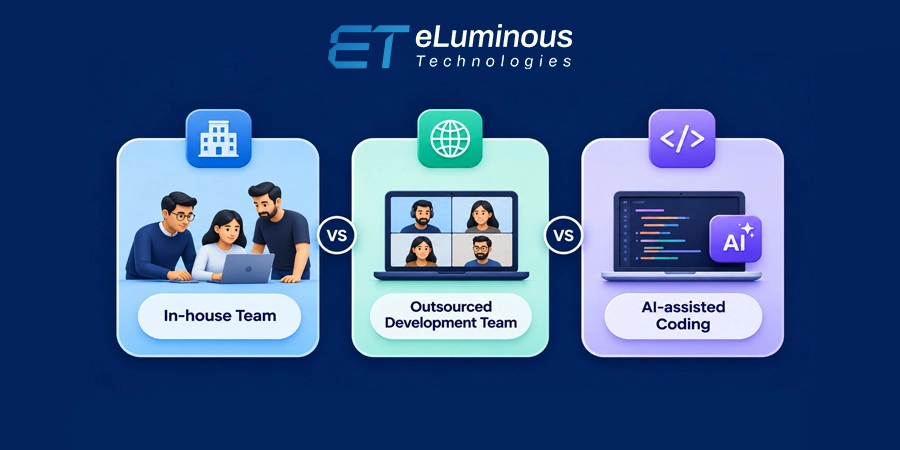
SaaS Startup Hire vs Outsource vs AI: What’s Best for Your Business

- SaaS startup hire vs outsource vs AI: Each development strategy offers distinct benefits, downsides, and challenges.
- In-house hiring gives you greater control over product development and direction but involves high overhead and recurring costs.
- Outsourcing gives you access to niche experts with more flexibility and a comparatively lower budget.
- AI coding tools can reduce initial costs but still require human oversight to ensure security, scalability, and maintenance.
- You can choose the hybrid model to balance the benefits of the three approaches.
If you’re a startup owner, you’re watching established companies lay off skilled employees, AI adoption accelerate, and outsourcing remain a lucrative option despite all the disruption.
It’s too much to decode, and that’s why ‘SaaS startup hire vs outsource vs AI’ has become an interesting topic. It’s a three-way comparison that needs to answer one question: ‘What is the best strategy in the post-AI world?’
To put it straight, there’s no single right approach to building a SaaS startup.
Hiring in-house resources gives you stability and a strong foundation.
Outsourcing helps you gain skilled expertise without the overhead.
Adopting AI gives you access to innovative tools for automation and improved productivity.
It also puts you in the 89% of global organizations that have integrated AI into at least one business function. But to make the right call, you need relevant details on each strategy.
This blog breaks down the three options in the context of today’s global IT market. Scroll ahead to see which choice fits your business model and goals.
SaaS Startup Hire vs Outsource vs AI: Comparing Development Strategies
Before we explain the main crux behind each option, explore the table below:
| Comparison Factor | Hire In-house | Outsource | Outsource |
| Initial Investment | High | Moderate | Low |
| Access to Expertise | Through recruitment | Specialized teams | Depends on tools and human oversight |
| Development Speed | Depends on hiring and onboarding | Faster team availability | Fast for prototyping and repetitive tasks |
| Control | High | Shared | Depends on internal expertise |
| Scalability | Requires additional hiring | Flexible team expansion | Scales with tools and infrastructure |
| Long-term Maintenance | Internal team responsibility | Depends on agreement | Requires human oversight |
| Best Suited For | Long-term product development | Specialized skills and faster execution | Prototyping and development assistance |
SaaS startups need to balance two crucial aspects:
- Budget
- Ambition
You want the best teams or tools at reasonable costs. You also don’t want to close shop within three years. That’s where you need to have the complete picture.
Artificial intelligence (AI) is already a booming market, with a valuation projected to reach USD 3.6 trillion by 2033. So, it’s natural to think, ‘Let’s invest in AI subscriptions and hold off on hiring or outsourcing activities.’
But that’s where you can make a mistake. In-house hiring or outsourcing serves different purposes. Outsourcing still holds its ground, given its market value of approx. USD 618 billion. This figure reflects continued worldwide demand for outsourced IT services, including software development and other technical offerings.
All in all, the SaaS startup hire vs outsource vs AI comparison sums up something like this:
- Hire: Build an in-house team for greater control, consistent collaboration, and long-term product ownership.
- Outsource: Access specialized expertise, flexible resources, and faster execution without building a full team internally.
- AI: Speed up development, automate repetitive tasks, and reduce manual effort without relying entirely on traditional resources.
In the next section, we’ll explain why in-house hiring remains vital even after adopting AI.
A Look at Hiring In-house Resources
Hiring in-house employees is a straightforward process of evaluating multiple candidates, interviewing them, and onboarding them onto your payroll.
They become full-time resources who work exclusively for your SaaS startup. These guys understand your vision and become your team throughout your startup journey.
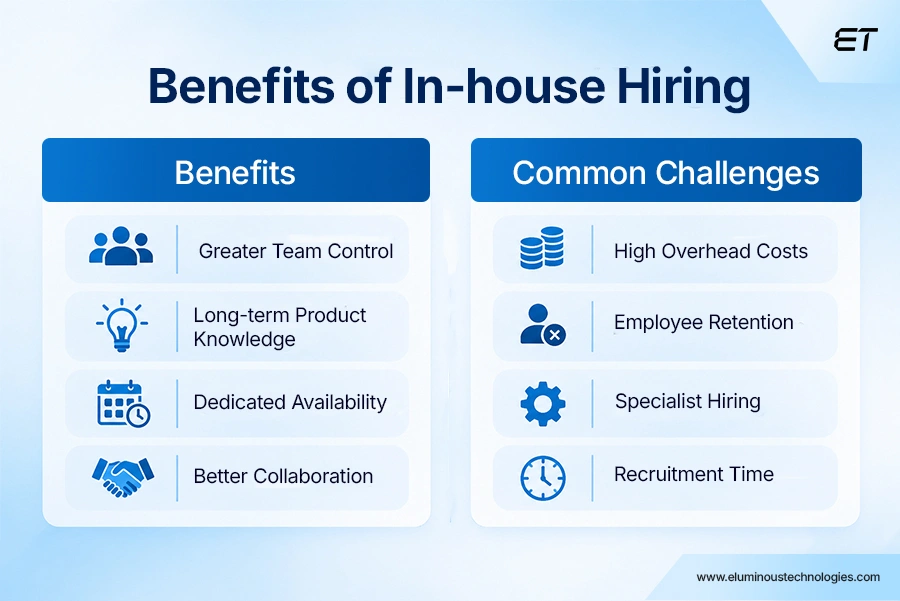
In SaaS product development, hiring in-house can offer the advantages below:
- Greater team control
- Long-term product knowledge
- Dedicated availability
- Better collaboration
However, in-house hiring also comes with some common challenges:
- High overhead, recruitment, and recurring expenses.
- Retention responsibilities and the need for smart team management.
- Difficulty affording or hiring multiple specialists for niche development requirements.
- Considerable time spent sourcing and selecting the right candidates.
So why hire in-house despite all the fuss about AI?
The reasons are simple. You need people who understand your product vision and requirements, and who can provide insights wherever possible. You also need specialists to oversee what AI tools produce and how they handle your data.
We recommend you build an in-house team if:
- You have secured funding or consistent revenue.
- There’s a need to protect proprietary technology or maintain strict internal control.
- You can afford to recruit, manage, and retain a development team.
- You expect ongoing product development rather than a one-off build.
The average annual salary for a software developer in the US is approximately USD 83,000. So, we won’t suggest going all-in and hiring 20 SaaS developers for your startup. You’ll need a smart approach combining the three choices rather than viewing them as a SaaS startup hire vs outsource vs AI comparison.
Understanding the Outsourcing Model for SaaS
Outsourcing means hiring external specialists or a vendor to handle your SaaS product or a part of its development. Your outsourcing partner can be in your country or miles away in another.
Regardless, modern software development collaboration tools make it easier to work with a remote team.
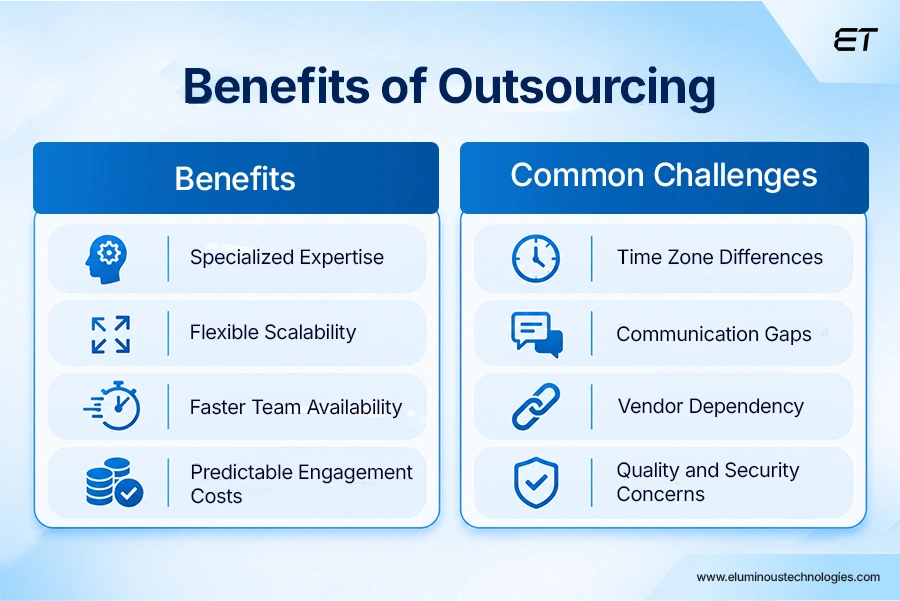
Now, traditional outsourcing offers you some nice benefits:
- Access to specialized experts.
- Scalability as per your changing needs.
- Faster team availability without a lengthy hiring cycle.
- Predictable engagement costs.
On paper, this option can seem like one of the best picks from our SaaS startup hire vs outsource vs AI comparison. But it does have some challenges like:
- Time zone incompatibility and communication gaps.
- High dependency on vendor performance.
- Quality variations in different outsourcing partners.
- Data security, NDA, and IP concerns.
You can reduce these risks, although not eliminate them, by choosing a reliable software development company. But you need to conduct thorough background checks to choose the right partner. For these checks, we recommend reviewing testimonials, case studies, press releases, and Clutch reviews.
Types of Outsourcing: A Quick Look
Mainly, outsourcing is of three types. The table below gives you a quick overview.
| Outsourcing Model | How It Works | Best Suited For |
| Project-based Outsourcing | An external team handles a specific project with defined deliverables and timelines. | MVP development and SaaS projects. |
| Dedicated Development Team | An external team works exclusively on your product and ongoing development needs. | Long-term product development and scaling. |
| Staff Augmentation | External developers join your existing team to fill skill gaps or increase capacity. | Additional expertise and temporary development support. |
IT staff augmentation is an interesting outsourcing model. To understand how it compares with in-house hiring, you can read our comparative guide.
Coming back to our choice. You can go ahead with outsourcing if:
- You need to launch an MVP without building a complete engineering team.
- You want ongoing development but aren’t ready to establish a large internal team.
- Your project needs additional development capacity quickly.
- You want to control fixed employee costs.
Now, IT outsourcing costs vary widely depending on your project’s complexity, developer expertise, tech stack, and engagement model. Still, you can expect a general fee of USD 25 to USD 150+ per hour. If you’re exploring the staff augmentation route, this cost calculator can give you an approximate estimate.
How SaaS Startups Use AI as an Alternative
The third option in our SaaS startup hire vs outsource vs AI comparison is a bit of a mixed bag.
With AI, you feel you’ve got all the tech superpower in the world. But it’s not that straightforward.
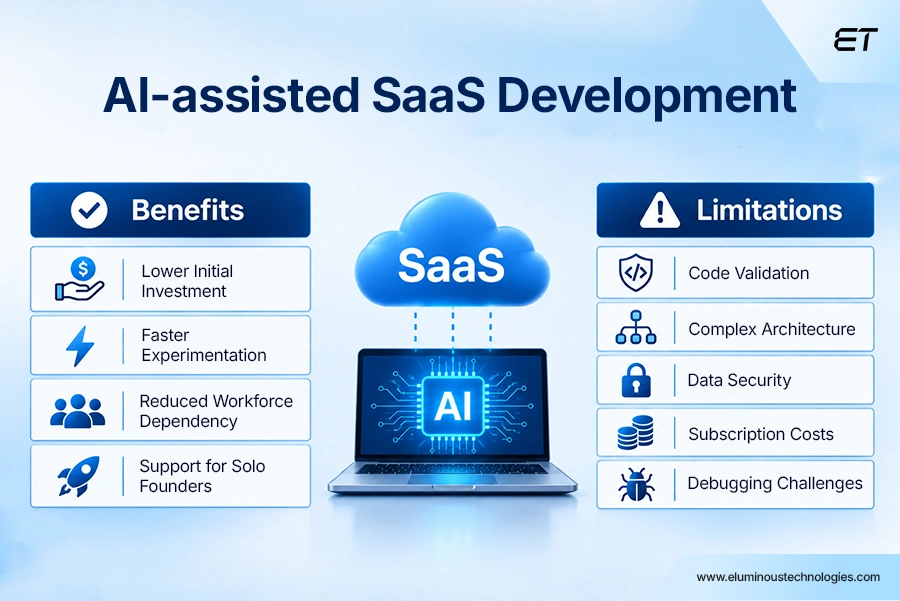
Artificial intelligence tools can help generate code, build prototypes, and automate repetitive tasks through prompts. Common options include ChatGPT, Claude, Gemini, and Grok AI.
You might find AI appealing for the following reasons:
- Lower initial investment
- Faster experimentation
- Less dependence on the human workforce
- Good assistance for a one-person startup
All these aspects are valid. But with the positives, you need to consider the limitations:
- You still need to validate AI-generated code.
- For complex architecture, human expertise is essential.
- There’s a need to keep an eye on data security and privacy.
- Subscription costs can add up and increase overall expenses.
- Debugging AI-generated code is tricky if you don’t have the technical expertise.
For SaaS startups, AI software development makes sense when you’re sure about the product and have someone to evaluate the output. This ‘someone’ can be an in-house resource or an AI expert from an outsourcing company.
Ignoring human oversight can have serious consequences. SaaStr learned this the hard way when a Replit AI coding assistant deleted its production database during development. Read the news about Replit’s AI coder for more details on this incident.
Which Option to Choose: SaaS Startup Hire vs Outsource vs AI?
Now that you know what each option brings to the table, it’s time to decide which is best.
If you ask us, we won’t declare a single outright winner because there isn’t one. And that’s the honest crux of the SaaS startup hire vs outsource vs AI comparison.
We’ll suggest the best model depending on the stage of your SaaS startup:
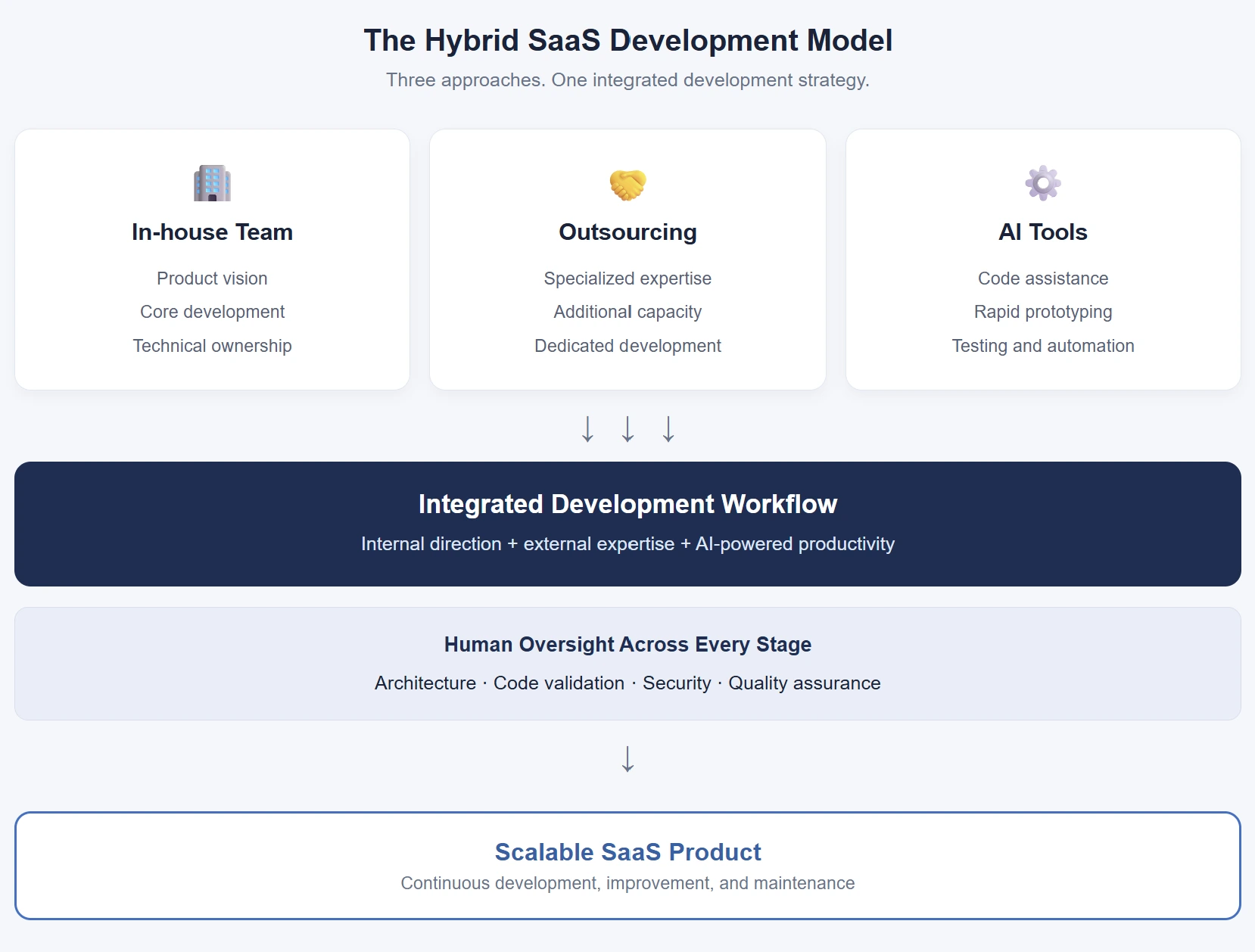
For instance, you could have one in-house technical lead managing the product roadmap. You can then hire an external team building specialized modules. The AI tools can assist with prototyping, documentation, and testing.
The vital thing here is to be accountable for the following facets:
- Product ownership: The in-house team should oversee product vision and technical direction.
- Code quality: Ensure all code undergoes proper review and quality testing.
- Data security: Maintain consistent security standards across internal teams, external developers, and AI tools.
- Source-code ownership: Retain access to the codebase, documentation, and development assets.
- Maintenance responsibilities: Clearly define who handles bug fixes, updates, and ongoing improvements.
Spend some time creating a solid structure for your hybrid model. That’s how you can improve the chances of becoming a well-planned SaaS startup.
Common Mistakes to Avoid in Resource and AI Tool Planning
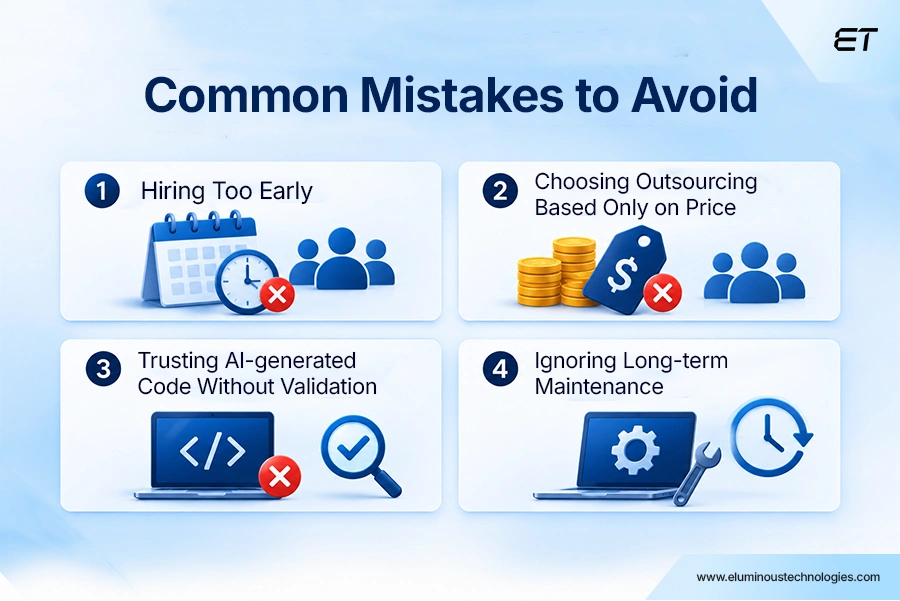
Even if you’re careful with your budget and technical needs, some mistakes can happen. Here are a few generic ones to consider:
- Early Hiring: You start recruiting in-house developers too early without securing sufficient funding or validating your product and concept.
- Focusing Only on Outsourcing Price: You compare quotes and neglect aspects like project scope, communication, technical expertise, client feedback, and testimonials.
- Trusting AI-generated Code Quickly: You skip code audits, quality testing, and important security checks.
- Neglecting Long-term Maintenance Costs: You think SaaS product development is a one-time activity and overlook scalability and maintenance.
Always try to strike the best balance of human and AI assistance. We always suggest building an MVP before investing in more sophisticated tools and resources.
Summing Up: SaaS Startup Hire vs Outsource vs AI
There’s no single right decision between hiring in-house developers, outsourcing your development work, or using AI tools for coding.
Each approach gives you distinct benefits:
- In-house resources give you high control, continuity, and a solid base.
- Outsourcing gives you access to specialized expertise at a competitive budget.
- AI coding tools help you gain speed and flexibility while automating repetitive tasks.
The right call depends on your startup’s stage, budget, technical requirements, and cost of ownership. A hybrid approach can give you control, external expertise, and AI-assisted productivity. Still, such a model isn’t mandatory for every SaaS startup.
Choose the right approach to help your startup stay sustainable and manageable. If you need an outsourcing partner, contact us, and we’ll get back to you as soon as possible.
Frequently Asked Questions: SaaS Startup Hire vs Outsource vs AI
1. Should a SaaS startup hire developers, outsource development, or use AI?
A SaaS startup doesn’t need to choose one approach for software and product development. Hiring in-house developers provides control and long-term stability, outsourcing gives access to specialized experts at lower cost, and AI tools improve speed and productivity. A hybrid model can balance these benefits, but it isn’t mandatory for every startup. The final decision depends on budget, stage, technical needs, and total cost of ownership.
2. Can AI build a SaaS MVP without developers?
Yes. AI can build an MVP (minimum viable product) without relying on professional developers. Still, AI-generated code needs careful validation and testing. It can become hard to scale and carry recurring usage costs. So, combining AI with human expertise can be a better middle ground.
3. Is outsourcing cheaper than hiring in-house developers?
Generally, software development outsourcing is cheaper for short-term projects. It has low overhead, more flexibility in onboarding and offboarding developers, and multiple engagement models to suit your budget. However, the overall cost depends on the scope, location, expertise, and engagement model.
4. When should a SaaS startup hire its first developer?
A SaaS startup can hire its first developer after validating demand, acquiring funding, and defining a stable product roadmap.
5. What should a SaaS startup outsource during product development?
A SaaS startup can outsource MVP development, quality assurance, and niche skills it lacks. Having an experienced outsourcing partner can cover the need to hire dedicated experts for specialized cases like RAG development, third-party API integrations, workflow automation, and more.
6. Can you use AI-generated code in the production of SaaS applications?
Yes. You can use AI-generated code for MVPs and rapid prototyping. However, you’ll still need human expertise to handle security, maintenance, and scalability.
Agentic AI in Manufacturing: Use Cases, Business Benefits, and Adoption Strategy
Your manufacturing operations generate enormous amounts of data every day. Production schedules, machine reports, inventory levels, and supply chain disruptions…


AI Agent Development Cost: Pricing & Cost Drivers
Summary: AI agent development costs vary widely between projects that look similar in stages, scope, or integrations. A focused proof…


