
 Book a Meeting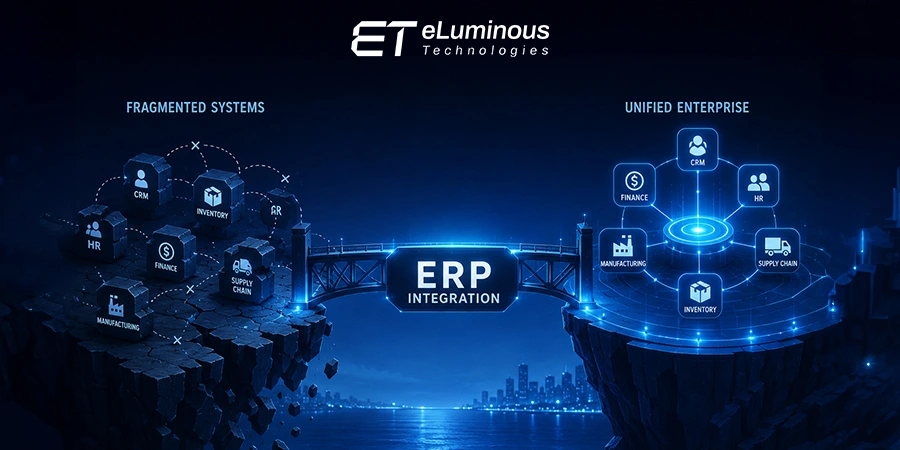
A Guide to ERP Integration: Why It’s Essential for Business Efficiency
Most organizations think of ERP Integration as interconnected systems for efficiency. It has been true for most enterprise efficiency development systems. But lately it serves another strategic purpose.
Separate systems require employees to manually transfer information from one department to another. It leads to errors and keeps decision-makers away from real-time realities and data.
In this guide, you will learn about how foundational issues such as stakeholder engagement play a role in integration failure. You will also find out how unified systems improve operational visibility and cross-functional decision-making.
You planned for ‘single source of truth’ and decided to bring system integration back from the IT office to boardroom discussions. Rightly so.
ERP integration is what actually delivers on that decision. It connects the separate systems your business runs on so data moves between them automatically instead of manual re-entering.
Businesses invest in it today to remove that manual work and give every department a real-time view of each process.
Despite the intention to strengthen enterprise architecture, many CIOs, CFOs and COOs miss their integration goals. Gartner has predicted that by 2027, 70% of recent enterprise resource planning (ERP) initiatives will fail.
In this situation, it’s wise to identify risks before you lay out an integration strategy.
More so, because the stakes have never been higher, especially with market volatility and Agentic AI in the picture now. It seeks a synchronized enterprise architecture.
To innovate, scale, and thrive (not just survive) with digital transformation, interconnected systems are the essentials for a strong enterprise architecture.
So, the goal is not to pour more funds into making the already running integration work, but rather to align. Balancing ERP initiatives with strategic goals and assessing whether integration is necessary for your organization are important to defining a roadmap.
In this guide, business leaders will learn what ERP integration is and why it matters. Alongside, you’ll find out why so many initiatives don’t get it right and a formula to execute ERP software integration successfully.
What is ERP Integration and Why It Matters Now: The Stakeholder and Governance Elements
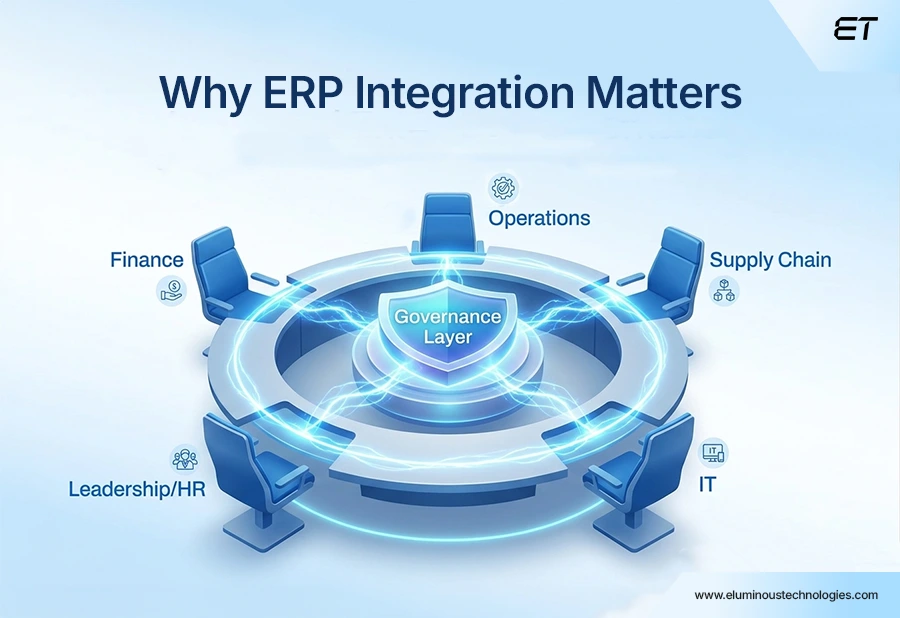
ERP integration connects your ERP system with the other applications your business runs on (CRM, warehouse management, eCommerce, etc.). It enables data flows between them automatically instead of relying on manual handoffs for each process across departments.
Without such connectivity, the whole business runs on data silos. Finance, operations, and sales each see their own version of business reality. Finance looks at invoiced revenue, operations tracks shipped orders, and sales keep count of closed deals. None of them sees the complete picture.
Data silos create two main barriers to business growth: moving data into data warehouses (26%) and deriving actionable insights from them (24%).
Integration solves these problems and more, providing a clear view of processes for informed decision-making.
Beyond removing blind spots, ERP integration serves two more purposes. But to know that, it’s essential to learn why so many initiatives fall short.
Beyond technology, successful integration depends on stakeholder alignment, governance, and a clear business strategy.
Stakeholder Engagement as Foundation: Making Strong Digital Architecture
ERP initiatives need preparedness from the ground up. They don’t succeed because foundational issues are overlooked.
Most ERP initiatives have a history of failed projects. Even in strategies, the integrations have been for monolithic, conventional systems based on IT-driven assumptions, not cross-functional business needs. When those same assumptions carry into adoption, they can’t deliver the business value leaders expect.
This led to ERP integration losing its appeal to C-suite executives. Underinvestment followed, along with rushed execution, which reinforced the perception that integration projects don’t pay off.
The core reason for such foundational failures in ERP integration was a lack of stakeholder engagement. Closing that gap brings the initiative closer to three critical ERP integration outcomes: cross-functional process alignment, user adoption, and business governance.
With a digital backbone as a necessity, the stakeholders who must be engaged are not optional, including:
- Finance & Operations: Need unified data for real-time decisions
- Supply Chain & IT: Require cross-system visibility and governance
- Leadership & HR: Must align on strategy and drive adoption
When these stakeholders align early, integration projects move faster, find a streamlined governance path, and see far higher adoption once they go live. A project can stall for months if Finance and Operations define conflicting data standards, or if Sales rolls out CRM workflows without looping in the ERP team.
Ensuring stakeholders reach a consensus before implementation starts is what prevents that.
Integration as Governance: Keeping Systems and Data Aligned
Aligning these stakeholders forms the same foundation that makes organizations technically and strategically ready for faster decision-making. It builds the operational visibility, process automation, and data consistency that cross-functional decision-making depends on.
Without clear business objectives, cross-functional alignment, and stakeholder engagement, integration efforts don’t yield the best results.
Think about it this way: an inventory management system cannot utilize real-time inventory information if that information is held in a database that no one else has access to. Accounting cannot reconcile records if billing information is stored in different databases from CRM.
Across operations of a multi-plant web development portal, having an integrated enterprise becomes even more important to ensure smooth processes and keep costs down. Without integrated systems, you’ve to manage multiple reconciliations, keep blind spots in check, and handle operational risks.
Integration in today’s digital age is far beyond syncing systems.
It works as the governance layer that keeps every department working with the required data as fast as it’s integrated. It is about aligning the organization itself—so they move as one entity.
It’s also what positions a business to adopt AI and automation later, once teams are already working from a shared, governed data foundation.
What Does Successful ERP Integration Bring: The Financial Impact
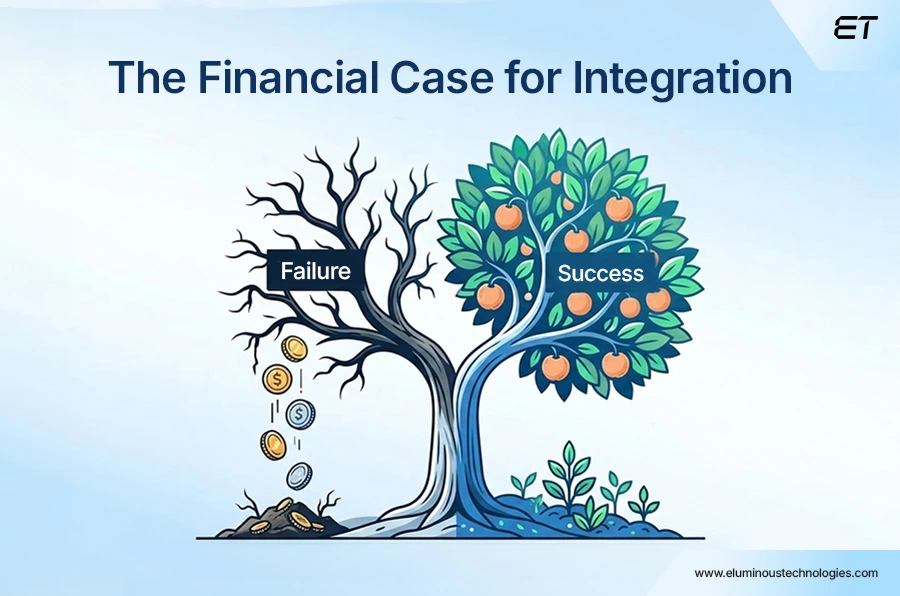
Where ERP integration is done effectively—both in terms of technical execution and stakeholder involvement- the benefits are significant.
The organizations that succeed have an average return on investment of 52%, meaning that for every dollar they invest, they get $1.52 in return.
But the real value shows in day-to-day operations.
For instance, manufacturing integration is one of the most complex procedures across industries. Production Planning, procurement, bill of materials (BOM), and demand forecasting operate in separate systems and create many blind spots.
By unifying these processes through proper ERP integration, businesses can reduce inventory costs by 10-15%.
The types of savings compound: less manual data entry, fewer reconciliation errors, faster order processing, more accurate inventory, and cleaner reporting across departments.
With a careful pre-implementation cost-benefit evaluation and proper stakeholder alignment, the success rate jumps to as high as 85%.
The difference is quite striking and lucrative for business leaders planning for integration across the organization. Where a major chunk of ERP integration projects fail, the remaining 30% succeed because of the disciplined execution methodology based on stakeholder involvement.
When Does Your Business Need ERP Integration
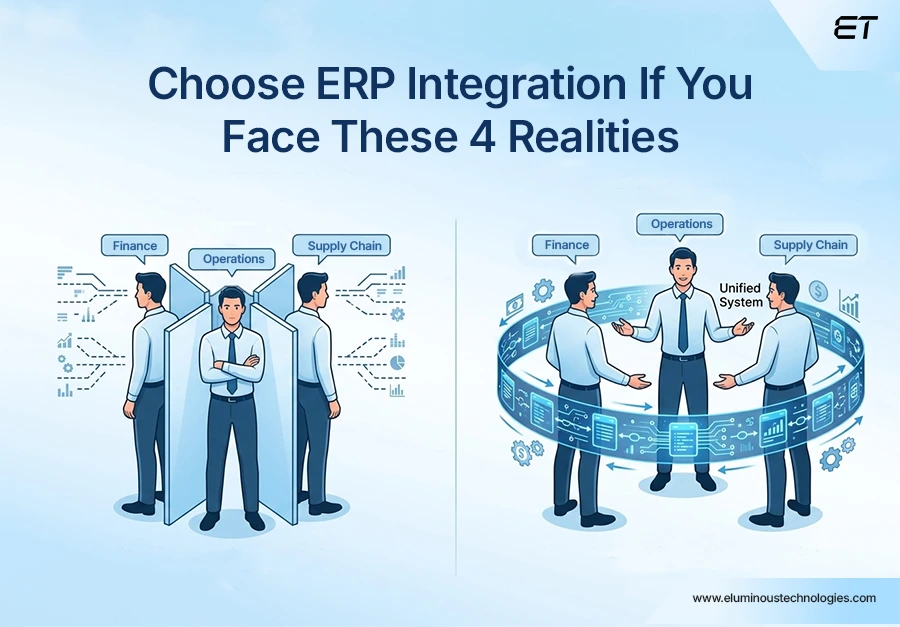
Not every enterprise is ready for an extensive integration initiative. Readiness should include technological capabilities, stakeholder buy-in, and a clear problem to solve through integration.
Some organizations are just beginning to become digitally mature enough to even consider an integration project. So, it’s crucial to look at key factors to decide whether ERP integration is what the business really needs right now.
Reality 1: You have complex internal processes across multiple systems
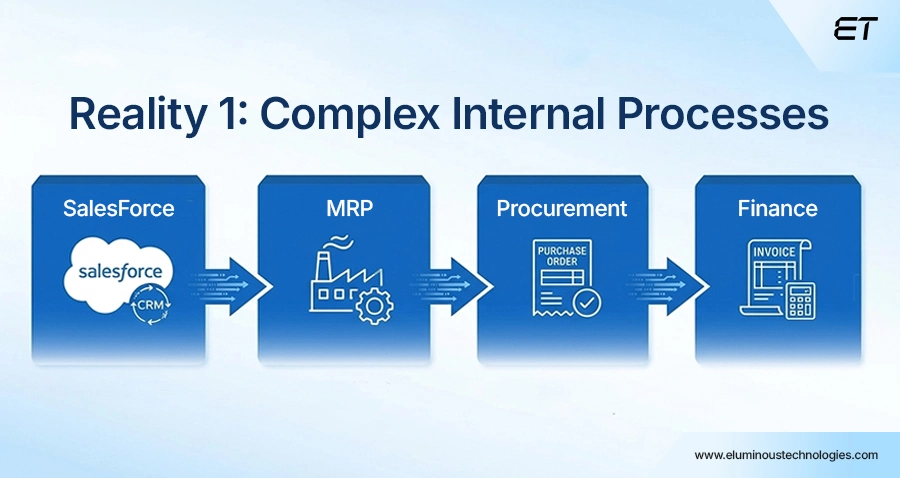
Since your business covers sales, manufacturing, purchasing, and accounting, each department has its own system. The orders pass through different applications, with manual transfers at each step. Every manual handoff increases workload and the time it takes to complete the manufacturing-to-sales tracking process.
If you have customers, someone will suggest CRM for sure. But is it going to solve your issue? For a key contrast between CRM and ERP, know that CRM handles customer relationships and the sales process, while ERP is responsible for internal processes.
But if your business needs both, they must communicate. CRM ERP integration is essential now.
Example: A discrete manufacturer with 50+ SKUs enters orders in Salesforce, schedules production in legacy MRP, manages procurement separately, and tracks costs in ERP. Each handoff is manual. Demand forecasts become stale. Procurement orders based on old assumptions. Finance has no visibility into profitability.
Here’s how ERP integration helps.
For manufacturers, this means building a manufacturing web development layer that connects Salesforce orders to production schedules, procurement signals, and ERP financials. So, demand forecasts stay current. As a result, finance sees profitability in real time, not weeks later.
Reality 2: You’re Losing Productivity to Manual Data Movement
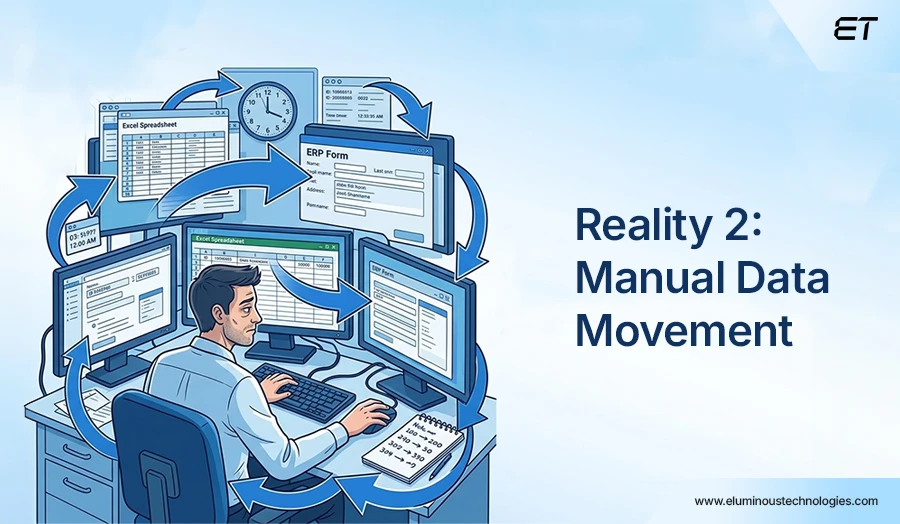
Manual data entry quietly drains productivity of any business.
Staff members devote many hours each day. They keep moving data from one computer screen to another, typing the same information over and over, and fixing discrepancies. Each manual entry creates an error risk.
For instance, accounts receivable workers spend 4 hours each day matching payments to invoices. Operational managers spend 2 hours comparing data between three different systems. Supply chain planners spend 3 hours compiling data from CRM, MRP, and warehouse management systems in Excel.
With ERP integration, invoices get matched with payments automatically. Production data updates dashboards in real time without manual reconciliation. Supply chain data goes straight into forecasting. All of this results in productivity gains of 78% and reduces errors creating rework and disputes.
Reality 3: You Cannot Scale Without Real-Time Visibility
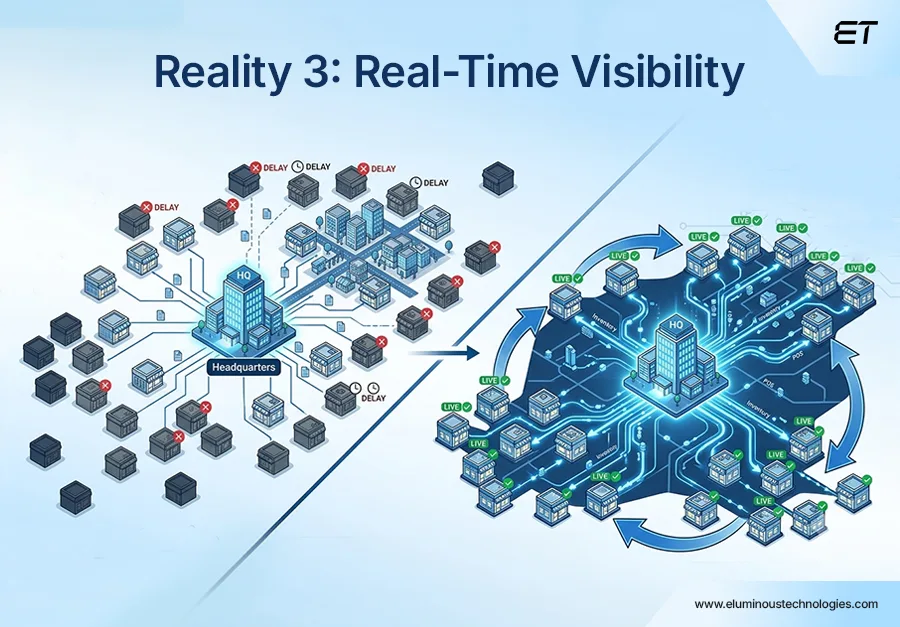
With an organization expanding to numerous locations and departments, manual reporting becomes impractical. Decision-making is based on old information. Supply chain disruptions result in information silos.
For example, an organization grows from 15 stores to 50 and reports manually through email. Store managers report daily sales and inventory information using spreadsheets. The corporation gets dashboards that are updated only once a day or even days late.
ERP integration makes a difference here. Inventory, sales, and staffing data from every store automatically flow into a centralized dashboard, giving decision-makers real-time visibility across the business. Disruptions in the supply chain are immediately flagged for all locations.
With quick data and insights available, decision-makers base actions on real-time information. All of it benefits customers too, who receive immediate, accurate responses catering to their problems.
Reality 4: You’re Running on Disconnected Legacy Systems
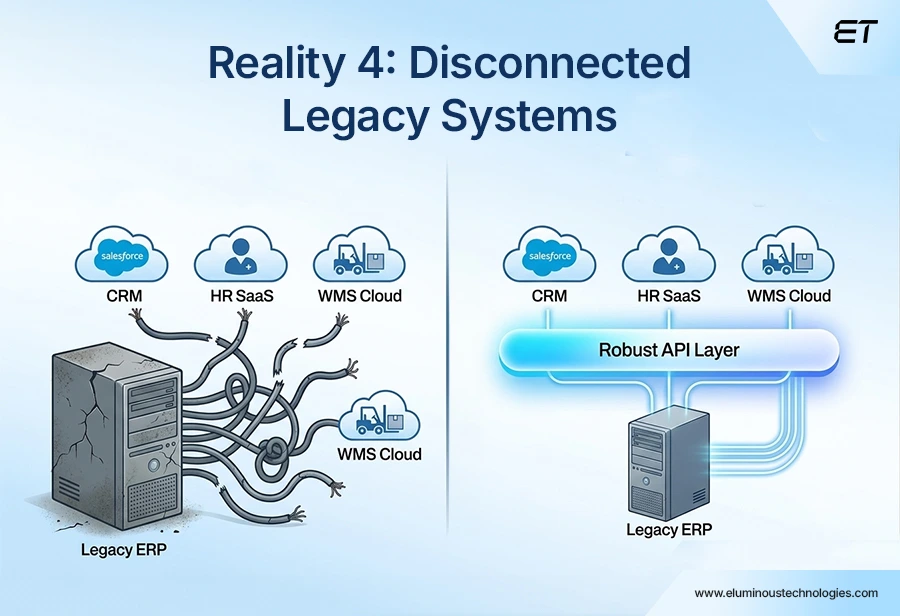
Most integration projects occur because there is an immediate need to link old legacy systems and third-party applications. An organization may use an old AS/400 ERP system for accounting but modern SaaS systems for HR and inventory management.
Since these systems do not talk to each other naturally, IT teams can’t access complete data and can’t deliver results with a new update.
But an ERP integration can provide stable, API-based integrations that improve current data efficiency and modernize the architecture.
How to Execute ERP Integration Successfully: A 7-Step Roadmap
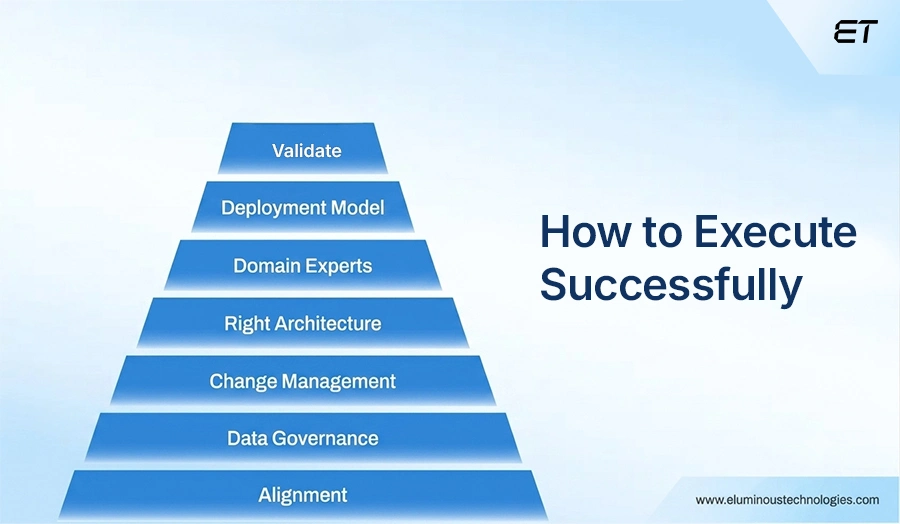
At this point, you understand what ERP integration is, why your business might need it, and the value it can deliver. To maximize your chances of success, it’s important to approach implementation with the right strategy. The roadmap below outlines the key steps for planning and executing a successful ERP integration initiative.
Here’s a step-by-step way to do that.
1. Establish Strategic Alignment and Stakeholder Engagement
Before any technical work begins, align your ERP initiative with corporate strategic goals and engage stakeholders across all affected and associated departments. This is the foundation upon which all other factors depend.
2. Prioritize Data Governance
Data migration is one of the highest-risk elements of ERP integration and implementation. Before writing a single line of code for integration, an organization needs to analyze, cleanse, and standardize its data. Integration of ERP applications with legacy systems may result in data inaccuracy, redundancy, or loss.
Such a preparatory stage will prevent many issues that emerge halfway through implementation.
3. Invest in Change Management
Stakeholder alignment means constant and clear communication with all parties so the integration meets their needs. Technology itself cannot fail; what usually fails is adoption. When people don’t see the utility in using the ERP system and prefer manual spreadsheets, integration can’t help.
To succeed in ERP integration, it’s vital that employees and other stakeholders see adoption as beneficial to them. Change management is the route through which it can be communicated.
4. Select the Right Architecture
The technology underlying your integration matters. Modern enterprises are moving toward API-first, cloud-native Integration, and Platform as a Service (iPaaS) solutions. Choosing the right technology stack for ERP integration initiatives ensures your architecture can scale with your business.
5. Partner with Domain Experts
Integration requires specialized expertise that most organizations lack internally. Inexperienced implementation teams are a leading cause of project failures. Relying on partners who understand your specific industry nuances and have proven track records in your sector is the single biggest predictor of project success.
6. Choose the Right Deployment Model
Your ERP integration deployment strategy is just as important as your design. There are three deployment approaches, each with its own risk level and timeline.
1. A phased approach will have each module deployed sequentially, first finance, then supply chain, then operations. The upside is minimal disruption and higher satisfaction. The downside is that it takes longer than other options and is best for more complex and larger organizations with low risk tolerance.
2. Big bang will have everything deployed all at once. It allows faster access to full system benefits, but success is solely dependent on execution. Failure with a big bang approach affects the entire organization. This works for organizations with less complexity and higher risk tolerance.
3. Parallel ERP integration deployment runs both new and old solutions simultaneously. Such deployment allows you to validate new system performance while maintaining the ability to revert to legacy systems if needed. It works when business continuity is critical.
7. Validate First, Optimize Later
Ensure structured testing and validation before ERP integration goes live and shortly thereafter. Keep conducting ongoing performance monitoring so problems do not accumulate. It involves examining data quality, integration performance, and process fit on a cyclical basis, with clear metrics of success decided beforehand.
Aligning ERP initiatives through checks that meet business objectives continuously is a top predictor of integration success. Additionally, it also catches errors before they impact the entire system and avoids cost overruns.
Endnotes
The increasing market volatility and operational complexity are making manually integrated systems difficult to maintain. ERP integration is what allows the company to function as an integrated system, from real-time decision-making to giving every department an integrated source of truth. CIOs and CTOs will receive the most value by considering integration as a strategic business approach.
Such an approach will stick only if stakeholder engagement remains a focus in your ERP integration strategy. It will earn you the trust necessary for the successful implementation across different departments while aligning with actual business objectives.
In addition, it is always important to measure organizational readiness and plan your integration efforts according to your current stage. The integration of the execution and stakeholder engagement processes is what defines the success of the whole project.
If done correctly, ERP integration will prepare you for the implementation of any new technology, including artificial intelligence. This is especially true for manufacturers, because production planning, procurement, inventory, and demand forecasting all require integrated systems that can communicate in real time. For a breakdown of what this looks like across manufacturing setups, our manufacturing website FAQs cover the operational baseline required to achieve these results.
Plan a Seamless ERM Integration Strategy Today
FAQs
1. What is ERP integration?
ERP integration is the process of connecting your ERP system to other applications such as CRM, WMS, e-commerce, and accounting systems for a seamless flow of information among them. It eliminates manual handling and provides one unified system as a shared source of truth for all departments.
2. Why is ERP integration important for businesses?
Lack of ERP integration means that there are different versions of data within Finance, Operations, and Sales departments: invoice sales, shipments, and closed deals, respectively. The integration process removes this problem and helps to automate data transfer within the company. It allows the top management to make decisions based on current information.
3. What systems can be integrated with an ERP?
ERP integration connects CRM systems, WMS, MES, SCM software, accounting software, e-commerce websites, HR software, and BI software. Depending upon the industry and complexity of the organization, one needs to select the appropriate mix.
4. What is CRM ERP integration?
CRM-ERP integration involves bringing together customer-oriented sales data and internal operational data. With this integration, you can keep track of every movement of the CRM system, inventory and production plans, along with the billing process, simultaneously. This seamless flow of data enables salespeople to access their inventory and prices in real time. At the same time, Finance and Operations can gain visibility into the customer to better forecast demand and fulfill those needs.
5. What are the biggest ERP integration challenges?
The key ERP integration challenges lie in organizational factors, rather than in technical aspects. A lack of proper stakeholder alignment, when each department (Finance, Operations, and Sales) establishes its own set of data standards, leads to failure. The next key challenge is data quality; linking systems with bad or inaccurate data generates poor results. Choosing the wrong implementation partner is the third.
6. How long does an ERP integration project take?
ERP integration varies by complexity and company size. Mid-size and small companies complete ERP integration in 3-9 months, whereas large companies may take 12-24 months or more. A full
ERP integration from finance, human resources, supply chain, and production for a mid-size multinational company will take 18-24 months. That said, companies that focus on aligning stakeholders and governance before ERP implementation tend to finish projects sooner and within budget.

.NET 10 Features and Enhancements: What’s New and Should You Upgrade?
Summary: .NET 10 is the latest LTS release of Microsoft’s .NET platform. It brings significant updates across the runtime, SDK,…


ServiceNow ROI: Why Process Design Matters More Than Platform Features
Summary: ServiceNow ROI ServiceNow is one of the most powerful workflow platforms available to enterprises today. Yet many organizations struggle…


