
 Book a Meeting
ServiceNow ROI: Why Process Design Matters More Than Platform Features


- ServiceNow is one of the most powerful workflow platforms available to enterprises today. Yet many organizations struggle to achieve the ROI they expected. The underrated problem? They overlook the processes behind the enterprise SaaS platform.
- Organizations that see the strongest returns treat ServiceNow as an operational transformation initiative rather than a simple tech deployment. They simplify workflows, establish clear ownership, and align governance before automating at scale.
- This article explores why process design is the biggest determinant of ServiceNow success and what you should focus on before configuring the platform.
ServiceNow is one of the most powerful workflow platforms available to enterprises today. Yet many organizations struggle to achieve the ROI they expected. The underrated problem? They overlook the processes behind the enterprise SaaS platform.
Organizations that see the strongest returns treat ServiceNow as an operational transformation initiative rather than a simple tech deployment. They simplify workflows, establish clear ownership, and align governance before automating at scale.
This article explores why process design is the biggest determinant of ServiceNow success and what you should focus on before configuring the platform.
A few months ago, I spoke with a CIO who was frustrated by the results of a recent ServiceNow implementation.
The organization had invested heavily in ServiceNow licenses, integrations, and workflow automation. Yet critical escalations were still happening through email and Teams messages. Employees were bypassing established workflows, approvals were taking longer than expected, and leadership didn’t gain a clear picture of their team’s performance.
The technology or platform wasn’t the problem.
But the underlying processes had simply been carried into a new platform without being redesigned as per their standards.
I’ve seen this pattern repeatedly across enterprise transformation initiatives. Organizations often focus on platform capabilities, automation features, and implementation timelines while giving far less attention to the workflows those capabilities are meant to support.
ServiceNow can automate, orchestrate, and scale operations across the enterprise. But no platform can compensate for unclear ownership, unnecessary approvals, fragmented governance, or poorly designed workflows.
In this article, I’m going to focus on how you can get meaningful ServiceNow ROI.
Why Features Alone Don’t Deliver ROI
One of the most common misconceptions in ServiceNow implementations is that more automation automatically leads to better business outcomes.
In reality, ServiceNow does exactly what it is designed to do: execute workflows, route tasks, enforce approvals, and automate repetitive work. The challenge is that the platform can only automate the process it is given.
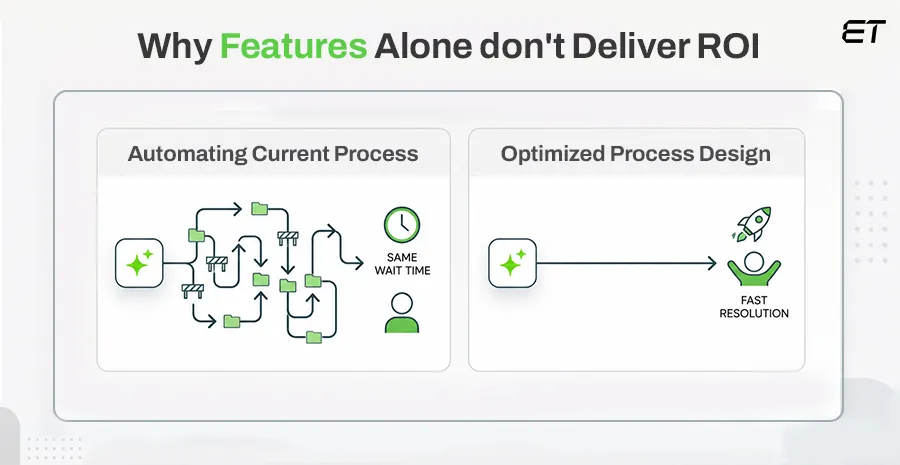
Consider a common access request workflow.
Over time, the process has expanded to require approvals from multiple departments, each added to address a specific concern or exception. When ServiceNow is implemented, those approvals are often automated exactly as they exist today.
The result is a faster version of the same inefficient process.
Requests may move through the system more efficiently, but employees still wait for multiple approvals, handoffs remain excessive, and resolution times fail to improve in a meaningful way. The platform performs as expected, yet the business sees limited gains.
This is where many organizations miscalculate ROI. They focus on platform capabilities while overlooking the operational design behind them.
ServiceNow can improve execution speed, increase visibility, and reduce manual effort. What it cannot do is eliminate unnecessary complexity, clarify ownership, or simplify decision-making on its own.
The goal is not simply to automate work but to improve how work gets done.
What is Process Design in this Context
Process design is in most cases misunderstood as a documentation exercise completed before implementation. It’s the work of examining how services are delivered, identifying unnecessary complexity, and deciding how work should flow before automation begins.
The goal is not to document existing processes exactly as they are. The goal is to determine whether those processes should exist in their current form at all.
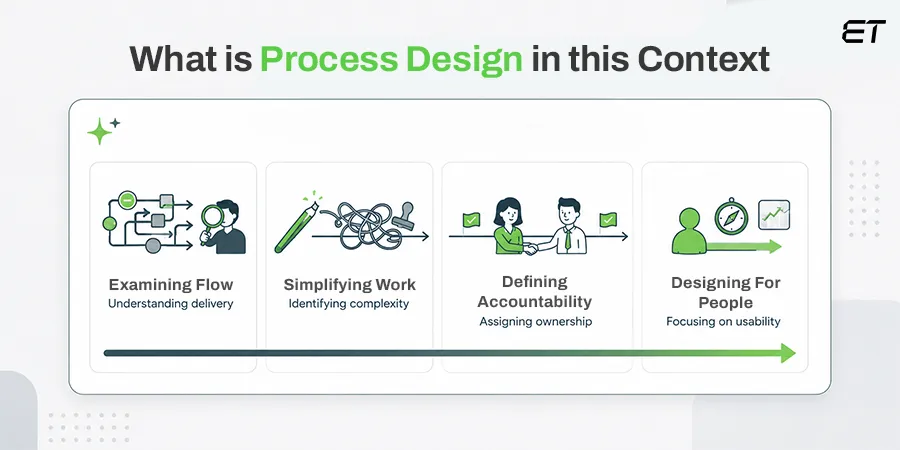
That means asking difficult questions like:
- Which approvals genuinely add value?
- Where do delays occur most often?
- Which handoffs create unnecessary friction?
- Why are employees bypassing established workflows?
- Who owns each stage of the process?
Organizations that achieve strong ServiceNow ROI spend time answering these questions before they configure workflows.
Simplify Before You Automate
Many enterprise processes become more complicated over time. New approval steps, exception paths, and manual workarounds are added to solve individual problems, but rarely removed once those problems disappear.
Automating that complexity rarely improves outcomes. It simply makes a complicated process run faster.
High-performing organizations simplify workflows before implementation. They reduce unnecessary approvals, eliminate redundant handoffs, and remove steps that no longer support business objectives.
Design Around People, Not Just Processes
A workflow may look efficient on paper while creating frustration for the people responsible for using it every day.
If employees struggle to understand ownership, spend excessive time navigating approvals, or regularly bypass the system, adoption suffers and ROI declines.
Effective process design considers usability, decision-making speed, exception handling, and cross-functional collaboration alongside technical requirements.
Focus on Accountability and Visibility
Organizations often measure implementation success through automation counts, module adoption, or integration metrics. While those indicators matter, they do not necessarily reflect operational effectiveness.
Strong outcomes typically come from clear ownership, defined accountability, transparent workflows, and escalation paths that employees understand and follow consistently.
Technology enables these outcomes, but process design makes them possible.
Why Simplification Creates Better Outcomes
Complexity is one of the biggest barriers to ServiceNow success.
Over time, organizations add approval layers, exception paths, manual workarounds, and departmental requirements to solve specific problems. Individually, each change may seem reasonable. Collectively, they create workflows that are difficult to manage, difficult to understand, and difficult to follow consistently.
When those workflows are automated without being simplified first, the underlying inefficiencies remain. Employees still encounter delays, ownership remains unclear, and teams continue looking for ways to work around the system.
This challenge becomes even more apparent in large organizations where HR, IT, Finance, and operations all participate in the same workflow. Without clear ownership and streamlined decision paths, even well-designed automation can struggle to deliver meaningful improvements.
Organizations that achieve stronger ServiceNow ROI focus on reducing complexity before introducing automation. They eliminate unnecessary approvals, simplify handoffs, and create workflows that employees can follow without confusion.
What Leaders Should Focus On
Organizations that achieve strong ServiceNow ROI tend to approach implementation differently. Rather than treating the platform as a technology project, they focus on the outcomes to improve and design workflows accordingly.
A few principles even you can keep in mind are:
- Design workflows before configuring the platform.
- Simplify approvals, handoffs, and escalation paths before automating them.
- Establish clear ownership for every stage of a process.
- Expand platform capabilities only after existing workflows are performing effectively.
- Invest in governance to prevent complexity from re-entering the system over time.
- Make performance and ROI metrics visible to both operational teams and leadership.
Most importantly, measure outcomes rather than activity.
High ticket volumes, automation counts, and workflow usage may indicate adoption, but they do not necessarily indicate value. Stronger indicators include faster resolution times, fewer exceptions, reduced decision latency, improved employee experiences, and greater cross-functional visibility.
Ultimately, ServiceNow ROI is not measured by how much automation has been deployed. It is measured by whether the business operates more effectively because of it.
The Bottom Line: ServiceNow ROI
ServiceNow can automate workflows, improve visibility, and support enterprise-wide operations at scale. But technology alone does not create business value.
Organizations that achieve strong ROI treat ServiceNow as more than a platform implementation. They use it as an opportunity to simplify workflows, clarify ownership, eliminate unnecessary complexity, and improve how work moves across the business.
The companies that struggle are often not dealing with a technology problem. They are dealing with process issues that automation simply makes more visible.
That is why process design matters.
Before introducing new workflows, automation, or AI capabilities, leaders should focus on the fundamentals: how decisions are made, how work is handed off, and how accountability is maintained.
The lesson is straightforward. ServiceNow can accelerate performance, but it cannot create operational excellence on its own. The quality of the outcome will always depend on the quality of the process behind.


.NET 10 Features and Enhancements: What’s New and Should You Upgrade?
Summary: .NET 10 is the latest LTS release of Microsoft’s .NET platform. It brings significant updates across the runtime, SDK,…


A Guide to ERP Integration: Why It’s Essential for Business Efficiency
Summary: Most organizations think of ERP Integration as interconnected systems for efficiency. It has been true for most enterprise efficiency…


