
 Book a Meeting
ServiceNow Predictive Intelligence: How IT Leaders Can Automate Smarter
IT leaders today are expected to improve both operational efficiency and deliver measurable ROI on AI investments. However, talent shortages impact 76% of technology teams, and service desk turnover is causing concerns.
With ServiceNow Predictive Intelligence, leaders can achieve both goals with a single deployment. It automates ticket categorization, routing, SLA prediction, and knowledge recommendations through four frameworks: Classification, Similarity, Clustering, and Regression.
Through these frameworks, organizations can automate a major part of their ticket management while forecasting to avoid future escalations.
If you’re a CIO or CTO, expectations from your role keep expanding. Shape business strategy, manage cost and talent, and strengthen IT operations, to name a few. And the complications of fulfilling these are growing with every year.
Talent shortages affect 76% of leaders’ efforts on their tech teams, with service desk turnover reaching as high as 61% in high-stress industries.
Tech teams are stretched thin, and burnout is becoming harder to avoid.
Many boards have AI integration as one of their essentials in their quarterly agendas and yearly goals. However, 40% of agentic AI projects can fail by 2027.
So, the main question is: can you solve the operational, AI, and efficiency problem simultaneously?
One way to achieve seamless execution is by using AI-native machine learning capabilities. ServiceNow Predictive Intelligence is one such purpose-built ML capability that has helped organizations with categorization and ticket routing.
This blog explains how Predictive Intelligence of ServiceNow works, its key frameworks, and how you can use it to solve modern-day AI-centric challenges.
What is ServiceNow Predictive Intelligence and How Does it Work?
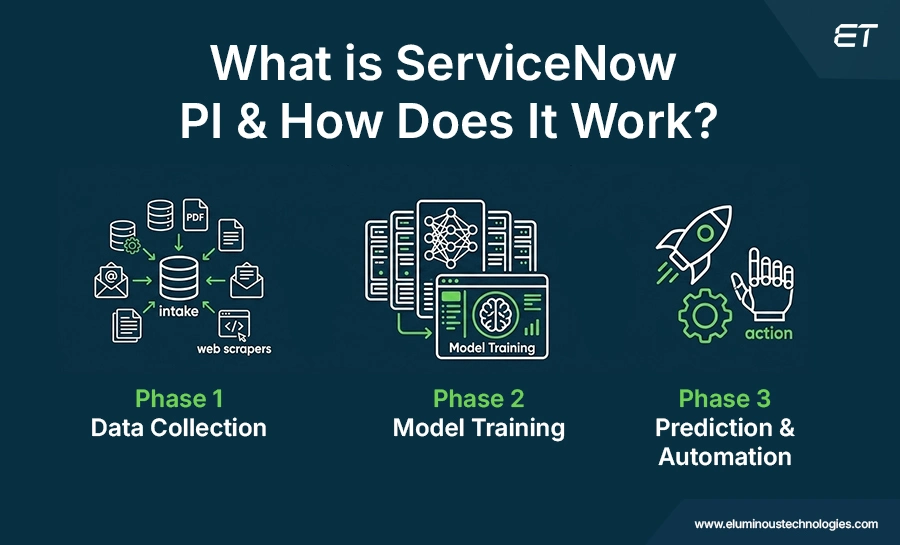
ServiceNow Predictive Intelligence is a machine learning capability built into the ServiceNow platform that automates ticket classification, routing, recommendations, and predictions. It is an AI-enabled intelligence layer that converts organizational institutional memory into a proactive decision-making IT system. This machine learning system works within the existing ServiceNow workflows for IT, HR, customer workflows, and creator requirements, with a major reduction in human error in assignment and data flow.
By catching routing errors, escalation risks, and misassignments, it prevents a problem spiral that can impact customers.
As the name suggests, ServiceNow Predictive Intelligence works on gathering, mulling over data, and acting in three unique phases.
Phase 1: Data Collection and Preparation
The predictive intelligence starts by accumulating historical data from your ServiceNow instance. It comprises thousands of generated tickets in the past, service requests, and their linked metadata.
Data quality is critical because model accuracy depends on clean, consistent historical records. The cleaner the data, the more accurate the predictions.
Based on the model, ServiceNow establishes a minimum and maximum bar for training records needed.
| Model | Minimum | Maximum |
| Similarity | 10 | 100,000 |
| Clustering | 100 | 100,000 |
| Classification | 10,000 | 300,000 |
| Regression | 10,000 | 300,000 |
Requirements vary per framework. But ServiceNow recommends that organizations feed 30,000 to 300,000 records.
It works better for the organization to test the model in the beginning, so accuracy levels are as per business goals and needs.
Phase 2: Model Training and Learning
Once the data has gone through the collection and cleaning process, ServiceNow Predictive Intelligence uses machine learning algorithms to detect patterns. The model assesses the relationship between ticket details and outcomes, assignment groups and resolution duration, urgency levels, and real business impact.
For example, in the most common model, like Classification, the system detects what kind of words a ticket contains. If the description has keywords like ‘password’, ‘access denied’, or ‘login’, it gets categorized as Identity, Access, and Management and is further moved to IAM teams. This kind of routing occurs because the model is trained on similar historical tickets. Through such trials and labeling, decision-making rules are made while refining the accuracy. The model continuously improves these predictions by learning from labeled historical data during training.
The trained model can accurately predict categories, assignments, or priorities for new tickets based on historical patterns.
Phase 3: Prediction and Automation
Once it’s fully trained, it begins making predictions for incoming records in real time. So, when a ticket arrives, it:
- Extracts relevant information from the incoming ticket, such as the description, requester details, and other ticket attributes.
- Compares it to the learned patterns it has studied in thousands of datasets before.
- Generates a prediction, measures the urgency, and assigns it a confidence score (Example: This is 96% likely to be an IAM issue.)
- Executes by automatically assigning it to the appropriate team, categorizing the urgency level, and suggesting a probable solution.
All of this at a brisk pace, reducing manual effort and speeding up ticket handling.
Four Frameworks of ServiceNow PI
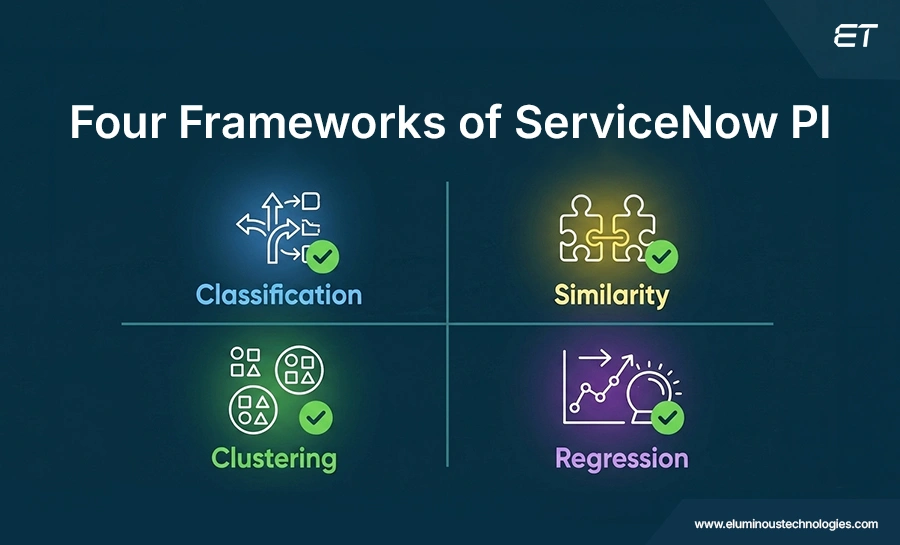
The Predictive Intelligence of ServiceNow uses four different frameworks. Each is built for a different machine learning task: Classification predicts a value, Similarity finds matching records, Clustering groups related records, and Regression forecasts numerical outcomes. Effective implementation relies on knowing which framework works best for your requirements and potential business issues.
Framework 1: Classification
This is one of the most common models for predictive intelligence in ServiceNow. It employs supervised learning based on historical data to predict values like category, assignment group, or priority based on historical records
It learns the connection between a ticket characteristic and the appropriate field assignment. So, when a new ticket comes in, it compares it against previous ones to put in the most likely field value.
Since it predicts the most appropriate category, assignment group, or priority based on historical patterns, IT desks use it to solve the usual routing and categorization problem. The system automatically categorizes the tickets with priority levels and assigns them to the right fulfillment team, which accelerates work distribution.
Framework 2: Similarity
This model identifies existing records that share characteristics with newly created records. Rather than predicting a specific value, it finds similar historical cases and surfaces them for reference or action.
It deploys word corpus analysis for pattern matching and then ranks them by relevance.
The framework recommends relevant historical cases or knowledge articles to help agents resolve issues faster. So, instead of agents having to go through an array of past tickets for similar cases, the system pops up the most relevant resolution.
Note: Word corpus analysis refers to the assessment of language in each ticket. It involves comparing wording and context against past records to find the closest matches, then ranking them.
Framework 3: Clustering
Clustering groups similar records together to reveal hidden patterns that aren’t visible at the individual ticket level. Once it recognizes what records belong together, it screens for patterns that might not be available at the individual ticket level. It can check for systemic problems, spot trends, and connect incidents to common root causes.
This model supports proactive incident management by finding related issues, addressing root causes, and preventing work stoppages. It also enables the organization to prioritize recurring systemic issues and resolve them more efficiently.
Framework 4: Regression
ServiceNow Regression predicts future numerical outcomes (such as resolution time) based on historical data.
This model of predictive intelligence in ServiceNow analyzes historical records where numeric outcomes are already available. Once done, it identifies the core factors that lead to such outcomes and then builds an algorithm to predict the coming ones.
CIOs and CTOs can focus on this framework for capacity planning and expectation management. By gauging the estimated resolution time, organizations can assign accurate SLAs, allocate resources adequately, and manage customer expectations. It goes a step further in helping organizations manage costs by identifying tickets at risk before an SLA breach occurs.
The most common use cases are predicting MTTR (Mean Time to Resolve), ticket forecasting, incoming volume resource optimization, and forecasting resolution time.
Before implementing this framework, it’s good to keep in mind the quality of your data, as the outcome depends highly on its accuracy.
Here’s a quick side-by-side comparison of all four frameworks:
| Framework | Best For | Primary Benefit |
| Classification | Routing, categorization, assignment | Automated work distribution |
| Similarity | Resolution recommendations, knowledge surfacing | Accelerated problem-solving |
| Clustering | Pattern detection, major incident identification | Proactive incident prevention |
| Regression | Time forecasting, capacity planning | Improved SLA forecasting |
Why ServiceNow Predictive Intelligence Delivers Better Results?
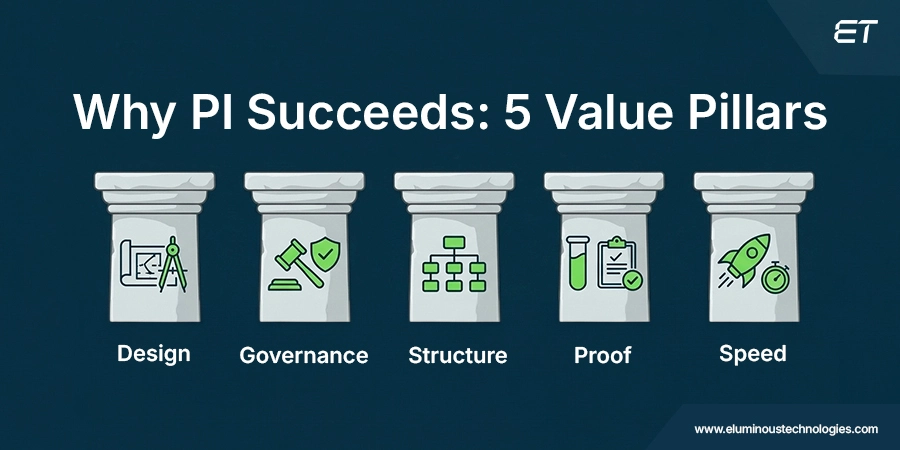
ServiceNow Predictive Intelligence works because it is designed to suit the needs of enterprise IT. The ML capability carries five distinct advantages:
1. Built into Existing Workflows: Native integration ensures that the intelligence layer is a natural extension of organizational demand.
2. Learn from Historical Data: Training the ServiceNow PI on the organization’s unique data enables it to create predictions that are tailor-made for a specific environment.
3. Supports Phased Integration: A pilot-first approach allows teams to validate results and build confidence without abruptly interrupting the ticketing system.
4. Embedded Governance: Real-time dashboards provide visibility into model accuracy and performance to avoid “black-box” failures.
5. Delivers Measurable Outcomes: Every feature targets core IT metrics, enabling teams to scale operations without sudden and proportional headcount increases.
Real-World ServiceNow Predictive Intelligence Success Stories
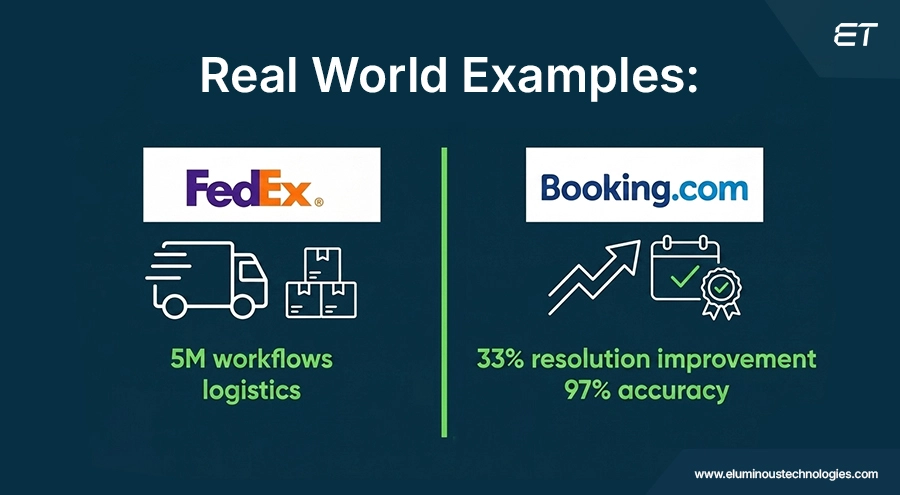
ServiceNow has integrated an AI layer of predictive intelligence across its products. While the following examples showcase broader ServiceNow AI capabilities, they illustrate the operational benefits organizations can achieve by embedding AI into enterprise workflows. Some of the prominent organizations that benefited from preliminary risk detection in their resolution journey are FedEx and Booking.com.
Booking.com reached a 33% reduction in IT resolution time while deploying AI agents that correctly assign 97% of tickets on the first pass. Its Quality Assurance Agent reviews 100% of closed tickets—up from manual review of 7%—with quality scores rising 30% in six months.
On the other hand, FedEx now processes 5 million ServiceNow workflows monthly, integrating the ServiceNow intelligence layer across critical logistics and operations.
Both organizations have shown measurable success in outcomes, including faster resolution, higher accuracy, and reduced manual work. Organizations across industries, from travel to healthcare, are now using ServiceNow Predictive Intelligence and AI agents to align their operations for efficiency gains while freeing teams to focus on meaningful work.
How to Prepare an Organization for ServiceNow PI Implementation?
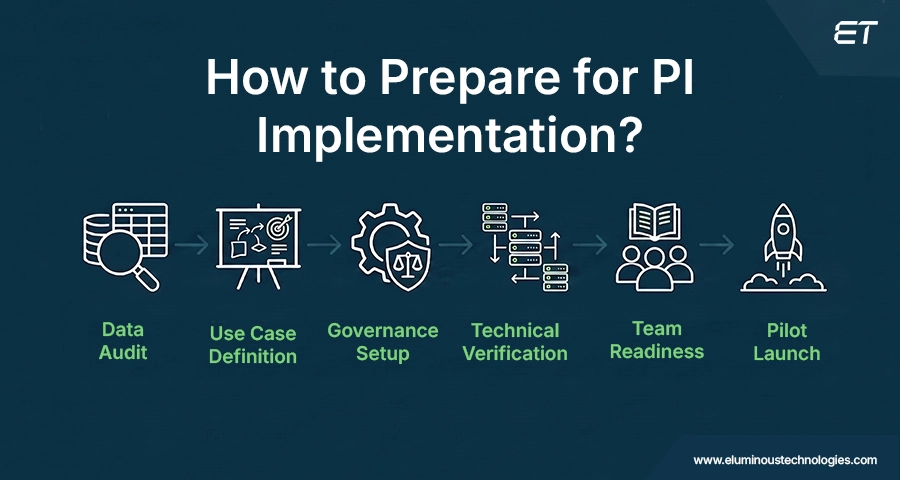
Before implementing Predictive Intelligence in ServiceNow, it’s wise to focus on organizational foundations to make the best use of this tech.
One such way to do so is by auditing the data. Clear and consistent records are the backbone of this intelligence layer. While businesses do so, strategy can focus on phased deployment with clear use cases, establishing governance protocols, and verifying technical prerequisites.
Along with these, it would work great if the team is aligned with the deployment and its goal. So, building organizational readiness through change management and team education strategies can also be considered.
The goal is to pilot the solution, validate its accuracy, gather feedback, refine the models, and then scale deployment across the organization.
Endnotes
Today, you want to nail two things: improve operational efficiency AND deliver measurable returns from AI investments. Achieving both requires intelligent automation that scales with your organization.
ServiceNow Predictive Intelligence combines machine learning with historical operational data to automate ticket categorization, routing, recommendations, and forecasting. Whether it’s ITSM, Customer Service Management, Security Operations, HR Service Delivery, or Field Service, organizations can choose the framework that best aligns with their business objectives and expand adoption as confidence grows.
Clean historical data, clearly defined use cases, phased implementation, and continuous model refinement help you realize measurable improvements while maintaining governance and operational control.
As enterprise AI adoption accelerates, organizations that approach Predictive Intelligence with clear business goals and a structured implementation strategy will be better positioned to build more resilient operations.
Ready to use ServiceNow Predictive Intelligence to improve your service operations?

AI Agent Development Cost: Pricing & Cost Drivers
Summary: AI agent development costs vary widely between projects that look similar in stages, scope, or integrations. A focused proof…

ServiceNow Governance Framework: A Guide to Consistent Multi-Team Workflows
Summary: Different teams using ServiceNow have unique priorities, but they compete on a shared ServiceNow platform. Such a conflict can…


