
 Book a Meeting
Choosing a Software Development Partner: A Practical Evaluation Framework


You’ve started shortlisting multiple vendors, and suddenly, every option looks the same. Polished portfolios, bold claims, similar tech stacks. It’s impossible to tell who can truly deliver, right? The problem here isn’t the number of choices; it’s that there’s no clear way to pick ‘the’ best software development partner tailored for you.
With the stakes being high, choosing the wrong partner can lead to rework, delays, and long-term operational friction. None of them is a plus point in any case.
So, your best way forward is finding the one that has a lasting operational advantage.
This guide breaks down a clear, structured framework to help you assess software development partners beyond surface-level signals.
Why Choosing a Software Development Partner Is Harder Than It Looks
The simple truth about choosing a trustworthy software development partner is that most options are indistinguishable at first glance. The reality does not match the pitch.
The saturated market of software development partners can provide polished portfolios and modern tech stacks, that look similar but fails to deliver on the promises.
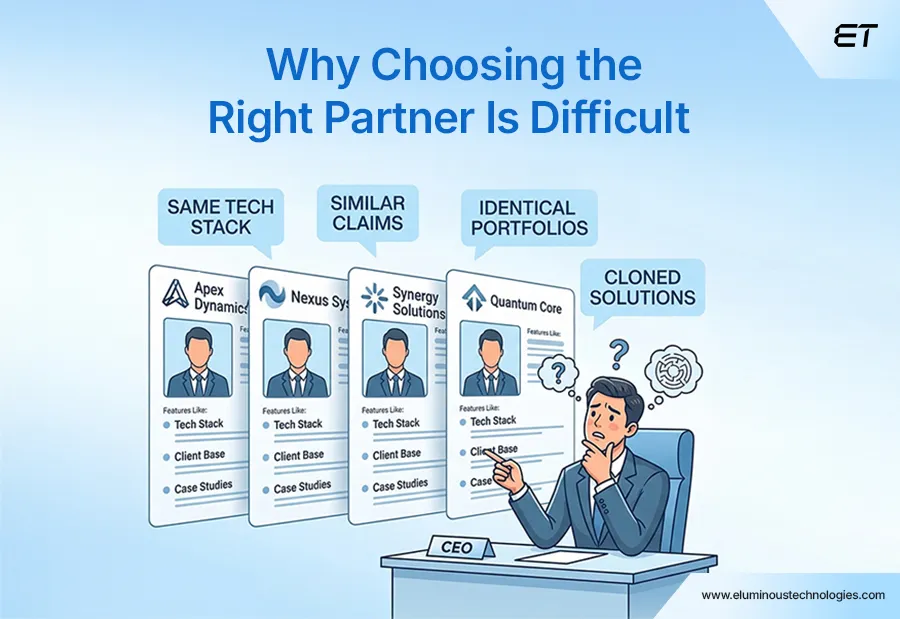
This leads to choosing from profiles that are:
- Identical to other vendors.
- Overlapping in tech stacks, causing operational inefficiency and security risks.
- Similar in delivery claims, making it hard to differentiate.
The problem for decision makers here is the clarity between choosing the best option. Evaluating on surface levels can come down to pricing or subjective impressions from initial calls.
The next section of the blog talks about the criteria for selecting a reliable software development partner.
Your Framework to Evaluate a Software Development Partner
Onboarding a software development partner without a structured framework can lead to unnecessary delays and risk. Understanding required dynamics for evaluation can help you focus on the process without being overwhelmed.
The following framework gives you a lens for going beyond the surface levels and assessing the factors. It could help you reflect on the collaboration before you invest your time.
1. Technical Expertise and Problem-Solving Ability
A strong software development partner is defined by how they handle real-world challenges. Instead of focusing on claims, evaluate how they approach complex scenarios and adapt to changing requirements.
Look beyond generic profiles and assess:
Case studies that clearly show the problem, approach, and outcomes.
Experience in handling complex projects, not just the number of deliveries.
One strong signal is the kind of questions they ask. The top IT consulting firms go deeper into your architecture, business logic, and edge cases are trying to fully understand the problem. This helps identify risks early and leads to more effective, reliable solutions.
2. Understanding of Your Business and Goal
Strategically planning and executing your goals is what separates a vendor from a partner.
A vendor helps you deliver your commitment, but a partner invests time in understanding and aligning your goals with your delivery.
This simply refers to a genuine software development partner that understands your business model, your user experience, and long-term goals.
One red flag at this stage is when your partner jumps to providing a solution without acquiring any kind of context. They are already talking about the tech stacks and delivery without understanding the users and your long-term objectives.
3. Communication and Collaboration Style
Establishing clear communication is one of the crucial parts of the whole process. Overlooking this aspect can lead to project breakdown, and often it has nothing to do with technical capability.
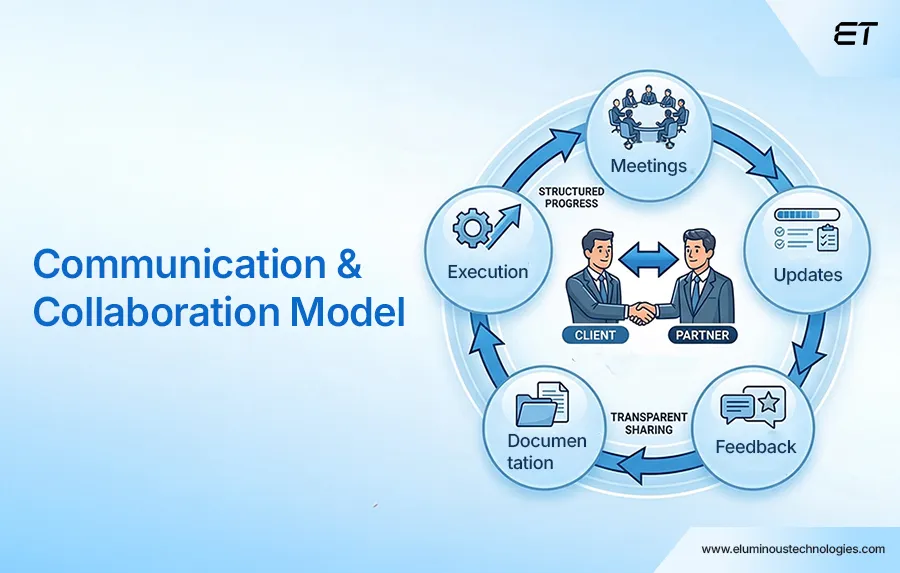
This is where you separate an excellent partner from an average one:
- They clearly explain the technical concepts
- They are responsive in sessions and early interactions
- They have a concrete structure for updates and reporting
- They are on their toes for regular check-ins
- They document their procedures and workflows
- They have clear escalation paths for faster problem-solving
In global setups, time zone overlap can help, but consistent and structured communication matters more.
Evaluate how the partner handles evolving requirements. Strong teams ask questions, clarify assumptions, and adapt to changes instead of passively accepting inputs. Partners who simply agree without probing deeper often create issues later.
For a deeper look at how effective teams maintain collaboration, this guide explains proven approaches and tools.
4. Development Process and Transparency
Evaluating the development process for a reliable software development partner ensures high-quality, secure and timely delivery.
From day one, they have a concrete plan for workflows, automation, planning, tracking, and escalation paths.
Their strong structural elements make communications across teams and delivery on deadlines predictable.
As a partner, you should have visibility into:
- What is being built
- Updates on the finished tasks
- What challenges are being addressed
A reliable software development partner should have a clear approach to planning, execution, and tracking work. Evaluating each stage helps you understand how predictable and structured their delivery will be.
Planning:
Clear timelines, defined milestones, and structured workflows
Red flag: vague deadlines or unclear deliverables
Execution:
How tasks are managed, dependencies handled, and blockers resolved
Red flag: unstructured handoffs or inconsistent communication
Tracking:
Visibility into progress, completed work, and ongoing challenges
Red flag: lack of updates, poor documentation, or hidden delays
For projects using Agile or sprint-based workflows, understanding the differences between methodologies can improve planning and tracking. Our Agile vs Scrum guide explains how each approach structures sprints, manages backlogs, and impacts project outcomes, helping you evaluate a partner’s process more effectively.
5. Reliability and Delivery Track Record
Compatibility and reliability determine the success. A team delivers flawlessly when the scope is clear and the client is engaged.
The real challenge lies in whether they can deliver consistently. Across different projects? Different clients? And different conditions?
When you are looking for a reliable software development partner, focus on:
- Their consistency in past timely delivery
- Their client retention rates
- Their long-term engagement with other clients rather than just one project
Remember, delays can happen, but communicating, managing and recovering through the process matters. Anyone can promise and deliver, but what matters is whether they are able to do it consistently.
6. Flexibility and Scalability
Software projects are rarely bound to follow fixed paths, they are always evolving and shifting priorities.
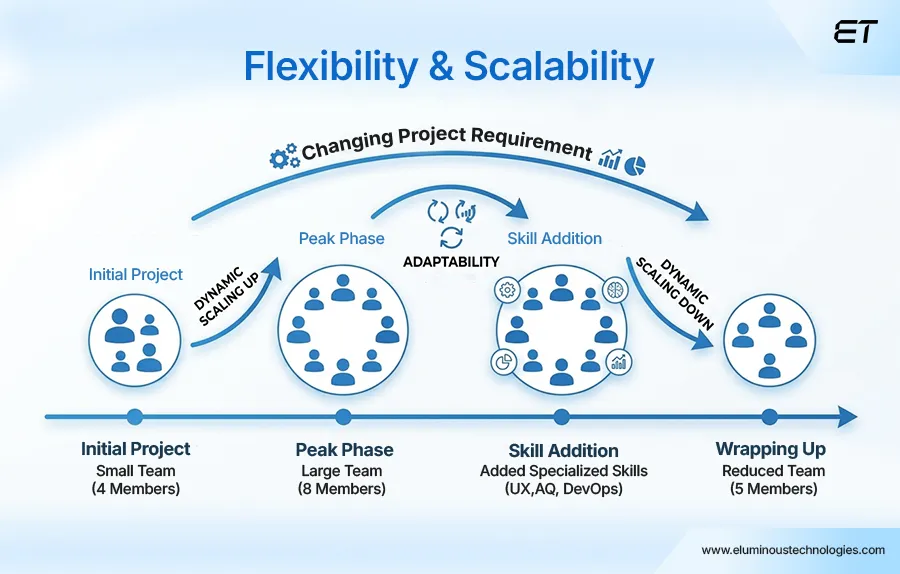
A dedicated software development partner is key to keeping up with the shifts and adapting to reality.
Asking these questions for evaluating their ability on previous experience can help:
- How did they handle scope changes?
- How did they maintain the required capacity?
- How do they maintain changes in the team for specific skills?
- How is knowledge distributed among the team?
Rigid teams often lead to delays, and inefficiencies. Therefore, an extended development team that can function with in-house operations is more effective precisely because the integration runs deeper.
7. Post-Development Support and Long-Term Commitment
One of the most overlooked aspects of onboarding a trustworthy software development partner is what happens post-delivery.
Software is not static and it does not maintain itself. Bugs emerging during production and integration breakdown are some common issues that could arise post development.
Most importantly, a product codebase continuously evolves.
A software development partner that leaves after launching is a risk to long-term product stability. Leaving you without any codebase support or further procedures for maintaining the product does not signal a long-form commitment.
Common Software Development Collaboration Models to Consider
Choosing the right software development partner is about how you work with them.
This is where collaboration models come in. They define how responsibilities are shared, how the team is structured, and how work is executed. The right model depends on your project’s scope, flexibility needs, and level of involvement.
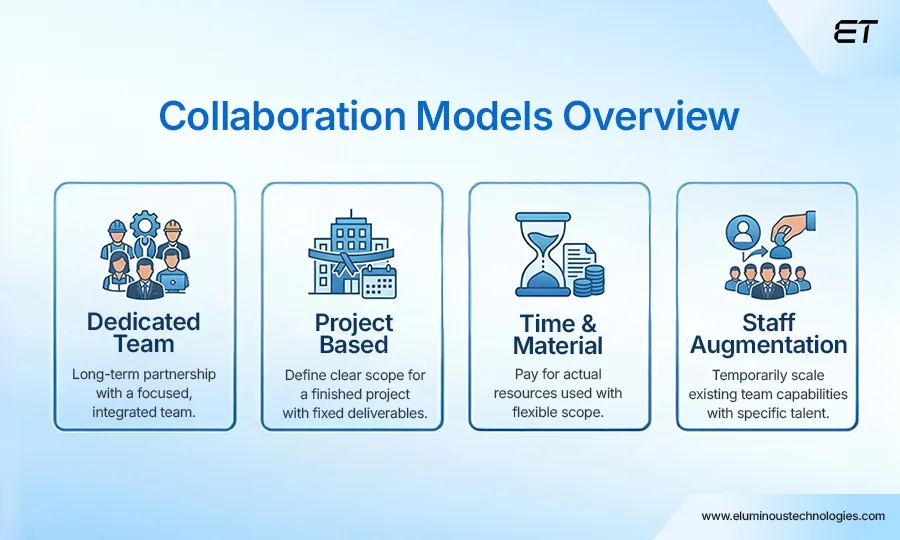
Dedicated Development Team
A dedicated development team is a full-scale team aligned exclusively for the client’s project. It consists of QA specialists, designers, developers, and project managers.
This model works best for long-term or evolving projects. Acting as an extension of your in-house team allows smooth adaptation to changing priorities and ensures continuity throughout the project.
The only major requirement in this model is that it needs integration and alignment with business goals consistently. This directly requires your involvement for guidance and decision-making.
Project-Based Model (Fixed Scope)
This project-based model is ideal for defined requirements as the vendor and client agree on the scope, requirements, process, and budget upfront.
Here, pre-defined deliverables reduce the management overhead. This model is less flexible compared to other models if the requirements change mid-way.
Time and Material Model
The time and material model focuses on providing maximum flexibility. Here, the project grows with the team, and everything is designed for flexibility.
This model does not contain risk of fixed quote. It is based on actual time and resources utilization. This allows model to serve dynamically as requirements become clearer.
But, given below are certain limitations this model deals with:
- Costs are less predictable
– Continuous product iterations require to manage priorities
- Huge risk of budget overruns
This model is especially compatible with agile methodologies.
Staff Augmentation
Staff augmentation helps you quickly fill skill gaps by adding external developers to your in-house team. It lets you move forward without going through long hiring cycles or building a team from scratch.
In this model, external developers work alongside your existing team, bringing in specific expertise where needed. However, since you’re relying on external resources, strong internal management and clear communication are key to making it work effectively.
How to Choose the Right Software Development Partner
Now that you understand how to evaluate partners and how different collaboration models work, the next step is putting that into action.
Focus on what to validate and how to compare your options. This will help you make a clear, confident decision without relying on assumptions.
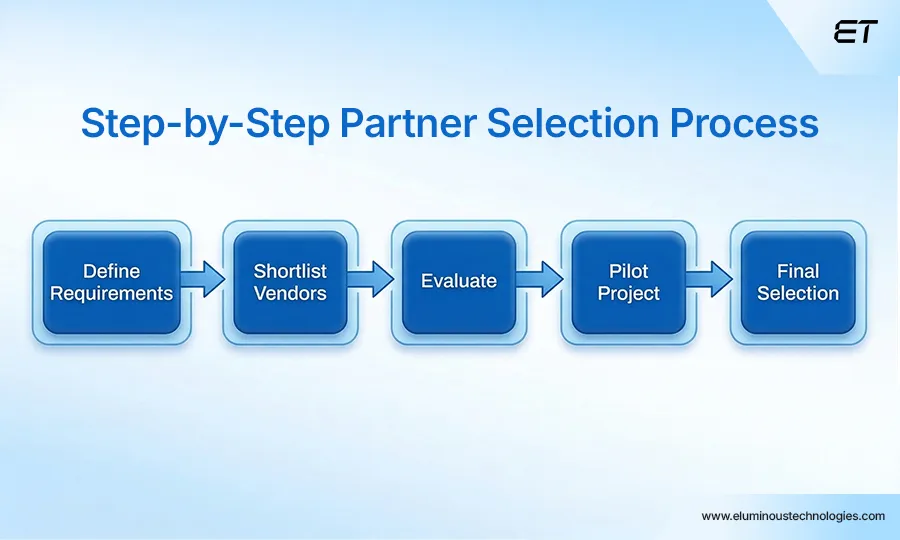
Define Your Project Requirements Clearly
Defining your goals clearly, before searching for a reliable software development partner, filters irrelevant vendors early and ensure the alignment stays on track.
This would not only help you in filtering vendors, but it will also lay out the structure of your project for smooth execution. Majorly, this will prevent misalignment with the wrong partners at the very first step.
Shortlist Based on Relevant Experience
Landing the right software development partner is about finding relevant experience. Look for vendors who have worked on similar problem types and delivered measurable outcomes.
Focus on depth, not volume. Avoid generic portfolios with broad claims, instead, look for meaningful work that clearly shows how they’ve solved problems like yours. Verified client reviews on platforms like Clutch can help validate their credibility.
Evaluate Using Clear Criteria
Apply the framework discussed earlier and compare every shortlisted partner with the same set of parameters. This could include understanding the technical issues, delivery track record, escalation paths, and post-launch support. Be straightforward and provide them with clear expectations. Completing this process directly contributes to eliminating the fluff and saves you from taking a gut-based decision.
Assess Communication Early
Early interactions tell you a lot about how the partnership will work in the long run. Pay attention to how clearly and consistently the team communicates from the start.
- Are they responsive and structured in their communication?
- Do they take the time to understand your requirements?
- Do they ask relevant questions instead of just agreeing?
Strong partners engage actively, clarify assumptions, and challenge ideas when needed. These early signals usually reflect how they’ll communicate throughout the project.
Start with a Small Engagement (If Possible)
A pilot project at the initial phase of screening can help. This would help you understand their working style, quality standards, and communication before you onboard and start working on the real assignment.
Doing so reduces decision risk and offers practical insights, which would help you to evaluate your decision rather than immediately jumping to long-term commitment.
For structured approach, to reaching trial-based collaboration, review different engagement models for additional clarity.
Review Terms, Pricing, and Flexibility
Before finalizing a partner, make sure there’s clear alignment on timelines, costs, and how changes will be handled. Transparency here prevents issues later.
Don’t focus only on low pricing: unclear terms, hidden clauses, or rigid contracts can create bigger problems down the line.
Also, check how the partner handles scope changes. Projects rarely go exactly as planned, so flexibility in adapting to new requirements is just as important as initial pricing.
Mistakes to Avoid When Choosing a Software Development Partner
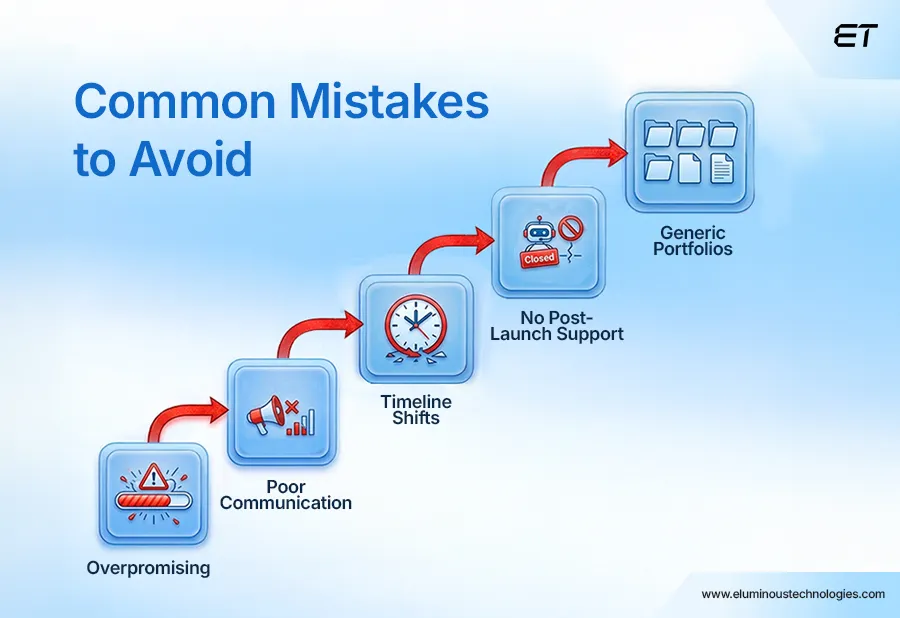
Choosing the wrong software development partner often comes down to missing early warning signs. These issues are usually visible during the evaluation stage but are easy to overlook.
Here are some common mistakes to watch for before you commit.
| Red Flag | What it Indicates |
| Overpromising on speed or budget | This indicates the building of unrealistic expectations. Later, it might lead to compromised quality. |
| Poor communication | Not being able to understand requirements or convey the process, likely leads to escalations and misalignment during the execution. |
| Shifting project timelines | They don’t have a concrete, structured plan, and their delivery process is unclear. |
| No clear post-launch plan | Their support is limited and can cause trouble after the delivery. |
| Generic Portfolios | Not having specific industry experience or case study reveals they have broad claims and no aligned problem-solving capabilities. |
| Limited discussions in the initial phase | Superficial understanding of objectives, without learning the technical depth of the goal. |
To Wrap Up
Choosing the right software development partner is a journey. The roadmap for this route is to know your goals, process, and way of working to the core.
You can make a confident decision when you:
- Evaluate partners beyond surface-level traits.
- Understand how collaboration models impact delivery.
- Apply a structured framework to compare vendors.
- Identify red flags early in the evaluation process.
By combining these steps, choosing a software development partner shifts from a high-risk decision to a strategically manageable one.
If you’re looking for a partner that focuses on transparency, collaboration, and consistent delivery, eLuminous can be a good fit.
Have a project in mind? Book a quick call, and we’ll help you figure out the right approach.
Frequently Asked Questions
1. How do I choose the right software development partner?
Choosing the right development partner requires evaluating technical capabilities, using a structured framework rather than just focusing on the cost. The key element is knowing your goals and aligning them with your vendor.
2. What are the key criteria for selecting a reliable software development partner?
The key factors of selecting a reliable software development partner include assessing technical expertise, problem-solving capabilities, communication style, delivery track record, and flexibility to move with a dynamic environment.
3. What is the difference between a software vendor and a development partner?
A major difference between them is that a software vendor focuses on delivering your requirements, while a partner aligns with them, executes them, and provides you with post-launch support. They contribute to the long-term growth.
4. Which collaboration model is best for my project?
The right collaboration model depends on your project type. For long-term or evolving projects, a dedicated team offers continuity and flexibility. Fixed-scope projects work best with a project-based model, while projects with changing requirements benefit from a time and material approach. If you just need to fill short-term skill gaps, staff augmentation is usually the most efficient choice.
5. How much does it cost to hire a software development partner?
For hiring an excellent software development partner, you need to initially be concise about your project complexity, team size, engagement model, and geographic location. look for flexibility, overall value, that would directly help you to determine the cost for long-term reliability.

Staff Augmentation Best Practices for High-Performance Teams
Do you have a clear vision, but lack the bandwidth or skills to execute fast enough? Then it might not…


Staff Augmentation Pricing Models Before and After AI
How do we link pricing to business outcomes, not just billable hours? The answer to this question has notably changed…


