
 Book a Meeting
AI in IoT: How AI Is Reshaping the Internet of Things


Imagine your factory machine noticing a problem before you do.
Its sensors keep monitoring temperature, vibration, pressure, and other operating conditions. That data travels through your connected systems in real time. Now, add AI in IoT to the picture.
You can use that data to spot unusual patterns, predict potential failures, and trigger timely actions.
The scale is already massive. IoT Analytics estimates 24 billion connected IoT devices to exist globally by 2026. The number is expected to reach 39 billion in 2030.
But what exactly happens when artificial intelligence meets connected devices? AI in IoT combines sensor data, connectivity, machine learning, and intelligent analytics. It turns raw device data into useful insights and automated decisions.
That combination can change how you monitor assets and respond to problems. Let’s explore how AI and IoT work together.
What Is AI in IoT?
| AI in IoT combines artificial intelligence with connected devices and systems. It helps your devices understand data and find useful patterns. |
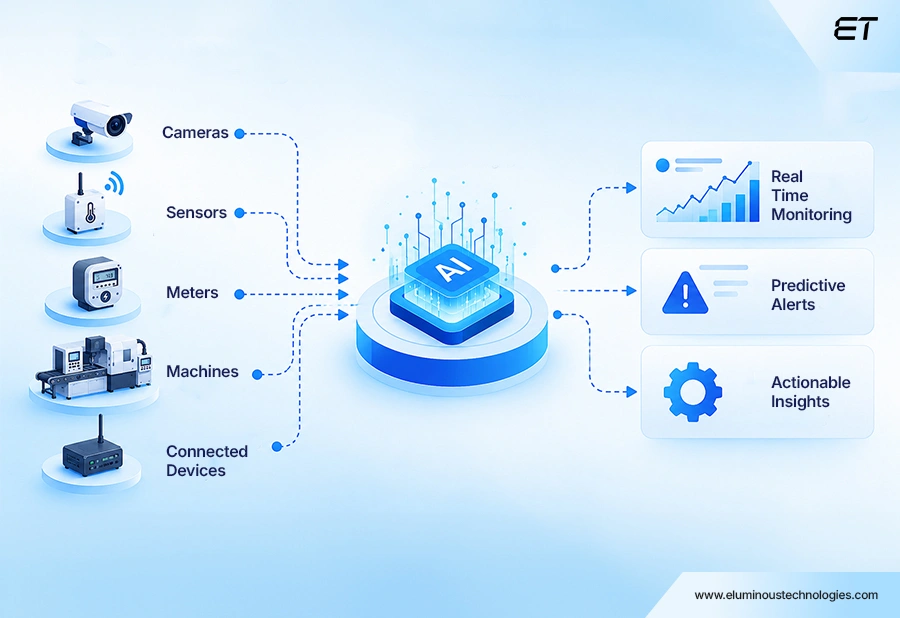
IoT devices collect information through sensors, cameras, meters, and other connected hardware. This information can include temperature, movement, location, pressure, and machine performance.
However, collecting data is only part of the equation. You also need intelligent systems to interpret that information. That is where artificial intelligence becomes useful.
- AI algorithms can analyze IoT data and identify patterns humans might miss.
- Machine learning can also help your systems learn from historical data.
- These systems can then recognize anomalies and predict potential problems.
For example, your manufacturing equipment can continuously monitor its operating conditions. AI can analyze those readings and detect unusual behavior.
You can then receive an alert before a minor issue becomes equipment downtime.
Together, they make your IoT infrastructure smarter and more responsive. Instead of simply collecting data, your connected systems can help you act on it.
How Does AI in IoT Work?
You now know what happens when AI meets connected devices. But how does the technology actually work?
Behind the scenes, several components work together to make AI in IoT possible.
Your devices first collect data from their surroundings.
That data then moves through gateways, networks, or edge devices.
AI models can analyze this information and identify meaningful patterns. The resulting insights can then trigger alerts, predictions, or automated actions.
For developers and technicians, the process involves several technical layers. Let’s break down each layer to see how they work together.
Connecting IoT Devices and Sensors
Everything starts with the devices connected to your IoT environment. These devices use sensors to continuously capture real-world information.
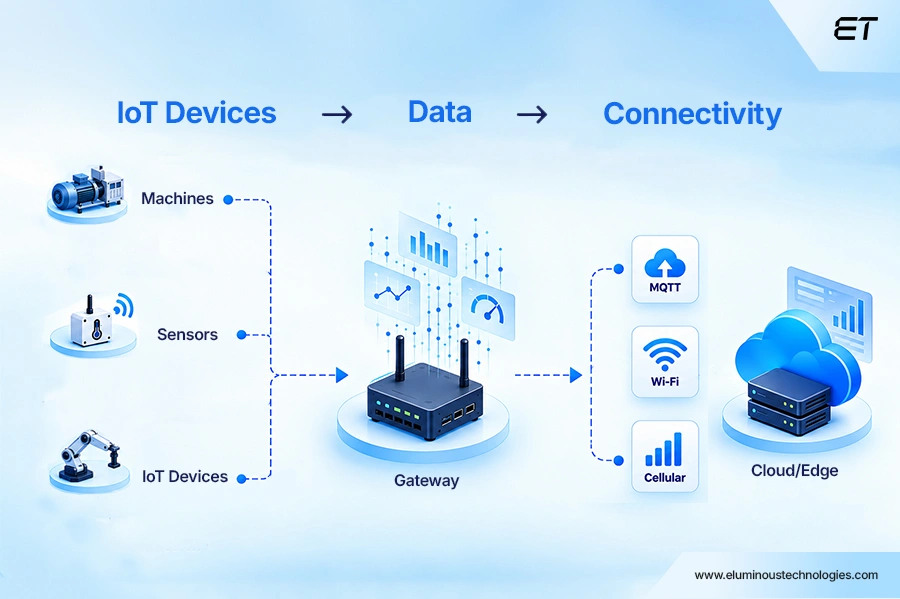
A temperature sensor might measure heat inside industrial equipment. A vibration sensor can monitor unusual machine movement. Developers connect these sensors to IoT devices, controllers, or embedded systems. These devices collect sensor readings and prepare them for transmission.
Connectivity can use protocols such as:
- MQTT
- HTTP
- Wi-Fi
- Bluetooth
- Cellular networks
The right option depends on your device, environment, and data requirements.
An IoT gateway can also collect data from multiple connected devices. It can then forward that information to edge or cloud platforms. This creates the data stream for AI systems. Without reliable sensor data, even sophisticated AI models have limited value.
Collecting and Preparing IoT Data
Once your devices collect data, you need to move and organize it.
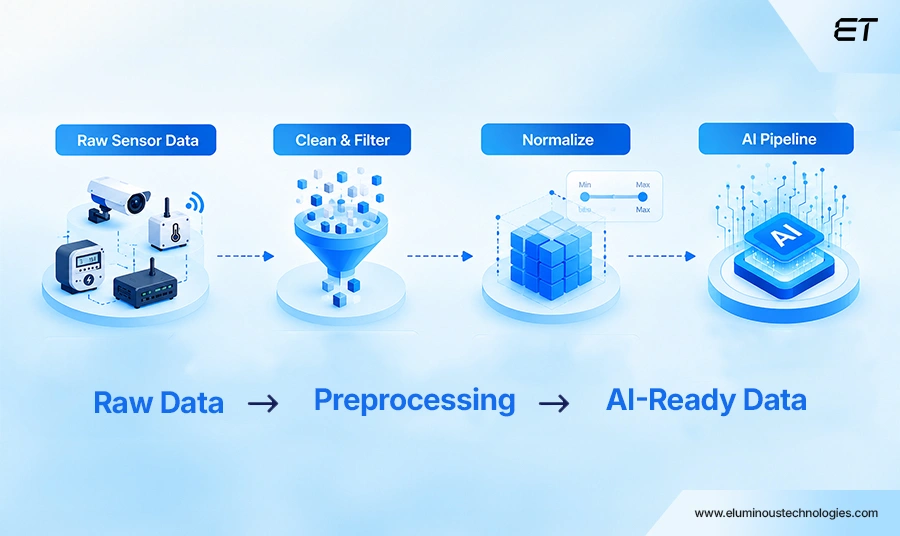
Raw sensor data is rarely ready for AI models immediately. Your IoT platform receives data through gateways, APIs, or messaging protocols. Developers then store this information in databases or cloud storage.
The next step is data preprocessing, which improves data quality. This process can remove duplicates, handle missing values, and filter noisy readings.
You may also need to normalize data from different sensors. This creates a consistent format for machine learning models. For time-sensitive applications, you can process data closer to the device. This approach uses edge computing to reduce latency and network traffic.
The prepared data can then enter an AI pipeline for further analysis. That is where machine learning starts finding patterns within your IoT data.
Applying AI and Machine Learning Models
Now you have structured data ready for intelligent analysis. This is where your AI models enter the workflow.
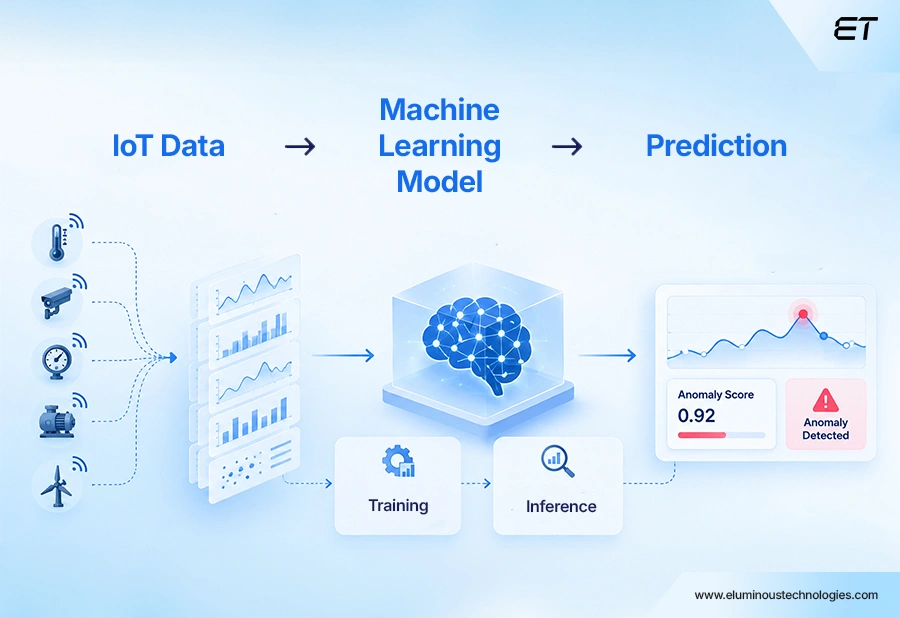
Developers train machine learning models using historical IoT data. The model learns patterns associated with normal and abnormal device behavior.
Different models can handle different IoT use cases. Classification can identify specific conditions, while regression can predict numerical outcomes.
For example, a model can analyze vibration patterns from industrial machinery. It can learn which patterns often precede equipment failure. Developers then deploy the trained model within an IoT environment. New sensor readings can pass through the model for inference.
The model compares incoming data with learned patterns. It can then produce predictions, classifications, anomaly scores, or other outputs.
This process turns raw sensor readings into information your systems can use.
Running AI at the Edge or in the Cloud
Once your model is ready, you need to decide where inference should happen. Two common options are:
- Edge computing
- Cloud computing
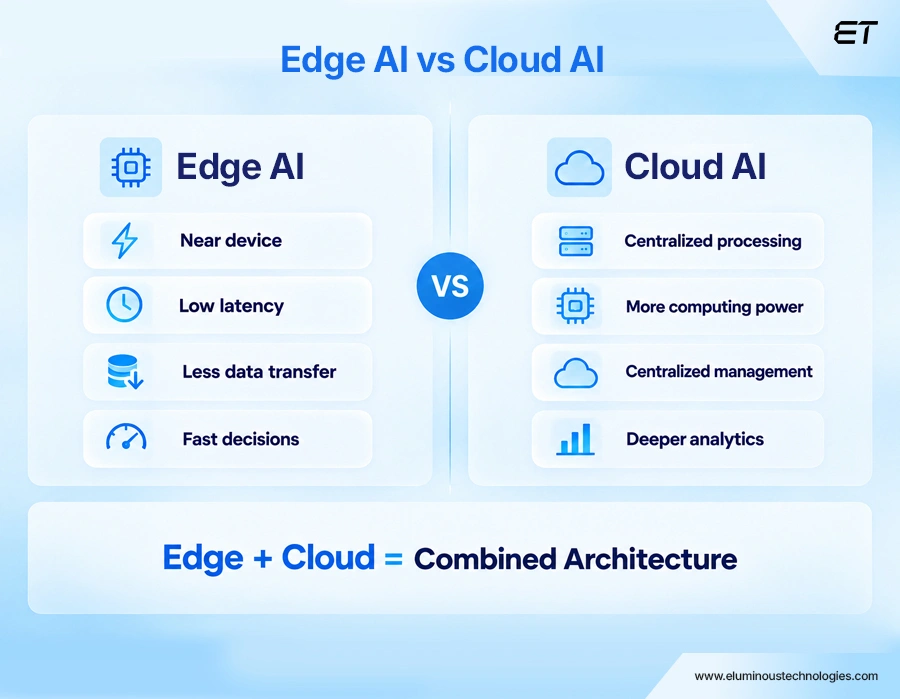
With edge AI, your model runs closer to the IoT device. An edge gateway or local device can process sensor data directly. This approach reduces latency and limits the amount of data sent to cloud servers. It suits applications requiring quick responses, such as industrial monitoring.
Cloud-based AI sends IoT data to remote computing infrastructure for processing. Cloud platforms provide greater computing resources and centralized data management. They can also simplify model deployment, monitoring, and updates across multiple devices.
Your choice depends on latency, connectivity, computing power, and data requirements.
Some IoT architectures combine both approaches. Edge devices handle immediate decisions, while cloud platforms manage deeper analytics.
Generating Insights and Automated Actions
Your AI model has analyzed the incoming data. Now, your IoT system needs to act on those insights.
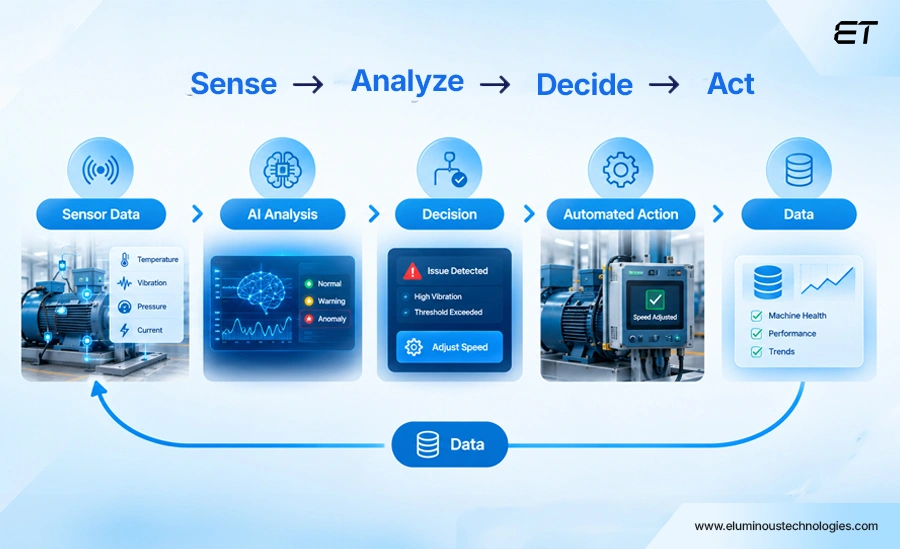
The model can detect anomalies, predict failures, or identify changing operating conditions. Your application can then trigger predefined actions based on those results.
For example, an AI model can detect unusual equipment vibration. Your system can immediately alert the maintenance team. It can also trigger automated responses through connected devices or control systems. This could adjust machine settings, change operating parameters, or initiate a shutdown.
Developers connect these responses through APIs, automation rules, or application logic. This creates a continuous loop between sensing, analysis, decision-making, and action.
You therefore move beyond monitoring your devices. Your IoT system can start responding intelligently to changing conditions.
Learning From New IoT Data
Your IoT environment keeps generating new data after deployment. That data can help your AI models become more useful over time.
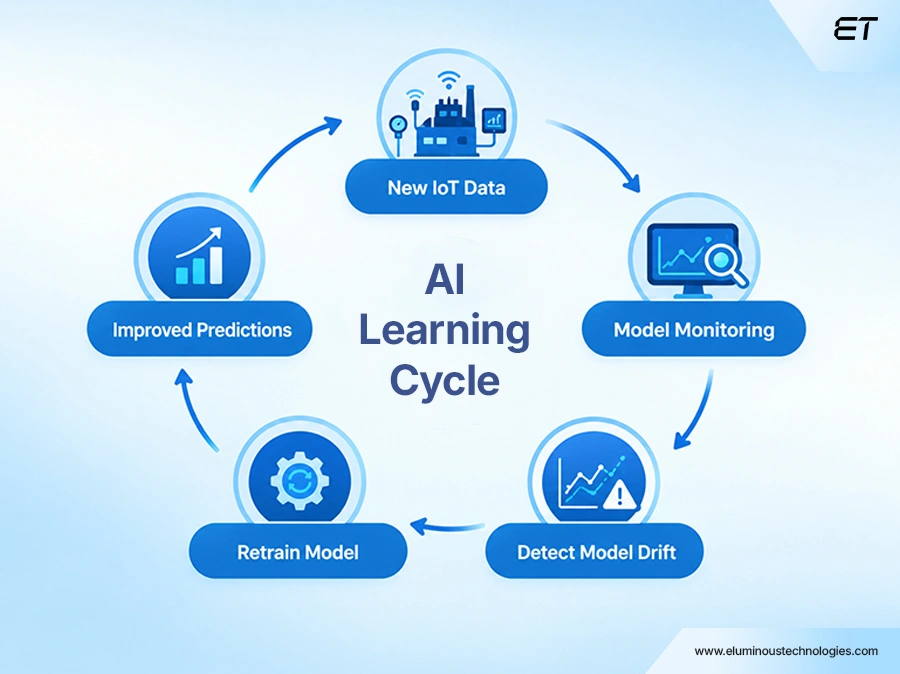
Developers can monitor model performance against new sensor readings. They can identify declining accuracy, unexpected patterns, or changes in device behavior.
This process helps detect model drift, which can affect prediction accuracy. Developers can then retrain models using newer, more relevant IoT data.
For example, machine conditions can change after equipment upgrades or process changes. A retrained model can account for these new operating patterns. This creates a continuous feedback loop between IoT data and AI models. Over time, AI in IoT can deliver more relevant predictions and decisions.
The result is an IoT system that can adapt as your environment changes.
What Are the Benefits of AI in IoT?
AI in IoT can help you get more value from your connected devices.
Instead of simply monitoring your operations, you can identify what needs attention. You can also predict potential issues before they disrupt your processes.
Here are some key benefits you can expect from this combination:
| Benefit | What It Means for You |
| Predictive maintenance | Spot equipment issues before failures occur. |
| Faster decisions | Act on real-time data and insights. |
| Higher efficiency | Find and reduce operational inefficiencies. |
| Less downtime | Address potential problems before they disrupt operations. |
| Anomaly detection | Identify unusual device or system behavior. |
| Smarter automation | Let systems respond without constant manual input. |
| Better resource use | Optimize energy, equipment, and other resources. |
| Actionable insights | Turn IoT data into useful business decisions. |
| Stronger security | Detect unusual activity across connected devices. |
| Easier scaling | Manage growing volumes of IoT data efficiently. |
How AI and IoT Support Each Other
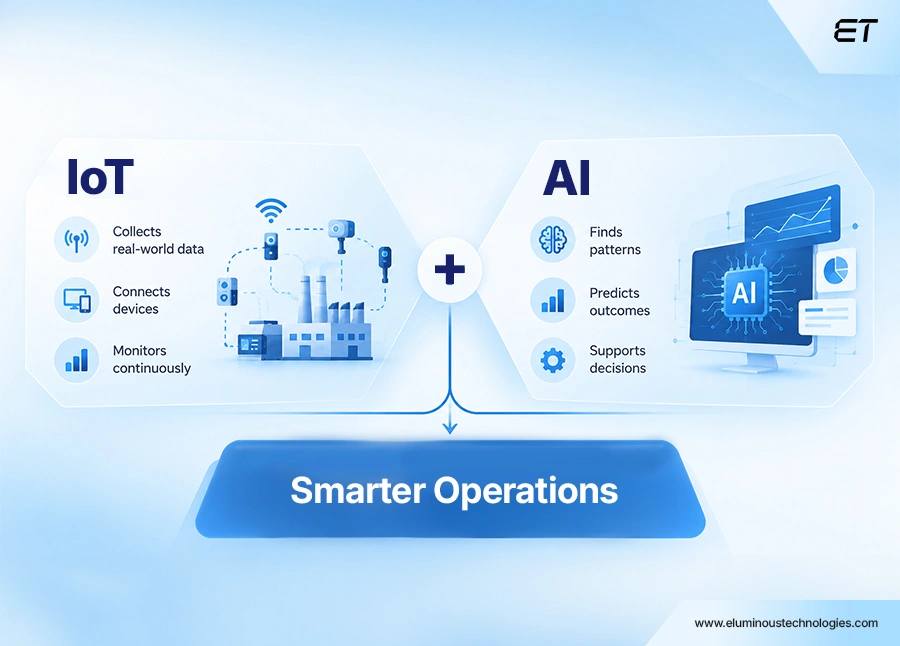
Simply put: Each technology fills an important gap in the other.
- IoT gives AI access to continuous, real-world data
- AI helps IoT systems understand that data and respond intelligently
Your connected devices can collect information from machines, environments, and users. AI can then analyze that information and identify meaningful patterns.
Think of IoT as the system’s senses. AI acts more like its brain, helping interpret what those senses detect.
| AI + IoT Combination | Value for You |
| Real-time data + AI analysis | Faster, better-informed decisions |
| Connected devices + predictive models | Earlier warning of potential failures |
| Continuous monitoring + anomaly detection | Quicker identification of unusual behavior |
| Sensor data + machine learning | More accurate predictions over time |
| IoT automation + AI decisions | Less manual intervention |
| Edge computing + AI inference | Faster responses with lower latency |
| Device data + predictive analytics | Better planning and resource allocation |
| AI insights + connected systems | Smarter, more responsive operations |
Examples of AI in IoT
AI already supports many systems you encounter every day.
You can see its impact across factories, buildings, vehicles, and energy systems.
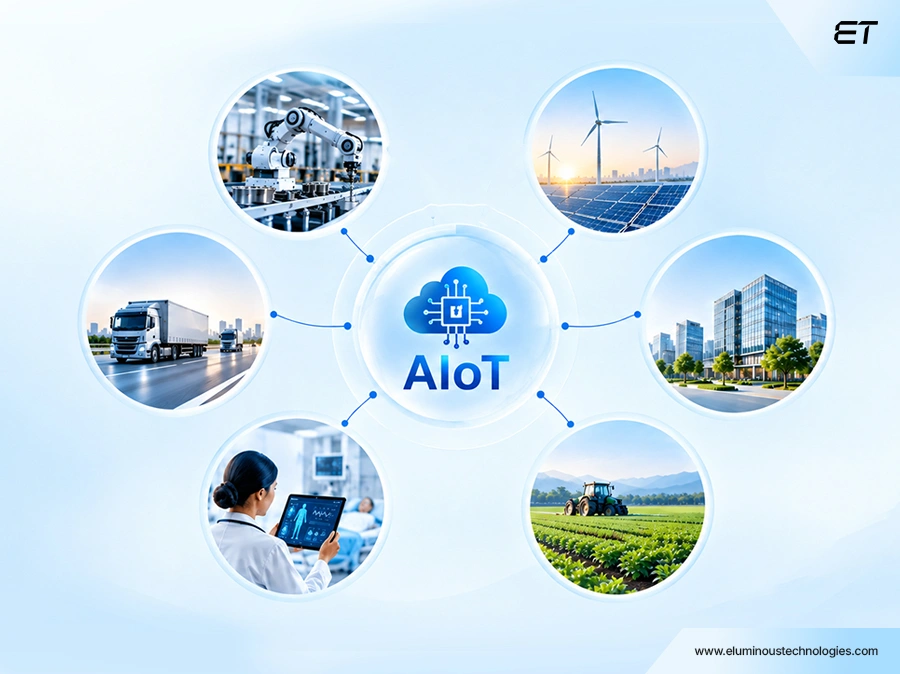
Predictive Maintenance in Manufacturing
Manufacturing equipment generates continuous data through connected sensors.
AI can analyze vibration, temperature, pressure, and other machine readings.
It can identify patterns associated with potential equipment problems.
Your maintenance team can then investigate issues before unexpected failures occur.
Smart Energy Management
Connected meters can continuously track energy consumption across your facilities.
AI can analyze usage patterns and identify unusual consumption.
It can also help forecast future energy demand.
Use these insights to optimize consumption and reduce unnecessary energy use.
Intelligent Fleet Management
IoT devices can track vehicles, routes, fuel usage, and operating conditions.
AI can process this information to identify fleet-wide patterns.
You can use these insights to improve route planning and vehicle utilization.
AI can also help identify unusual driving or vehicle behavior.
Smart Buildings
Connected building systems can monitor temperature, occupancy, lighting, and energy consumption.
AI can use this data and identify changing usage patterns.
Your building systems can then automatically adjust certain settings.
This can help improve occupant comfort while managing energy consumption.
Connected Healthcare Monitoring
IoT in healthcare devices can continuously collect information from connected healthcare equipment.
AI can use these readings to identify unusual patterns.
Healthcare professionals can receive alerts when readings require further attention.
This supports remote monitoring and faster intervention.
Smart Agriculture
Connected sensors can monitor soil conditions, temperature, humidity, and other environmental factors.
AI can process these readings alongside historical data.
You can use these insights to improve irrigation and plan resources more effectively.
AI can also help identify changing conditions that may affect crop growth.
Emerging Innovations Shaping AIoT
AIoT is moving beyond basic monitoring and predictive analytics.
New approaches are making connected systems more adaptive and autonomous.
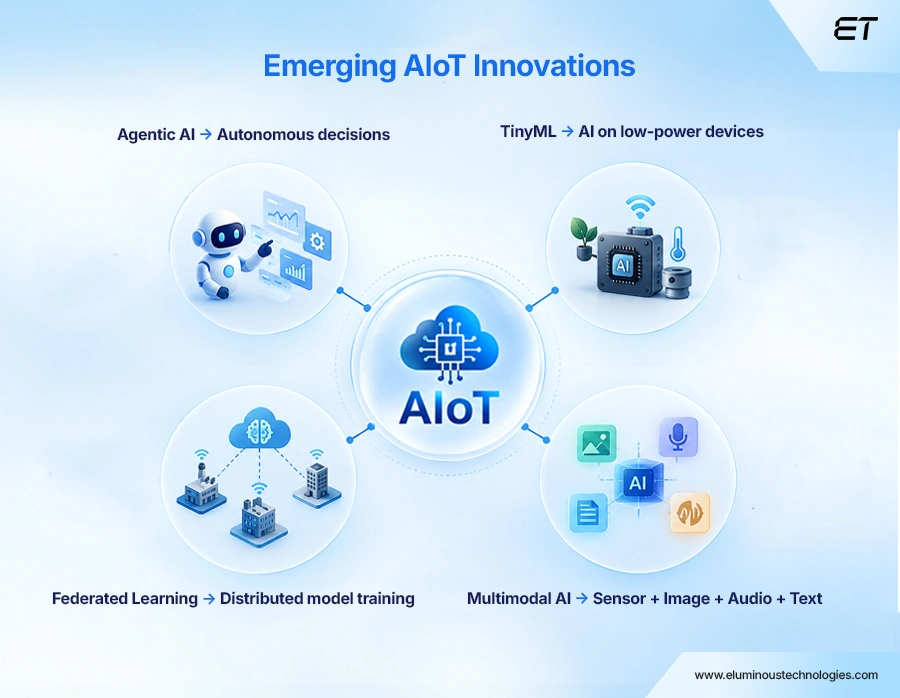
Agentic AI for IoT
AI agents can interpret IoT data and determine appropriate actions.
They can work across multiple systems rather than handling a single task.
For example, an agent could detect abnormal equipment behavior.
It could then investigate relevant data and recommend a maintenance response.
TinyML for Resource-Constrained Devices
TinyML brings machine learning capabilities to small, low-power IoT devices.
These devices can process certain data without relying on cloud infrastructure.
This approach can reduce latency and dependence on the network.
It can also support AI capabilities on devices with limited computing resources.
Federated Learning
Federated learning allows models to learn across distributed IoT devices.
Devices can train models without sending all raw data to a central server.
This approach reduces data movement and supports stronger privacy.
It can be useful when IoT environments generate sensitive or distributed data.
Multimodal IoT Intelligence
Future IoT systems can combine multiple data types for analysis.
These inputs can include sensor readings, images, audio, and text.
AI can combine these signals to build a broader understanding.
You can then make decisions using information from several sources.
These innovations could make connected systems more autonomous and context-aware.
The key will be applying them where they solve real operational problems.
To Wrap Up
AI in IoT can help you turn connected data into meaningful business outcomes.
It can help you predict issues, automate responses, and improve operational efficiency.
However, successful implementation requires more than connecting devices.
You need the right sensors, data architecture, AI models, and integration strategy.
The right approach depends on your specific business requirements.
You may need edge processing, cloud analytics, predictive models, or automated workflows.
If you are exploring AIoT for your business, start with a clear objective.
Then build the technology around the problem you want to solve. At eLuminous, we can help you plan and build IoT solutions around your needs.
You can reach out to our team to discuss your requirements.
Frequently Asked Questions About AI in IoT
1. What is AI in IoT?
AI in IoT combines artificial intelligence with connected devices and systems.
It helps you assess IoT data and make intelligent decisions. Your devices collect real-time information through sensors and connected hardware.
AI models can then identify patterns, anomalies, and potential problems.
2. How does AI improve IoT?
AI helps your IoT systems do more than collect and transmit data.
It can process incoming information and identify meaningful patterns. This makes your connected systems more responsive and useful.
3. What are the benefits of AI in IoT?
AI in IoT can improve efficiency, reduce downtime, and enable faster decisions.
It can also support predictive maintenance and automated workflows. You can continuously analyze large volumes of sensor data.
4. What are some examples of AI in IoT?
You can find AI in IoT across several industries and applications.
Manufacturing uses it for predictive maintenance and equipment monitoring. Energy companies can analyze consumption patterns using connected meters.
Healthcare providers can use connected devices for remote monitoring. AI also supports smart buildings, fleet management, and intelligent agriculture.
5. What is the role of machine learning in IoT?
Machine learning helps IoT systems learn patterns from historical and real-time data.
You can train models to recognize specific conditions or predict future outcomes. For example, an LLM can learn what normal machine behavior looks like.
It can then flag unusual readings that may indicate a potential failure.
6. What are the challenges of implementing AI in IoT?
Implementing AI in IoT can involve technical, operational, and security challenges.
You may need to manage large volumes of sensor data. You also need reliable connectivity, suitable infrastructure, and quality training data.
Device compatibility and system integration can create additional complexity. Privacy and cybersecurity also require careful consideration.

IoT in Healthcare: Connecting Devices, Data, and Patient Care
Imagine a doctor seeing how a patient’s condition changes, even when they’re at home. A wearable tracks their heart rate,…

AI Staff Augmentation: A Faster Move from Prototyping to Production
Summary: AI is changing staff augmentation across industries. As artificial intelligence’s usage moves from isolated systems to connected, ready-to-use workflows,…


