
 Book a Meeting
Industrial Internet of Things (IIoT): Applications, Benefits, and Use Cases
It’s night shift. A conveyor belt on a bottling line suddenly stops working. The whole line halts. No maintenance technician is on the floor to check and fix it until morning. Now, operators have to wait while the orders keep piling up.
Technicians discover the belt’s motor was running hotter than usual. But it just missed. What if a system could prevent this situation?
The industrial internet of things (IIoT) is such a solution. It connects your industrial equipment to software, so you can monitor each machine and respond as needed.
Below, you’ll learn how IIoT works and its key applications. You’ll also learn about use cases that show how reliable data drives better decision-making in manufacturing.
What is the Industrial Internet of Things?
Industrial IoT uses sensors on devices to collect data that you can access on a suitable digital platform. This interconnectivity happens across factories, transport networks, utilities, mines, energy facilities, and more.
A few common examples are:
- Vibration sensors on motor and pump bearings
- Temperature sensors on motor hot spots
- Pressure sensors on pumps
- Location tags and RFID on tools and pallets
- Remote asset sensors on pipelines, pumps, and substations
Data from these sensors may pass through several steps before reaching the final dashboard.
A gateway or PLC → gets processed on an edge computer → then lands on an operator dashboard/production plan/maintenance request.
Some IIoT setups can make only the current conditions visible to the teams. Others may have more complex roles, triggering automated responses based on the plant’s safety rules.
IIoT works alongside operational technology (OT). Together, these controls and equipment run physical processes, such as conveyor motors and their PLCs. Because IIoT collaborates with OT, data or security issues can hamper manufacturing machines. So, reliability and safety rules apply equally to both IIoT and OT projects.
IIoT vs IoT: What’s the Difference?
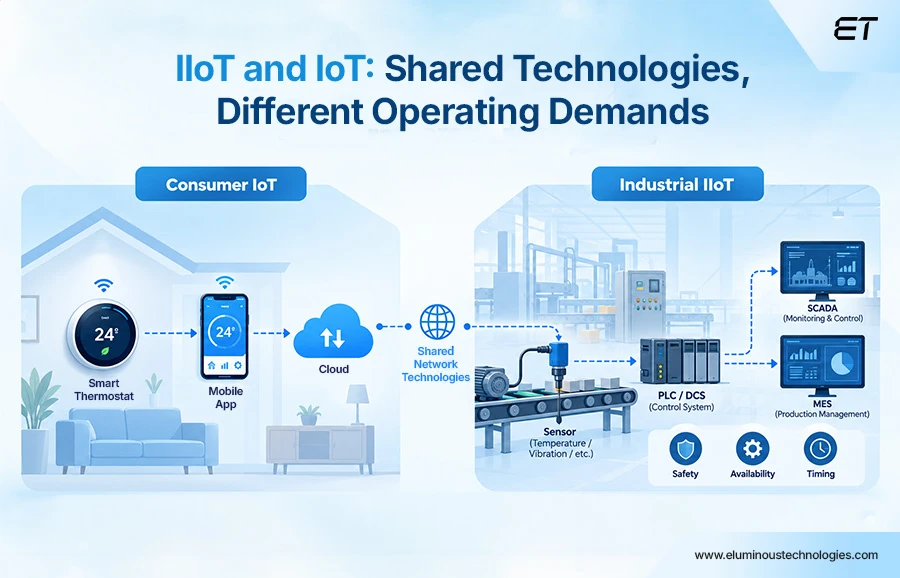
Both Industrial IoT (IIoT) and the Internet of Things (IoT) connect devices so they can share data. Much of the underlying technology is similar. The difference is mainly in how and where they are used.
- Consumer IoT has devices such as smart speakers, home cameras, and connected thermostats
- IIoT applies connected technology to industrial operations and equipment
The control requirements also vary.
1. Industrial sites have both old and new equipment, so linking them requires a range of protocols: Modbus, OPC UA, MQTT, industrial Ethernet, and vendor-specific options.
2. Gateways often translate data from legacy machines so everything can communicate.
Note that none of these belong specifically to IIoT.
With OT in the picture, how fast data must move also matters. Because of this linkage, the security stakes change too.
A cyber breach in the Industrial Internet of Things can reach the physical environment. So industrial cybersecurity has to protect safety and system availability alongside confidentiality and integrity.
You can manage these risks through network segmentation and controlled remote access.
| Dimension | Consumer IoT | Industrial Internet of Things |
| Example | Home thermostat | Sensor on a conveyor motor. |
| Data path | Device to app or cloud service | Sensor data may pass through a DCS, PLC, or gateway to SCADA, a historian, or MES |
| Equipment | Usually purpose-built consumer devices | A mix of legacy and newer equipment, connected directly or through gateways. |
| Connectivity and protocols | Wi-Fi, Bluetooth, Zigbee/Thread, or vendor and app ecosystems | Modbus, OPC UA, MQTT, industrial Ethernet, or vendor-specific protocols. |
| Timing | Usually best-effort; seconds of delay may be acceptable | Monitoring may tolerate delays. Control functions can require bounded latency and direct response. |
| Security priorities | Protect accounts, privacy, and service integrity | Protect safety, system availability, and process integrity, along with data confidentiality. |
| Failure causes | Service interruption, loss of a feature, or inconvenience | Missed alerts, lost operational visibility, production interruption, or safety risk. |
Keep in mind that these differences mainly come from the operational context, not the technology stack. An IIoT may also use IoT protocols, but it integrates them with OT and process-specific manufacturing requirements.
How Does IIoT Work?
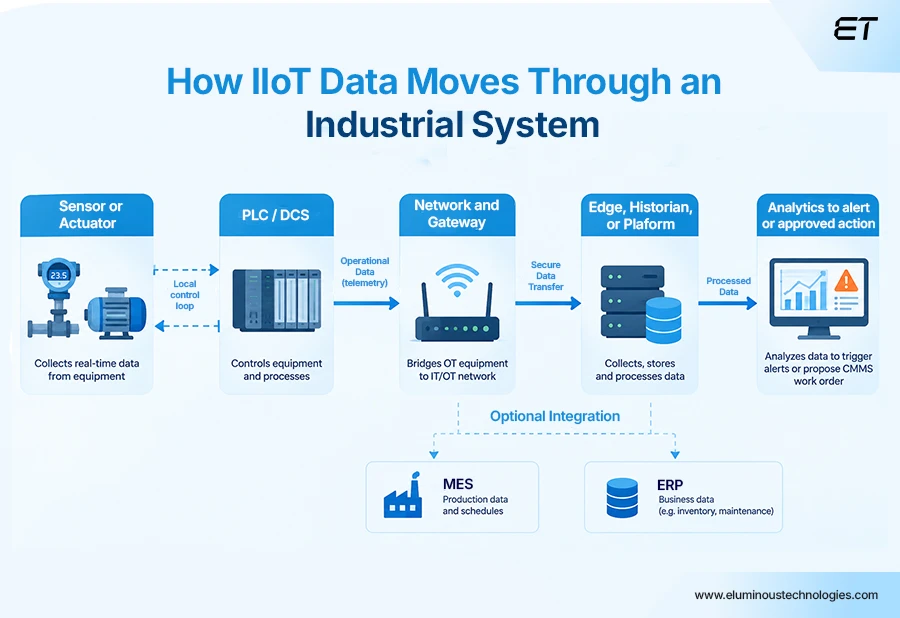
The Industrial Internet of Things moves information from an industrial process to the right person or application.
It works mainly like this:
1. Sensors grab vibrations, flow, temperatures, or current.
2. A PLC or DCS system catches that signal and manages local control.
3. From there, industrial networks handle selected data through a gateway or edge computer.
4. Gateways help connect legacy equipment to newer applications.
5. When local response matters, edge software reads and filters signals, adds asset content, or buffers data during a network outage. (Time-sensitive control is still with PLCs and DCS).
6. For long-term assessment, an industrial historian, cloud service, on-premises platform, or hybrid system collects readings. It helps in comparing data across machines to reveal patterns in isolated signals.
7. When analysis spots a condition, it generates an alert to prompt an inspection.
8. Data may also update the MES or ERP.
The right computing architecture depends on the tasks it must manage. Edge processing helps when connectivity or response time matters. For long-term storage or comparisons across sites or assets, centralized systems work more efficiently. Many deployments blend both.
Industrial IoT Applications and Use Cases
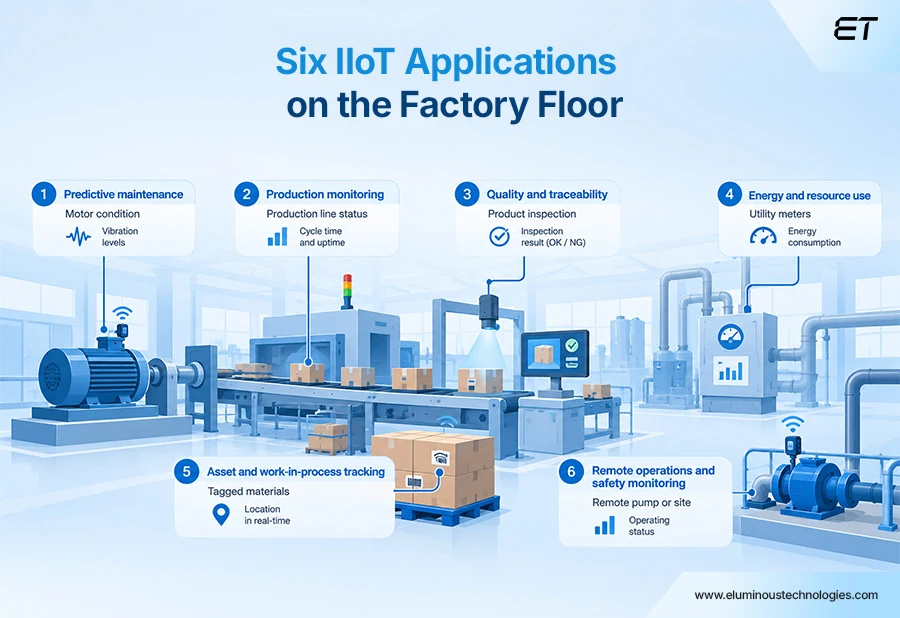
Here are six use cases of IIoT so you can see where and how that happens.
Predictive Maintenance
A conveyor motor on your production line may sound completely normal, even though it’s starting to break down. IIoT sensors can help track temperature, pressure, vibration, or shifts in electrical current. A basic monitoring rule can alert staff when a reading crosses a set threshold. Then, maintenance teams can check an asset before a simple fault disrupts the entire line.
This means every alert helps predict failure more accurately. That’s why your teams need to tune thresholds, check for false alarms, and connect the right insights. All of this happens after a threshold has been reached.
Industrial AI IoT can go a step further. A machine-learning model learns the motor’s usual operating patterns from historical data. It can then compare multiple readings to flag unusual behavior, even when no single reading crosses its threshold.
Unlike a single-threshold alert, which fires up when one reading crosses a preset limit, an LLM can assess trends in advance. This lets production teams prepare and estimate risk to avoid failure beforehand.
It also gives maintenance staff a risk score to review. They can then decide on the right action.
Production Monitoring and Optimization
Optimization teams need to check where time and capacity are lost. To help, Industrial Internet of Things systems can collect cycle times, line speed, machine status, and stoppage data. Combined with production context, they show machine constraints during product switching, equipment changes, or across schedules.
This shared view aims to avoid juggling dashboards during decision-making.
A supervisor may use the gathered info to investigate repeated halts or even rearrange work between stations.
To see whether the change is working, you can measure overall equipment effectiveness, stoppage duration, and cycle time.
Quality Control and Traceability
Process conditions affect the overall quality of a finished product. But if you link process data to a batch of production time, it lets the team trace:
- How an item was created
- Where the defect began
- Which products need review
Smart factories use IIoT technologies to shift production from traditional automation to a fully connected, flexible, and optimized system. This digital transformation also supports designing customized products at mass-production prices.
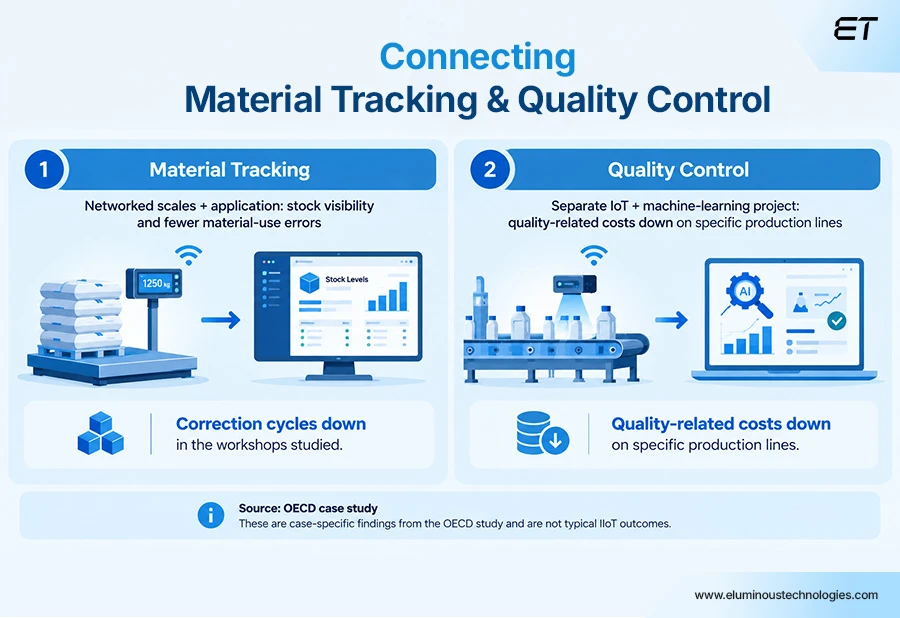
Siegwerk, a German inks and coatings manufacturer, deployed IIoT in two projects.
1. Through the networked scales, the initiative fed an in-house app, giving staff live stock levels and cutting material-use errors. In the workshops studied, correction cycles fell by nearly 10%.
2. In another project, IoT data and machine learning flagged quality trends and predicted machine failures. On specific lines, the company reported quality-related costs nearly 70% lower.
While these results reflect strong outcomes for Industrial Internet of Things investments, they shouldn’t be treated as a universal benchmark.
In your manufacturing processes, scrap defect rates, rework, and time to trace an issue are key metrics for quality-related results.
Energy and Resource Management
Utility bills show a site’s complete energy consumption. But they are still unable to pinpoint which process or asset drives it. Smart IIoT meters and industrial sensors provide a more holistic view of energy use.
Your teams can then compare readings by shift. They can also track how energy readings vary by production volume, machine state, or process conditions.
That visibility may reveal equipment running while idle, compressed-air leaks, or unexpected changes in consumption. Once you find a discrepancy, you can schedule a maintenance check or adjust the operating schedule.
Asset, Inventory, and Work-in-Process Tracking
Imagine a bottling line needs to switch container sizes. The tricky part is that if a part is missing or stored elsewhere, staff search the plant while the line sits idle.
Location sensors, RFID tags, and connected trackers support the staff by showing where equipment, goods, and work-in-process items are. They also help planners spot shortages before they hit the line.
But not all IIoT technologies work the same way. The tech should match the environment and what items need to be located. A reusable machine may need a different tracker from a small component moving along a production line.
To see how tracking is useful, check inventory accuracy, search time, dwell time, and delays caused by unavailable materials after deployment.
Remote Operations and Safety Monitoring
Some of your industrial assets may be spread across different plants or located in hard-to-access areas. Connected sensors help you here. They let you easily report operating conditions from pipelines, pumps, substations, and other remote equipment.
Remote monitoring doesn’t eliminate inspection, though. With enough data, teams can review alerts and prioritize on-site inspections.
The same approach can help monitor worker safety.
Even though useful, it doesn’t replace safe work procedures, protective equipment, or trained staff. Your teams should know what the system measures, how fast someone responds, and what happens if connectivity drops.
Benefits of IIoT in Manufacturing
The biggest win with IIoT initiatives is making the invisible visible. Once a team can watch a process, a lot gets easier. That visibility pays off in five ways:
Less Unplanned Downtime
Early warnings give your team reasonable bandwidth to act before a fault stops a line. Maintenance shifts from reacting to planning.
More Output from Existing Equipment
Data from stoppages, cycle times, and idle capacity shows where to allocate and optimize production capacity. Teams can fix scheduling gaps before they buy new machines.
Better Quality
Linking process data to batches traces a defect back to the machine conditions behind it. Comparing those records helps teams find the cause faster and review fewer products.
Less Wasted Energy and Material
Plant-wide energy consumption totals can hide where resources are being wasted. Breaking down data by machine, process, or shift helps teams locate avoidable energy and material use.
Faster Answers Across Teams
When maintenance, quality, and operations work from one view of asset condition and production history, you spend less time gathering data. It prevents wasted time pulling reports from separate systems, so experienced staff can spend more time fixing root causes.
The exact gains and results depend on the type of manufacturing enterprise and use case.
To know whether an IIoT project delivers real benefits, start by recording current performance and assigning an owner to measure it in the future. Then track the metric that aligns with the goal:
| Goal | What to track |
| Fewer Breakdowns | Downtime and repair frequency |
| Better Quality | Scrap, rework, traceability time |
| Less Energy Usage | Resource use per unit of good output |
IIoT Security and Implementation Challenges
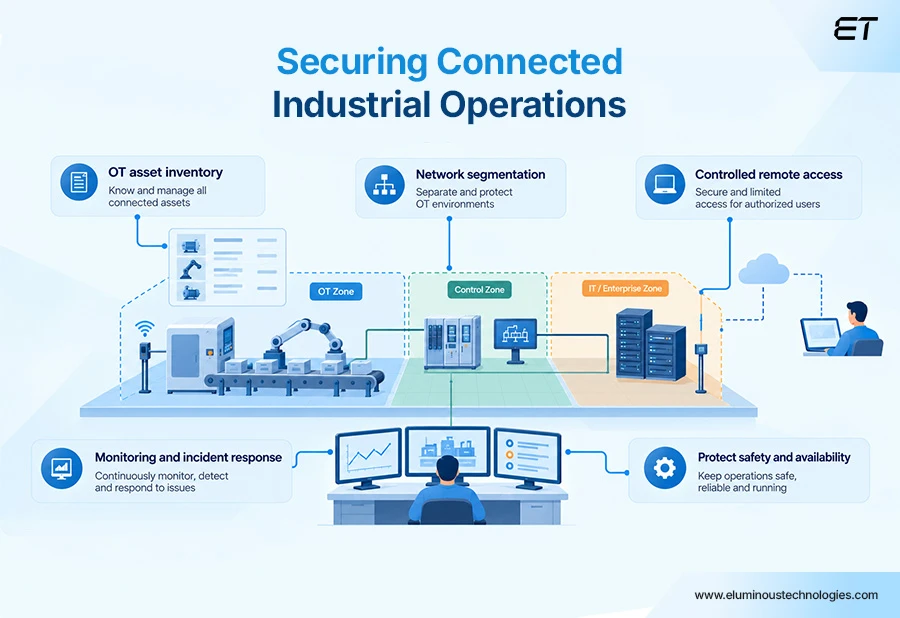
Connecting equipment can improve visibility, but each new device integration adds security work. In these cases, most Industrial IoT security challenges stem from legacy equipment, added connections, and the people behind them.
Legacy Meets Modern Solutions
Legacy machines sit alongside newer systems, so connecting them often requires gateways, adapters, or extra sensors. Moreover, every system must stay in sync and read measurements the same way. Any change can reduce the initiative’s overall outcome.
Security Concerns
An asset inventory lists software, devices, network connections, and owners. Every connected machine adds an impact challenge by giving teams a new asset to monitor. So, while doing asset inventory, you need to check for:
- Weak authentication
- Poor network segmentation
- Unprotected remote access
- Insecure protocols
Knowing what is connected is the first step in deciding what to protect.
To manage all of this cohesively, cover the full lifecycle and split responsibility among owners, integrators, suppliers, and service providers. Next, limit access, control networks while monitoring activity, and plan for incidents in Industrial IoT security.
People and Partnerships
Teams matter as much as the underlying technology running your business. Operations, IT, engineering, maintenance, and security often want different things. Without clear ownership, training, and a plan for acting on alerts, new data just adds workload.
How to Build an IIoT Solution
To plan an IIoT platform, here are a few steps you can consider to see if the use case is safe, measurable, and practical to pilot:
- Select an issue that affects the business the most, such as repeated stoppages on a critical line or poor visibility into energy use. Record the baseline and highlight who owns the outcome.
- See which systems, equipment, protocols, and data are available. Determine whether the use case requires local processing, maintenance, a production system link, or offline buffering.
- Keep safety and security in mind before connecting devices for remote access.
- If you begin with a pilot, ensure that it represents the business case. Agree on success criteria, then check data reliability and whether staff can use it.
- Factor in connectivity, support, integration, and license costs. It’ll help you figure out the scope of overall lifecycle IIoT costs.
If you’ve covered all of these aspects, it’s time to see what a vendor can offer. You can start by asking them questions:
- How does the platform handle existing protocols?
- How does it export data?
- How does it manage device identities over time?
- Where is data stored, and who can access it?
A software development partner offering a complete solution can help with sensor connectivity, gateways, integration, security controls, and maintenance.
Summing Up
The Industrial Internet of Things connects devices and processes across industrial operations. It helps teams use that information to monitor processes, respond to problems, and improve performance.
It can serve many purposes, including maintenance, manufacturing process control, quality, resource management, and remote operations.
The best implementations start with a real business need, consider safety and security, and compare results to the baseline.
If you’re looking for industrial IoT solutions, consult our experts to build the right system for your environment.
Frequently Asked Questions
What is an example of Industrial Internet of Things?
A vibration sensor attached to a motor is a good example of IIoT. This setup can detect unusual operating patterns and alert maintenance staff so they can inspect the motor before a fault occurs.
How is IIoT different from IoT?
Both IIoT and IoT connect devices and collect data. However, IIoT applies these features in industrial operations, and IoT is more commercial.
What is an industrial IoT platform?
An IIoT platform is software that connects industrial devices, processes the data they generate, and makes it available to the end user.
What are the main benefits of IIoT in manufacturing?
IIoT enables manufacturing companies to monitor machines, identify production problems, optimize maintenance, monitor quality, and track resource consumption.


Healthcare IoT Security: Risks, Best Practices, and How to Secure Connected Devices
Hospitals have many connected devices like patient monitors, wearable sensors, and clinician dashboards. Each is crucial, but only if it…

AI in IoT: How AI Is Reshaping the Internet of Things
Imagine your factory machine noticing a problem before you do. Its sensors keep monitoring temperature, vibration, pressure, and other operating…


