
 Book a Meeting
Healthcare IoT Security: Risks, Best Practices, and How to Secure Connected Devices


Hospitals have many connected devices like patient monitors, wearable sensors, and clinician dashboards. Each is crucial, but only if it works right.
A vulnerability in one device can expose patient data. If the affected device connects through a weakly authenticated gateway, an attacker may use it to reach and impact other hospital systems. In fact, 53% of hospitals with connected IoT medical devices struggle with critical vulnerabilities. It impacts patient safety and overall hospital operations equally.
That’s why healthcare IoT security becomes crucial. It protects the entire smart ecosystem.
In this blog, we’ll take you through the core healthcare IoT risks. You’ll also find out the best practices to secure devices, architecture, data, and integrations.
What Is Healthcare IoT Security?
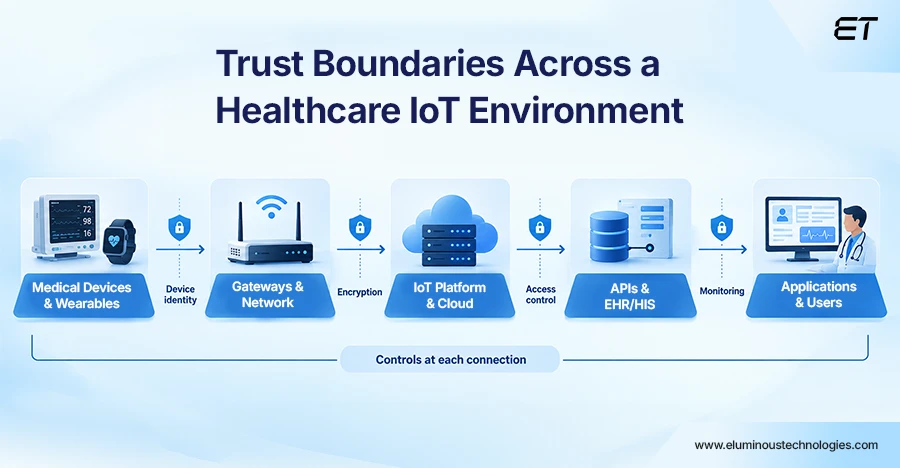
| Healthcare IoT security is a set of controls that protects connected healthcare devices, the data they generate, and how that data is used. |
It runs across trust boundaries. These boundaries are points where data or access is exchanged between devices, systems, applications, and users. It includes:
- Medical devices, sensors, and wearables
- Gateways, networks, and connectivity
- APIs and EHR/HIS integrations
- IoT platforms and cloud infrastructure
- Dashboards and applications
- Device-generated patient data
- Care providers and receivers, i.e., clinicians, patients, administrators, and other users
Effective IoT security in healthcare isn’t limited to access control. It covers the complete healthcare environment:
- Confidentiality: Only authorized people and systems get access.
- Availability: Data, devices, and applications are available when needed.
- Integrity: Data stays accurate and is not changed without approval.
- Authentication: Only approved users, devices, and systems can access the healthcare workflow or a specific environment.
- Lifecycle management: Monitor, update, maintain, and decommission devices when no longer required.
Simply put, it’s an ecosystem-wide protection practice that prevents misuse, disruption, and unauthorized access, ensuring seamless healthcare operations and delivery.
Why Is IoT Security Critical in Healthcare?
Healthcare IoT devices support data collection, patient monitoring, clinical decisions, and daily hospital operations. At each touchpoint, it can be a matter of life and death. So, any failure affecting connectivity and safety has far more serious consequences than in typical IoT environments.
Connected Devices Can Handle Sensitive Health Data
Hospital monitors, sensors, and wearables provide vital health signs, location data, treatment progress, and clinical readings. Combined with unique patient identifiers, this data becomes highly personal and therefore highly valuable.
Due to exposure faults, offenders can access this information, leading to privacy violations, fraud, and loss of patient trust. It can also damage the hospital’s reputation.
Security Failures Can Affect Patient Care
Healthcare teams rely on connected systems to get critical information on time.
So, a compromised consumer device affects only one person using it. But a compromised medical device in the middle of a healthcare workflow can have a cascading impact. It can show altered readings, delay alerts, interfere with monitoring, or even take down the entire hospital system.
For example, a patient monitor detecting a change in oxygen levels sends an alert to the on-duty clinician. If device connectivity breaks, the care provider won’t receive the alert. It can result in serious health issues or even fatality.
If the same alert is sent to a different device or clinician, the current care provider can’t track the patient’s condition.
If not stopped on time, the same issue can affect other workflows. It can cause data loss in equipment or clinical dashboard malfunctions. So, patient-centric care needs embedded security as a key layer within the ecosystem.
Healthcare IoT Creates a Large Attack Surface
A healthcare IoT environment has more than physical devices. It also includes:
- Firmware and software
- Gateways and hospital networks
- APIs and EHR integrations
- IoT and cloud services
- Mobile apps and clinician dashboards
- Bluetooth, WiFi, and cellular connections
- Vendors, administrators, clinicians, and of course, patients
Each added part creates another connection to manage. This means each connection needs the right controls for access, monitoring, encryption, and data protection.
Every device, API, cloud service, and integration is a potential entry point for risk. So, securing one device or one layer of the ecosystem doesn’t protect everything.
Legacy Medical Devices Create Additional Risk
Medical equipment often remains in service for a decade or more. These devices may run on outdated software, unsupported operating systems, lack encryption, or have no patching procedure.
These legacy devices lack modern protections, including detailed logging, strong authentication, and monitoring tools. As a result, access control and incident investigation become even trickier.
The risk increases when you add newer systems alongside legacy devices. For example, a legacy patient monitor may send data through a gateway, share a hospital network, and connect to an EHR. The monitor can become an entry point that affects the entire chain of devices.
Some devices can’t be patched because every update requires vendor approval, testing, or scheduled downtime. Replacing them may also be expensive or impractical, especially when clinical operations depend heavily on them.
What Are the Common Security Risks in Healthcare IoT?
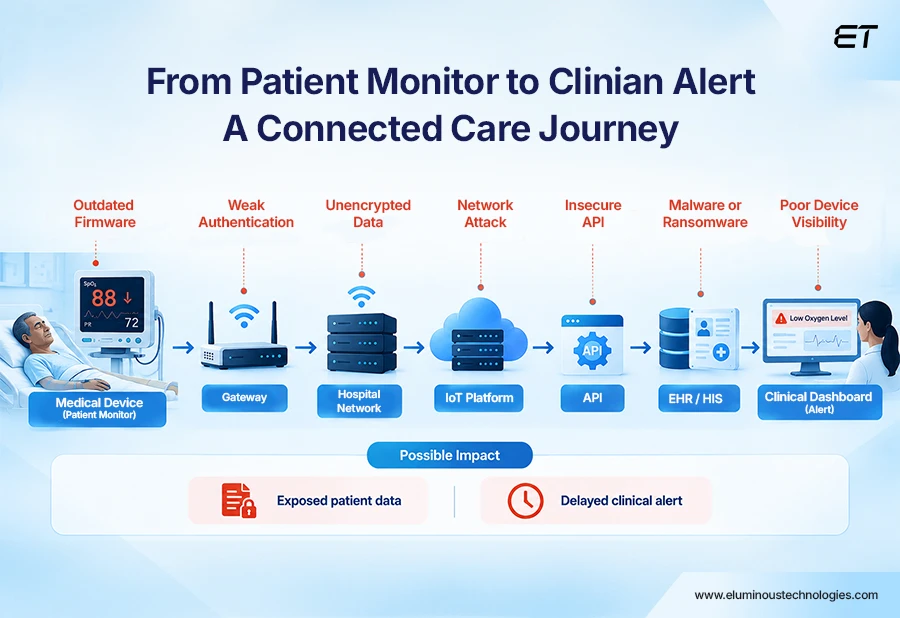
A connected environment without IoT healthcare security faces risks across many touchpoints. These risks stem from how devices, networks, and software interact. Attackers can use these to break into hospital systems.
Vulnerable Connected Medical Devices
Hospitals use a range of connected devices, such as monitors, infusion pumps, imaging devices, and smart beds, across many departments. Some may run outdated software, reuse old passwords, or allow unauthenticated remote access.
These devices can remain on the hospital network for years with an unpatched flaw because changing them requires vendor permission and control over firmware. Because clinical teams can’t take it offline, an attacker may use it to access data, change settings, or pivot to other hospital devices.
Weak Authentication and Access Controls
A nurse, technician, vendor, or administrator may access the same device dashboard. Because access is so fast, they may use default passwords, shared logins, or leave vendor access active after service.
Weak access control and authentication can let an unauthorized person steal control of an integrated account and capture the whole system. It can also let a rogue device join the ecosystem and compromise database integrity.
Unencrypted Data
Patient data travels through many devices. From sensor to gateway, cloud gateway, cloud to application, and application to EHR. Along the chain, some devices may lack encryption. Legacy systems may use outdated protocols.
Anyone on this network can alter or read unencrypted data. The same risk exists when you store sensitive data in a database, backup, or application without protection or access controls. So, if the hardware is lost, stolen, or resold without being deep-wiped, anyone who gets it can easily access crucial hospital information.
Insecure APIs and Integrations
APIs hold some of the most valuable data in the medical ecosystem because they connect platforms, dashboards, and mobile apps in the hospital management system. Common risk points in this connection include:
- Missing authentication
- Tokens with no expiry set
- Endpoints returning more data than requested
- No validation of incoming input
These flaws can let an unauthorized user extract data in bulk or inject fabricated readings into a clinical workflow. For example, when an IoT platform receives a patient’s glucose reading, it includes it in their record. The API with secure rails checks the device, patient, users, and information included in that request.
If the API checks only the patient ID and ignores everything else, an attacker may change it, which could misplace the patient’s record. Without a validation layer, someone may send incorrect information, and the hospital record may include it.
Outdated Firmware and Software
Firmware decides how medical devices communicate and operate. So, when a device has a weakness, the manufacturer shares a firmware update.
Let’s say the hospital delays installing the update. The unpatched device remains connected to all other devices in the hospital environment. So it becomes an entry point for risk.
In addition, if several devices use the outdated software or firmware, an attacker can target them similarly and succeed. The risk becomes even harder to limit when the hospital doesn’t know which devices received updates and which are still in the queue.
Network and Communication Attacks
Each connectivity channel comes with its own exposure.
- Bluetooth pairing can have “open” settings to link with any nearby device.
- Shared Wi-Fi gives access to the connected systems, so any compromised phone or laptop can scan nearby medical devices.
- For cellular and remote-monitoring links, if the device doesn’t authenticate the server it connects to, a spoofed endpoint can give false instructions.
- A weak admin gateway can give attackers visibility into all interconnected data and let them modify it before it reaches the cloud.
These are a few ways attackers can eavesdrop, fabricate information, or even block communication for hospital operations and care delivery.
Malware and Ransomware
Malware may reach the hospital digital environment through a workstation, email attachment, vendor connection, or remote-access account. Connected medical devices are at risk because they can’t run traditional endpoint protection like antivirus. Their operating systems are usually proprietary with limited processing power.
Similarly, ransomware can enter through a vulnerable device or phishing email and hijack control of connected equipment. They spread fast across a flat network. Once reached, they encrypt records and scheduling systems.
All of this can delay hospital operations, giving attackers an advantage.
Any downtime can directly impact patient care, so the pressure to restore quickly and pay a ransom if asked is much higher. This is one reason healthcare is a ransomware target.
Poor Device Visibility and Management
Many hospitals that rely on manual checks may not know which devices they have, where they are, or what firmware they run. This is especially common when departments buy devices individually, including trial equipment and unused medical gadgets.
This gap creates a security concern. Without a record, the hospital can’t track, monitor, or restrict the devices attackers use. This makes it harder to respond quickly to incidents and contain the threat.
How to Secure a Healthcare IoT Ecosystem
Healthcare IoT security is not a layer on top of existing devices, connections, applications, data, and users. It’s embedded control, woven into each component’s mechanisms.
To build it securely, you can:
Give Every Device a Secure Identity
Every device needs a unique, verifiable identity at setup. It’s the same identity that you manage across its lifecycle. These hardware-backed certificates or credentials help the platform confirm that its data is genuine and acceptable.
During setup, teams should:
- Register the device
- Adding credentials
- Apply a secure configuration
- Enlist connections to approved systems
- Track failed access attempts
Note that it’s a recurring activity. This means you will need to replace the device’s credentials on schedule or after a trigger event, such as a credential leak or theft.
Encrypt Data in Transit and at Rest
Encryption secures data in transit against breaches.
For example, a wearable may send a patient’s heart-rate data to a gateway. Encryption stops an unauthorized interceptor from reading and using that data.
So, healthcare IoT security should secure the passage across each connecting point from:
- Device to gateway
- Gateway to the cloud
- Cloud to application
- Between IoT platform and HIS or EHS systems
The organization should also encrypt data at rest on devices, in cloud databases, on servers, and in backups.
Apply Strong Authentication and Least-Privilege Access
Security breaches usually require valid credentials at some point to call an API, log in, or configure a device. Once encryption is in place, the system must control who can access it and what they do with it. Defining access boundaries helps track where a breach occurred and how far a compromised account can reach.
Based on the functions of the person to be authorized, here’s how access can be defined:
- Role-based Access: Give permissions by job function.
- Least Privilege: Grant access based on user and service need.
- Multi-factor Authentication Where Appropriate: Require MFA for administrative, remote, and sensitive roles.
- Separated access: Keep administrative and clinical access distinct so a compromised clinical account cannot reconfigure the platform.
These rules also apply when system data changes.
Secure APIs and Healthcare Integrations
Because APIs link IoT platforms to electronic health record (EHR), HIS systems, dashboards, applications, and analytics tools, verify every request. The verifications should include checking:
- If the request came from an authentic user or system
- If the requested action is allowed
- If the data is valid
It should also send the specific details that have been requested.
For instance, an IoT platform may send a reading to an EHR. This integration should confirm the device, request, patient, and destination before accepting or transferring the data.
Log API requests, why access failed, and unusual data transfers too. They will help your team investigate problems and detect misuse.
Segment IoT Networks
Segmentation limits an attack’s reach after an attacker gains access to one device. It can also reduce the exposure of older devices that cannot receive regular security updates.
So, keep connected medical devices in controlled network areas. Do not place them on one unrestricted network with every hospital system.
A patient monitor may need to communicate with a gateway and monitoring platform. It may not necessarily need access to staff email, financial systems, or unrelated servers. Keeping these barriers in place helps your security protocols limit the damage a risk can cause.
Secure Firmware and Software Updates
Firmware decides how the device functions and communicates with other systems. Updating firmware can help eliminate any vulnerabilities and optimize interaction.
A healthcare IoT update process should accept software only from an approved source. Teams must test updates before deployment, use controlled, staged rollouts, track which devices receive them, and keep a rollback option.
Patch management should also track:
- The devices that need updates
- Weaknesses each update addresses
- Ownership of the remediation
- Timing of update installation
- Unresolved devices
Teams need continuous visibility to confirm devices are healthy and behaving as expected.
Monitor Devices and Detect Abnormal Activity
Monitoring checks for expected behavior and controls unusual activity in time.
Teams need to monitor:
- Device health and current connection status
- Login and failed attempts
- System logs
- Security events
- Unexpected connections or data transfer
- Device settings
- Unusual or unrequested activity
For instance, a patient monitor suddenly sending huge volumes of data to an unknown device must raise an alarm.
Centralized visibility helps teams review such events from one place and act on priorities. But monitoring works best when each team manages assigned devices.
Maintain a Complete Device Inventory
An organization must first identify its devices before applying Healthcare IoT security measures. An accurate inventory makes patching, segmentation, monitoring, and incident response easier.
This inventory should include which devices exist, since unrecorded devices can go unmonitored and unpatched, creating risk entry points. Teams should also consider location, as the network and position determine how quickly you can find and isolate a device during threats.
It should also include firmware and software versions to identify vulnerabilities that could bring down a system. A named owner to act on alerts is also crucial.
Plan for Incident Response
When a device or system is compromised, there isn’t much time to figure out an action plan. Damage spreads fast, so a predetermined incident response plan helps.
- Isolation is the first step.
- Disconnect the affected device or segment based on predefined controls and the owner’s name; authorizing it as an offline device can affect patient care.
- Investigation follows.
- Check preserved logs and device state to identify the entry point and other systems in the chain.
- Then comes recovery.
- This means restoring from clean, risk-free backups, reissuing credentials, and patching the exploited component.
You can resume normal operations after checking integrations and devices and reviewing the overall incident to update the future response.
How to Secure Healthcare IoT Architecture
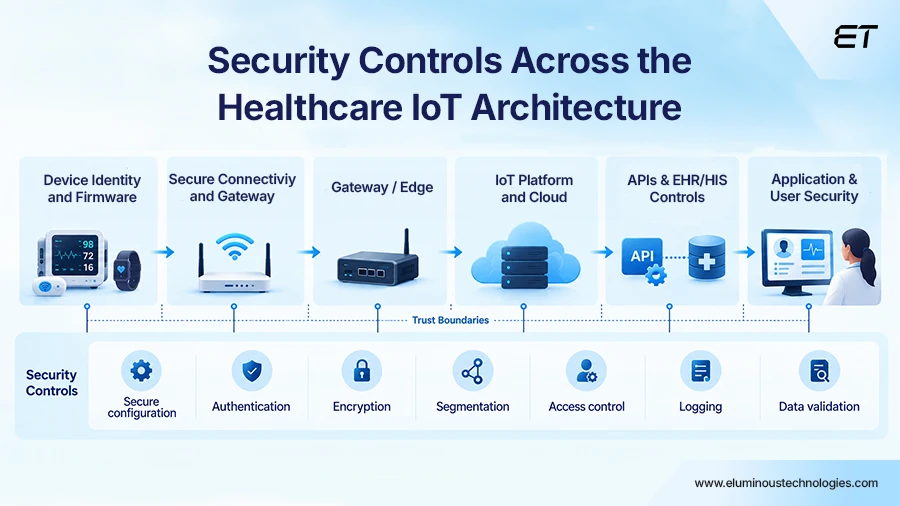
Security controls work best where data moves from one system to another. This is where risk appears.
A simplified healthcare IoT architecture looks like this:
Device → Connectivity → Gateway/Edge → IoT Platform → Data/Cloud → Healthcare Systems → Applications
Each layer brings its own threats and controls.
Device Layer
Medical devices operate in unsecured clinical environments and patient residences, where anyone can access device ports. They also run firmware that’s hard to update.
If corrupted, the cloned and modified device may deliver false information that the healthcare platform might accept without any clearance. You can resolve this problem with unique device identification, signed firmware, hardened configuration, disabled ports and services, and physical port protection.
Connectivity and Gateway Layer
All device traffic passes through this layer, so interception or a compromised gateway can expose everything at once. With encryption, authentication, segmentation, and traffic monitoring, you can create a strong healthcare IoT security system.
Encryption and authentication protocols safeguard information during transit. Gateways authenticate each supported device, and network segmentation prevents a breach from spreading to other areas.
Traffic monitoring flags anomalies.
IoT Platform and Cloud Layer
Because the platform contains data on all devices and configuration capabilities, stolen administrator credentials can impact the entire fleet.
Role-based access control, end-to-end encryption, and centralized device management reduce that exposure risk. Detailed logging also provides traceability of all user activity, especially as devices scale.
Integration Layer
This is where IoT data enters clinical systems. Ineffective or weak APIs may expose patient information in bulk or introduce incorrect data into the EHR. Each call must authenticate the caller’s identity, authorize access rights, and validate data.
In addition, information sharing within each integration process must stop after the requested data transfer.
Application Layer
Dashboards and mobile apps are the most visible entry point, since users log in from many locations and devices. Compromised credentials or hijacked sessions can directly grant access to patients’ records. To reduce exposure and prevent misuse, use strong authentication, role-based access, secure sessions, and audit logging.
Healthcare IoT Security and Compliance
Security and compliance overlap but are not the same thing. Compliance provides a baseline safety standard for all, while security addresses threats to individual systems. A system can meet a regulation and still be vulnerable. The requirements differ by market and product, so no one-size-fits-all approach works for every organization.
HIPAA and Protected Health Information
In the US, HIPAA applies when a covered entity or business associate handles electronic protected health information (ePHI).
A covered entity includes:
- Healthcare providers
- Health plans
- Healthcare clearinghouses
Software and cloud providers can become business associates of covered entities if they handle ePHI, as HHS HIPAA guidelines state.
The HIPAA Security Rule has certain protections for ePHI. These include access control, authentication, logging, data transmission security, risk analysis, and incident response procedures.
FDA Cybersecurity Requirements for Applicable Medical Devices
FDA requirements apply when a connected product falls under the category of a medical device.
Section 524B of the FDA is relevant for some kinds of cyber devices.
The FDA considers these devices to incorporate software, internet connectivity, and technology that cyberattacks can affect. The present FDA guidelines include design, labeling, pre-market considerations, and a Software Bill of Materials (SBOM).
When needed, developers must create security plans for vulnerability management, security updates, and software components. Security must last the entire device lifespan.
Security and Privacy Requirements Vary by Market
Applicable regulations depend on geography, the product’s nature and application, the data used, medical device qualification, and the organizations involved. Data privacy legislation depends on the patient and where the technology is deployed.
For example, the EU’s GDPR considers health data a special category of personal data. Saudi Arabia’s Personal Data Protection Law and transfer regulations affect how organizations protect and transfer personal data outside the Kingdom.
Identify these aspects from the outset, as they shape data residency, consent, and logging policies.
Healthcare IoT Security Across the Device Lifecycle
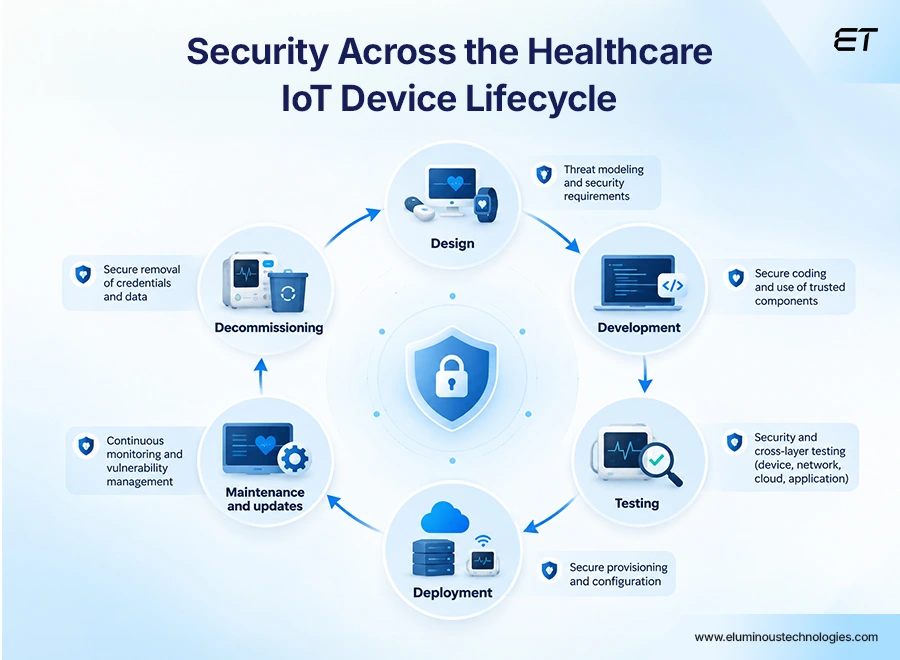
Security does not end at launch. Each stage of a device’s life brings different risks, and each needs its own controls.
Design and Development
Early threat modeling shows what can happen before you write code. Threat modeling informs security requirements, architecture, and secure coding.
Testing and Validation
Security testing includes devices, APIs, networks, applications, and integrations. Penetration testing and third-party component testing find weaknesses that functional testing doesn’t reveal.
Deployment
At this stage, provision unique credentials and securely configure devices. After this, monitoring and access management become active before deployment.
Maintenance and Updates
Patching, signed firmware updates, vulnerability management, and continuous monitoring keep devices secure as new threats emerge. Organizations also update incident response plans to address post-breach issues.
Decommissioning
Retired devices still carry credentials, network access, and stored patient data. When decommissioning, disconnect the device from the network, revoke credentials and access, and delete its data.
Healthcare IoT Security Best Practices Checklist
Once you’ve laid the groundwork, you can check the main controls of healthcare IoT security across the below-mentioned areas:
| Security area | What to implement |
| Device security | Give each device a unique identity. Use secure settings and protect its firmware. |
| Authentication | Verify every device and user before giving access. |
| Access control | Use least privilege and role-based access |
| Data security | Encrypt data and protect it from unauthorized access |
| Network security | Separate IoT devices from unrelated systems and establish secure communication. |
| API security | Authenticate requests, check permissions, validate data, and track activity. |
| Monitoring | Collect logs, create alerts, and detect unusual behavior. |
| Device management | Check inventory, provisioning, updates, actions, system ownership, and lifecycle status. |
| Vulnerability management | Regularly assess devices and fix known weaknesses. |
| Incident response | Detect incidents, contain affected systems, identify the cause, and restore operations. |
| Compliance | Identify requirements based on product, market, intended use, data regulations, and organizations involved. |
How to Build a Secure Healthcare IoT Solution
Building a healthcare IoT security solution starts before you identify devices. If you want to begin, you can follow this step-by-step approach:
Start With the Healthcare Use Case
Describe the software functions, the data types it will use, the end users, and what can potentially fail.
Identify Devices and Data Flows
Map all devices, connections, systems, APIs, applications, users, and data flows.
Design Security Into the Architecture
Make early decisions on identity management, access control, encryption, network segmentation, monitoring, and incident handling. For a deeper understanding, consult healthcare solution experts.
Build and Secure the Software Layer
Secure the backend, dashboards, mobile applications, APIs, cloud environment, and healthcare system integrations.
Test the Complete Ecosystem
Test the entire end-to-end device-to-application flow, including failed connections, invalid data, access failures, and unavailable systems.
Deploy, Monitor, and Maintain
Finally, implement the solution in your healthcare ecosystem. Healthcare IoT security is an ongoing process, so regular upkeep, periodic reassessment, and a response plan are essential.
Real-World Healthcare IoT Security Use Cases
The examples below show why these considerations matter in modern-day, connected healthcare environments.
Connected Digital Therapy and Patient Data
A digital therapy program can use wearables to collect movement data and transmit it to the therapy platform. The data helps clinicians provide appropriate medical advice and track the patient’s progress.
To ensure integrity and system reliability, secure communication is crucial. From the devices and platform to patient access, the clinician dashboard, and data use, everything needs protection to ensure accurate readings and system availability.
The IoT-enabled digital back pain therapy platform is an example of this kind of setup. In that case study, 74% of patients reported satisfaction with their pain reduction.
IoT-Enabled Patient Monitoring and Healthcare Workflows
An IoT-enabled healthcare app may use Bluetooth beacons and GPS technology, along with patient data and clinical workflows.
Data exchange occurs constantly between the beacons, the app, and the server.
Thus, each information-exchange channel and every place where patient data might be exposed or stored requires proper security. Any security failure can reveal patient data or disrupt the workflow staff relies on.
One example is a women’s healthcare platform we developed, where Bluetooth, GPS, a healthcare app, and servers exchanged patient information as part of the care workflow. Seamless, secure interoperability enabled the platform to grow 43% in the first quarter after launch.
Endnotes
Healthcare IoT security is an end-to-end discipline. It spans devices, connectivity, data, applications, integrations, users, and the entire device lifecycle. Each layer should include controls that work alongside other layers and connected systems.
Organizations that plan strategically by designing security into their architecture, testing the ecosystem, and maintaining it are better prepared for downtime-free patient care.
If you’re exploring how to implement healthcare IoT security controls in your environment, consult our experts to develop IoT business solutions.
Frequently Asked Questions
1. How can connected medical devices be secured?
Provide the device with unique identification. Then, configure it securely, limit its access, and encrypt communication between the device and other components. After that, update the device’s software and monitor its activity.
2. How is patient data protected in healthcare IoT?
IoT in healthcare requires data protection at every stage, including collection, transfer, processing, and storage. You’ll need to use encryption, access controls, authentication, data validation, monitoring, and backups.
3. How do you secure IoT devices that use legacy technology?
Start by identifying the device and its vulnerabilities. Next, limit the device’s network access and turn off unused services. Finally, monitor its communications, apply available updates, and replace it once it’s no longer supported.
4. Does healthcare IoT need to comply with HIPAA?
Yes, only if a covered entity or a business associate processes electronic protected health information in the United States. Not all healthcare IoT products are subject to HIPAA.
5. What security measures should be included when developing a healthcare IoT solution?
Your healthcare IoT security solution should include device identification, authentication, access control, encryption, secure APIs, and network segmentation. Add updates, monitoring, device inventory, vulnerability management, incident response, and lifecycle management for complete protection after launch.


AI in IoT: How AI Is Reshaping the Internet of Things
Imagine your factory machine noticing a problem before you do. Its sensors keep monitoring temperature, vibration, pressure, and other operating…

IoT in Healthcare: Connecting Devices, Data, and Patient Care
Imagine a doctor seeing how a patient’s condition changes, even when they’re at home. A wearable tracks their heart rate,…


