
 Book a Meeting
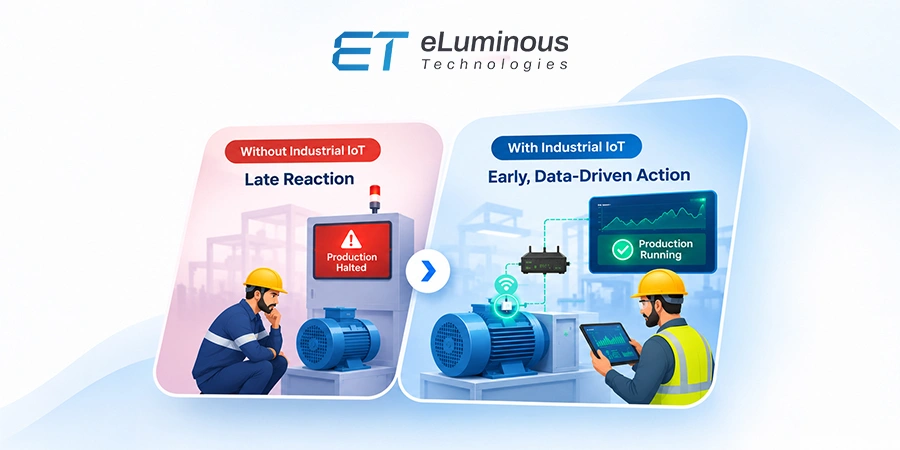
Industrial IoT Architecture: A Guide to Planning, Connecting, and Scaling Your Manufacturing Data



You’ve installed sensors across your manufacturing plant. The machines are running, and systems are online. But do you think you’ve truly nailed industrial IoT?
Your factory can have all the latest equipment and sensors and still operate blind. As long as machines produce disparate signals, your teams get a partial view of the process.
Industrial IoT architecture links these fragments into a practical, usable decision path. It gives machine data an origin, timestamp, context, processing layer, and final destination.
In this blog, we’ll explore key components, use cases, benefits, and applications of IIoT architecture. It’ll help you understand what you need for connecting legacy and modern systems and improving your overall output.
What Is Industrial IoT Architecture and How Does It Work?

Industrial IoT architecture is the framework that carries data from industrial equipment to the people and systems that use it. It runs alongside existing operational technology (OT), so plants keep what already works.
This flow connects physical operations with digital applications and sets the context for every layer that follows.
A typical Industrial IoT architecture follows this path:
Sensors and machines → PLCs and control systems → Gateways and protocols → Edge processing → Cloud storage and analytics → Dashboards, alerts, MES, ERP, and maintenance actions
- Sensors gather temperature, vibration, flow, pressure, energy consumption, speed, and machine status.
- A PLC or industrial controller handles signals and local control.
- A gateway connects machines that use different industrial IoT protocols.
- Edge computing filters and processes data close to the equipment.
- Cloud or on-premises platforms deal with storage, analytics, reporting, and integration.
It’s not necessary to create the whole enterprise architecture at once. You can start with one production line, move across plants, and expand as you wish. Your IIoT architecture design should fit your business goals, equipment latency needs, security requirements, data volume, and enterprise systems.
Key Layers of Industrial IoT Architecture
Each IIoT layer has a specific, clearly defined job and must pass reliable data to the next. Here’s how a factory uses different components to turn physical conditions into usable operational context.
Connected Industrial Equipment and Sensors
Think of a bottling line where interconnected equipment each produces its own signals.
- Sensors measure conditions on motors, pumps, conveyors, compressors, tanks, and energy systems.
- Common measurements include temperature, vibration, pressure, flow, motor current, speed, torque, machine state, and fault codes.
A raw value isn’t useful on its own without context.
That’s why a production-ready data point should carry:
- Asset ID
- Tag name
- Unit
- Timestamp
- Quality status
- Production/Work-order specifics
For instance, a temperature reading is useful when the system knows its line, product, sensor health, and active order.
High-frequency vibration may only need local feature calculation. In contrast, a slow environmental reading may only need periodic reporting. Swapping or combining the two can add complexity and costs without improving the data quality or benefit.
This decision settles what the next layers of industrial Internet of Things (IIoT) architectures should process and store.
PLCs, SCADA Systems, and Historians
PLCs run machine-control logic. They have machine state, counters, recipes, cycle times, alarms, setpoints, and process values.
SCADA systems give operators supervisory control. Historians store time-series data for trends, investigations, and reporting.
An IIoT solution should usually work alongside these systems rather than replace them. A gateway can read the selected data it needs from each one and pass it along to edge or cloud applications. Meanwhile, the existing controls keep doing their job.
If you wish to start with the safest point, you can choose read-only telemetry. It helps prevent a safety breach or risk from affecting the whole plant.
Later, if the IIoT platform needs to send a command or setpoint back to a machine, that path should include:
- Explicit authorization
- Validation
- Audit logging
- Safety review
Critical control and safety functions should always be in the appropriate PLC or safety system.
Industrial Gateways
Consider a plant with new cobots, an older energy meter, and a PLC from another vendor. An industrial gateway helps them understand each other’s protocols, normalizes formats, adds timestamps and quality data, filters unneeded readings, and buffers data during outages. It also gives OT and IT networks a controlled route to each other.
Gateways matter most in brownfield plants, where they connect existing equipment to the edge layer. You can add modern monitoring over time. This makes the gateway the practical bridge from legacy equipment to the edge layer.
OPC UA
OPC Unified Architecture (UA) is a platform-independent industrial communication architecture. It integrates structured information models, subscriptions, events, read and write operations, encryption, message signing, certificates, and auditing.
It is useful when equipment exposes structured information or when applications need machine context instead of flat register values. It suits equipment that exposes structured data. Alongside, OPC UA subscriptions reduce unnecessary polling by reporting changes according to defined criteria
MQTT is a lightweight publish-subscribe protocol commonly seen between gateways, brokers, and cloud platforms. It’s designed for constrained devices with low-bandwidth, high-latency, or unreliable networks; it supports sessions, TLS, and several quality-of-service levels.
A practical structure can look like this:
| Text factory/{site}/{line}/{asset}/telemetry factory/{site}/{line}/{asset}/events factory/{site}/{line}/{asset}/commands |
A good MQTT implementation defines these key aspects beforehand:
1. Payload schemas
2. Authentication
3. Access control
4. Message retention
5. Duplicate handling
6. Topic ownership
Along with these, a unique event ID is also useful when the system delivers multiple messages.
Modbus

Modbus TCP and RTU remain common in brownfield factories. They connect controllers to other machines. Still, they don’t give your integration team much to document: register addresses, function codes, data types, scaling, byte order, units, and polling intervals.
A gateway can first read the Modbus registers. Then, they add asset and quality context and publishes the result over OPC UA or MQTT.
Edge Computing in Industrial IoT
Just because a plant has lost its cloud connection doesn’t mean that production data should stop flowing into the local storage. Edge computing actually helps there.
- It processes data close to the machines that generate it.
- It supports fast responses and local continuity, reducing bandwidth even when cloud connectivity is limited.
- The edge layer also helps with filtering, applying dead-band normalization, adding asset context, calculating local KPIs, running rules, or even machine-learning inference, and buffering data during outages.
In industrial IoT use cases with edge architectures, store-and-forward is particularly important. That’s why, when you have it, its design should define buffer capacity, offline duration, retries, and full storage behavior. It should factor in reconciliation behavior as soon as the connectivity returns.
Cloud Infrastructure and Industrial Data Storage
Now that the edge layer has prepared the data, the cloud makes it useful across lines and sites.
It handles data ingestion, long-term storage, cross-site analysis, and access for business applications.
Depending on the control requirements, organizations can use on-premises or hybrid platforms. Recent data feeds dashboard analytics, while historical data supports reporting and model development.
Note that the type of storage that you get should support the applications that will follow.
Analytics, Dashboards, and Alerts
Once data collection and governance are in place, build them into operations. The most common applications of such data include:
- Predictive maintenance
- Conditional monitoring
- Quality analytics
- Energy monitoring
- Production optimization
- Anomaly detection
- OEE analysis
But these analytics only make sense when a responsible person sees them. That’s where alerts and dashboards come in: they name the asset, its condition, the severity of the breach or threshold, the owner, and the escalation path.
- Without these details, your teams may get overwhelmed by too many notifications or not understand alert prioritization.
Dashboards should be relevant to the user.
Operators need machine state and cycle time. But maintenance teams need asset-health trends. Executives, on the other hand, need OEE, downtime, quality, energy, and cross-site performance. Each view should clearly move you toward a defined action.
MES, ERP, EAM, and Enterprise Integration

With so many elements in the picture, an IIoT platform should not become another isolated data silo. Its core value shoots up when operational insights flow into systems that already manage production and business processes.
A Manufacturing Execution System (MES) may own production orders and quality rules. ERP manages materials and planning. Whereas EAM or CMMS manages maintenance work orders, and QMS manages non-conformances.
When each component has its distinctive scope, the ownership should be clear, like:
1. PLC owns machine state
2. MES owns production status
3. IIoT owns contextualized telemetry
4. EAM owns maintenance execution.
APIs and event streams are generally better than direct database writes, and each event should include a unique identifier, validation rules, and retry behavior.
With the enterprise path defined, you can now see the architecture through the lens of manufacturing outcomes expected to improve.
Industrial IoT Architecture Use Case
Take a packaging-line motor that has begun developing a bearing problem. The line is still functioning at speed, but vibration is creeping up, and the motor seems to get a little warmer after each shift. The IIoT data path includes:
- A vibration sensor and a temperature sensor pick up the change.
- The PLC captures those readings along with machine state, speed, cycle count, and faults.
- The gateway reads the PLC data over OPC UA, adds the asset ID, timestamp, unit, and quality status, and publishes it over MQTT.
- The edge layer filters out invalid readings, calculates vibration features, and buffers data if the connection drops.
After these steps, the data goes to the IIoT platform, a cloud or on-premises system that stores and analyzes the information.
The platform matches each reading to the production line, active order, shift, machine speed, and load. With that context, analytics compare the current pattern with the motor’s history and point out a possible bearing fault.
- A dashboard shows the trend and triggers an alert.
- When the reading crosses the agreed threshold, the system creates a notification in the EAM or CMMS and sends an inspection event to MES.
- Your maintenance team inspects the motor. ERP shows whether the spare bearing is in stock, and the team schedules the repair for a planned production window.
- The technician logs the findings against the asset in the EAM, which gives future analysis more to work with.
A typical end-to-end IIoT architecture workflow looks this way:
[Sensors and Machines]
↓
[PLCs and SCADA]
↓
[Industrial Gateway]
OPC UA | Modbus | MQTT
↓
[Edge Computing]
Filtering | Rules | Buffering
↓
[Cloud or On-Premises Platform]
Storage | Analytics | APIs
↓
[Applications]
Dashboards | Alerts | MES | ERP | EAM
Through this workflow, your team can step in early and prevent surprise stoppages. But the outcomes still depend on data quality, model accuracy, alert configuration, and timely human response.
Industrial IoT Architecture Applications

A well-designed Industrial IoT architecture can support many manufacturing applications. These applications comprise some interesting use cases.
Predictive Maintenance
With IIoT, you can detect fluctuations in vibration, temperature, pressure, or current before equipment fails. The architecture sends those signals into the maintenance workflow. So, a damaged bearing gets replaced during a planned stop, long before it takes the line down.
Production Monitoring and Optimization
IIoT can help identify production bottlenecks, recurring stoppages, and long changeovers. By monitoring machine status, cycle time, production count, downtime, and downtime causes, you can identify production-order correlations and fix issues.
Quality Control and Traceability
Temperature, pressure, speed, and recipe settings shape a batch’s quality. So, when a deviation appears, root-cause analysis is faster, and your teams can target only the affected product review, saving time.
Energy and Resource Management
Smart meters with IIoT frameworks can link energy use to machines, shifts, products, or production volume. This can reveal idle equipment, compressed-air leaks, and inefficient operating conditions.
Remote Operations and Asset Tracking
RFID tags, location sensors, and connected trackers help your staff find tools, components, pallets, and work-in-process materials. The same connected sensors can report conditions from remote pumps, substations, and restricted areas, which lets teams review them centrally and prioritize inspections.
All in all, for your business, these applications mean:
1. Less unplanned downtime
2. Clearer production visibility
3. Better traceability
4. Less manufacturing waste per order
5. Faster and data-informed decisions
The primary reason for such results is a well-executed implementation. An industrial IoT structure alone doesn’t guarantee them.
Key Implementation Considerations for IIoT Design
Before you meet with an IoT expert to plan your pilot, consider these five factors.
Scalability
What IIoT solution works with five machines in your manufacturing plant may fail with 20. So, start estimating the number of assets, tags, sampling rate, peak message rates, storage requirements, users, and downstream consumers. Test your pilot using production load before making any platform commitment.
Inteoperability
Consider which equipment uses open protocols and a versioned asset model. It’s good to keep protocol adapters separate from dashboards and applications. So, when your business grows and you add new equipment, you won’t have to rebuild everything.
Latency
Which decisions can wait for the cloud, and which can’t?
For machine control, the response has to be immediate; hence, it remains within the PLC or a validated local control system. Edge computing manages fast-operation alerts, while the cloud handles historical data analytics.
Reliability
Plants rarely run under perfect conditions, so test, test, and test. To do that, you should look into:
- Sensor failures
- PLC and gateway restarts
- Network loss
- Broker outages
- Duplicate messages
- Out-of-order data
- Clock drift
- Full local storage
Specify buffering, retries, and recovery at the very beginning.
Security
Every new connection means a new path that needs securing. Do not merge your plant network with the corporate IT infrastructure, and limit each device/user’s access to what is needed. Begin with read-only telemetry where data will be collected, but do not make changes to the machine. If you need to send any commands, do so with approval, tracking, and safety checks in place.
How to Build an Industrial IoT Solution

A pilot can evolve into a dependable platform with a robust IIoT architecture. It follows five steps to become a scalable, tested IoT solution.
1. Select a Measurable Business Use Case
Start with a recurring manufacturing problem, such as a critical motor that keeps stopping or excessive energy usage. Record the baseline, decide on the target metric, and name the owner for the expected outcome.
2. Connect and Review Equipment, Protocols, and Available Data
With the problem defined, review your sensors, PLC tags, historians, and protocols. Connect only the signals the use case needs, starting with read-only telemetry.
3. Architect Security and Integration Requirements
After deciding on connections, develop the pathway from the gateway to the analytics. Define how the pathway communicates with MES, ERP, and EAM systems. Also establish data ownership and security issues before expanding the deployment.
4. Launch a Representative Pilot
Run it under real conditions and test restarts, network interruptions, offline buffering, and alert workflows. The pilot confirms your assumptions and does not guarantee ROI.
5. Evaluate Results and Plan for Expansion
Compare results with the baseline on the key problem you started with, then decide whether to extend to more lines or plants.
Endnotes
An industrial IoT architecture integrates machines, sensors, PLCs, gateways, edge computing, clouds, and enterprise applications into a connected manufacturing ecosystem.
Each layer delivers verified information to the next. Successful IIoT initiatives begin by defining a concrete manufacturing problem. They build on existing equipment, match the protocol to each connection, and process time-sensitive data near the machine.
If you’re planning your first Industrial IoT project, we can help you. Discuss your use case with our experts to build the right system for your environment.
Frequently Asked Questions
1. How does Industrial IoT architecture work?
Industrial IoT architecture collects data from machines and sensors, processes it through gateways and edge devices, and sends it to cloud platforms for storage and analysis; the insights support dashboards, alerts, maintenance, and production decisions.
2. Why is edge computing important in Industrial IoT architecture?
Edge computing processes industrial data near the machines on the factory floor, reducing response time and dependence on cloud connectivity. It supports local monitoring, faster alerts, offline operation, and efficient data filtering.
3. How do you choose the right Industrial IoT architecture?
The right architecture depends on equipment types, communication protocols, data volume, latency, security, scalability, and integration needs. You should also consider existing PLCs, MES, ERP systems, and future expansion plans.

What Are IoT Medical Devices? Benefits, Types, and Integration Explained
Imagine investing in advanced medical devices only to discover that they can’t seamlessly share data with your mobile app or…

Industrial Internet of Things (IIoT): Applications, Benefits, and Use Cases
It’s night shift. A conveyor belt on a bottling line suddenly stops working. The whole line halts. No maintenance technician…


