
 Book a Meeting
Why Every Manufacturing Plant Needs a Digital Backbone


It’s a complex phase for manufacturing companies. Industry 4.0 is up and running, AI is showing operational gains, but the systems aren’t evolving together.
Historically, manufacturing tools largely operated in silos. ERP focuses on finance, CRM handles customer data, and MES helps execute shop-floor production. By design, very few plants have a digital backbone to begin with.
But today, enterprises are going all-in on digital transformation with expenditure crossing the USD 2.5 trillion mark. In short, if you’re not considering an integrated ecosystem, it’s time to think again.
This blog explores the necessity of a digital backbone in future manufacturing.
Why Manufacturing Systems Aren’t Evolving Together
Before understanding the need for a digital backbone, it’s crucial to know the reason behind it.
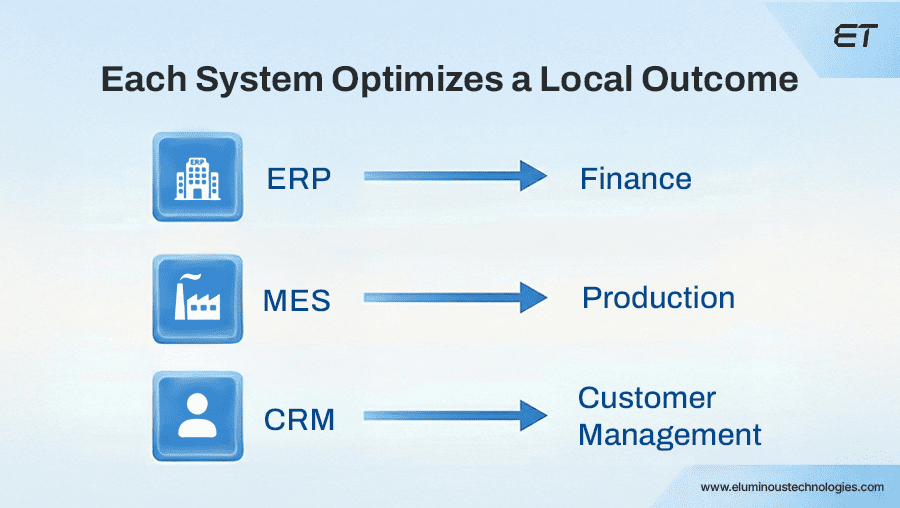
In manufacturing, each system optimizes a local outcome. Here’s a table explaining this fact.
| System | Department | Goal |
| Enterprise Resource Planning (ERP) | Finance | Accurate accounting, compliance, reporting |
| Manufacturing Execution System (MES) | Production | Execute shop-floor tasks efficiently |
| Customer Relationship Management (CRM) | Customer Management | Track leads, orders, and client interactions |
Companies use these systems and tools separately to solve departmental challenges. In most cases, decision-makers don’t consider integrating them for long-term gains.
This siloed structure is the reason behind an ongoing architectural debt.
Over time, manufacturing companies witnessed an increase in the number of plants, vendors, and Stock Keeping Units (SKUs). However, the architecture was unchanged. The impact?
- Delayed insights due to a lack of cross-system visibility
- Slow decision-making due to sluggish data flow
- Incapable manual integrations like ad-hoc APIs
- Challenges while scaling digital architecture
Simply put, the systems are valuable individually. However, there is a misalignment when you use them collectively. That’s why it’s inevitable to think beyond segregated manufacturing systems, aka, consider a digital backbone.
What a Digital Backbone Means for Manufacturing
The digital backbone is the structural layer that connects all manufacturing systems. Basically, you arrange your ERP, MES, CRM, and IoT platforms together using a solid architecture.
This facet takes care of three things:
- Data flow
- Integration
- Scalability
For future manufacturing, this setup ensures smooth communication between siloed systems. There’s no need for manual reconciliation and re-platforming.
The main question is – how does an IT vendor achieve this feat?
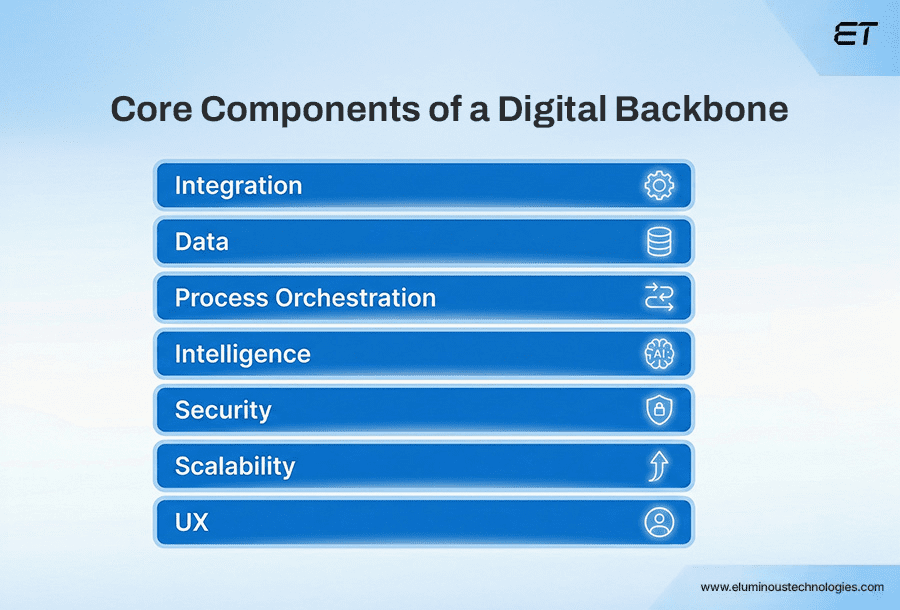
Here are the core components of a digital backbone:
- Integration Layer: APIs, microservices, loose coupling
- Connects all systems
- Data Layer: SKUs, ETL pipelines
- Matches data from the systems
- Process Orchestration: Workflow engines, event triggers
- Aligns the workflow
- Intelligence Layer: KPI dashboards, AI/ML pipelines
- Extracts insights from the data
- Security Layer: Access controls, audit logs, data encryption
- Protects data and maintains compliance
- Scalability Layer: Modular architecture, cloud-native/hybrid deployment
- Keeps systems future-proof
- UX Layer: Dashboards, mobile apps
- Presents insights to humans efficiently
This system, cumulatively, solves data fragmentation, maintains cohesion, and stays aligned with evolving manufacturing tech. It’s as simple as that.
As Industry 4.0 rapidly adopts AI, a robust digital backbone ensures your plant is ready for essential shifts. Moreover, this investment ensures minimal stoppages in manufacturing activities.
ERP Integration: The Core Constraint in Manufacturing Digitalization
It’s a fact that Enterprise Resource Planning is the central focus in many manufacturing plants. Other systems, such as CRM or IoT platforms, revolve around ERP.
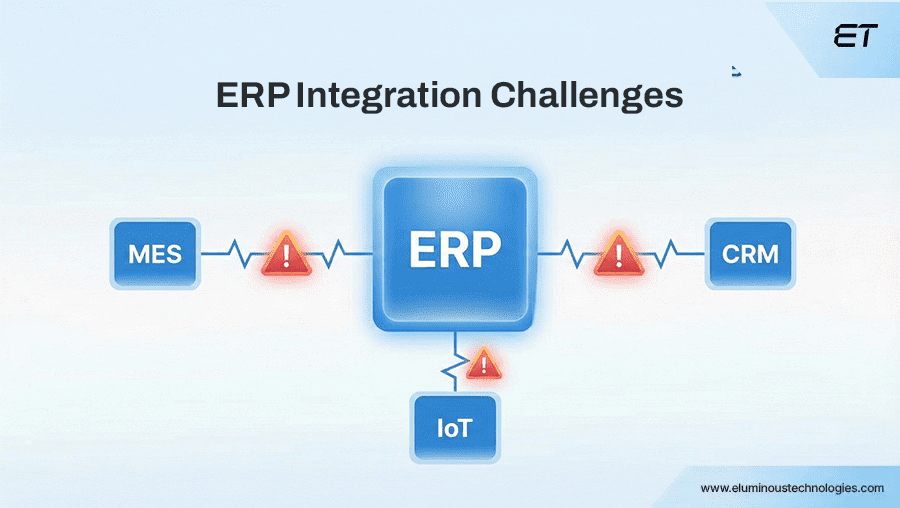
The US alone is poised to generate over USD 28 billion in ERP software this year. So, the stats don’t lie. ERP integration is vital. But is it simple? No. Here’s why:
- Legacy ERP, in most cases, uses outdated APIs or proprietary connectors
- Point-to-point scripts and custom integrations are present in most platforms
- You might hesitate to integrate ERP, as it can break the workflow
All reasons are valid. But if they influence your decision, your plant can experience:
- Slow adoption of AI/IoT initiatives
- Delayed analytics and reporting
- An increase in manual reconciliation tasks
Now, this issue doesn’t impact ERP alone. It creates dependency lags. For instance, changes in MES require you to adjust ERP data. Even CRM reporting requires ERP information. Overall, your organization’s digital system becomes brittle.
The Solution
When you build the digital backbone, here’s what happens:
- The architecture layer composes data flow
- You keep ERP stable
- MES, CRM, and IoT systems evolve independently
- There’s no need to maintain point-to-point integration
- You get a flexible layer for managing and scaling AI
Long story short, building a digital backbone helps solve this ERP integration hiccup. In return, you move one step forward in creating a fluent software workflow.
The Role of Web Architecture in Manufacturing Operations
By now, you’re aware of the meaning of digital backbone and know its importance. So, it’s natural to assess this solution for your business.
But before you get started, here are some points to consider:
- Web architecture in manufacturing is not about building websites
- Digital backbone emphasizes systemic connectivity
- Web architecture is your execution layer
- It is safer than ERP customization (more on this later)
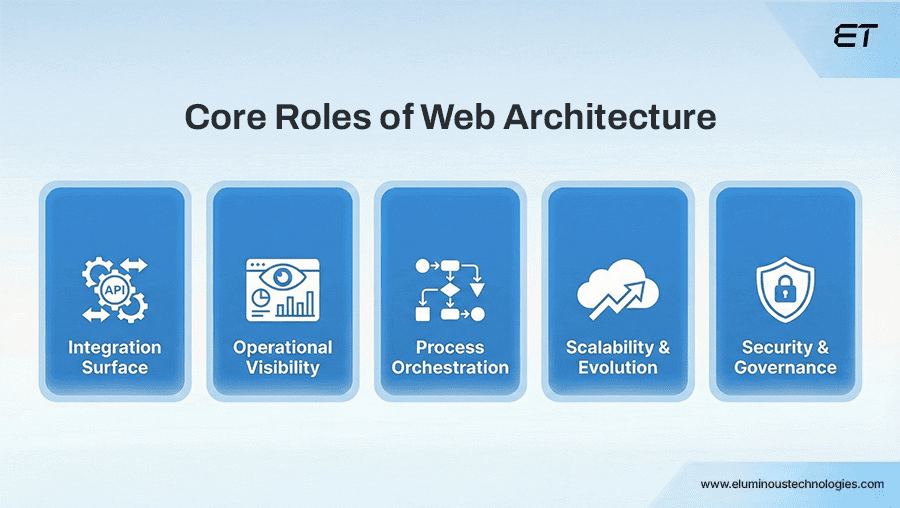
Since the digital backbone revolves around web architecture, you should understand its core roles.
| Core Role | What It Does |
| Integration Surface | Exposes ERP, MES, CRM via APIs; enables loose coupling |
| Operational Visibility | Unified dashboards; role-based access; real-time insights |
| Process Orchestration | Automates workflows; triggers cross-system events |
| Scalability & Evolution | Supports new plants, SKUs, and systems without re-platforming |
| Security & Governance | Centralized authentication, access control, audit trails |
If you focus on ERP customization, you risk breaking workflow during upgrades and increasing maintenance costs. However, web layer orchestration pushes logic into flexible layers, reducing long-term technical debt.
It also enables security pillars like centralized authentication, role-based access, audit trails, and secure external integrations. All this depends on robust web portals, API layers, and a scalable backend. So, the right choice in building a long-term web architecture is your key to fluent manufacturing operations.
Future Manufacturing Depends on Adaptable Systems
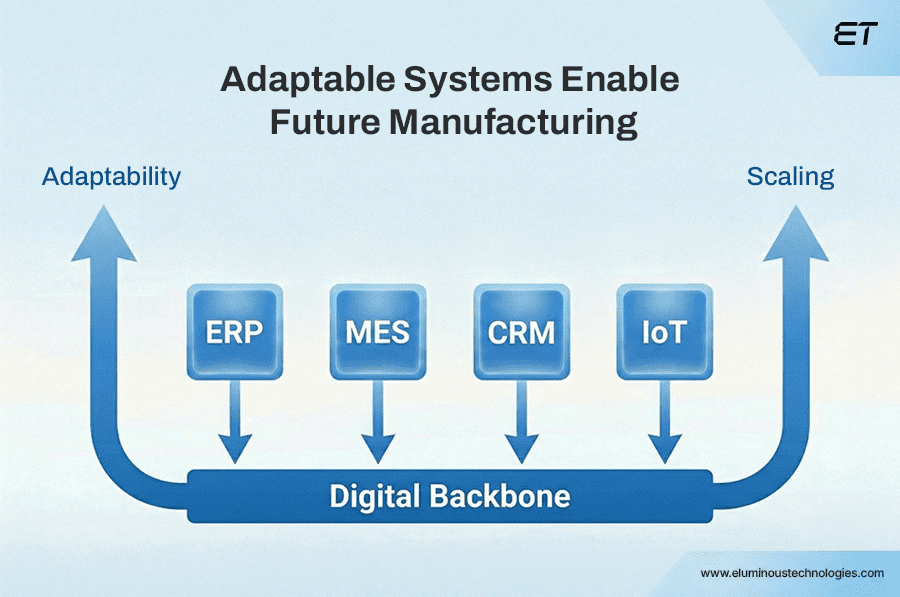
For future manufacturing, a digital backbone is now a core necessity. The reason is simple: systems that can’t adapt quickly can’t keep up with changing demand, new technologies, or evolving business models.
Here are some more reasons emphasizing the need for such adaptable systems.
Adaptability is the Key Driver
Today, you deal with multiple product lines, new SKUs, and distributed operations. Rigid systems slow down production, decision-making, and innovation.
The fix? Adaptable systems allow ERP, MES, CRM, and IoT platforms to scale independently while staying aligned.
Digital Backbone Enables Adaptability
A dedicated web architecture layer serves as a bridge between all systems and supports modular upgrades without halting operations.
So, such a layer can handle new technologies (AI, predictive maintenance, robotics) without full re-platforming. Simply put, this decision prevents technical debt from piling up as your company grows.
Real Operational Payoffs
When you develop such a centralized connecting layer, the outcomes are noticeable:
- Faster deployment of new products or processes
- Reduced downtime during system upgrades or migrations
- Real-time insights from connected systems
- Easier integration with suppliers, partners, and external data sources
All in all, these positive effects act as a foundation for future scalability. Depending on your plant positioning, these results can vary in magnitude.
CTO Considerations
Now, let’s talk about the practical approach to building a dependable digital backbone.
- Look for modularity, API-first architecture, and event-driven workflows
- Avoid monolithic upgrades, vendor lock-in, and point-to-point spaghetti integrations
Remember that such systems evolve at the pace of the business. As Industry 4.0 adoption accelerates, AI and IoT are becoming vital additions to manufacturing.
So, you need to build a system ecosystem that can evolve without breaking. The backbone makes that possible, and web architecture makes it executable.
The Hidden Cost of Operating Without a Digital Backbone
Let’s get it straight. You won’t realize the drawbacks of not having a solid web architecture layer in place. The downsides aren’t directly visible.
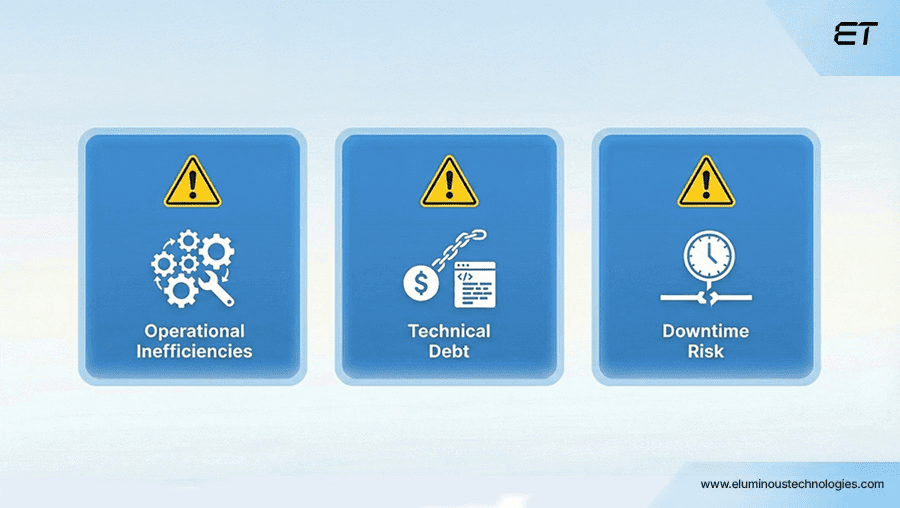
But that doesn’t mean they are absent. The table below explains these ‘hidden costs’ in brief.
| Hidden Cost | Impact on Operations |
| Operational inefficiencies | Manual reconciliation, delayed reporting, reactive decisions |
| Technical debt | Fragile custom integrations, upgrade risks, costly implementations |
| Increased downtime risk | Workflow misalignments halt production, errors propagate |
| Missed strategic opportunities | Slow AI/IoT adoption, delayed analytics, reduced market responsiveness |
| Costly workarounds | Spreadsheets, duplicate data entries, more IT maintenance |
| Long-term financial impact | Lost production hours, lower ROI, higher maintenance costs |
Now, if you want direct numbers, here’s an intriguing fact. Your plant might still run on legacy systems. This outdated architecture is highly susceptible to cyberattacks and data breaches.
And the average cost of a data breach is USD 4.4 million. That’s another solid reason firms are investing considerable money in upgrading legacy systems.
How CTOs Should Think About Building a Digital Backbone
It’s action time.
You know the hurdles. You see the value of a digital backbone.
You also know the hidden costs of delaying the decision to create a unified system pillar.
The next step is execution. Here’s what you should consider:
- Modular architecture
- Integration
- Loose coupling
- Centralized data flow
- Security and governance
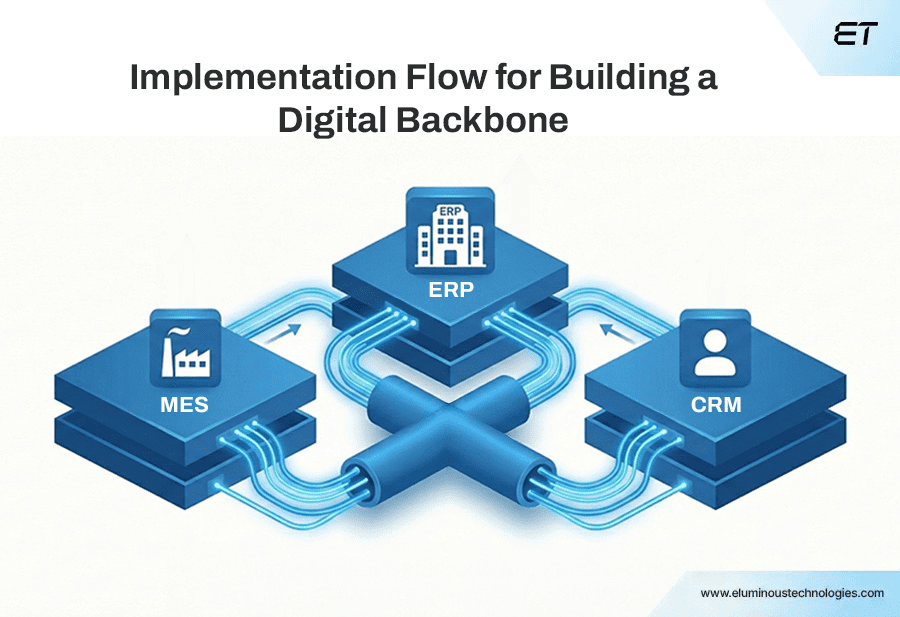
We won’t explain each facet in technical terms here (drop a comment if you want us to write a blog on it). However, this flow chart can show the implementation route:
Start ➡ Focus on Architecture, Not Tools
⬇
Prioritize Integration & Loose Coupling
⬇
Make Data the Control Plane
⬇
Design for Scalability & Flexibility
⬇
Embed Security & Governance
⬇
Measure Impact & Iterate
⬇
Outcome ➡ Modular AI-Ready Manufacturing Systems
Remember, this process is long-term. It sits well above application choices. By developing a digital backbone, you’re putting architecture above tools and systems.
Build Your Unified Manufacturing Plant
AI, IoT, and Industry 4.0 aren’t futuristic concepts. They are here, and your manufacturing business needs a well-thought-out digital backbone to leverage them.
Right now, you need your systems to evolve together. Siloed ERP, MES, CRM, and IoT platforms can slow operations, increase costs, and block innovation. So, you should focus on:
- Connecting all systems reliably
- Enabling modular upgrades without downtime
- Reducing technical debt and operational risks
- Gaining real-time visibility for faster, smarter decisions
- Future-proofing operations for AI, IoT, and Industry 4.0
So, focus on web development for manufacturing companies that build systems with architecture in mind. Seek out vendors who know the sector inside and out. A good decision is to prioritize vendors who understand how to integrate ERP, MES, CRM, and IoT systems.
Connect your manufacturing systems and unlock real-time insights, scalability, and AI-ready operations.


The Complete Guide to Software Development Strategy for Long-Term Scalability
Before any code is written or sprint planned, one strategic decision decides whether your software scales smoothly or eventually breaks.…


Zero UI Explained: How Technology is Becoming Invisible
Key Takeaways: In Zero UI, users interact with voice, gestures, and motion instead of traditional input methods. The devices understand…


