
 Book a Meeting
Distributed Team Management: A Modern CEO’s Playbook


- Distributed team management is a core C-suite responsibility.
- CEOs must prioritize clarity, cultural fluency, and async-friendly systems to succeed.
- Overcommunication and documented processes beat micromanagement every time.
- The success of a project depends on trust, transparency, and tangible outcomes.
- Structuring teams around regional leads improves accountability and decision-making.
- Leading distributed teams well can create unmatched agility, innovation, and resilience.
Distributed team management isn’t a perk or a post-pandemic workaround. It’s the backbone of modern business strategy.
Your engineering team is in India. Marketing spans three time zones. Your top designer just moved to Portugal. And you? You’re still expected to deliver results like everyone’s in the same room.
Welcome to the new leadership reality.
The CEOs who win in this era are managing distributed teams with precision and clarity, backed by high-performing dev teams and a playbook built for scale. And this guide isn’t here to tell you to ‘use Slack’ or ‘trust your team.’ You’ve heard that. Instead, we’ll walk through:
- Proven frameworks for managing distributed teams.
- Culture strategies that work across borders.
- Tool stacks built for outcomes.
- And the mistakes even seasoned executives make when scaling remote teams.
It’s time to treat distributed team management with strategic discipline.
Ready to build your dream distributed team with expert guidance?
What Is a Distributed Team? (And Why It’s the Future of Work)
A distributed team is a group of professionals working together across different geographic locations, time zones, and often, cultures. Unlike traditional remote teams, where members might work from home but still live near a central HQ, distributed teams are location-agnostic by design.
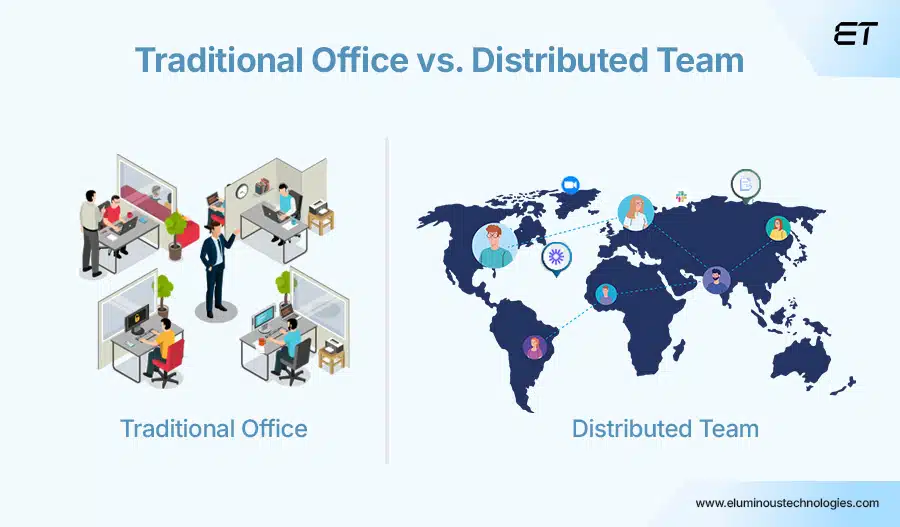
In other words, there’s no ‘main office.’
If your developers are in Bangalore, your product manager is in Austin, and your marketing lead is in Warsaw, that’s a distributed team.
Understanding the Process
Distributed team management is the strategic leadership of globally scattered teams. It’s about creating a work environment where location doesn’t dilute accountability, collaboration, or momentum.
Why is this model exploding in 2026?
- Top talent isn’t local anymore. It’s global.
- Companies save money on overhead by going distributed.
- Productivity rises when people work during their peak hours.
For CEOs, distributed teams aren’t a cost-cutting tactic. They’re a scaling strategy. And managing them right is what separates high-growth companies from chaotic ones.
Curious how high-performing development teams are structured in 2026?
Why Distributed Team Management Is Now a CEO Priority
Distributed team management has moved from a tactical concern to a strategic imperative. In a world where talent is borderless, cost pressures are real, and agility defines winners, managing globally dispersed teams is a core leadership function.
Today’s CEOs face a triple mandate:
- Access global talent fast.
- Deliver outcomes consistently.
- Maintain culture and clarity remotely.
All while competitors are chasing the same developers in Bogotá, product managers in Bangalore, and designers in Berlin.

This strategy is about building a company that runs just as well when no one’s in the same room.
This shift changes everything:
- How you hire.
- How you communicate.
- How you hold teams accountable.
- How you, as a CEO, lead from the front without being in front.
And that’s exactly where most leaders struggle.
See how top CEOs adapt project strategies to distributed realities.
Top Challenges in Distributed Team Management
With talent spread across continents and time zones, the promise of distributed work is clear: access, agility, and around-the-clock execution. But the reality? It’s far messier.
Distributed team management introduces complexity in communication, accountability, trust, and even culture. And unless CEOs address these early, they scale dysfunction.
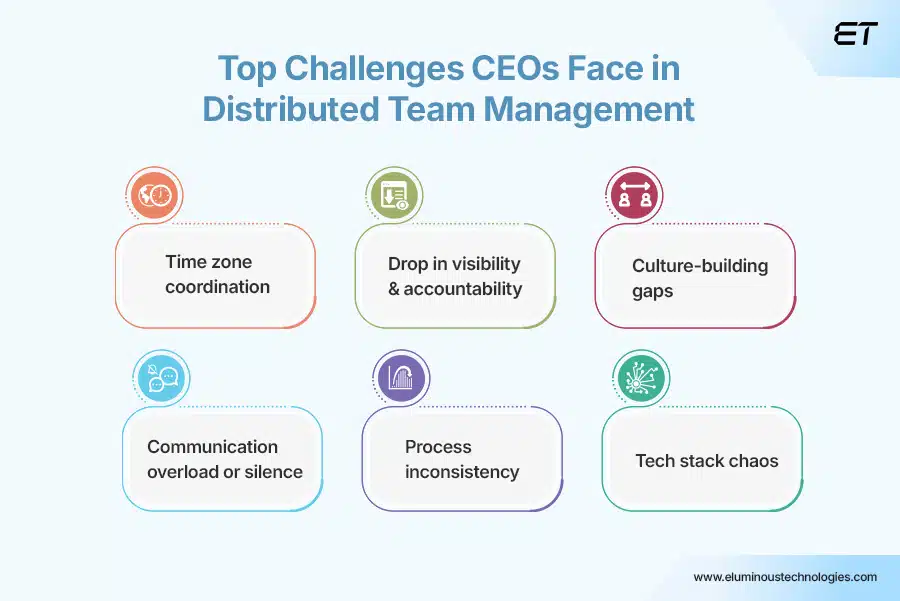
Here’s what separates the winners from the ones still chasing Slack threads:
- Time zone misalignment and chaos.
- Gaps in visibility and micromanagement.
- Diluted accountability and lack of focused ownership.
- Too much communication, like threads, meetings, updates, and check-ins.
- Trust deficit and lack of sharing the purpose of a project or organization.
- Cultural misalignment and evident cross-regional nuances.
Distributed team management doesn’t fail because of tech. It fails when leaders underestimate the human systems behind remote execution.
The CEO’s Framework for Managing Distributed Teams
Great distributed teams don’t happen by accident. They’re engineered with intent, discipline, and systems that scale beyond the CEO’s direct line of sight.
This strategy isn’t about remote-friendly perks or adding another tool to your tech stack.
This is a CEO-level operating framework for distributed team management. It’s the one that drives outcomes, not just appearances.
1. Hire for Time Zone Strategy, Not Just Talent
Yes, the 10x engineer in Eastern Europe is impressive.
But if your product manager is in San Francisco and there’s zero overlap, you cannot ship anything on time.
CEO move:
Build zones of overlap, not just organizational charts. Hire in regional pods with at least 2–4 hours of workday crossover.
Prioritize ‘collaboration density’ over geographic diversity when it matters most.
Need top-tier engineers in India with built-in time zone alignment?
2. Lead with Outcomes, Not Activity
In distributed setups, measuring hours worked is meaningless. Measuring value created? Non-negotiable.
CEO move:
• Shift from input tracking (time logged) to output accountability (goals met).
• Replace daily stand-ups with weekly asynchronous progress videos.
• Use OKRs and delivery cadences to define what success looks like.
All in all, you don’t need to see people working. You need to see their work working.
Build timezone-aligned teams with smarter staff augmentation strategies.
3. Build a Single Source of Operational Truth
Information sprawl is the silent killer of distributed productivity.
If your roadmap is in one place, sprint notes in another, and decisions in someone’s Slack DMs, you’re already bleeding efficiency.
CEO move:
- Adopt a source-of-truth model: one place for plans, updates, and decisions.
- Standardize tools: Notion, ClickUp, Linear, GitHub, etc. (Don’t use 5 when 2 will do)
- Make documentation a culture, not an afterthought.
Pro tip: The more distributed your team, the more obsessive your documentation needs to be.
4. Coach Managers to Lead Across Screens
Here’s the hard truth: most managers have never been trained to lead distributed teams. They’re winging it. And their teams feel it.
CEO move:
- Invest in remote leadership training. Focus on communication, feedback loops, and conflict resolution.
- Create shared rituals: async 1:1s, virtual ‘office hours,’ retrospective weeks.
- Make it clear: being remote is not an excuse for being invisible.
Distributed leadership is a skill. And like any skill, it needs coaching, not assumptions.
5. Systemize Culture Without Forcing It
You can’t ‘happy hour’ your way to trust. But you can embed culture into daily behaviors and expectations.
CEO move:
- Define your remote culture playbook (values, communication norms, escalation paths).
- Use tools like Donut, Bonusly, or CultureAmp to reinforce human connection.
- Celebrate wins publicly across time zones, teams, and titles.
When culture is clear, distance doesn’t dilute it.
Distributed team management is a design challenge, not a delegation one.
You don’t fix it with more meetings. You fix it with better systems, clearer leadership, and a framework that works when you’re asleep and your dev team is pushing code halfway around the world.
Mistakes to Avoid in Distributed Team Management
Even experienced leaders stumble when managing distributed teams. This is not because they’re inexperienced, but because they’re applying in-office logic to a borderless environment.
Here’s what derails even the best:
Mistake #1: Confusing Visibility with Control
When you can’t ‘see’ your team, it’s tempting to over-index on check-ins, screen tracking, and micromanagement rituals.
But control isn’t the antidote to distance; clarity is.
Avoid it: Build systems that report outcomes, not mouse movements. Weekly async demos > daily anxiety huddles.
Mistake #2: Overengineering the Tool Stack
Slack. Zoom. Notion. Jira. Trello. Miro. Asana. Teams. Google Docs. Confluence.
Add too many, and suddenly your productivity suite is your biggest blocker.
Avoid it: Consolidate your stack. Choose tools that scale with you, not ones that multiply friction.
Avoid tech overload. Build smarter stacks that scale with your team.
Mistake #3: Leaving Onboarding to HR
Distributed teams don’t get hallway conversations or desk-side support. If onboarding is weak, productivity suffers fast.
Avoid it: Make onboarding a CEO priority. Personal welcome videos, cross-team intros, and crystal-clear ramp-up plans should be standard.
Mistake #4: Ignoring Cultural Intelligence
Distributed doesn’t mean monoculture. It means nuance.
Unspoken hierarchies, feedback styles, and decision-making pace differ drastically across geographies.
Avoid it: Train your leaders to lead with cultural context. What works in New York may backfire in Nairobi.
Mistake #5: Assuming Culture Will ‘Just Happen’
Your company values won’t magically scale across time zones.
Culture in a distributed model is either intentional or invisible.
Avoid it: Codify your values. Celebrate wins. Make recognition part of your weekly rhythm, even if no one’s in the same timezone.
The CEOs who scale distributed teams successfully aren’t better communicators.
They’re better architects. They design systems that replace guesswork with clarity and ego with empathy.
How to Structure a Distributed Team for Scale
Distributed team management is all about intentional architecture. In this strategy, every decision about roles, reporting, time zones, and communication style either drives performance or slowly erodes it.
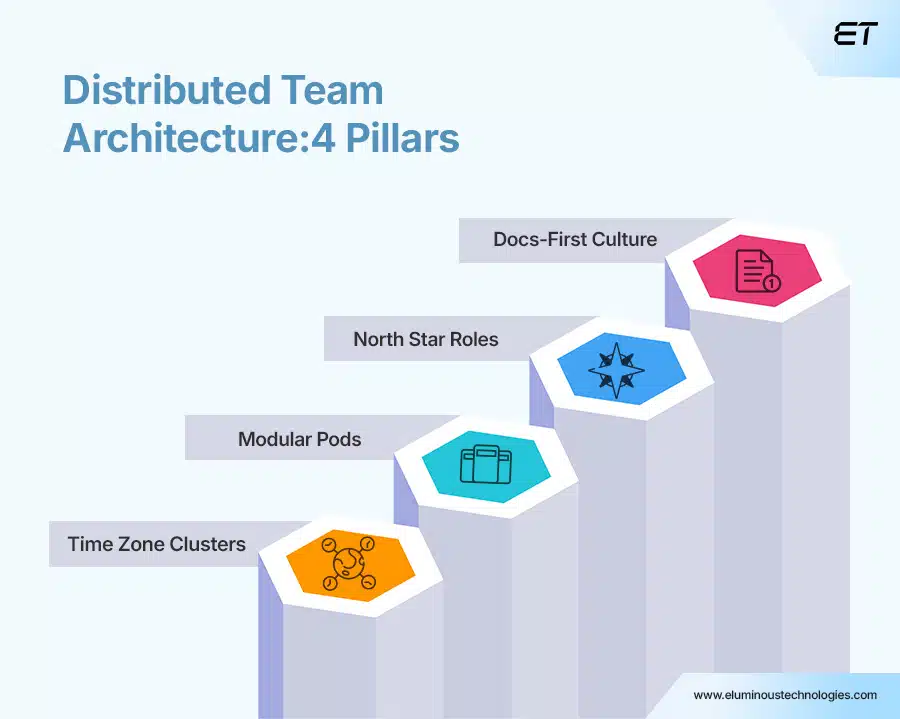
Let’s break it down into the four core layers of effective distributed team structure:
1. Structure by Time Zone, Not Geography
Why it matters:
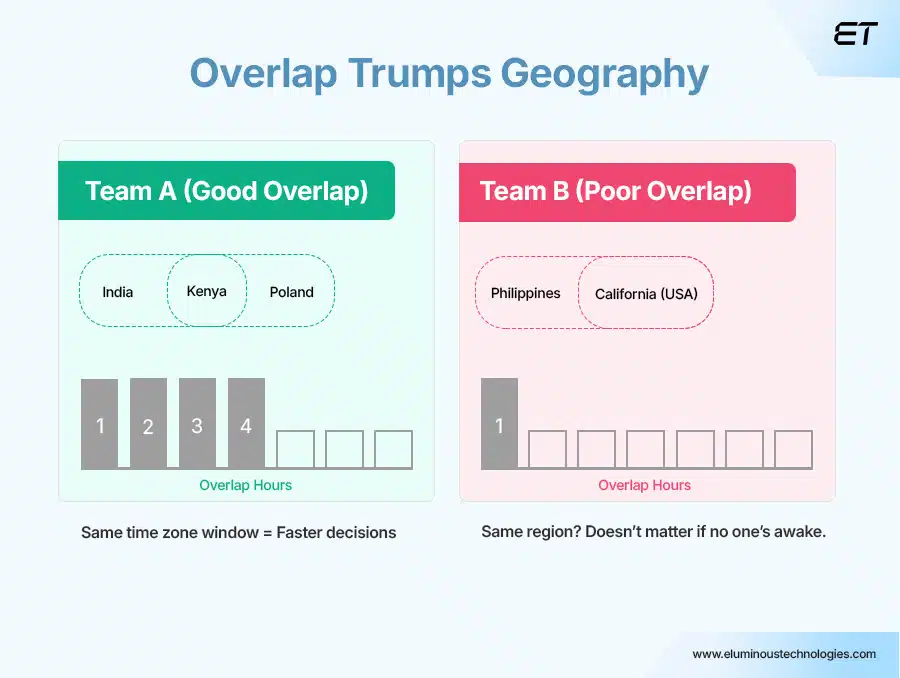
Geography doesn’t kill productivity; misaligned time zones do. You don’t need your backend developers and UI designer on the same continent. You need them overlapping 3–4 hours a day, where decision-making actually happens.
CEO Move:
Organize teams into time zone clusters, not ‘regions.’
Example:
- A product pod with members in Poland, Kenya, and India works because they overlap 4–6 hours.
- But pairing someone in California with someone in the Philippines for a real-time project? That’s a daily bottleneck waiting to happen.
Pro Tip:
Limit the total spread of hours per team to under 6 hours. Anything more requires heavy async workflows, and not every team is built for that.
2. Create Modular, Autonomous Units
Why it matters:
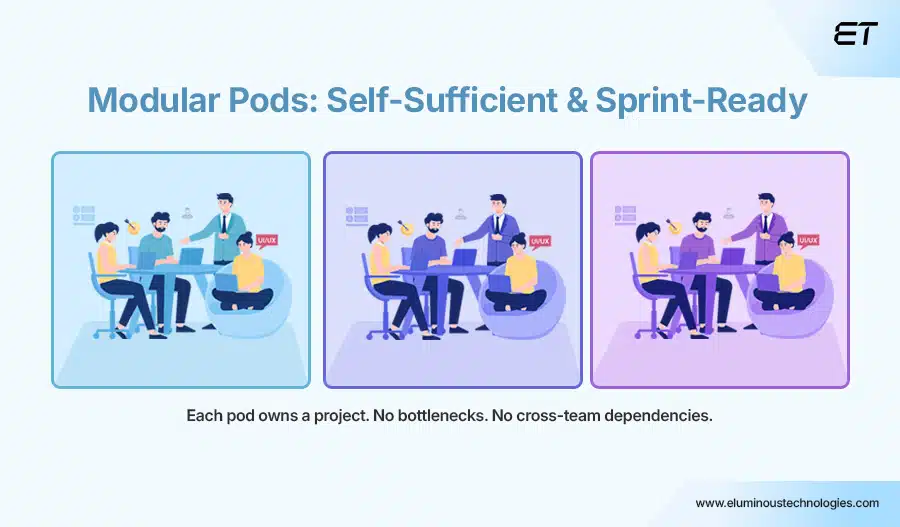
Distributed teams fail when dependencies create latency. If DevOps can’t ship until QA in another country signs off, your whole sprint rhythm suffers.
CEO Move:
Design teams to be cross-functional and modular.
Think ‘pods’ or ‘squads.’ Each one has everything it needs to own a project end-to-end:
- Engineering
- QA
- Product
- Design
All inside one self-contained unit.
Example:
GitLab’s remote playbook structures teams this way, ensuring velocity regardless of who’s awake when.
Execution Tip:
Pair this with clear OKRs per pod. So, accountability doesn’t float upward to some central team leader 5 time zones away.
Design agile, self-sufficient teams that thrive remotely. Learn how here.
3. Define ‘North Star’ Roles in Every Team

Why it matters:
In distributed environments, confusion compounds quickly. If no one knows who is driving the ship, everyone starts rowing in different directions. You don’t just need leads, you need anchors.
CEO Move:
In every distributed team or pod, assign a ‘North Star’ role, i.e., a person whose job is to:
- Keep the team aligned with the business goal
- Make priority trade-offs when Slack turns into chaos
- Serve as the default decision point when ambiguity arises
This could be a tech lead, product manager, or senior IC. But the title is less important than the function.
Pro Tip:
Don’t confuse a North Star with a micromanager. Their job is to simplify choices, not approve every click.
4. Build a Culture of Documented Decision-Making

Why it matters:
When teams are spread across 4 time zones and 5 tools, verbal decisions vanish. That quick call someone had while you were asleep? Gone. The context is lost, and suddenly you’re debugging direction.
CEO Move:
Make documentation part of the culture, not an afterthought:
- Every major decision goes into Notion, Confluence, or your tool of choice.
- Every process has an owner and a reference page.
- Every change of course is logged somewhere searchable.
Example:
GitHub has a practice called ‘Decisions, not Discussions.’ They don’t document every conversation. It keeps teams lean without losing clarity.
Execution Tip:
Reward documentation in performance reviews. You can’t expect clarity if you only incentivize speed.
These four elements: time zone clusters, modular pods, North Star roles, and documentation culture form the skeletal structure of any high-functioning distributed team.
Tired of decisions getting lost in Slack threads? We document everything.
Leadership Principles for Distributed Team Management
If structure is the skeleton of a distributed team, leadership is the nervous system. And in this new era of distributed team management, old-school ‘all-hands-on-deck’ leadership styles collapse fast.
Here’s how great CEOs lead when no one’s in the same room:
1. Lead Through Context, Not Control
Micromanagement is a virus in distributed teams. It kills trust and clogs workflows. Instead, CEOs must become masters of context-setting.
That means:
- Crystal-clear goals (think: OKRs, North Star metrics).
- Over-communication of priorities and purpose.
- Trusting teams to choose the ‘how’ once the ‘why’ is nailed.
GitLab’s CEO, Sid Sijbrandij, runs one of the world’s largest distributed teams by focusing on outcomes over activity. ‘Measure results, not hours.’
2. Prioritize Asynchronous Alignment
No, not just async communication, async alignment.
That’s the difference between 12 smart people working independently and 12 smart people moving in the same direction. Create:
- Weekly async updates from department heads.
- Strategic memos from the C-suite with pre-read deadlines.
- Pre-recorded briefings to eliminate timezone friction.
Async is not slower. It’s more thoughtful. CEOs who build this habit see fewer meetings, better decisions, and faster execution.
Asynchronous teams thrive with the right partner, especially in Python projects.
3. Default to Documentation
Distributed leadership breaks down when knowledge is tribal or locked in someone’s head. The fix? Build a culture where writing is leadership.
- SOPs for recurring workflows.
- Decision logs for major calls.
- A single source of truth (Notion, Confluence, or a custom internal wiki).
Rule of thumb: If it’s said in a meeting, it should live in a doc.
4. Create Rituals That Transmit Culture
Remote-first doesn’t mean culture-second. But you have to be intentional.
The best distributed CEOs don’t leave team culture to chance; they engineer it:
- Async shoutouts every Friday
- Monthly ‘CEO ask me anything’ videos
- Digital town halls that highlight how the team is winning, not just what
Rituals replace water coolers. Build them with purpose.
5. Hire for Autonomy, Not Just Talent
In the office, a high-performer can be hand-held to success. Distributed? That won’t cut it.
Hire team leads who:
- Make decisions with imperfect info
- Work backwards from goals
- Manage themselves (and others) without reminders
Your distributed leadership strength depends on your weakest autonomous link.
|
To lead a distributed team that doesn’t crumble under distance:
|
The Essential Tech Stack for Effective Distributed Team Management
Managing a distributed team isn’t just about Zoom and Slack anymore.
CEOs leading modern, location-agnostic teams need a tech stack that reinforces structure, supports asynchronous operations, and makes collaboration seamless across time zones.
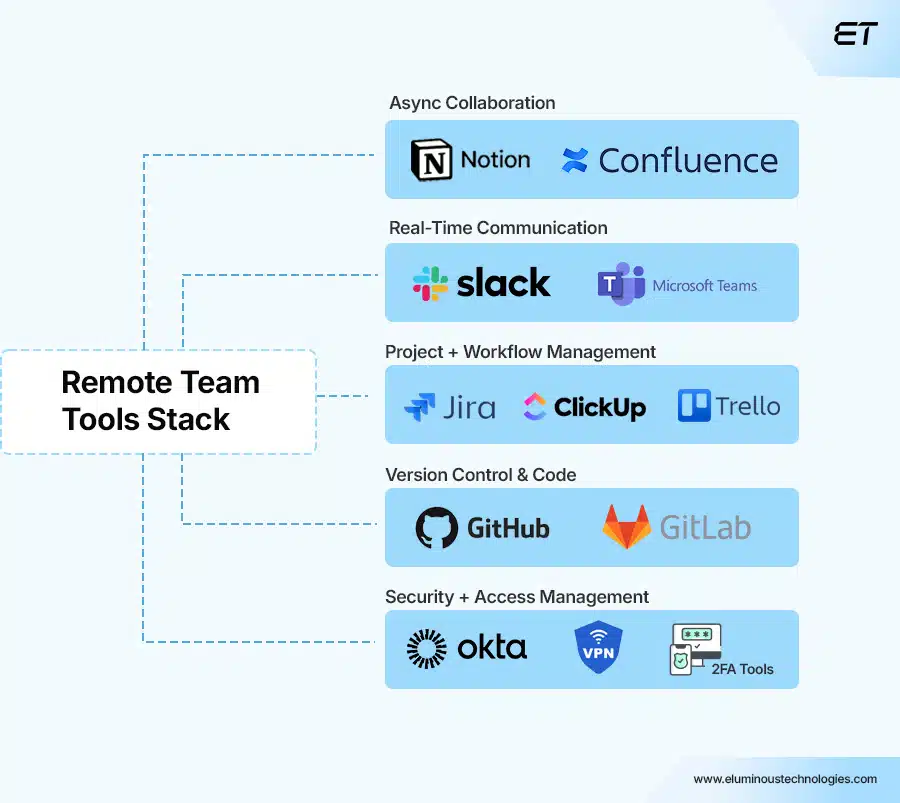
Here’s a quick, strategic breakdown of the tools worth investing in based on function and fit.
| Function | Recommended Tools | Why It Matters |
| Project Management | Asana, ClickUp, Jira | Keeps workflows visible, aligned, and trackable across locations. |
| Documentation & Knowledge | Notion, Confluence, Slab | Your remote team’s brain that ensures SOPs, decisions, and learnings are easy to find and update. |
| Team Bonding & Culture | Donut (Slack), Gather, Icebreaker | Fosters informal interactions and builds trust in remote-first teams. |
| Security & Access Control | 1Password, JumpCloud, Okta | Protects sensitive data across distributed endpoints. |
| Time Zone & Work Planning | Clockwise, Timezone.io, World Time Buddy | Makes scheduling and collaboration smoother across geographies. |
| Daily Standups & Updates | Geekbot, Range, Standuply | Enables async status sharing without cluttering calendars. |
| Hiring & Staff Augmentation | Revelo, Turing, YourCompanyNameHere | Streamlines onboarding vetted offshore or nearshore talent when scaling distributed teams. |
Choose the right tools for smoother, smarter project execution. Here’s how.
High-Impact Best Practices for Distributed Team Management
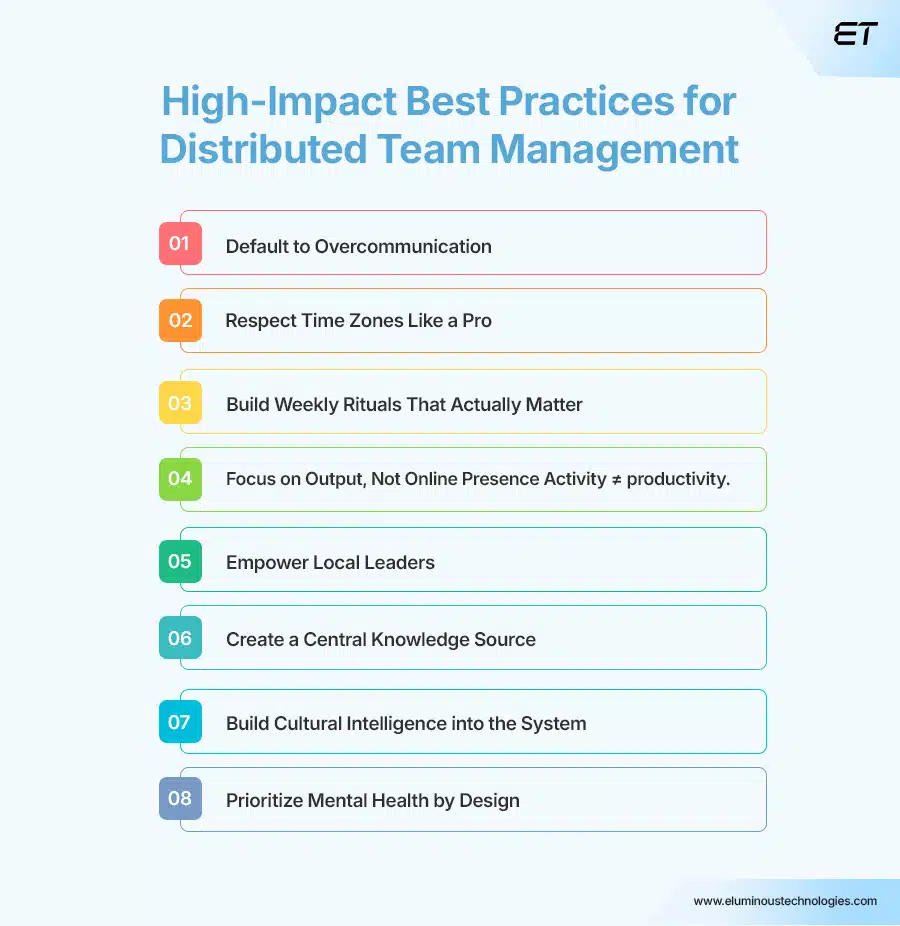
Whether you’re managing five engineers across two time zones or a 50-person product team spread across continents, these best practices will sharpen your execution and leadership.
1. Default to Overcommunication
In distributed team management, silence isn’t golden; it’s risky. Repeat expectations. Document outcomes. Summarize after every meeting. This kind of intentional overcommunication reduces ambiguity, which is often the root cause of remote friction.
2. Respect Time Zones Like a Pro
Use scheduling tools (Clockwise, World Time Buddy) to avoid meetings that wreck someone’s sleep or sanity. Time zone-aware planning is a mark of high-trust, globally fluent leadership. You want equity, not exhaustion.
3. Build Weekly Rituals That Actually Matter
Weekly standups, retros, or demo days shouldn’t feel like calendar filler. Make them tight, purpose-driven, and predictable. Rituals build rhythm and create momentum across distributed teams.
4. Focus on Output, Not Online Presence
Shift your leadership lens from “Are they active?” to “Did they deliver?” Define clear KPIs and outcomes. Tracking activity in distributed teams is outdated. Results are what matter.
5. Empower Local Leaders
Appoint cluster or regional leads who can make tactical decisions independently. This minimizes bottlenecks, boosts responsiveness, and gives your distributed team a stronger sense of ownership.
6. Create a Central Knowledge Source
Your Slack threads won’t cut it. Use Notion, Confluence, or Slite to build a real-time, living wiki. Documentation is the backbone of scalable distributed team management.
7. Build Cultural Intelligence into the System
Cultural missteps aren’t just awkward; they’re expensive. Offer resources or onboarding sessions to boost cultural fluency. It enhances collaboration and builds mutual respect.
8. Prioritize Mental Health by Design
Remote burnout is real. Encourage breaks. Normalize flexible hours. Check in without micromanaging. Healthy teams = high-performing teams.
Distributed Team Management Is a CEO’s Strategic Edge
Managing distributed teams isn’t a compromise; it’s a competitive advantage. But only if it’s done right.
The best CEOs aren’t just reacting to the remote revolution. They’re shaping it by investing in clarity, building async-first systems, and trusting their teams to deliver results without the daily shoulder-tapping.
Distributed team management isn’t about fancy tools or time zone gymnastics. It’s about operational maturity, cultural intelligence, and the willingness to lead differently.
And the payoff?
Increased productivity. Global talent access. Resilience in a volatile world.
Ready to scale your distributed team with expert support? Let’s talk.
Frequently Asked Questions
1. What is distributed team management?
Distributed team management refers to leading and coordinating a team whose members work from multiple geographic locations. It focuses on maintaining productivity, communication, and alignment across time zones and cultures.
2. What’s the difference between remote and distributed teams?
Remote teams may all work from home, but still within the same city or region. Distributed teams, on the other hand, span cities, countries, or continents, requiring more structured communication, cultural awareness, and async workflows.
3. Why is managing distributed teams more complex?
Because you’re dealing with time zone gaps, cultural differences, tech reliance, and asynchronous communication, all of which can affect productivity, trust, and engagement if not managed deliberately.
4. How can CEOs improve distributed team performance?
Start with crystal-clear expectations, hire for autonomy, build documentation-first systems, and empower local leaders. Most importantly, measure outcomes, not hours.
5. What tools help with distributed team management?
Tools like Slack, Zoom, Asana, Notion, and Loom are common. But tools are secondary to leadership mindset and process design. No tech can fix unclear goals or poor communication.
6. Is distributed team management sustainable long-term?
Absolutely. Companies like GitLab, Zapier, and Automattic prove that fully distributed models can scale, innovate, and thrive if structured right.


Choosing a Software Development Partner: A Practical Evaluation Framework
You’ve started shortlisting multiple vendors, and suddenly, every option looks the same. Polished portfolios, bold claims, similar tech stacks. It’s…

Staff Augmentation Best Practices for High-Performance Teams
Do you have a clear vision, but lack the bandwidth or skills to execute fast enough? Then it might not…


