
 Book a Meeting
How Enterprise Web Portal Development Supports Multi-Plant Operations
I once spoke with an operations leader at a US-based manufacturing firm. They had grown from two plants to seven in under five years. On paper, growth looked impressive. Revenue was up. Output was strong. New facilities were online.
But behind the scenes? Each plant operated like its own island. Different reporting formats. Different dashboards. Different processes. A simple question like “What did yesterday’s total output look like across all plants?” required a lot of back-and-forth.
At times like these, you need well-planned enterprise web portal development. The real issue is whether you can see, compare, optimize, and scale performance across locations. As you expand across states, regions, or through acquisitions, complexity multiplies. Data volumes increase. User roles diversify. Integrations become messier. What worked for one facility doesn’t hold up when you’re managing multiple plants.
Scalable web portals solve this challenge by creating a centralized, role-based digital layer. In this blog, we’ll break down what scalable enterprise web portals mean for multi-plant manufacturing, and how you can approach enterprise web portal development as a long-term growth strategy.
Why Plan Enterprise Web Portal Development for a Multi-Plant Setup
Enterprise web portal development for manufacturing is about creating a centralized digital environment that enables different stakeholders to access data and tools through a single unified platform.
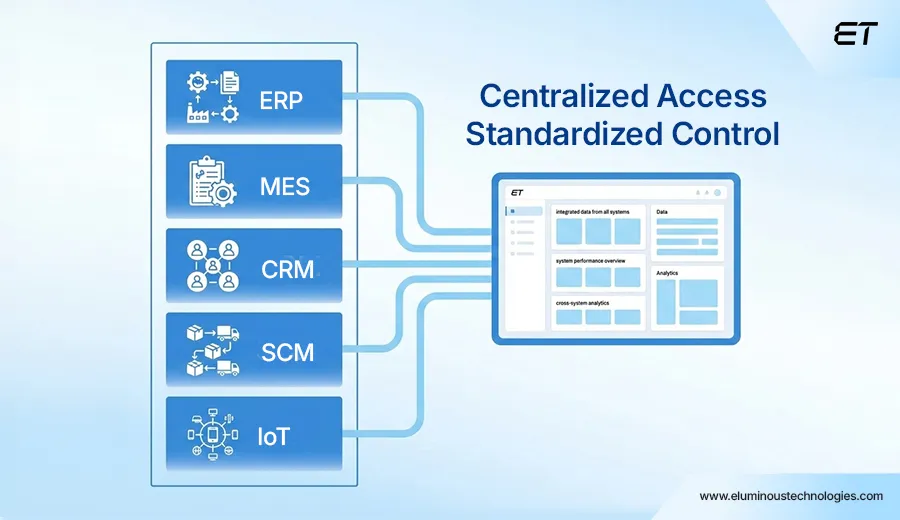
You don’t need five logins, 10 disconnected dashboards, or weekly PDF reports.
The only requirement is a well-designed enterprise web portal. Such a platform:
- Aggregates data from ERP, MES, CRM, SCM, and IoT systems.
- Applies role-based access so users only see what matters.
- Standardizes reporting across the organization.
- Enables real-time visibility instead of retrospective reporting.
- Scales as the organization adds users, plants, or integrations.
In multi-plant setups, you typically see:
- Variations in processes between locations.
- Different reporting structures and KPIs.
- Inconsistent system adoption.
- Separate vendor networks.
- Local optimizations that don’t always align with enterprise goals.
Each plant might be performing well on its own. But leadership lacks real-time visibility across facilities. When a company expands, you’re adding more data streams, users, compliance considerations, integration points, and operational risk.
Without a centralized digital strategy, every new plant increases friction. This is exactly why you must plan an enterprise web portal development for manufacturing.
What Happens When You Build a Unified Portal
When you architect a web portal with multi-plant scalability in mind from day one:
- New facilities plug into a standardized framework.
- Leadership gets enterprise-wide visibility instantly.
- Plant-level flexibility coexists with corporate governance.
- Integrations follow a repeatable model.
- Expansion becomes operationally smoother.
In other words, the portal becomes the connective tissue of your manufacturing enterprise.
What Is an Enterprise Web Portal for Manufacturing Companies
If you walk into most manufacturing enterprises today, you’ll find powerful systems everywhere. ERP runs finance and inventory, MES tracks production, SCM handles logistics, and CRM manages customer relationships. Each system does its job well.
The problem?
They don’t always talk to each other in a way that makes sense to leadership.
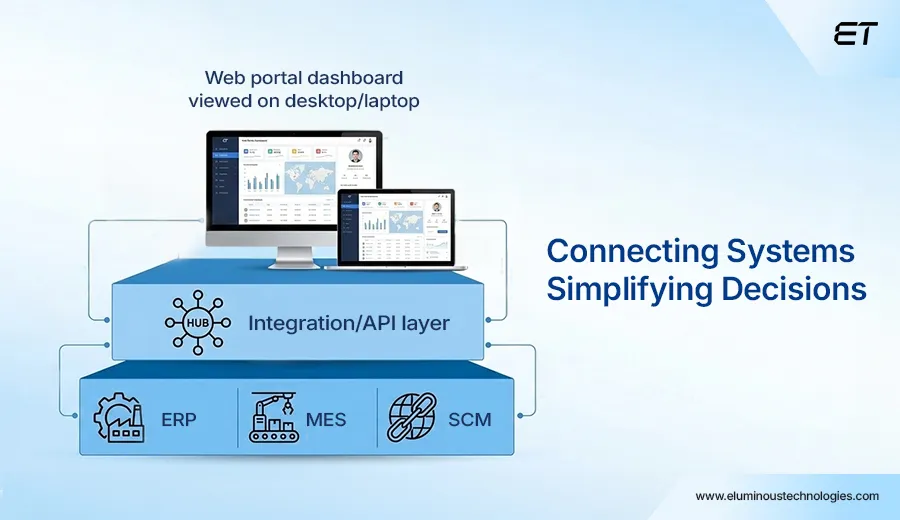
An enterprise web portal for manufacturing is the layer that connects all of them. It presents the right information to the right people, at the right time.
That’s the simple version.
From an architectural standpoint, an enterprise web portal is a secure, web-based platform that:
- Integrates with backend enterprise systems (ERP, MES, SCM, CRM, IoT platforms).
- Uses APIs and middleware to aggregate real-time and batch data.
- Implements role-based access control (RBAC).
- Supports modular, scalable architecture for multi-plant environments.
- Provides centralized authentication and governance.
- Enables analytics, dashboards, workflows, and document management.
It sits above core operational systems, acting as a presentation and orchestration layer rather than a transactional engine itself.
Why Web Portals Are Becoming the Digital Backbone of Manufacturing Enterprises
Before Industry 4.0 and AI, manufacturing technology investments were system-first.
- Buy a strong ERP.
- Implement MES at the plant level.
- Layer in SCM.
- Add analytics later.
Each system solved a specific operational problem. But as organizations expanded across plants, regions, and acquisitions, leadership discovered something uncomfortable:
The systems worked. The enterprise didn’t.
That gap between functional systems and unified enterprise visibility is exactly why web portals are moving to a digital backbone.
Here’s what’s changed.
| Traditional Multi-Plant Setup | Enterprise Web Portal as the Digital Backbone |
| Each plant runs slightly different processes and reporting formats | Standardized enterprise-wide reporting with plant-level flexibility |
| Leadership relies on static reports consolidated manually | Real-time dashboards with centralized data visibility |
| Multiple system logins for ERP, MES, SCM, and partner platforms | Single secure access layer integrating all enterprise systems |
| Expansion requires duplicating systems and rebuilding integrations | Modular architecture that scales as new plants come online |
| Vendor and distributor communication happens via email and spreadsheets | Dedicated supplier and partner portals with controlled access |
| Security policies vary by system and location | Centralized governance, authentication, and compliance controls |
Get this upfront:
A web portal doesn’t replace core manufacturing systems.
It connects them.
It doesn’t remove ERP, MES, or IoT platforms.
It creates a unified interface and orchestration layer that makes them operate as a single enterprise system.
Why Most Manufacturing Web Portals Fail to Scale
Most manufacturing web portals outgrow their original purpose.
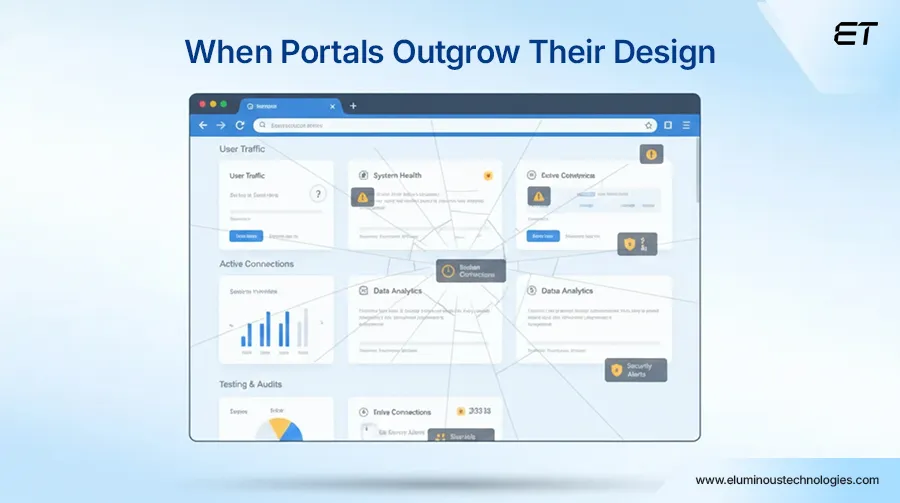
As users multiply, data volumes increase, and integrations stack up, the cracks start to show. Without planning enterprise web portal development around multi-plant scalability, the portal eventually becomes another system that leadership must work around. Let’s dissect what goes wrong, even if you build a simple web portal.
No Multi-Plant Scalability
Most manufacturing portals start as solutions to local problems.
One plant needs better reporting. A specific team needs workflow automation. IT builds a portal optimized for that environment.
Then the company expands.
New plants operate differently. KPIs vary. Data structures aren’t identical. Suddenly, what worked neatly for one location becomes rigid and fragile across five. Instead of scaling smoothly, the portal requires heavy rework for every new facility. Architecture that wasn’t designed for multi-plant variability becomes a bottleneck.
Integration Gaps
Manufacturing enterprises rarely operate on a clean tech stack.
You’ll often see:
- Different ERP versions across plants.
- Legacy MES implementations.
- Custom inventory tools.
- Isolated quality management systems.
When enterprise web portal development doesn’t account for this fragmentation, integration becomes reactive. Data synchronization fails. Reporting logic varies by plant. APIs are built ad hoc. Over time, the portal becomes a patchwork of connectors instead of a unified data layer.
Customization Overload
Customization feels powerful in the short term.
A plant manager requests a unique workflow. A regional team wants its own dashboard logic. A department demands tailored reporting fields.
Individually, each change makes sense.
Collectively, they create an architecture that’s hard to maintain, difficult to upgrade, and expensive to scale. Over-customized portals lose modularity. Updates break existing configurations, and adding a new plant requires unique custom coding rather than plugging into a reusable framework.
Scalability and Security Risks
As user counts grow and data volumes increase, strain becomes visible.
Dashboards load more slowly. Reports time out. Data pipelines lag.
At the same time, risk exposure expands:
- More external partners are accessing the system.
- More plants with varying security maturity.
- More compliance requirements across states or industries.
If scalability, role-based access control, and governance aren’t embedded in the architecture early on, the portal becomes a liability. That’s when you need to plan a dedicated enterprise web portal development strategy.
How to Build Truly Scalable Web Portals for Multiple Mfg. Plants
Building a scalable web portal for multi-plant manufacturing is about designing for growth from day one. That means assuming more plants will come online, more users will log in, more systems will need to be integrated, and more data will flow through the platform. You should focus on architecture, governance, and repeatable frameworks as the core pillars. Here’s an in-depth breakdown.
Step 1: Define Enterprise-Level Goals Before Plant-Level Features
Before architecture, UI mockups, and vendor discussions, define what success looks like at the enterprise level.

Too many portal initiatives start with plant-specific pain points:
- Plant A needs better reporting.
- Plant B wants vendor access.
Instead, start with:
- What enterprise KPIs must leadership see daily?
- What cross-plant comparisons are non-negotiable?
- What governance standards must apply across all facilities?
- What does growth look like over the next 3 – 5 years?
If the enterprise blueprint is unclear, the portal will default to plant-by-plant customization. And you definitely don’t want that.
Step 2: Design a Modular, Multi-Plant Architecture
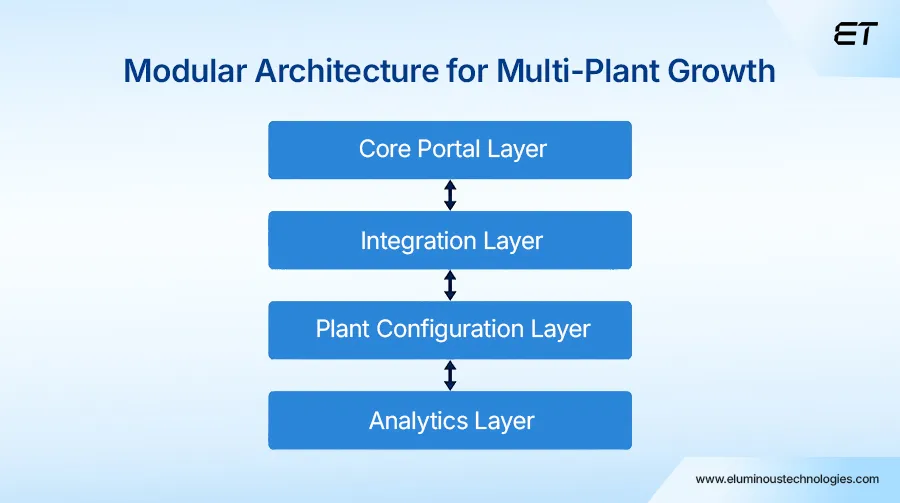
This is where scalability in enterprise web portal development becomes structural.
A scalable architecture separates:
- Core enterprise modules.
- Plant-specific configurations.
- Integration layers.
- User access management.
Here’s a reference table for this step:
| Architectural Layer | Purpose | Why It Matters |
| Core Portal Layer | Authentication, UI framework, role-based access | Ensures consistency across all facilities |
| Integration Layer | APIs, middleware, data connectors | Enables standardized connections to ERP, MES, and SCM |
| Plant Configuration Layer | Local KPIs, workflows, and dashboards | Allows flexibility without altering core logic |
| Analytics Layer | Reporting, BI, executive dashboards | Enables enterprise-wide visibility |
Your goal should be ‘plug-and-configure.’ So, always avoid the rebuild-and-patch approach. You can also stay up to date with the key trends in web portal development to take the right call.
Step 3: Standardize Data Before You Centralize It
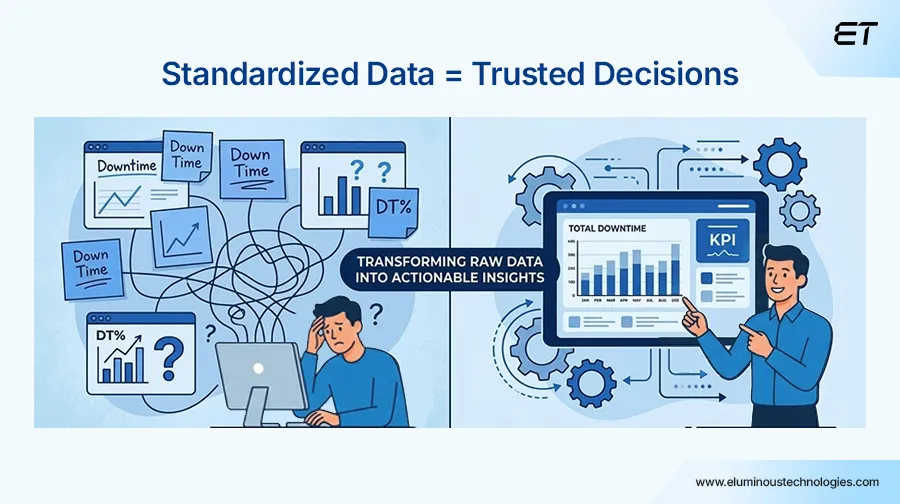
Here’s where many projects quietly derail. You cannot centralize inconsistent data and expect clarity. Before aggregating plant-level data into one enterprise portal:
- Align KPI definitions.
- Normalize naming conventions.
- Standardize data structures.
- Agree on reporting frequency.
If downtime means one thing in Texas and something slightly different in Ohio, your executive dashboard becomes unreliable. And once leadership stops trusting the data, adoption drops.
Remember, scalable enterprise web portal development requires a unified data model.
Step 4: Build Integration as a Strategy
Integration should never be treated as a post-development activity.
In multi-plant manufacturing, your portal must connect with:
- ERP systems.
- MES platforms.
- Inventory tools.
- Supply chain software.
- IoT devices.
- CRM systems (for order visibility).
So, instead of one-off connectors, build:
- API-first architecture.
- Reusable integration templates.
- Middleware for system translation.
- Real-time and batch data pipelines.
Bottom line: If integrations are fragile, scalability becomes expensive.
High-Impact Web Portal Use Cases in Manufacturing
You don’t invest in enterprise web portal development for aesthetics or convenience. The main focus is rectifying visibility gaps that slow decision-making. The portal becomes meaningful when it directly supports revenue, cost control, operational uptime, and strategic expansion.
In multi-plant environments, the highest-impact use cases unify performance data, streamline collaboration across locations, and reduce manual coordination between teams, partners, and suppliers. Below are the use cases where manufacturing web portals deliver measurable business impact.
Real-Time Enterprise-Wide Performance Dashboards
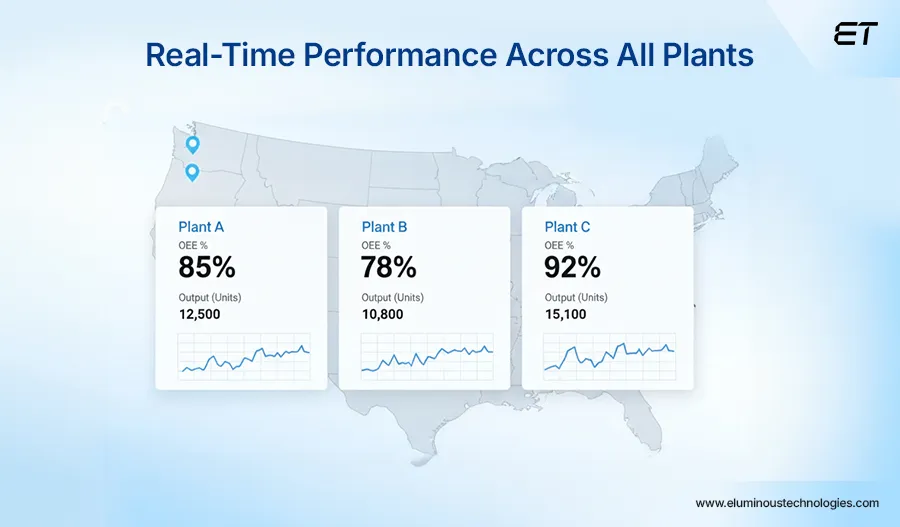
In multi-plant manufacturing, speed of insight affects speed of decision-making. One plant missing production targets is an operational issue.
But when three plants miss them, it becomes a blind spot.
A high-impact web portal use case is the creation of unified, real-time performance dashboards that consolidate data across all facilities into a single executive view. Instead of waiting for weekly reports or manually compiled spreadsheets, you gain immediate visibility into:
- Production output by plant and product line.
- Downtime trends and root cause patterns.
- OEE comparisons across facilities.
- Inventory levels and fulfillment rates.
- Quality metrics and defect rates.
- Energy consumption and sustainability KPIs.
Modern enterprise portals integrate directly with MES, IoT sensors, and ERP systems to stream live production data. Layered analytics can automatically highlight anomalies, flagging underperforming shifts, unexpected downtime spikes, or supply chain disruptions before they cascade.
The impact is measurable:
- Faster corrective action.
- Cross-plant benchmarking that drives accountability.
- Reduced reporting cycle time.
- Data-driven capital allocation decisions.
This use case transforms the portal from a reporting tool into a live operational command center.
Supplier and Vendor Collaboration Portals
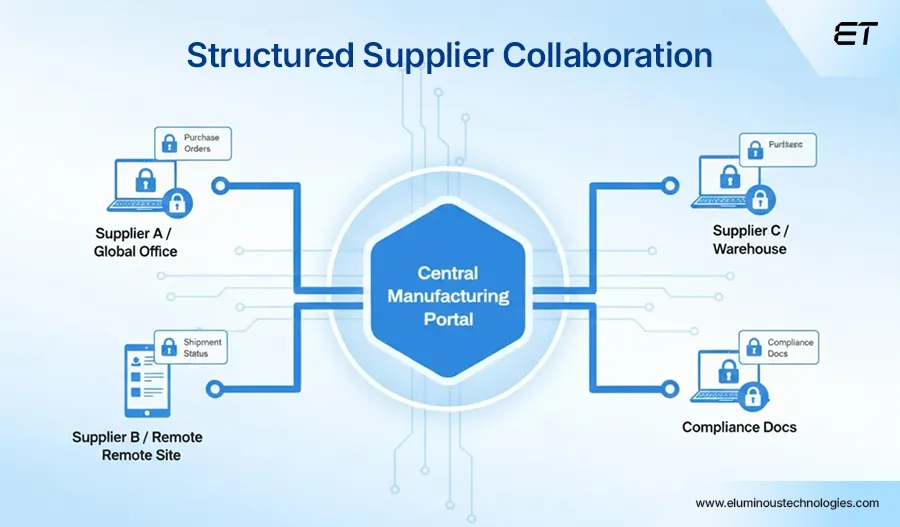
In multi-plant manufacturing, supplier coordination becomes exponentially more complex as the network grows.
Different plants often work with overlapping vendors. Communication occurs via email, calls, shared spreadsheets, and, occasionally, ERP access. A supplier and vendor portal centralizes that interaction layer.
Instead of fragmented communication, a portal gives vendors controlled, role-based access to:
- Purchase orders and order status.
- Shipment schedules and delivery windows.
- Inventory requirements by plant.
- Quality documentation and compliance uploads.
- Payment status and invoicing workflows.
From the enterprise perspective, this creates structured collaboration across all facilities. Modern web portals also support:
- Real-time order tracking across multiple plants.
- Automated alerts for supply delays.
- Centralized document management for certifications and audits.
- Performance scorecards to evaluate supplier reliability.
Procurement teams reduce back-and-forth communication. Plants avoid last-minute material shortages. Leadership gains visibility into supplier performance trends across locations, enabling better negotiation and consolidation strategies.
Cross-Plant Maintenance and Asset Management Portals
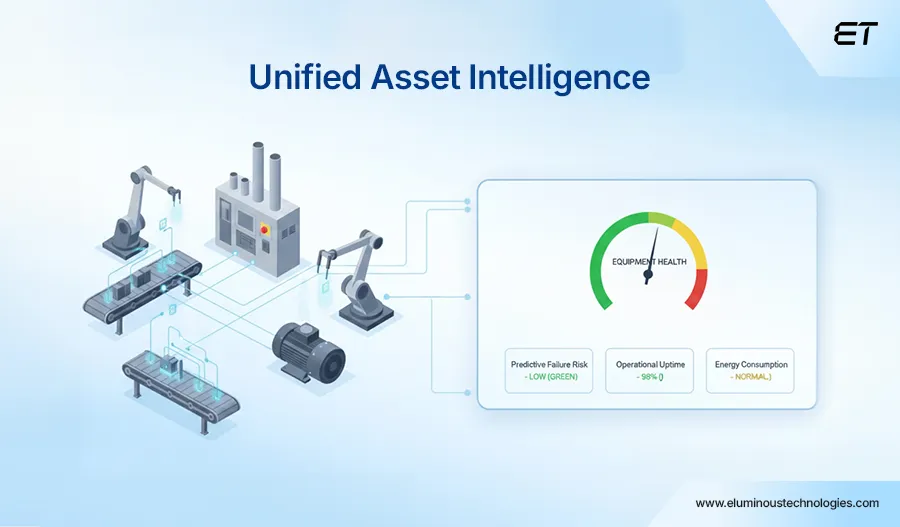
In multi-plant environments, maintenance practices often evolve locally. One plant may follow predictive maintenance protocols using IoT sensors. Another may rely heavily on reactive fixes.
Documentation lives in separate systems. Asset histories are fragmented. Lessons learned in one location don’t always travel to another.
A centralized maintenance and asset management portal changes that.
Through a unified web portal, you can:
- Monitor equipment health across all plants.
- Track downtime events in real time.
- Standardize maintenance schedules and workflows.
- Maintain centralized asset histories.
- Share root-cause analysis reports across facilities.
When integrated with MES and IoT systems, the portal can surface:
- Predictive maintenance alerts.
- Performance degradation trends.
- Spare part consumption patterns.
- Maintenance backlog visibility.
For leadership, the portal enables cross-plant benchmarking of asset performance. If similar equipment in two plants shows different failure rates, that insight becomes actionable. Capital expenditure decisions become data-driven. Maintenance best practices become repeatable.
Enterprise-Wide Compliance and Quality Management Portals
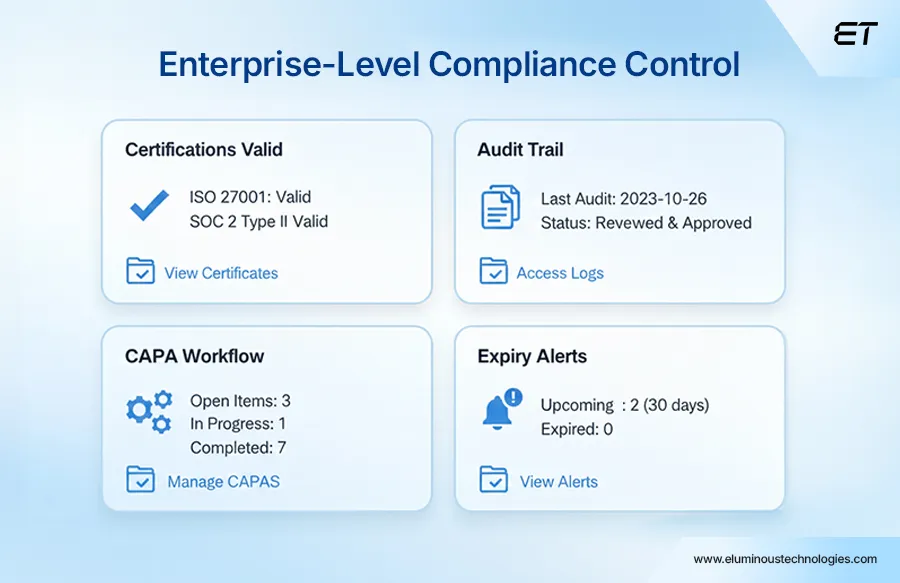
In a single-plant setup, compliance tracking can feel manageable. In a multi-plant enterprise, it becomes layered, repetitive, and risky.
Different facilities may operate under varying state regulations, industry certifications, customer-specific quality standards, and internal audit requirements. Documentation lives in folders. Audit trails sit in separate systems. When an inspection happens, teams scramble to consolidate records.
A centralized compliance and quality management portal eliminates that fragmentation.
Through a unified web portal, manufacturing enterprises can:
- Maintain standardized quality documentation across plants.
- Track certifications, renewals, and regulatory requirements.
- Log non-conformance incidents and corrective actions.
- Centralize audit trails and inspection records.
- Monitor quality KPIs across facilities in one view.
Modern portals can also support:
- Automated alerts for expiring certifications.
- Structured workflows for corrective and preventive actions (CAPA).
- Version-controlled SOP management.
- Digital sign-offs and approval chains.
So, instead of plant-level management during audits, enterprise web portal development enables proactive oversight. Patterns in defects or compliance gaps across facilities become visible.
New Plant Onboarding Portals
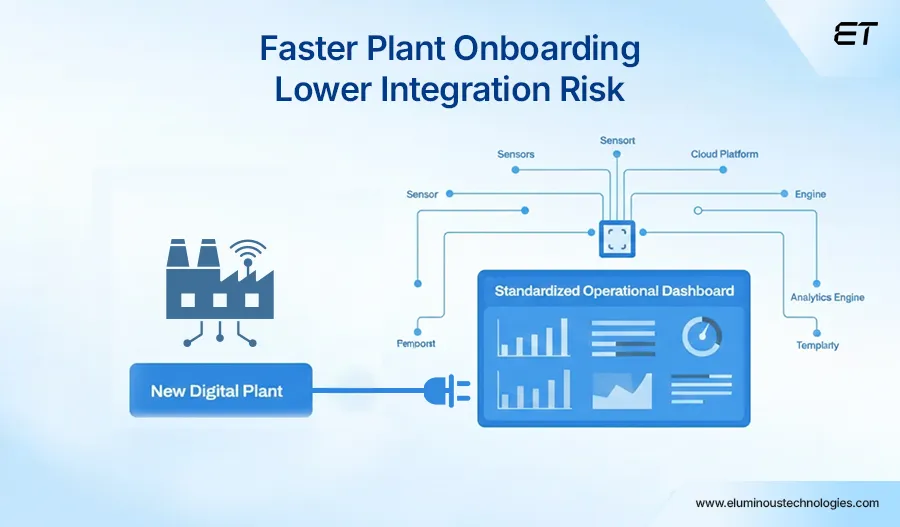
Multi-plant manufacturing growth rarely happens organically forever. At some point, acquisitions come into play.
And that’s where digital chaos usually explodes.
When a new plant is acquired, you’re integrating:
- New ERP configurations.
- Different reporting standards.
- New supplier ecosystems.
- Different compliance documentation.
Without a structured enterprise web portal development framework, onboarding becomes manual and inconsistent.
So, instead of rebuilding reporting structures from scratch, the new facility plugs into:
- Predefined KPI templates.
- Standardized executive dashboards.
- Established governance and access controls.
- Existing supplier collaboration models.
- Unified compliance tracking frameworks.
The portal becomes the digital onboarding layer for acquisitions.
In high-growth manufacturing enterprises, this use case alone justifies developing a web portal as a long-term investment.
The Future of Manufacturing Web Portals
Manufacturing web portals are evolving into operational intelligence platforms.
What began as centralized dashboards and partner access points is rapidly transforming into a digital control plane that connects plants, systems, data streams, and decision-makers in real time. The next generation of enterprise web portal development will be defined by deeper intelligence, tighter integration, and faster adaptability.
We’re already seeing the shift.
Portals are integrating live IoT feeds directly from factory floors. They’re embedding AI-driven anomaly detection instead of relying solely on static KPI reporting. The interface stays simple. The intelligence underneath becomes sophisticated.
Here’s what that evolution looks like at a high level:
| The Past | The Present + Future |
| Static dashboards with delayed reporting | Real-time, streaming operational data across plants |
| Manual KPI tracking and periodic reviews | AI-assisted anomaly detection and predictive insights |
| Separate systems stitched together visually | Unified orchestration layer across ERP, MES, SCM, IoT, and analytics |
| Plant-level performance visibility | Enterprise-wide benchmarking with automated insights |
| Reactive compliance documentation | Proactive risk monitoring and automated alerts |
| Expansion requiring significant IT rework | Modular onboarding for new plants and acquisitions |
The future of manufacturing web portals is about absorbing complexity without passing it on to leadership. When you invest early in scalable, intelligent portal architecture, you can build a digital foundation capable of supporting expansion, automation, and smarter decision-making for the next decade.
Final Thoughts
Multi-plant manufacturing doesn’t slow down because production weakens. It slows down when visibility, coordination, and governance fail to scale with growth. As facilities expand and systems multiply, fragmented data and inconsistent reporting create confusion, making enterprise web portal development a business necessity.
A truly scalable portal unifies systems, standardizes performance visibility, and scales without forcing constant rework. It becomes the digital backbone that supports real-time decision-making, supplier collaboration, compliance oversight, and smoother plant onboarding. Designed correctly, it reduces complexity instead of amplifying it.
If you’re ready to build that foundation, partnering with the right technology team matters. eLuminous specializes in web development for manufacturing enterprises, helping organizations design and implement scalable portals tailored to multi-plant environments.
Ready to unify your multi-plant operations with a scalable web portal?

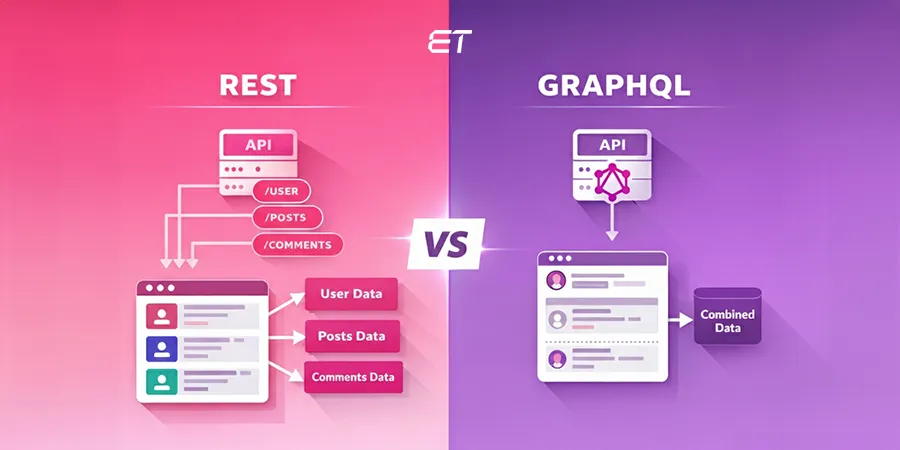
GraphQL vs REST APIs: Differences, Performance, and When to Use Each
REST and GraphQL are two different approaches to designing APIs that allow applications to communicate with servers. GraphQL vs REST…

Decoding the Future: Software Development Industry Trends 2026
Key Takeaways: Agentic AI tools will continue automating complex tasks with contextual reasoning. Low-code platforms will empower faster builds and…


