
 Book a Meeting
ServiceNow AI Agents: A Guide to Intelligent Workflow Automation


- ServiceNow AI agents are transforming traditional automation by using AI and machine learning.
- These AI agents are capable of analyzing operational context, recommending actions, prioritizing tasks, and executing workflows across business functions.
- Key capabilities include intelligent ticket resolution, autonomous workflow execution, and predictive operational intelligence.
- AI agents ServiceNow implementations are helping organizations to reduce service desk overload, improve customer service, and automate repetitive infrastructure tasks.
- Successful implementation requires a structured approach that includes high-impact workflows and building human-in-the-loop governance.
- With growth, AI agents have become a foundational component of intelligent workflow automation; this helps organizations operate faster and smarter.
Enterprise automation is evolving beyond rule-based workflows and scripted task execution. Organizations are increasingly looking for intelligent systems that can understand context, make recommendations, and act across business processes.
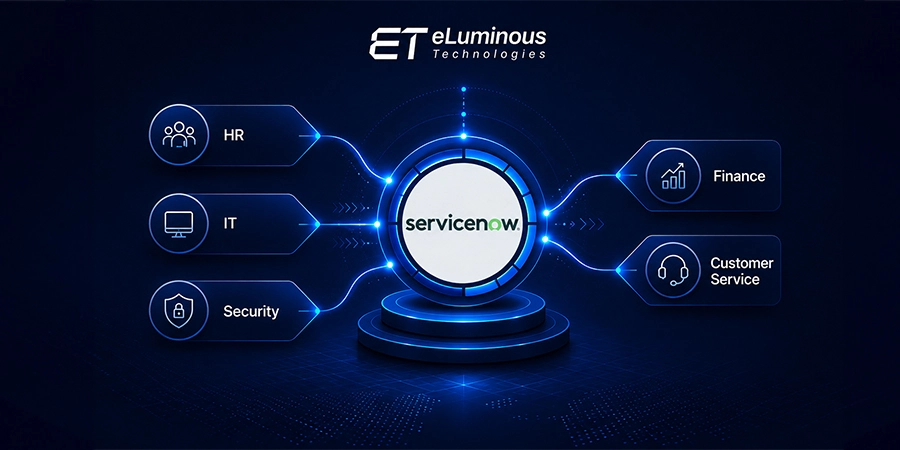
This shift has accelerated interest in ServiceNow AI Agents. Built to operate within enterprise workflows, these agents can help automate repetitive work, support decision-making, and improve operational efficiency across IT, customer service, HR, security, and other functions.
For technology leaders, understanding how AI agents fit into enterprise operations is becoming increasingly important. This guide explores their capabilities, common use cases, implementation considerations, and best practices for successful adoption.
ServiceNow AI Agents: Why Are Enterprises Investing in Them?
What differentiates ServiceNow AI Agents from standalone AI tools is their ability to operate within existing enterprise workflows and service management processes. Rather than functioning as isolated assistants, they can access workflow context, interact with enterprise systems, and execute actions within governed operational environments.
Unlike traditional automation systems that primarily follow predefined rules and workflows, ServiceNow AI Agents can use context, historical data, and AI-driven reasoning to support decision-making and execute actions dynamically. Rather than simply following static instructions, they can adapt to changing conditions and assist with more complex operational tasks.
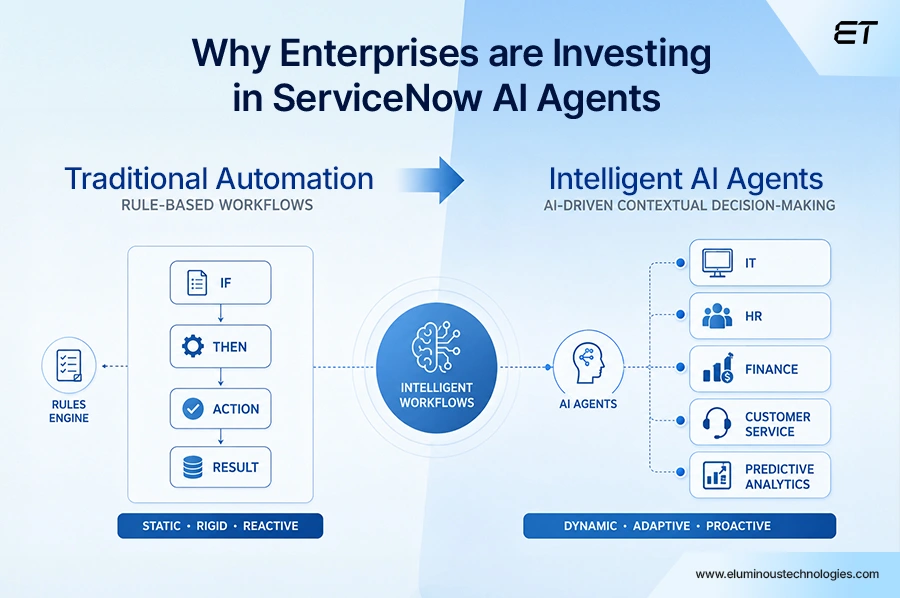
Built on the ServiceNow AI platform, Organizations can deploy both prebuilt AI agents and custom agents tailored to their specific workflows, while managing them through centralized governance capabilities available within the ServiceNow platform.
Unlike traditional automation systems that have fixed rules, AI agents can:
- Prioritize tasks
- Improve workflow outcomes
- Suggest recommendations
- Trigger actions
- Analyze operational context
This allows the organization to move from reactive operations to intelligent operational management.
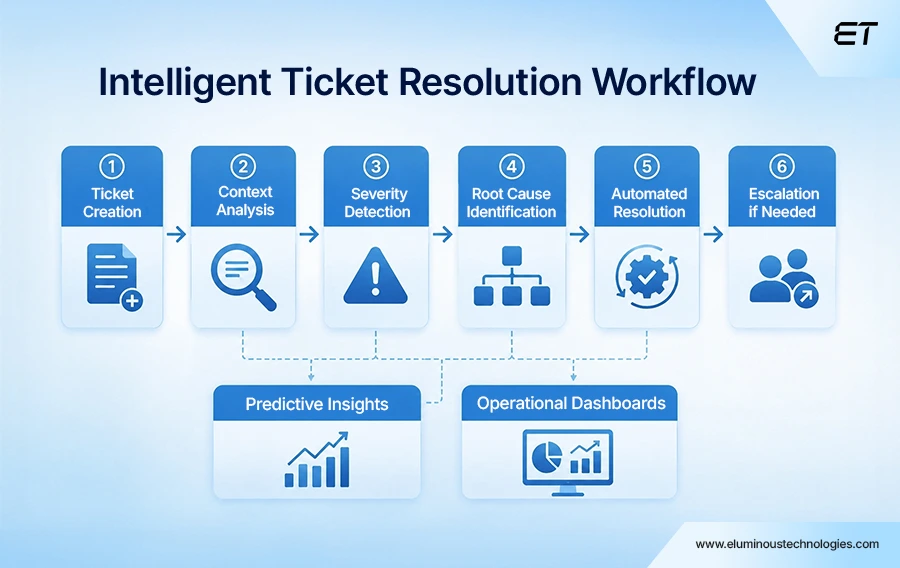
For example, when a ticket is raised, instead of simply routing, ServiceNow AI agents can assess issue severity, identify potential root causes, prioritize escalation, and analyze historical incident patterns. This is where the significant operational advantage lies for enterprises that are actively managing large-scale service ecosystems.
Today, companies are working with far more complex environments than a few years ago. For instance, they are managing distributed workforces, growing service demands, hybrid cloud infrastructures, and expanding digital transformation initiatives. They must deal with changing technology while keeping up with the fast pace.
Here, traditional automation models fail because they are not designed to dynamically adapt to changing operational conditions. This is one of the primary reasons organizations are investing heavily in ServiceNow Agentic AI expertise.
ServiceNow AI Agents: Core Capabilities
ServiceNow AI agents do not fit into traditional automation, they go beyond. They have adaptive capabilities that streamline operations and orchestrate workflows instead of just executing simple tasks.
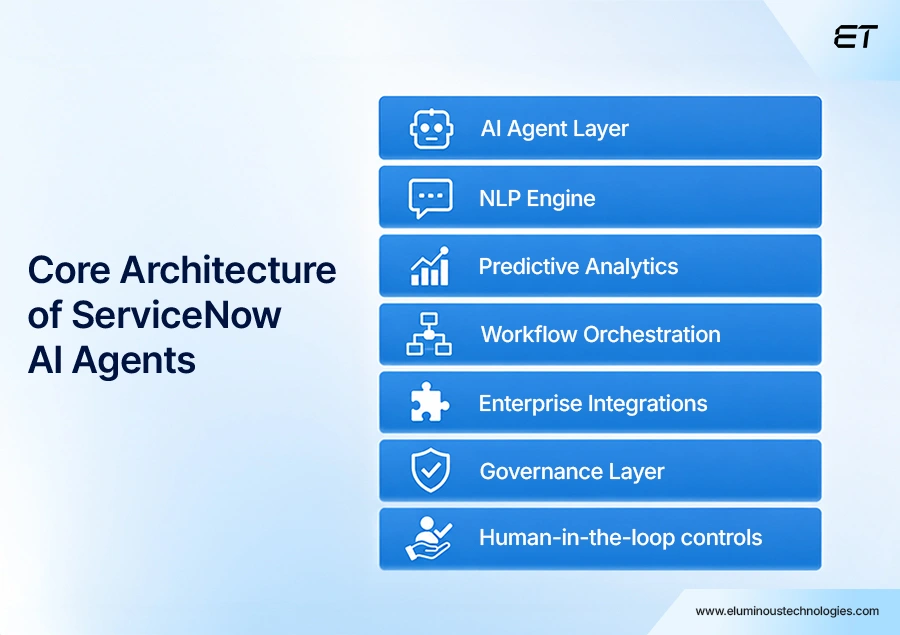
Below are some of the most impactful enterprise capabilities:
- Multi-Agent Collaboration: ServiceNow AI agents work together autonomously, while coordinating through an orchestrator. This solves complex, cross-department business procedures. They work together like a specialized digital workforce that is actively managed by a central engine.
- Intelligent Ticket Resolution: This is the most common enterprise use case for AI agents ServiceNow implementation. AI agents can classify incidents, recommend remediation actions, and prioritize tickets. This nature of intervention improves response times significantly. For enterprises that have a high volume of service environments, advanced ticket handling can improve operational efficiency while actively reducing service desk overload. For example, when an employee reports a VPN connectivity issue, an AI agent can classify the incident, review historical tickets, identify common root causes, recommend remediation steps, route the issue to the appropriate team, and initiate predefined workflows. This reduces manual effort while improving response times.
- Predictive Operational Intelligence: This function leverages historical data and machine learning for automation. It is a valuable component of ServiceNow agentic AI that proactively identifies anomalies, operational risks, performance degradation, and infrastructure vulnerabilities. For example, ServiceNow AI agents can detect unusual infrastructure behavior while simultaneously initiating preventive remediation workflows, before a service outage reaches the point of impacting a business operation. If infrastructure monitoring tools detect unusual memory consumption patterns across multiple servers, an AI agent can correlate the alerts, identify potential risks, create incidents, notify stakeholders, and trigger remediation workflows before service disruption occurs.
- Autonomous Workflow Execution and Learning: This execution refers to systems where AI agents can independently plan, execute, and adapt multi-step processes. Depending on governance requirements, AI agents can automate portions of multi-step workflows while escalating approval-dependent or high-risk actions to human stakeholders when necessary. With ServiceNow AI agents, organizations can automate access management, incident escalation, operational approvals, infrastructure requests, and provisioning workflows.
In this case, AI agents have predefined enterprise logic and contextual analysis. This helps enterprises to reduce workflow delays while maintaining compliance controls and governance.
ServiceNow AI Agents: Enterprise Use Cases
While traditional chatbots primarily focus on answering questions and providing information, AI agents can take actions, coordinate workflows, and complete multi-step tasks across connected systems.
This means it is capable of intelligent ticket routing, password resets, and software provisioning. Let’s discuss more examples of how these AI agents actually help out in different parts of the business.
IT Operations Management (ITOM)
Effective IT operational management is crucial for ensuring an organization’s performance and efficiency. This department includes administering individual processes, including hardware and software support, with internal and external client services.
Operations teams are flooded with thousands of low-level alerts that need direct response. Trained AI agents here monitor real-time data and analyze and summarize massive alert volumes. It can automatically resolve false alarms.
Another significant use case is automated remediation. Engineers spend a lot of time executing repetitive tasks for recurring infrastructure issues. Here, AI agents can detect and run multi-step workflows. For example, their work includes clearing server patches, restarting crashed services, and reducing mean time to resolution.
Customer Service Operations
ServiceNow AI agents are increasingly capable of executing tasks autonomously while coordinating actions across multiple systems and workflows. They are able to proactively solve issues like customer return requests, track orders independently, and execute product recalls.
AI being integrated into the CSM systems can streamline risk assessment and automatically process low-risk operational approvals. They also actively analyze the tickets and prioritize them based on urgency while suggesting a customized response.
The result of working with AI agents is faster and further leads to more consistent customer communication.
Security Operations
Cybersecurity management is a crucial part of any organization. ServiceNow AI Agents empower security teams by managing vulnerabilities and organizing responses across departments in real-time.
Agentic AI enriches incoming alerts with cross-referenced threat intelligence, analyzing risk patterns, and accelerating incident response. As cybersecurity environments are becoming more complex, intelligent operational support is becoming non-negotiable.
Across departments, ServiceNow AI agents are fundamentally transforming how enterprises are managing their complexity. It’s not just about automating repetitive tasks, but they are adapting and acting with a certain level of intelligence that reduces the burden on engineers. With businesses continuing to scale with intense operational demand, AI agents are no longer just a competitive advantage; they are a foundational necessity to work faster and smarter.
Best Practices for Implementing ServiceNow AI Agents
Organizations working towards deploying ServiceNow AI Agents should adopt a structured implementation strategy. This would require them to include necessary practices that balance long-term stability and speed of deployment. One such framework approach is the ServiceNow Adaptive Implementation Framework. This provides the methodology and guardrails that enterprise integration with AI would require.
Below are key practices for successful implementation across your ServiceNow instance:
Start with High-Impact Workflows
Good starting points include high-volume service desk requests, password resets, access provisioning, incident triage, and employee onboarding workflows. These processes typically offer measurable efficiency gains while presenting relatively lower implementation risk.
Trying to automate everything at once usually turns into a hassle. A phased approach for identifying categories that need attention would work significantly better. These categories can include sections like repetitive operational tasks that are consuming teams’ bandwidth or high-volume workflows where small efficiency gains turn into large cost savings.
Build Human-in-the-loop Systems
AI agents are powerful, but they need guidance for decisions that carry legal, financial, and reputational risk.
So, while ServiceNow AI agents are integrated into the systems, the right model is augmentation and not replacement. This means AI handles the high-volume classification, routing, and drafting while humans approve and review
Adapting this design style preserves governance control and reduces error risk.
Prioritize Enterprise Integration
An enterprise can leverage ServiceNow AI agents when they are connected across the enterprise technology stack. This includes ITSM, HRSD, ERP systems, and security platforms.
Deep integration enables agents to pull context and execute end-to-end workflows without handoffs.
Common Challenges When Implementing ServiceNow AI Agents
While AI agents offer significant benefits, organizations should prepare for several implementation challenges:
- Data quality issues that limit decision accuracy
- Poorly defined workflows that create inconsistent outcomes
- Governance and compliance concerns around autonomous actions
- User adoption challenges and resistance to change
- Integration complexity across legacy systems
Addressing these challenges early helps organizations achieve more reliable and sustainable AI adoption.
To Wrap Up
ServiceNow AI Agents represent a significant evolution in enterprise automation. Rather than simply executing predefined rules, they help organizations analyze information, support decisions, coordinate workflows, and automate complex operational tasks.
When implemented with strong governance, high-quality data, and clearly defined workflows, AI agents can improve service delivery, reduce operational overhead, and help organizations respond more effectively to growing business demands.
At eLuminous Technologies, we help enterprises design, implement, and scale AI-powered workflow solutions that align with operational goals and long-term digital transformation initiatives.
From workflow design and platform integration to enterprise-scale deployment, our team helps organizations turn AI initiatives into measurable operational outcomes.

AI Agent Development Cost: Pricing & Cost Drivers
Summary: AI agent development costs vary widely between projects that look similar in stages, scope, or integrations. A focused proof…

ServiceNow Governance Framework: A Guide to Consistent Multi-Team Workflows
Summary: Different teams using ServiceNow have unique priorities, but they compete on a shared ServiceNow platform. Such a conflict can…


