
 Book a Meeting
Smart Manufacturing Industry 4.0: Technologies Driving the Next Revolution


- The smart manufacturing industry 4.0 combines advanced technologies like IoT, artificial intelligence, cloud computing, and digital twins. These help generate predictive analysis and create connected and data-driven production environments.
- With high-tech smart manufacturing, real-time data, process optimization, and informed decision-making are possible across the production cycle.
- Key benefits of smart manufacturing include reduced downtime, stronger supply chain resilience, and greater operational visibility.
- As technologies continuously grow and evolve, the future of industry and smart manufacturing will be driven by autonomous systems, agentic AI and hyperconnected factories.
- The growing role of consultancies in the smart manufacturing industry shift helps enterprises navigate the technical implementation, system integration, and workforce readiness.
The manufacturing industry has been undergoing a significant shift, as Industry 4.0 marks the fourth industrial revolution. This is where traditional production environments and physical manufacturing systems integrate with intelligent connected ecosystems that can adapt in real-time.
Today, growing customer expectations and global competition have made efficiency and agility critical business priorities. This makes choosing smart manufacturing technologies non-negotiable.
This has led to the rise of the smart manufacturing industry 4.0, which has moved beyond traditional production methods to build highly connected, data-driven operations. Manufacturers are heavily investing in AI (artificial intelligence), IIoT (industrial internet of things), and cloud computing in their production environments.
In this blog, we explore the adoption of new technology and how it is driving long-term growth.
What is smart manufacturing?
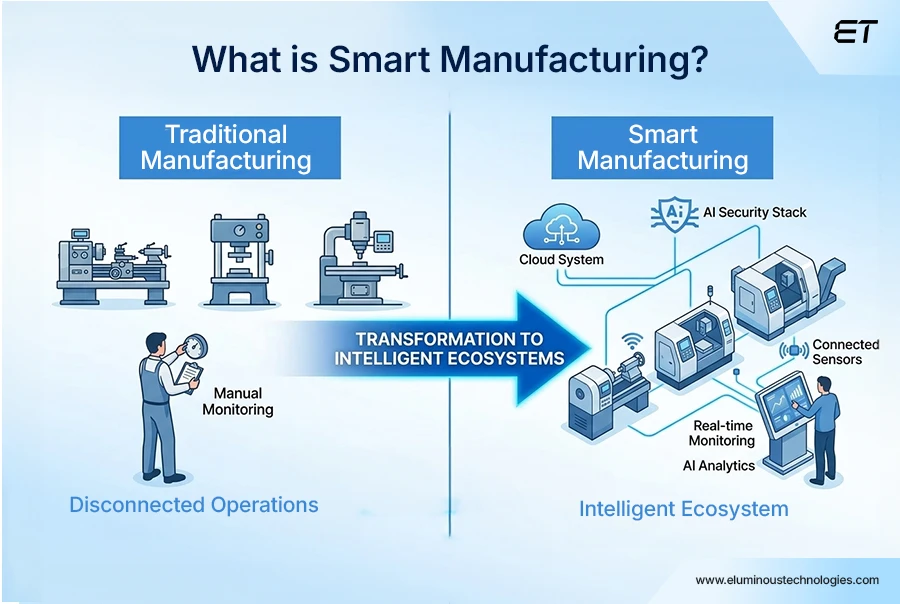
Smart manufacturing refers to a technology-enabled approach to production that combines connected systems, real-time data, automation, and advanced analytics to improve operational performance. Unlike traditional manufacturing environments, smart factories use intelligent technologies to monitor processes, optimize production, and support faster decision-making across operations.
Unlike traditional manufacturing environments where systems are working independently, smart manufacturing integrates with analytical platforms, data collection, and other newer technologies. This creates an interconnected system where machines, people, processes, and data work together to achieve goals in real-time.
This approach allows manufacturers to monitor production performance, predict equipment failures before they occur, automate repetitive tasks, and analyze operational data instantly.
The concept of smart manufacturing has been around for many years; the primary objective of intelligent factories is being capable of adapting to changing business conditions. The modern smart manufacturing industry connects sensors to monitor and collect data during the process. This data is received by the robust machine learning algorithms that transform it into actionable insights used for making smarter decisions. This helps them proactively identify risks and optimize production schedules.
Smart Manufacturing Industry: The Core Technologies That Empower
The smart manufacturing Industry primarily focuses on collecting real-time data that contributes to adapting to any need that the business objectives demand. The core of the process is to optimize different parameters through sensors and technology so it can identify any potential faults through its predictive behavior.
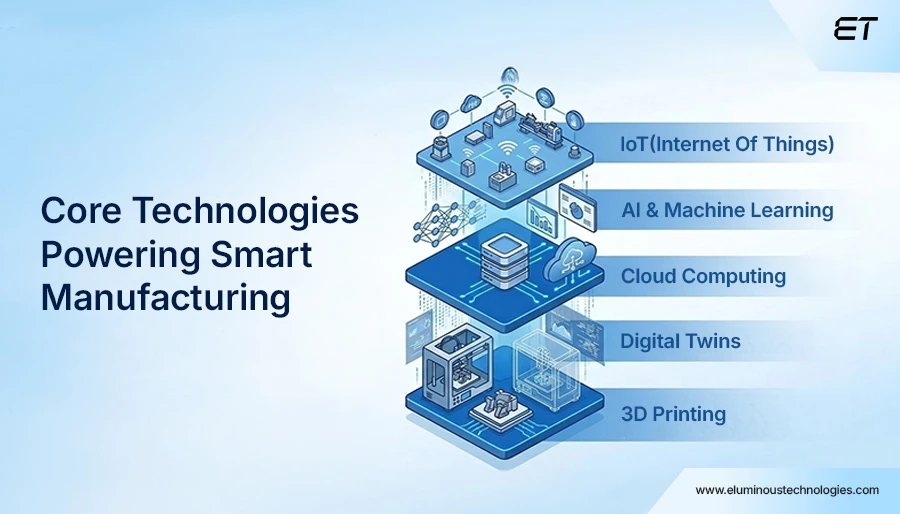
Some of the smart manufacturing technologies that deliver connected and manufacturing capabilities include:
Cloud Computing
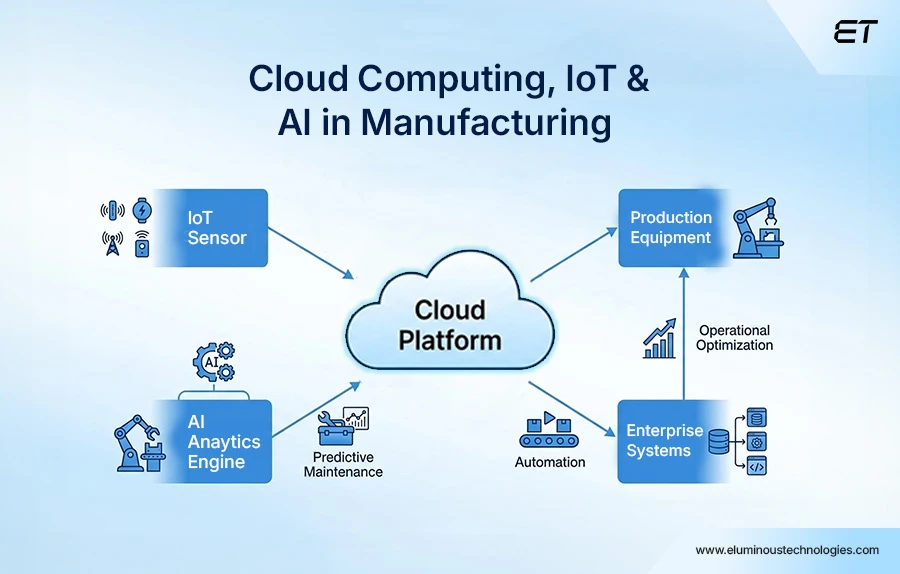
Smart Manufacturing Industry collects a vast amount of data. This is collected for insights, forecasting maintenance needs, fine-tuning operations, and collaborating with supply chain partners. Cloud computing allows this information to be stored and operated on from off-site servers.
They are used for analysis and automation, which reduces overhead costs for high-powered machinery.
IoT
Internet of Things (IoT) is one of the core technologies for manufacturing. It is used for connecting machines, equipment, sensors, and devices across manufacturing facilities.
For example, sensors installed on CNC machines can continuously monitor temperature, vibration, and machine utilization. When abnormal patterns are detected, maintenance teams can be alerted before equipment failure occurs, helping reduce costly production downtime.
Artificial Intelligence and Machine Learning
AI and ML have grown significantly in recent years and now play a crucial role in interpreting and analyzing IoT data. They are a key part of the smart manufacturing industry, as they are regularly used for optimizing procedures, reducing product and manual efforts, and spotting manufacturing defects before they occur.
Manufacturers are increasingly using AI-powered computer vision systems to inspect products on assembly lines. These systems can identify quality defects, inconsistencies, or production anomalies in real time, allowing corrective actions to be taken before defective products move further through the manufacturing process.
Digital Twins
Digital twins are dynamic digital representations of physical assets, machines, production lines, or entire manufacturing environments. By continuously receiving data from connected systems, they allow manufacturers to simulate scenarios, monitor performance, identify inefficiencies, and evaluate potential changes before implementing them in the real world.
This helps organizations reduce operational risk, optimize production processes, and improve decision-making through predictive insights.
3D Printing (Additive Manufacturing)
3D printing technology helps in building precise objects by using various materials. This is an excellent advantage for industries like automotive, medical, and aerospace, as it can be used to build specialized products.
A three-dimensional product being built with materials that are complex in nature reduces the time-to-market and manufacturing costs. This is possible as at this stage, the production team can determine the errors, size, and components with an exact real-size model.
The smart manufacturing industry has evolved over time, and with technology, it is able to generate data that improves operational efficiency, reduces waste, and identifies new growth opportunities.
Business Benefits of Smart Manufacturing
The adoption of smart manufacturing technologies is not solely about modernization. Manufacturers invest in these initiatives to achieve measurable operational and business outcomes that improve efficiency, productivity, and competitiveness.
Some of the key benefits include:
- Reduced unplanned downtime through predictive maintenance
- Improved product quality through real-time monitoring and defect detection
- Better visibility across production lines and supply chains
- Faster decision-making using real-time operational data
- Improved resource utilization and energy efficiency
- Greater production flexibility to respond to changing customer demands
By combining connected technologies with data-driven decision-making, manufacturers can improve operational resilience while creating a foundation for long-term growth.
Common Challenges in Smart Manufacturing Adoption
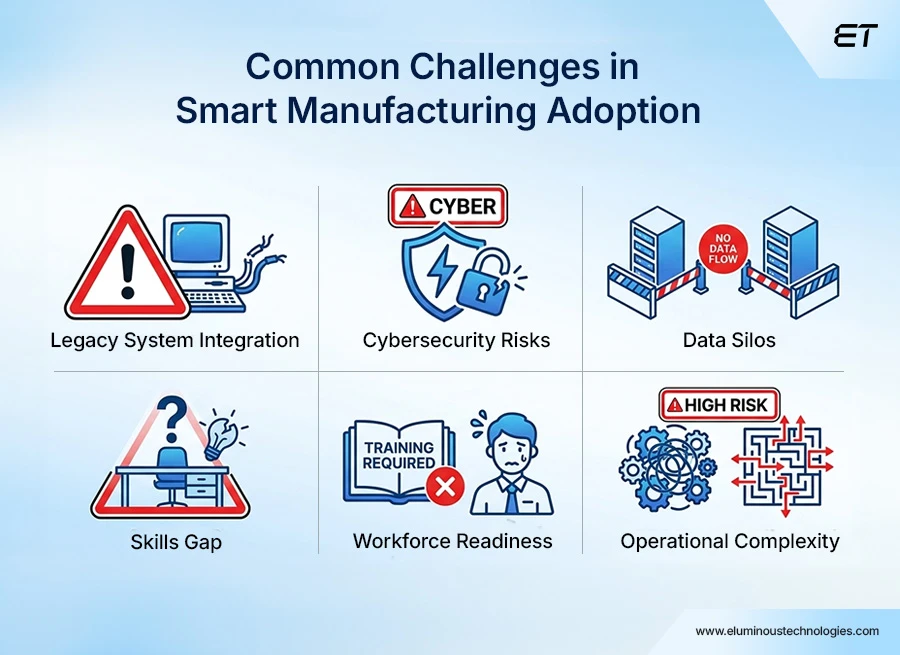
Smart manufacturing has significantly improved the entire production process while transforming industrial operations. It is responsible for optimizing the current version of the product, with the help of technology, and reducing downtime and rework.
But, with production being channelized with independent working environments like artificial intelligence, it requires certain levels of monitoring, and there are significant challenges that come with the proficiency.
Legacy System Integration
This term refers to managing and integrating older or traditional systems with modern platforms to enable better communication. This includes strategies like point-to-point integration and API-led connectivity. Some of the major concerns that arise during this process are regarding data transfer, incompatibility, and data silos. Legacy system integration is not just about integrating and upgrading the existing setup; it also involves people, machines, and communication to achieve the desired result. This means carefully evaluating every step and being able to manage both the machine and human side of changes.
Cybersecurity Risks
As manufacturing companies collect real-time data and use it to improve their current production lines, advancing the entire system across the organization takes time. Because production downtime is exceptionally costly, these upgrades in factories become prime targets for ransomware and intellectual property theft. These vulnerabilities can pose physical hazards to the production environment.
In highly connected manufacturing environments, cybersecurity incidents can affect both IT and operational technology (OT) systems. A successful attack may disrupt production schedules, compromise sensitive operational data, or impact critical manufacturing equipment. As a result, cybersecurity planning must be integrated into every stage of smart manufacturing adoption.
Data Silos
Operational data is being collected and distributed across multiple systems and departments. But the real problem arises when information processing and software operate in complete isolation. This type of working architecture leads to ineffective planning delays, undermined AI initiatives, higher operational costs, and impaired problem-solving. Without proper integration, enterprises struggle to achieve the visibility needed for effective decision-making.
Skills and Workforce Readiness
It is no exception that upgrading any work environment in an organization requires its employees to match the pace and skills. In the case of the smart manufacturing industry, this creates a need for employees capable of understanding both manufacturing processes and emerging technologies. Combining the technical workforce with optimal skills can be challenging for companies. Upskilling and change management are both critical components of transformation initiatives.
With changing requirements and advancing technologies, smart manufacturing is evolving to connect and deliver efficient results. To match the speed of change and transforming technologies, enterprises need to cover every small detail, continuously upskill their workforce, and be ready for challenging upgrades.
Final Thoughts
Smart manufacturing represents a long-term shift in how industrial organizations operate, compete, and scale in increasingly connected environments. As technologies such as IoT, AI, cloud computing, and digital twins continue to mature, manufacturers are gaining new opportunities to improve efficiency, quality, and operational resilience.
In the future, it will be defined by autonomous systems that would include advancements like agentic AI manufacturing, hyperconnected factories, and sustainability-driven manufacturing.
As manufacturers face increased pressure for improving efficiency and managing complexity, adoption of smart manufacturing technologies will continue to accelerate.
Organizations that understand the shift and take appropriate actions to embrace industry and smart manufacturing transformation will be able to unlock greater visibility and grow stronger operational performance.
However, this transformation will need more than just the technology investment alone. It demands a clear strategy and the right implementation approach. Our web development for manufacturing team understands what matters and specializes in implementing tailored solutions for advanced production environments.
Planning Your Smart Manufacturing Transformation?

Industrial Internet of Things (IIoT): Applications, Benefits, and Use Cases
It’s night shift. A conveyor belt on a bottling line suddenly stops working. The whole line halts. No maintenance technician…

Healthcare IoT Security: Risks, Best Practices, and How to Secure Connected Devices
Hospitals have many connected devices like patient monitors, wearable sensors, and clinician dashboards. Each is crucial, but only if it…


