
 Book a Meeting
The Future of Manufacturing Web Development: Modular, Scalable, Connected
Constantly changing demands, supply chain disruptions, and outdated legacy systems are pushing manufacturers to rethink their web infrastructure models.Modern manufacturing web development rests on three core pillars, i.e., modular, scalable, and connected architectures. While legacy monolithic systems help sustain a business, they become a technical hurdle to innovation.The time and scope for each action vary depending on the goal and investment priorities.Modular infrastructure suits independent deployment without factory downtime.Scalable architecture manages demand surges with adequate provisioning. And connected systems deliver real-time visibility in operations and customer-facing platforms.A thorough assessment enables a business to utilize the right web architecture while matching pace with growth and customer satisfaction.
It’s a Tuesday morning, and you’re heading to work when a notification pops up. Your supply chain manager tells you that tensions in the Strait of Hormuz are putting your logistics network at risk. Any blockage of the strait disrupts around 20% of global maritime oil and energy trade (WGSA). Every manufacturer whose suppliers or shipping routes run through it feels the ripple effects.
So, you ask, “How does this affect our production and by how many days?” If you run a monolithic legacy system, his answer would be, “We don’t know. Perhaps days, or weeks.”
This reply implies a potential dip in revenue for at least that quarter. That kind of uncertainty rarely comes down to logistics alone; it usually traces back to how disconnected your systems are from the ground floor. A broader digital transformation initiative takes years to pay off, but a modern web architecture offers visibility in weeks. So you start evaluating how your technology stack can respond more quickly to disruption. And decide to invest in modern manufacturing web development. Now the next question becomes: which approach best fits your business — modular, scalable, or connected?
Most manufacturers go wrong by implementing a one-size-fits-all solution. After some trial and error, it might get the entire production process on track, but can you afford to lose that time? Fret not. This blog answers such questions by elaborating on the three core development styles.
In this guide, we’ll explore each approach, where it fits best, and how it can help improve operational efficiency.
Four Critical Failures: Why Legacy Manufacturing Systems Collapse in Urgency
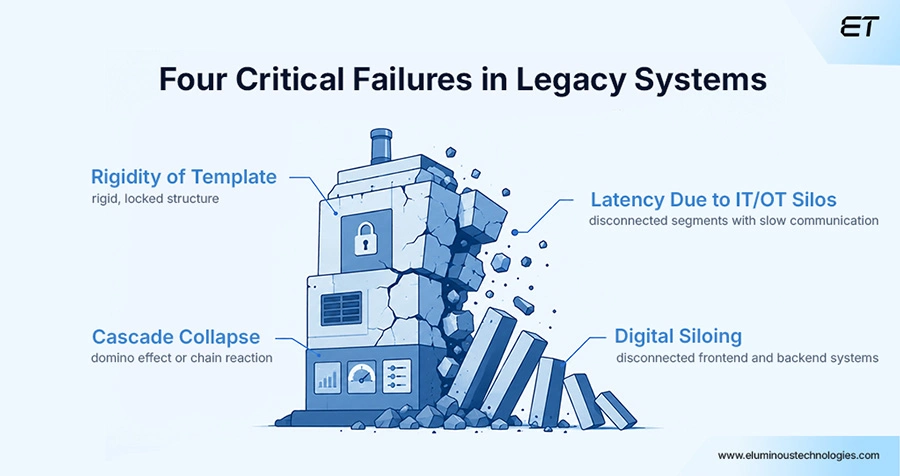
The smart manufacturing market is experiencing a 12% CAGR, more than twice the overall industry’s growth rate. Tech-savvy manufacturers are taking advantage of this opportunity, but the rest have legacy systems that can’t keep pace with growing demands.
Legacy system architecture results in operational inertia, including slower response times and limited visibility. So, the manufacturers benefiting from growth are the ones who know which part of the legacy system architecture is failing them. Here’s a breakdown for you:
Failure 1: Rigidity of Template
Standardization of operations becomes a technical roadblock, preventing operations from flowing seamlessly. A single monolithic MES or ERP with standardized workflow, rigid data schemas, and centralized approval processes is a single-tier architecture. When combined, it becomes a design for control and not flexibility.
Let’s say your Mexico facility uses legacy PLCs that can’t integrate with standardized data models. Or, your Germany factory has Industry 4.0-ready equipment with real-time IoT sensor streams that traditional MES can’t process fast.
Teams often resort to manual workarounds, turning what was meant to be a catalyst into technical debt.
Failure 2: Latency Due to IT/OT Silos
If a scheduling change at an offshore facility requires approval from 47 other requests, delays become the norm.
Corporate IT prioritizes based on enterprise-wide priorities rather than local operational needs. The request goes through the standard SDLC (Software Development Life Cycle): requirements gathering, development, unit testing, integration testing, UAT (User Acceptance Testing), and finally production deployment. By the time your request is approved, coded, tested, and deployed through the CI/CD pipeline, the market opportunity has passed. Your facility missed the window to capitalize on local demand.
Such frequent occurrences discourage the local team from seeking improvement. They would rather settle for suboptimal operations, and this communication gap hinders agility. It also leads to missed market opportunities, slower responses to competitive threats, and demoralized operations teams.
Failure 3: Cascade Collapse Due to Tight Coupling
A single inventory bug can trickle through supply chain, production, and even finance modules, resulting in a complete system crash.
The entire application ecosystem may need to be taken offline while the issue is resolved. At that time, no scheduling, shipment planning, or data analysis can occur. On the front end, customers and vendors lose trust in the business.
The cost of this downtime can lead to significant losses.
Failure 4: Digital Siloing of Manufacturer Website
The first three failures have roots inside your operations. This one shows up on the front end, but it comes from the same cause: systems that can’t share information fast enough.
Everything on the backend is up to date. Your ERP is up to date, internal supply chain visibility is clear, and production schedules are running smoothly. Until there’s a change.
In this case, does the website reflect the transition right away or leave buyers without accurate information when they need it most?
If buyers have no insight into the latest product status or lead time estimates, it creates a trust gap. This is how outdated manufacturing web development can lead to wasted marketing spend, lost sales, and ripple effects into future launches.
The Three Manufacturing Web Development Pillars
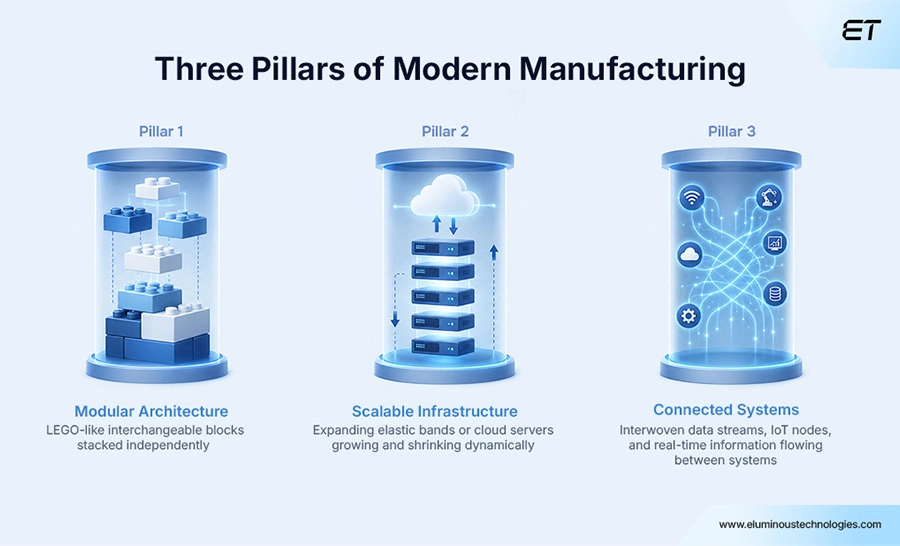
With multiple options available, the right approach to manufacturing web development depends on your business priorities.
For instance, a global automotive manufacturer would require a different approach from a single-facility specialty chemical manufacturer. That’s why it’s important for you to understand where each pillar adds the most value and where it doesn’t. And whether such enterprise web architecture is one that your organization needs.
Here’s a closer look at each pillar and the role it plays in modern manufacturing.
Modular Architecture
In this architecture, complex software is broken into independent, small, and interchangeable blocks. Instead of one large, tightly coupled application, you get targeted services for specific functions.
Think of it like a LEGO set. Each brick has a purpose. You can add, replace, or upgrade them as your business evolves.
Microservice architecture lies at the core. With containerization (Docker/Kubernetes), API-first design patterns, and event-driven communication (Kafka or MQTT), businesses can deploy and scale each service independently.
This flexible architecture allows a business to add a supply chain module without having other services interfere with it.
So, when your business requires adaptation, the factory doesn’t have to be offline. Teams work independently, and features are deployed without interrupting operations.
Scalable Infrastructure
This model evolves with demands. When data volume increases, processing demands surge and user load jumps; scalable manufacturing web development architecture expands accordingly.
Think of it like an elastic band that stretches and returns to its original form as needed.
Traditional manufacturing web development systems push businesses to over-provision infrastructure for peak demands. During periods of fluctuating demand, provisioning additional infrastructure manually is too slow and costly.
Because of cloud-native platform deployment, auto-scaling capabilities, elastic load balancing, and serverless computing, resources are automatically provisioned and deprovisioned.
This is how scalable cloud manufacturing web development removes the limited capacity bottleneck of on-premise legacy systems.
Connected Systems
Connected systems are designed to keep data flowing seamlessly across applications and teams.
Implemented through IoT pipelines, data flows instantly from one to another. So supply chain data is routed through a unified data layer, accessible across the organization, even to production and management in real time. This gives every team access to the same real-time information.
By contrast, with disconnected/legacy silos, each team operates with a different version of the truth. Data becomes so stale by the time it reaches decision-makers that any discussion proves to be futile.
With connected systems manufacturer web development, the whole infrastructure behaves like one living, breathing organism.
Which Pillar Matters for Your Manufacturer Web Development?
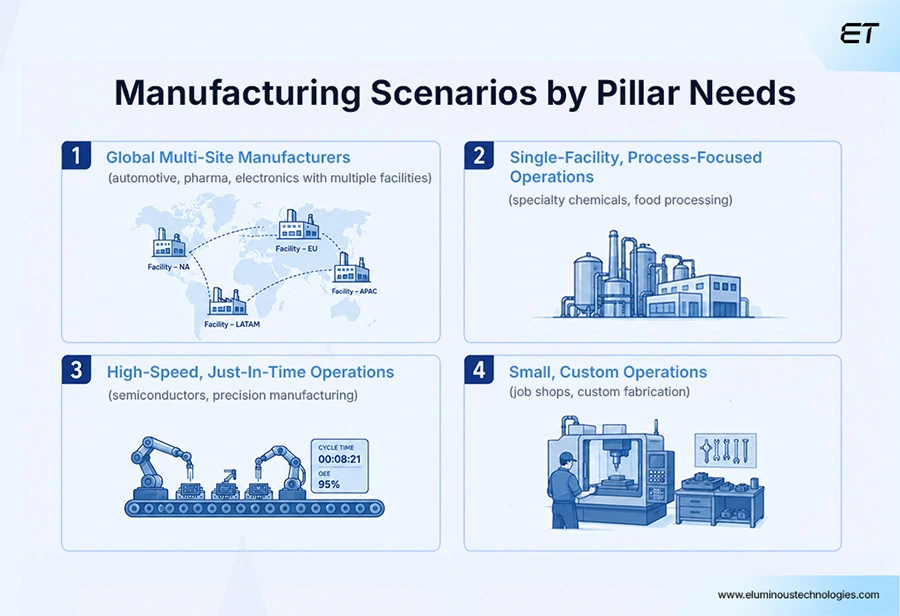
The simplest answer is: it depends on your industry and the scope of operations.
1. For Global Multi-Site Manufacturers (such as Automotive, Pharma, Electronics)
For maximum efficiency and real-time insights, these businesses can consider a combined manufacturer web development architecture that integrates all three. Complex supply chains, global coordination, regulatory requirements, and multiple facilities demand infrastructure-wide agility.
Rising demand for hybrid cloud and cloudbursting is evidence that global ventures are leaning towards flexibility, provisioning resources as needed, and deprovisioning them as needed. According to Flexera’s State of the Cloud 2026 report, 73% of enterprises have adopted hybrid cloud to run their operations.
Volkswagen is a prime example of the blended approach. It deployed a common web platform across 124 plants, 500 warehouses, and 1,500 suppliers. The model ensured each site operated independently (modularity), handled regional demand swings without over-provisioning (scalability), and shared data across the entire network in real time (connectivity).
2. For Single-Facility, Process-Focused Operations (such as Specialty Chemicals, Food Processing)
In these ventures, businesses primarily need modular manufacturing web development so they can refine and update their individual production lines independently. The goal is to ensure operational excellence. But during seasonal spikes, scalable infrastructure provisioning is also necessary to capture the ROI of operational flexibility.
A modular approach allows manufacturers to build independent services for different production lines without affecting the rest of the system. As your web infrastructure scales, you handle increased workload and pay only for the capacity you use. Cloud-native manufacturing web infrastructure proves helpful here.
That said, this doesn’t mean you don’t need a connected systems infrastructure. Real-time visibility can boost your decision-making, but that can be integrated as the business matures.
For instance, a chemical manufacturer can begin with manufacturing web development services for various production processes and, over time, include sensor connectivity to improve production efficiency.
3. For High-Speed, Just-In-Time Operations (Industries such as Semiconductors and Precision Manufacturing)
Extreme speed coupled with hundreds of sensors streaming data from around the globe — businesses like these call for millisecond-level decision-making.
So, a connected and scalable web system becomes crucial. Event-driven architectures allow applications to respond to data changes in near real time, making them well suited for high-speed manufacturing environments. You can scale processing power up and down based on data volume.
For example, semiconductor manufacturers often manage hundreds of interconnected tools that continuously generate operational data. They need both the processing of terabytes of daily data and edge computing for a standardized core process.
4. For Small, Custom Operations (Example: Job Shops, Custom Fabrication)
The characteristic trait of such ventures is the simplicity of their operations. No massive data volume to handle, no global connectivity, but the focus is on building a standard operating process.
If you’re just starting out, you’ll need a scalable web dashboard to track orders and monitor machines. So, a cloud-hosted web app works. Over time, as you add more processes, modularity can be the next add-on.
Consider a small job shop. It can suffice with a scalable dashboard. As the business expands, you can introduce modular capabilities incrementally. If IoT sensors are part of the growth plan, the entire manufacturer web development infrastructure will receive a connectivity layer.
Assessment Framework for Manufacturing Web Development
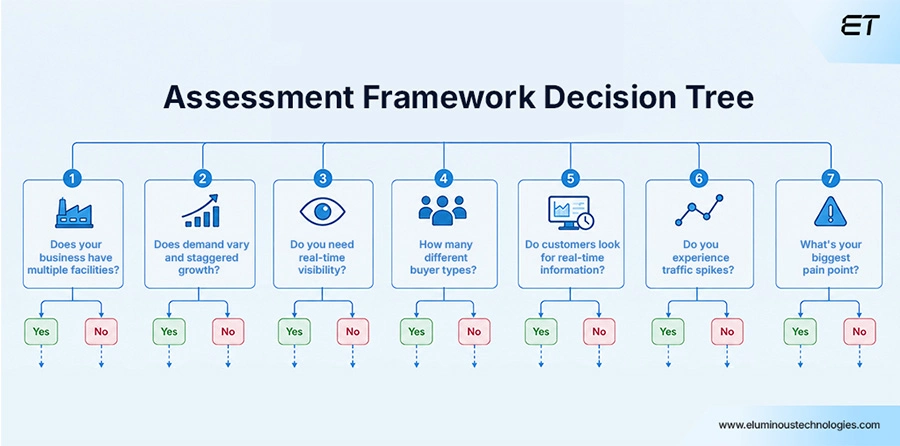
Thinking purely about long-term feasibility can be a mistake in manufacturing web development. Likewise, treating your website as nothing more than a digital brochure can limit operational efficiency, customer experience, and your ability to scale.
So, how do you decide which approach is right for your business? Start by asking yourself these questions:
1. Does your business have multiple facilities or sites?
- Yes → You likely need modularity.
- No → You might not need modularity.
2. Does the demand for your product/service vary, and do you have staggered growth plans?
- Yes → You likely need scalability.
- No → You might not need scalability.
3. Do you need real-time visibility across systems or facilities?
- Yes → Your business can get better with connectivity.
- No → You might not need connectivity.
4. How many different buyer types do you serve? (engineers, procurement, distributors, resellers)
- Multiple types → You can opt for modularity (to customize for each type)
- One or two types → You might not need modularity.
5. Do your customers look for real-time information? (availability, lead times, order status, production updates)
- Yes → You’ll likely benefit from connectivity.
- No → Batch updates might be sufficient.
6. Do you experience traffic spikes on your customer portal?
- Yes, major spikes → You’ll likely benefit from scalability
- No, steady traffic → Basic scalability might be sufficient
7. What’s your biggest pain point today?
- Operational rigidity → Prioritize modularity
- Operational scalability → Prioritize scalability.
- Operational visibility → Prioritize connectivity
- Customer experience friction → Prioritize digital integration.
- Outdated customer information → Prioritize connected systems.
Endnotes
There’s no single best architecture for a business web development. Modular, connected, and scalable each solve a different problem in modern manufacturing web development. But picking the right architecture boils down to specific business priorities.
Before you consider adoption, assessment must be a core criterion for optimizing investment. This includes determining where you stand, both operationally and digitally. While internal efficiency is wonderful for operations, customer experience can be severely hampered if the digital manufacturer’s web development infrastructure lags behind.
It’s also worth keeping in mind that modernization is most effective when approached in stages. This will help keep costs in check and customer trust evolve with you.
Want to modernize your existing web development or build a new one from scratch?

Industrial Internet of Things (IIoT): Applications, Benefits, and Use Cases
It’s night shift. A conveyor belt on a bottling line suddenly stops working. The whole line halts. No maintenance technician…


Healthcare IoT Security: Risks, Best Practices, and How to Secure Connected Devices
Hospitals have many connected devices like patient monitors, wearable sensors, and clinician dashboards. Each is crucial, but only if it…


