
 Book a Meeting
AI in Manufacturing: Why Integration Determines Success
For AI adoption to succeed in manufacturing, organizations need to progress beyond pilots to full scaling that drives concrete business outcomes. Success requires orchestrating AI in manufacturing across your entire organization. This means aligning data, governance strategies, and organizational readiness. Manufacturers that treat AI as an enterprise-wide initiative, not a department-level experiment, achieve expected results. The core benefits range from quality improvements to operational efficiency. Over time, this results in financial impact as well. So, the path forward lies in remaining true to integration that fits with the current capacity of the organization beyond mere aspirations.
As a CIO, CTO, or Head of Manufacturing, there’s no doubt that you understand the benefits of using AI for increased efficiency, reduced downtime, and more freed-up employees. What you want to see is that this investment pays off and the digital ambitions of your business align with the appropriate execution.
‘This is where the real problem lies. Manufacturers continue to spend more on artificial intelligence adoption, up to 47% by the end of 2026 (Gartner).
At the same time, the majority of executives report that their investments in AI have not met the expected outcomes. By implementing fragmented AI pilots and projects rather than integrating them and making each support another, they are missing out.
The smart manufacturers pulling ahead have found the fix: they treat integration, not adoption, as the goal. Instead of running a predictive maintenance pilot here and a computer vision project there, they connect these systems that support each other.
Here, we will learn more about the execution gap, its implications, and the way leading manufacturers manage to bridge it.
The Execution Gap: Why Most AI in Manufacturing Initiatives Fail
51% of manufacturers say data quality is their biggest obstacle to AI success — more than integration issues or unclear ROI.
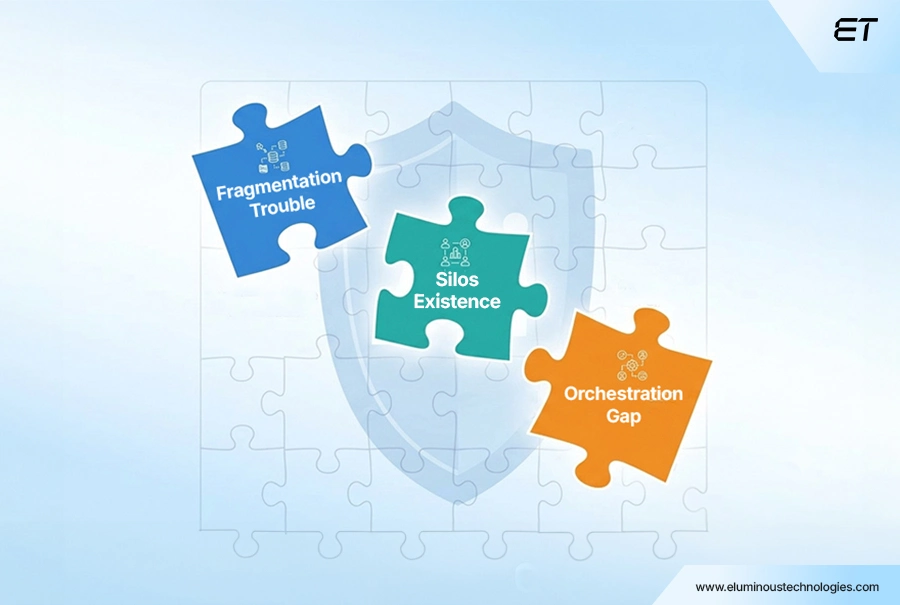
These aren’t failures of technology, but rather of coordination. To put it clearly, integration is missing from most AI in manufacturing processes due to fragmentation, silos, and an orchestration gap. Each of these shows up differently on the plant floor, so it’s worth looking at them one at a time.
The Fragmentation Trouble
This fragmentation stems from template adaptation i.e. generic, one-size-fits-all AI models. Solution vendors train these models on aggregate datasets collected from various sectors and equipment.
Generic solutions are adequate in average situations; however, they do not perform well in practical settings. These models function fine in average conditions, but they struggle in the messy reality of a real plant floor.
Fifteen-year-old equipment differs from the equipment the solution was trained on. So, just because a particular company has integrated a certain solution doesn’t mean the same solution will be suitable for your case. The similar gap shows up in how teams share information, not just in how AI models are trained.
Data and Operational Silos
When communication between AI in manufacturing systems falters, the optimization opportunities leak out.
Only 27% of manufacturing leaders have fully embedded an AI strategy across business units.
So, how does this translate into a business process?
Maintenance teams see equipment alerts while production teams and supply chain teams operate from separate points of view—all deciding with fragmented information.
Not only this, but where a predictive maintenance system detects a likely failure, it must trigger a workaround and automatically align work schedules. This should also be reflected in alerts to supply chain teams about parts or resource availability.
In a siloed environment, none of this happens. Cross-system insights across manufacturing enterprise web portals that can be optimization indicators end up being a missed pattern. On top of this, teams interpret the same situation differently, leading to misalignment.
The Orchestration Gap
In businesses with AI in manufacturing, the orchestration gap has a pilot purgatory pattern.
1. AI is deployed by organizations at the department level and not orchestrated enterprise-wide. Pilots in such cases operate in controlled reality, so the implementation translation, such as during production, fails.
2. They deploy technology without an orchestration strategy. Lack of data modeling, integration, and governance, which is the core reason why technology investments have not lived up to expectations.
3. When no one owns the AI outcomes, accountability disappears. So, the same governance that is free in pilots becomes expensive in production.
4. Employees are unclear on how things should be done in new workflows. Due to underinvestment in change management, employees remain unclear and annoyed because they have yet another system to master.
5. Without proper metrics and success criteria, ROI measurement is tricky since only 30% of organizations rank scalability among their top objectives.
How Manufacturers Build AI That Delivers Results
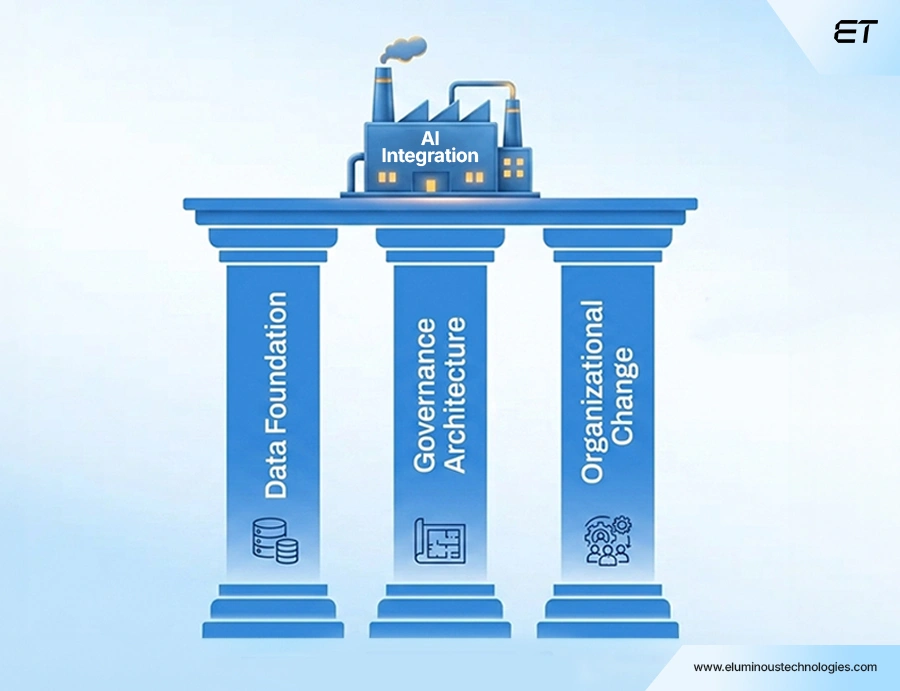
The key to successful integration of AI in the manufacturing industry depends on three important pillars: Data Foundation, Governance Architecture, and Organizational Change. Here’s how each one works in practice.
Data Foundation
You should start with high-quality, relevant data instead of waiting for perfect datasets. For smart manufacturing strategies, that means aligning AI deployment with the data you already have. It involves establishing baseline quality for such datasets and then generating value over time through iterative Improvement.
You can start with clean, well-identified failure data pointers for specific assets to suit the AI types for enterprise transformation with deployment.
Generally, these are bottleneck machines whose failure would result in a halt in production. Starting with this will kickstart your AI in manufacturing journey and at the same time, give you space to expand with additional equipment.
For instance, a predictive maintenance system wouldn’t require datasets across all equipment. A plant might begin with vibration-sensor data from its three most failure-prone conveyor motors, rather than waiting to instrument the entire line before starting.
Governance Architecture
Most organizations think of governance as a brake. In practice, it helps organizations scale their AI strategies faster, even with pauses in the beginning.
Scaling gets a structure when a manufacturer starts with policies. It comprises designing rules for data access, defining roles and responsibilities across IT/OT teams, and creating accountability processes.
That said, it’s best to keep governance identification-first. This implies keeping the starting point around identity: knowing who has access to a system, when, and what actions they performed.
Now that IT and OT (operational technology) are converging, it is essential to be able to answer the basic questions, such as who has access to this system, when, and what actions were performed?
For example: A plant that can tie machine-level access to individual employee logins, rather than shared operator credentials. Doing this will enable the organization to trace exactly who changed a setting before a defect occurred.
Companies that consolidate their identities from the enterprise and industrial systems will be able to scale AI safely.
Organizational Change
Using tech in a business is an easy part. Convincing the workforce ‘why’ is a different ballgame altogether.
Leaders aiming to integrate AI in manufacturing treat implementation as an organization-wide change.
This involves proactive participation of leadership across functions. This begins with addressing workforce concerns as a primary directive and reworking how teams collaborate at the ground level. The goal is to show teams that AI is for them, not against them.
For instance, when a maintenance technician sees that AI adoption has led to a reduction in 2 AM emergency calls, their confidence in the process improves—and so does overall efficiency.
Thus, it makes employees advocates while freeing them for strategic optimization.
Benefits of AI in Manufacturing
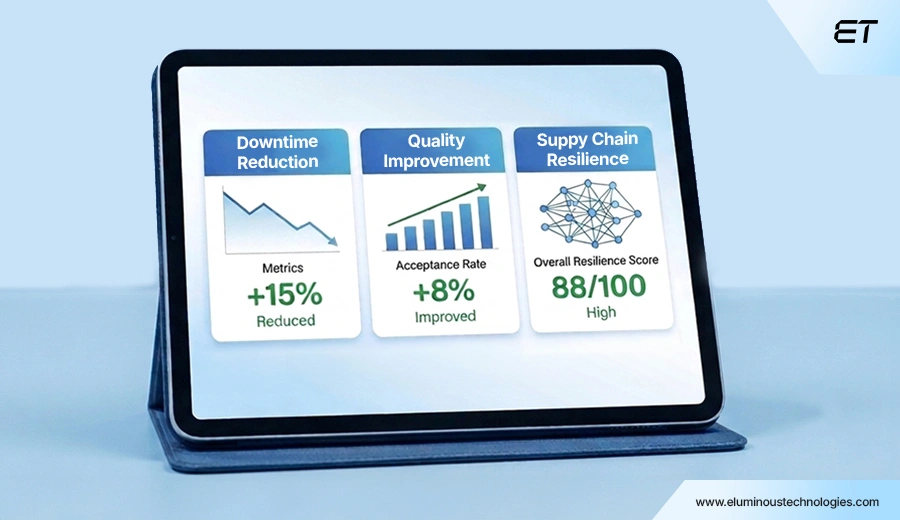
Efficiency is the most commonly talked benefit of AI in manufacturing. But there’s more to it. It’d be best to say there’s more nuance to it.
Efficiency gets most of the attention when people talk about AI in manufacturing. But the real payoff of the integration-first approach shows up in several other ways too. Let’s unpack one by one below.
Downtime Reduction
Early failure detection using AI stops machines from sudden breakdowns and makes it easier to maintain a seamless production strategy.
On top of downtime reduction, equipment lifespan also increases. Because of condition-based maintenance, instead of calendar-based checkups, manufacturers can save on unnecessary maintenance costs and unplanned repair spend significantly.
Quality Improvement
With real-time quality control, manufacturers can make changes in their process before any defect is made rather than detecting it after the manufacturing process is completed.
It avoids wastage of time, labor, and ingredients, saves on reworking expenses, and provides a quality product that further boosts customer trust.
Case in point, computer-vision-based inspection can flag a defect mid-process. IT can spot a misaligned weld or an inconsistent coating before the part moves further down the line.
Operational Efficiency
Integrating AI across multiple dimensions in the manufacturing industry yields a variety of positive results.
For instance, in the food and manufacturing industry, AI can bring it under control. It can simulate changes in processing parameters, see the likely impact, and help operators make adjustments to remove errors that cause losses.
Supply Chain Resilience
Supply chain disruptions rarely make themselves apparent early on for manual tracking to catch. AI changes that by continuously monitoring supplier performance, shipping delays, and material costs, then flagging risks before they hit the production line.
For example, if a key supplier’s on-time delivery rate starts slipping, an AI system can surface that pattern. This will give procurement teams time to line up an alternative supplier.
This gives manufacturers room to make sourcing and cost decisions proactively rather than reactively
Financial Impact
The financial benefit from an integrated application of AI is significant. That said, the path to financial benefit varies greatly depending on AI use cases in manufacturing, the approach taken, and the timing of deployment.
You should note that the advantage of AI in manufacturing isn’t direct. It comes primarily from operational cost reduction and holistic efficiency gains rather than revenue expansion.
Siemens, for example, saw both a 40% reduction in downtime and a 32% improvement in product quality after integrating AI across its factories. These gains appeared as cost savings long before they showed up as new revenue.
This is one of the fundamental distinctions that shapes how manufacturers should evaluate and structure their AI investments.
Real-World Examples of AI in Manufacturing
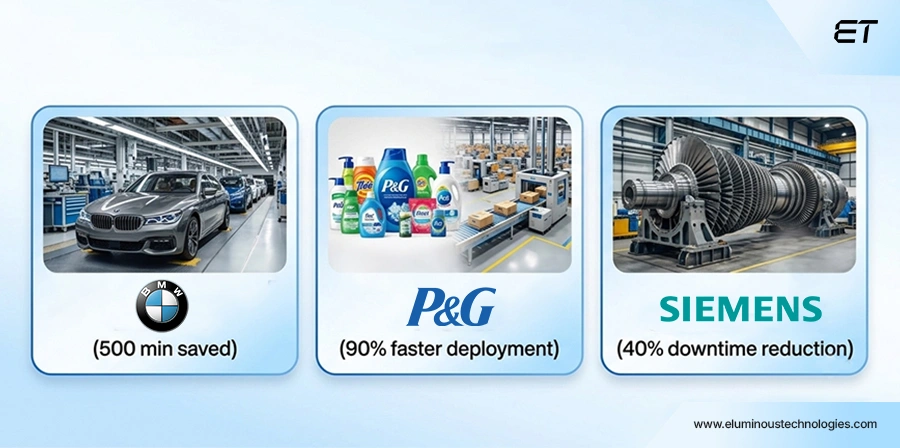
Connecting systems for the integration of AI in manufacturing rather than operating in silos help with downtime reduction, efficiency, revenue, and more. But what does it look like in practice?
Here are three real manufacturers that have moved beyond pilots and achieved measurable results.
BMW: Avoiding Downtime
BMW’s Regensburg plant faced a common challenge: equipment failures on conveyor lines could halt the workflow of the entire assembly process.
True to the Data Foundation principle, BMW built the predictive maintenance system on the sensor data its existing conveyor equipment already produced. The AI-supported system monitors conveyor technology during assembly that signals a problem is en route. When it spots an anomaly, such as an unusual vibration or temperature reading, it alerts the maintenance team before the equipment fails.
The key difference from other approaches is its proactive working. An integrated, learning maintenance system identifies potential faults early and automatically removes the affected conveyor from the production line so it can be repaired without stopping everything else.
80% of main assembly lines now use this predictive approach. The system continues to learn and improve from every piece of data it collects. Therefore, the manufacturing plant with a digital backbone keeps running seamlessly.
Procter & Gamble: Faster AI Deployment
Procter & Gamble (P&G) took a different approach to deploying AI in one location at a time. With this, the company reduced model deployment time by up to 90%.
P&G collaborated with Microsoft to implement Azure IoT operations. Azure Arc allowed the creation of a unified AI platform. It relies on the principle of an “internal AI factory.” All the machinery-related information is gathered by this single platform. AI models are deployed right on the shop floor.
By developing an AI-based algorithm at Procter & Gamble, the firm’s data analysts can now get this technology operational in just days, compared to months.
This is a good example of Governance Architecture.
P&G connected its IT systems (where data scientists work) with its OT (operational technology) systems (the actual factory equipment). This integration allowed the company to directly interact with the manufacturing systems in the plant while executing and learning from real-world results simultaneously.
Siemens: Downtime Reduction, Quality Improvement
Siemens deployed its own MindSphere platform across its factories.
How? All the sensors and systems used within the manufacturing facility were integrated into a single intelligence layer. This implied that instead of the machines sending their information to separate dashboards, all the information was then sent to one place where artificial intelligence could analyze it all at once.
The maintenance team found out which equipment needed servicing even before it stopped working; the quality assurance team could detect any defects immediately.
The results became a natural progression, resulting in reduced downtime, higher-quality products, and employees working on improvement rather than troubleshooting.
AI in Manufacturing: A Side Note From our Team
BMW, P&G, and Siemens all had the budget and the engineering bench to build these systems in-house. Most manufacturers don’t work with that kind of runway, so their AI challenges tend to look a little different.
If you’re a smaller and mid-sized manufacturer, the problems you run into might be related but distinct for AI in manufacturing support and operations, such as:
- Scrappy technical knowledge: Critical data sits scattered across PDFs, outdated manuals, and the heads of a handful of senior engineers. That makes it hard to give every technician or support agent consistent, accurate answers.
- High volume of repetitive technical queries: Support and service teams get buried under setup, troubleshooting, and warranty questions.
- Slow root-cause diagnosis: Technicians have to manually cross-reference multiple documents, systems, and past incidents just to pin down what actually went wrong, which drags out diagnosis time.
- Operational technology security exposure: Plant floors carry different security risks than standard IT systems, so manufacturers stay cautious about anything that widens that exposure.
- Keeping pace with product updates: As products evolve, documentation and support processes often fall behind, leaving gaps in service quality.
- Workforce strain: Engineers spend so much time on repetitive troubleshooting that little bandwidth is left for higher-value technical or product work.
- Rising cost of support at scale: As the customer base grows, so does the cost of scaling technical support headcount.
- Reactive maintenance model: Most equipment issues only get addressed after a failure or complaint, instead of being caught and prevented in advance.
The same integration-first principles apply here too, just at a smaller scale.
A suitable approach is to start with the data you have to create an AI business process automation system. Take help from AI experts to streamline your governance, and then bring the organization team along.
Final Thoughts
The most successful businesses with AI in manufacturing have orchestrated practical solutions tailored to their unique needs. That approach pays off in several ways at once. It includes cost optimization and productivity increases, while reducing downtime and improving quality.
The path forward becomes clear with this approach. Define the challenge you’re facing. Invest in data quality and governance. Build an AI system that collaborates through engagement from the team and leadership.
If you feel ready to move in this direction, the first step is a conversation with an AI development partner that understands manufacturing and implementation equally.
Wondering how to build a custom AI for your manufacturing business?


Healthcare IoT Security: Risks, Best Practices, and How to Secure Connected Devices
Hospitals have many connected devices like patient monitors, wearable sensors, and clinician dashboards. Each is crucial, but only if it…

AI in IoT: How AI Is Reshaping the Internet of Things
Imagine your factory machine noticing a problem before you do. Its sensors keep monitoring temperature, vibration, pressure, and other operating…


