
 Book a Meeting
AI Staff Augmentation: A Faster Move from Prototyping to Production


AI is changing staff augmentation across industries. As artificial intelligence’s usage moves from isolated systems to connected, ready-to-use workflows, expectations are growing, too.
AI staff augmentation now spans beyond resource deployment. Augmented teams now support businesses with data collection, operations, integrations, governance, and human review. The common thread across these changes is why enterprises deploy an AI model and where they fall short. While external teams’ responsibilities may expand, the client retains decision-making authority and accountability for the AI system and its outcomes. This article will help you understand how staff augmentation is changing with AI and what buyers need to consider when choosing and managing augmented teams.
If you’ve adopted a new technology in your organization, finding the right talent can be tricky. Artificial intelligence usage follows the same footsteps.
So far, most AI work has focused on use cases such as forecasting, code assistance, automation, and industrial inspection. But now, enterprises are shifting toward more complex, connected multi-system workflows.
As businesses plan to deploy new AI products, like GPT-6 Astra, specialists need broader capabilities beyond model development. More complex workflows mean more connections with the existing systems. This creates a greater need for skilled professionals to bridge the AI gap organizations face.
That means AI staff augmentation has to work on two fronts: providing technical expertise and broader implementation and operational capability.
The skills needed for AI delivery have expanded since last year. Being effective means keeping up with how its processes and capabilities keep changing.
In this blog, we’ll explore which aspects of AI-driven staff augmentation are evolving and which persist. From cross-functional capability mix to human-in-the-loop, these IT staff augmentation trends offer many important considerations before you plan staff restructuring.
What AI Staff Augmentation Means in a Business Setting
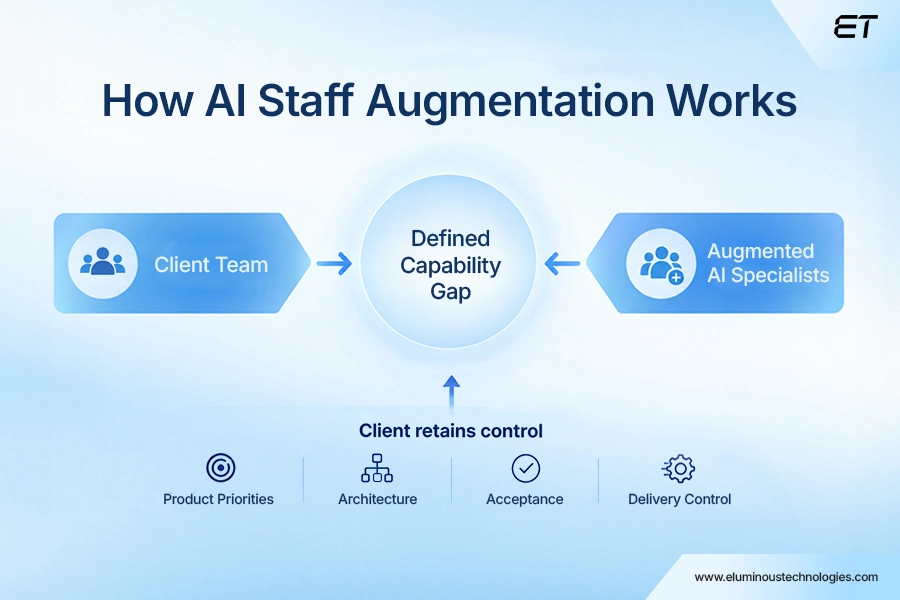
AI staff augmentation integrates external specialists into the client’s current business team. These specialists primarily fill a specific skill or capacity gap for an agreed-upon engagement.
The client owns priorities, architectural decisions, acceptance rules, and final decisions. The augmented teams support daily deliveries within those boundaries.
There’s no hard-and-fast rule for the exact provisions of an AI staff augmentation services provider. It varies from one contract arrangement to another. The provider may help the client first identify the needed role mix. Then, they assemble a team by sourcing, vetting, and embedding AI specialists in the desired initiative.
But the core question remains the same no matter the arrangement: who owns the work and its consequences?
To give you a clear view, the AI staff augmentation team may have several roles, such as:
- AI engineers for building and integrating models
- Data engineers for feeding reliable and governed datasets
- MLOps engineers for deploying, updating, and monitoring models
- LLM or RAG specialists for creating systems around the existing business needs and enterprise knowledge
- Quality and evaluation specialists for checking accuracy, safety, trustworthiness, and regressions
- Security and privacy experts for protecting the code, data, credentials, and model access
- Product and domain experts for defining what business outcomes to be expected and associated risks
- Change and enablement facilitators for helping enterprise employees adopt the new workflows
The right mix depends on what you need the AI staff for.
When in doubt, ask:
Do you need the extra support for product capacity, enterprise model engineering, data readiness, evaluation, or something else?
Getting this distinction right matters because AI talent is a broad category. The client controls the extent of that control. That’s why it’s important to outline business outcomes, risks, and responsibilities before the move.
How AI Is Changing Staff Augmentation Requirements
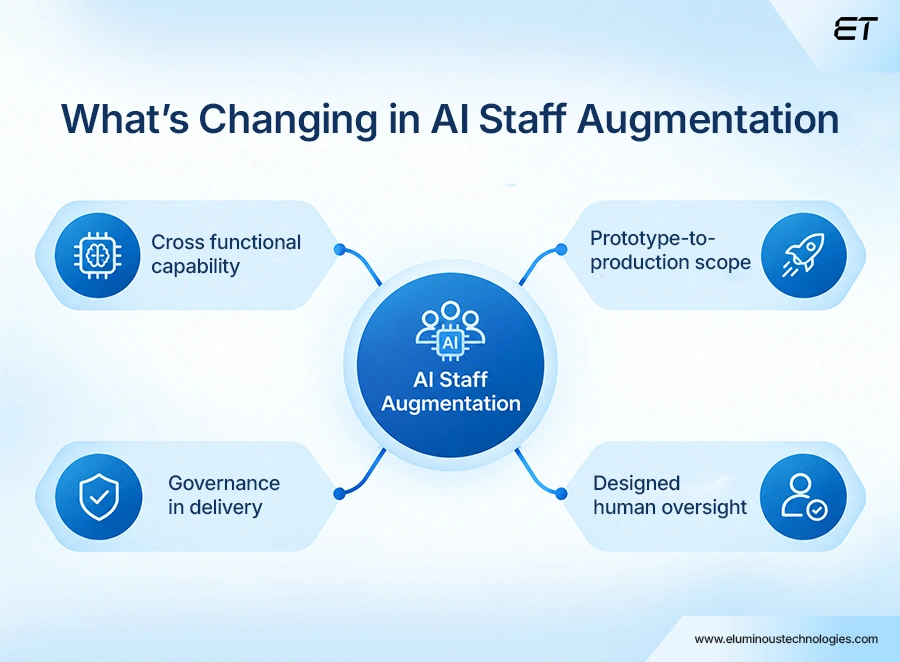
As AI moves from isolated experiments into production workflows, buyers need more than additional AI development capacity. They seek AI staff augmentation that can integrate, operate, monitor, and govern connected workflows cohesively. Four changes are reshaping what enterprises expect from an augmented team.
1. Augmented Teams Are Becoming More Cross-Functional
In the pre-AI era, staff augmentation decisions focused on role fit, rate, time zone, years of experience, and similar factors. These aspects still matter, but buyers now need broader AI capabilities and deeper technical expertise.
As organizations move from experimentation to scaling, demand is shifting from capacity to capability for augmented AI talent. Now, AI experts from external teams have to sit at the junction of data, integration, security, deployment, and monitoring.
This doesn’t mean every company needs a large cross-functional team from its AI staff augmentation vendor.
This is where defining your needs beforehand becomes useful.
If you’re in the early stage of AI deployment, you need additional capacity to build and test a use case. As you move to production deployments, you require both capacity and capability:
1. Enough experts to deliver the work
2. Expertise to integrate AI with current systems
If you already have strong data, product, and security capabilities, you would only need an AI engineer or MLOps specialist. On the other hand, if you lack many connected capabilities, a small team covering data, engineering, evaluation, and deployment may be enough.
Use this table for a quick overview of the capability mix and ownership you can expect.
| Business need | Likely capability mix | Internal ownership that remains important |
| Enterprise knowledge assistant | Data engineering, retrieval design, evaluation, security, product | Knowledge policy, access rules, adoption, and acceptance |
| AI-enabled software delivery | AI engineering, platform engineering, QA, security, developer enablement | Architecture, release authority, code ownership, and risk acceptance |
| Predictive maintenance | Data science, industrial integration, reliability, cybersecurity, domain expertise | Plant decisions, safety, operational approval, and workforce adoption |
| Clinical or regulated workflow | AI engineering, validation, privacy, compliance, domain experts | Clinical or regulatory accountability and human review |
2. The Scope Is Expanding from Prototype to Production
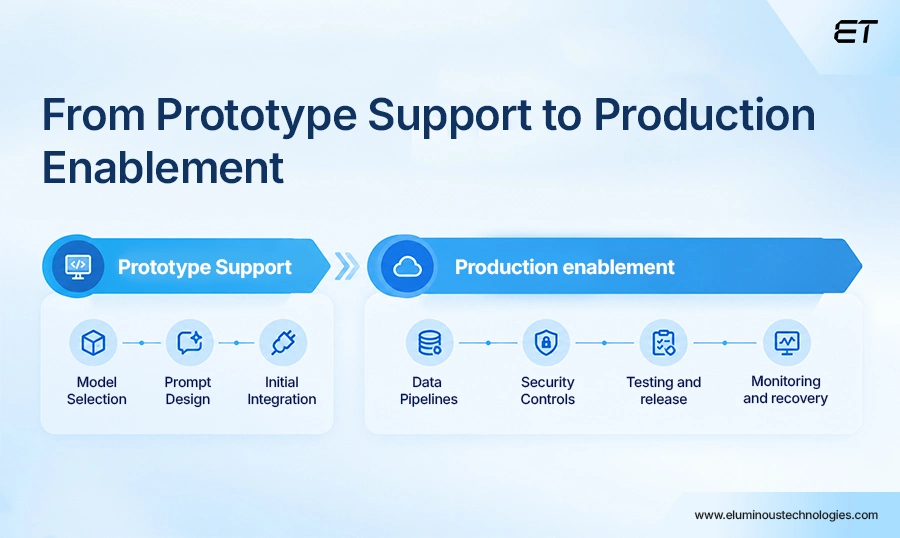
Production success is no longer limited to a working prototype. It demands much more. Teams prepare data, connect systems, evaluate outputs, manage access, document the rationale, monitor performance, and respond to incidents.
As an AI use case moves from prototype to production, the augmented team’s responsibilities expand.
1. During the prototype stage, teams can isolate variables and limit access.
2. In production, the focus shifts to reliability, security, monitoring, integration, and failure handling.
3. Augmented teams, therefore, take on responsibilities beyond model development.
A specialist hired for a prototype may focus on model selection, prompt design, or initial integration. However, the same expert in production engagement needs to work within the client’s data pipelines, security controls, testing procedures, and release environment.
In production, augmented teams also need to address AI risks throughout the system lifecycle.
Beyond the value proposition, another reason for broadening the scope of augmented teams is stability. AI adoption can amplify delivery throughput, but it can also hurt delivery stability. In simpler terms, AI helps teams implement changes faster without confirming whether those changes are reliable. Augmented teams bridge this gap between operations and reliability.
As enterprise AI strategies mature, augmented teams’ role expands from building solutions to operating them reliably.
3. Governance Is Becoming Part of the Delivery Scope
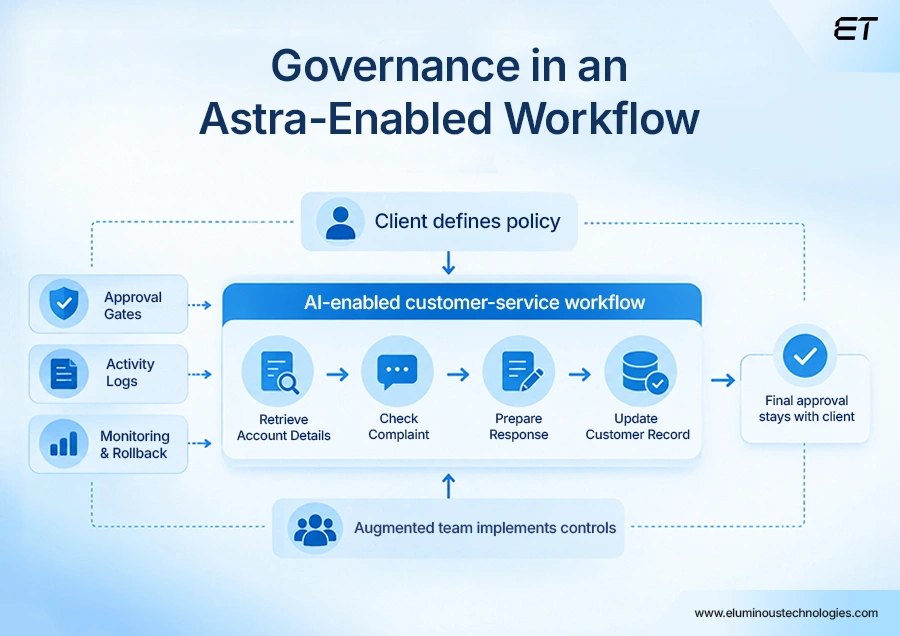
Let’s say that you adopt OpenAI’s Astra in your customer-service workflow. It retrieves information such as account details, reviews complaints, prepares responses, and updates customer records.
As AI systems become more connected and autonomous, governance needs to be embedded in the technical implementation. It’s not wise to keep it aside as a separate compliance review in the interest of efficient processes.
The client designs the policies around the technical implementation of a process. Such policies serve as effective controls within the organization.
With agentic systems that interact with multiple applications, businesses can require a higher degree of monitoring with AI staff augmentation, including:
- Configuration of the data and applications for a tool or agentic AI to use
- Decision on the permissible access to the technology
- Blocking of actions falling outside the purview of allowed usage
- Inclusion of approval gates, activity logs, monitoring, and rollback
- Collection of technical evidence for security and compliance feedback
Such practice is more prominent now because executives place responsible-AI infrastructure technically closer to where the systems are built. With new models and tools released every year, governance implementation is becoming a crucial capability alongside top staff augmentation skills. Nevertheless, the client still holds the reins on risk acceptance, policy, and final approval.
4. Human Oversight Expands AI Staff Augmentation Capability
While seeking the expertise of extended teams, a common question pops up:
Where should the resources stop and in-house personnel intervene?
Many service descriptions mention ‘human-in-the-loop’ as fine print without explicitly suggesting the reviewer, trigger, or authority for taking action. As AI takes on more consequential actions, its design and implementation are becoming more explicit and essential in AI system staff augmentation models. Earlier, this interaction was limited to provider-client handoff, but with AI handling connected workflows, this evolution with another step makes more sense.
At the heart of this recognition is an understanding gained through trials and tribulations that AI and human skills are complementary. AI works best in defined processes, while humans handle the shifting, complex, and sensitive aspects of business.
Mapfre used this two-pronged approach to innovate the job while integrating well-governed AI with human oversight. This insurance company deployed AI agents across the organization for routine admin tasks. For sensitive tasks, such as customer communication, they added a human oversight layer.
In the handoff of AI staff augmentation with human oversight, the briefing can include:
- Who approves the model, threshold, and production release?
- Which claims must have employee review?
- Who can veto or change an AI-supported decision?
- What knowledge and controls must remain in-house?
The ultimate goal is to achieve efficiency with minimal back-and-forth and errors. An augmented team with human oversight delivers that efficiency in a designed, tested, and documented way.
What Remains the Same in AI Staff Augmentation?
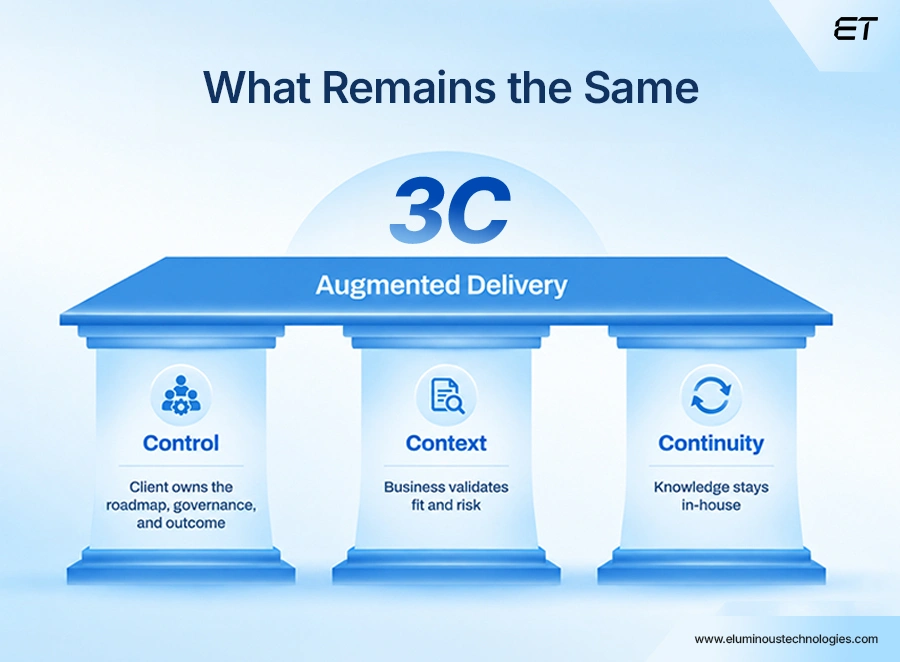
While AI staff augmentation teams may handle production support, governance, and human oversight, the fundamentals across the three domains still lie with the businesses.
1. Control: The client owns the architectural roadmap, governance, and business outcome. This implies they are the final authority on whether a particular use case solves a problem and should be further invested in or called off.
2. Context: AI staff specialists can suggest solutions. But the business decides whether it fits legacy technology, obligations, and risk appetite.
3. Continuity: Since augmentation is a temporary plug-in, the client retains the ownership of architectural decisions, business context, risk acceptance, and long-term operational knowledge.
As long as the organization has a clear view of the core fundamentals, both the augmented and in-house teams enable each other rather than pulling each other down.
Here’s a side-by-side comparison of what has evolved and what still holds up.
| Area | What’s Changing | What Isn’t |
| Talent | Buyers are seeking interconnected capabilities across AI, data, integration, evaluation, security, and MLOps with/without an increase in developer headcount. | The client determines which capabilities need to be supplemented based on its existing team and its gaps. |
| Delivery | Augmented specialists are transitioning from prototype support to production enablement. | The client continues to control the roadmap, architecture, acceptance criteria, and final release decisions. |
| Governance | Governance controls are increasingly designed and implemented alongside AI systems rather than treated as a separate review step. | The client owns policy, risk standards, and final approval. |
| Human Oversight | Human review points, approval gates, and escalation paths are increasingly designed, tested, and documented within connected workflows. | The client retains final authority over high-risk decisions and exceptions. |
To Wrap Up
As AI moves from experimentation to production, the role of staff augmentation is expanding. Businesses increasingly need the right combination of engineering, data, integration, and operational expertise.
That does not mean handing ownership to an external team. The client still determines the business priorities, architecture, risk appetite, and final decisions. The augmented team supplements the capabilities required to deliver and operate AI effectively.
The best results come when businesses first identify their capability gaps and provide the necessary foundation across data, systems, architecture, and internal ownership. From there, the right AI staff augmentation partner can help take artificial intelligence from idea to governed production.
Identify the Right AI Staff Augmentation Model for Your Team


Healthcare IoT Security: Risks, Best Practices, and How to Secure Connected Devices
Hospitals have many connected devices like patient monitors, wearable sensors, and clinician dashboards. Each is crucial, but only if it…

AI in IoT: How AI Is Reshaping the Internet of Things
Imagine your factory machine noticing a problem before you do. Its sensors keep monitoring temperature, vibration, pressure, and other operating…


