
 Book a Meeting
Software Development Team Structure: Models That Actually Work


- A clear software development team structure is crucial for scaling efficiently and delivering the best results.
- The right structure depends on your company’s size, product complexity, and growth stage.
- The three common team structures are: generalist, specialist, and hybrid. They have distinct advantages, disadvantages, and ideal scenarios.
- Key roles, such as developers, designers, QA, DevOps, and project managers (PMs), must align with delivery goals.
- An agile software development team structure promotes speed and adaptability.
- Scaling your team without breaking the well-laid structure requires intentional role expansion.
- Remote and distributed teams demand more defined processes, leadership layers, and communication protocols.
- Modern software development team organizational structures should align with your product lifecycle and business model.
If you’re staring at missed deadlines, budget blowouts, and frustrated stakeholders, you might suspect that your software development team structure is the main culprit. This phrase isn’t just a terminology. In fact, it’s the backbone that determines whether your team delivers or falters.
Even if there’s abundant information on boosting efficiency, over 26% of teams fail to deliver projects on time. A main contributor? A broken structure.
If you don’t want to end up falling short, it’s crucial to choose a modern software development team structure that meets your strategy. In this blog, we’re jumping straight to ‘who does what,’ ‘how they report,’ and ‘why it matters for speed, scale, and ROI.’
So, let’s dive into what each structure looks like in practice, the trade-offs you need to manage, and how to align your organizational design with your business goals.
Not sure how to structure your development team the right way?
What Is a Software Development Team Structure?

When most people hear the term software development team structure, they think of an org chart: developers reporting to a team lead, maybe a scrum master floating somewhere in between. But that’s just the surface.
The real structure goes deeper. It’s how you distribute responsibilities, manage communication, and how well the team maps to your business goals.
At its core, the software development team organizational structure is about the following:
- Who does what
- how they work together
- how decisions are made
And if you’re optimizing your product delivery, this structure is your biggest asset.
Here’s what the structure actually governs:
- Role distribution: Who’s on your team? (Developers, UI/UX designers, QA engineers, business analysts, DevOps, architects, product managers).
- Reporting and collaboration model: Do your designers work under the same umbrella as your developers? Does QA sit with the product or engineering? The answers shape velocity and clarity.
- Workflow dynamics: Whether you use an agile software development team structure or a more traditional model. The structure controls how fast feedback loops happen, how issues escalate, and how knowledge transfers across roles.
A modern software development team structure is about enabling your team to ship faster and adapt quicker. If you get it right, you reduce delays, miscommunication, and duplicated effort.
Want to go deeper into building a solid web development team?
Software Development Team Structure: Generalist, Specialist, or Hybrid?
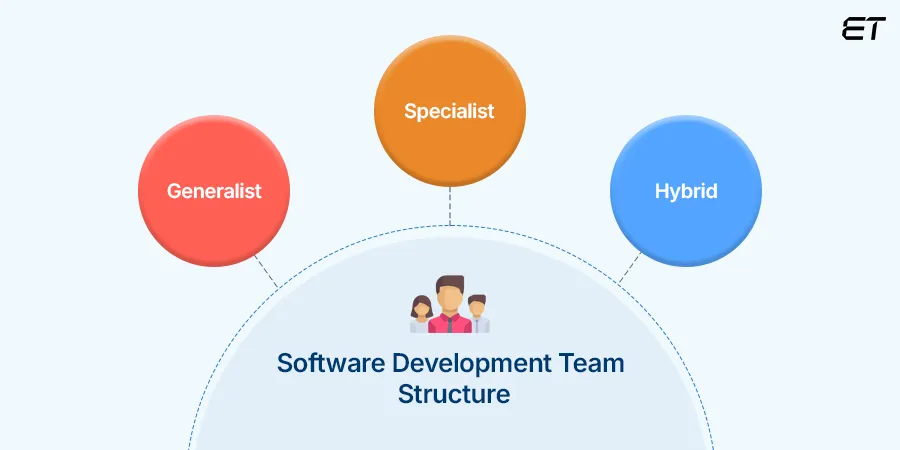
Once you understand what a software development team structure governs, the next logical step is to decide how you want to build that structure.
The core question? Whether your team members should wear many hats, one hat, or something in between.
There are three dominant approaches in the modern software development world:
- Generalist
- Specialist
- Hybrid
Each has its strengths and weaknesses. Let’s break them down.
Generalist Team Structure

A generalist team comprises multi-skilled professionals. These are people who can handle a wide range of tasks, from front-end coding to minor UX tweaks or from database queries to basic QA.
This structure is lean, agile, and flexible. In modern software development team structures, generalist teams are popular in early-stage startups or projects where speed and adaptability matter more than deep domain expertise.
✅ Pros
- Great for MVPs and early product stages
- Faster internal handoffs, fewer silos
- Easier to reallocate team members based on workload
⚠️ Cons
- Shallow expertise can cause quality issues at scale
- Risk of knowledge gaps on complex tasks
- Can burn out team members trying to do too much
Best for:
Startups, small cross-functional teams, and rapid prototyping environments.
Specialist Team Structure

A specialist team structure is one in which each member owns a well-defined role. You’ve dedicated front-end developers, back-end engineers, QA testers, UI/UX designers, business analysts, DevOps, and so on.
This structure fits perfectly in large-scale, enterprise-grade systems where precision matters more than flexibility.
✅ Pros
- High quality, deep expertise in every domain
- Fewer errors in complex workflows
- Easier to manage performance and expectations
⚠️ Cons
- Risk of silos and slower cross-team collaboration
- More coordination effort is necessary
- Less adaptable to shifting project priorities
Best for:
Mature products, regulated industries, and long-term projects with well-defined scope.
Unlock proven ways to scale with remote specialists, fast.
Hybrid Team Structure

Hybrid is where most modern software development team structures land today. It’s a mix of both worlds. You combine generalists with specialists who own critical areas, such as architecture, security, or testing.
✅ Pros
- Balanced expertise and flexibility
- Scales well as product complexity grows
- Encourages cross-functional collaboration without losing depth
⚠️ Cons
- Needs strong leadership to avoid confusion
- Risk of team imbalance if not intentionally designed
Best for:
Mid-to-large teams, scaling startups, or enterprises shifting toward Agile or DevOps models.
| Structure | Strengths | Weaknesses | Best Used When |
| Generalist | Fast, flexible, lightweight | Shallow expertise, burnout risk | MVPs, lean teams |
| Specialist | Deep skills, high quality | Slower, less adaptable | Large projects, enterprise apps |
| Hybrid | Balanced, scalable | Needs intentional design | Growing teams, agile orgs |
Key Roles in a Modern Software Development Team Structure
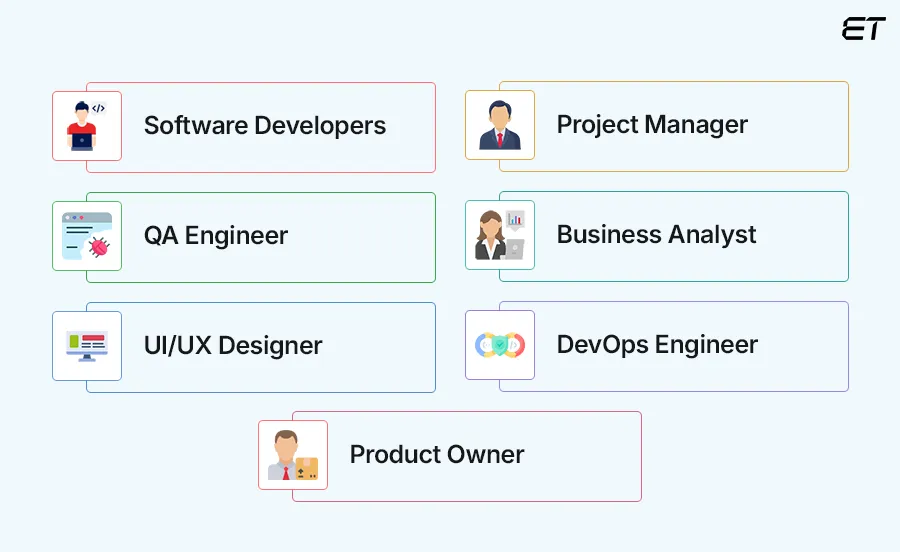
No matter how you design your software development team structure, your success depends on the experts. The right roles drive velocity, maintain code sanity, and protect the user experience.
Let’s break down the key roles of a modern software development team.
The Software Developer(s)
Developers are your core contributors. They code the logic, handle integrations, fix bugs, and bring the product to life. Whether full-stack or divided into front-end and back-end, they’re the hands on the keyboard.
Structure Tip: In generalist teams, developers wear multiple hats. In specialist models, you’ll see strict separations by layer (UI, API, DB, etc.).
Tap into top-tier developers, aligned to your delivery goals.
The Project Manager (PM)
This expert owns timelines, resources, and stakeholder alignment. They keep the chaos at bay and ensure the right alignment of your deliverables. A good project manager (PM) turns meetings into outcomes.
Structure Tip: In an agile software development team structure, this role often overlaps with that of the Scrum Master or Product Owner. But in enterprise orgs, PMs run the show.
Your project manager deserves smarter tools. Here’s what to pick.
The QA Engineer
Quality Assurance (QA) is about preventing a disaster. QAs test features, automate test cases and make sure you don’t deploy an incomplete product into production.
Structure Tip: In modern software development team structures, it is essential to involve QAs early. This way, it becomes easier to resolve issues in real time.
Catch bugs early with expert QA and testing support.
The Business Analyst (BA)
A great BA connects business goals with technical execution. They capture requirements, map them to features, and bridge the gap between stakeholders and developers.
Structure Tip: If your delivery team keeps missing the mark, you’re probably missing a solid BA.
The UI/UX Designer
Designers make your software or website usable and intuitive. They wireframe, prototype, and test flows that helps create an intuitive and engaging product.
Structure Tip: In lean teams, this role gets rolled into development or PM. In a scalable team structure, they deserve their own seat at the table.
The DevOps Engineer
This expert manages infrastructure, automates deployments, and keeps CI/CD flow. Without DevOps, your team doesn’t have a clear and concise goal.
Structure Tip: In agile or hybrid team structures, DevOps should work closely with both QA and developers to minimize cycle time.
Understand how DevOps stacks up against Agile teams.
The Product Owner
In agile software development team structures, the Product Owner represents the voice of the customer. This professional prioritizes features, defines user stories, and ensures the team stays focused on value over volume.
Each of these roles serves a unique function. Together, they form the structural integrity of your team. Next, we’ll talk about how to align these roles into actual delivery models.
How to Structure Your Software Development Team for Maximum Delivery?
Picking the right people is half the battle. The other half? Structuring them in a way that gets things done consistently. The software development team structure you choose impacts decision-making, delivery speed, and innovation. So, let’s break down the major structure models, and how they influence your output.
1. Centralized Software Development Team Structure
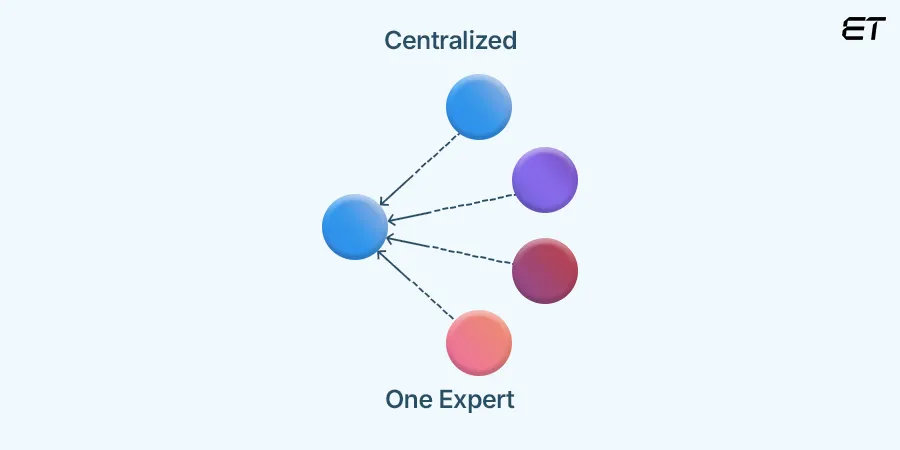
In a centralized structure, your development team operates as a single, unified unit. Everyone reports into the same tech leadership. The team members share the same backlog or work on common initiatives.
✅ When it works
- You’re building one product or platform
- Consistency, code reuse, and process alignment are critical
- You want to enforce high engineering standards across the board
⚠️ Watch out for
- Bottlenecks from over-managed backlogs
- Teams becoming disconnected from business goals
- Lack of ownership when too many people hover around the same tasks
Best fit for:
Enterprises with large, monolithic platforms or strict governance environments.
2. Decentralized or Product-Aligned Structure
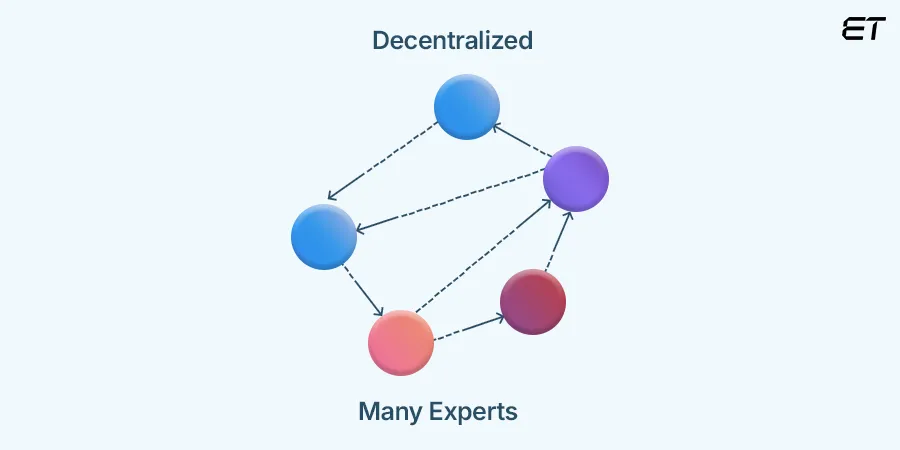
In this model, your software development team works in the form of smaller, cross-functional units. Many orgs call them ‘pods’ or ‘squads.’ Each team owns a feature, product area, or microservice and includes a mix of roles.
This agile software development team structure is a favorite among product-led organizations, as it brings the business problem and the delivery team together in the same room.
✅ When it works
- You’re shipping multiple products or services in parallel
- Speed, autonomy, and customer-centricity are key
- You want tighter product feedback loops and faster iteration
⚠️ Watch out for
- Redundancy across pods (duplicate code, tools, or effort)
- Cultural or technical fragmentation
- Lack of shared engineering vision without strong architectural oversight
Best fit for:
Modern SaaS, scaleups, or orgs running multiple product lines.
3. Hybrid Structures
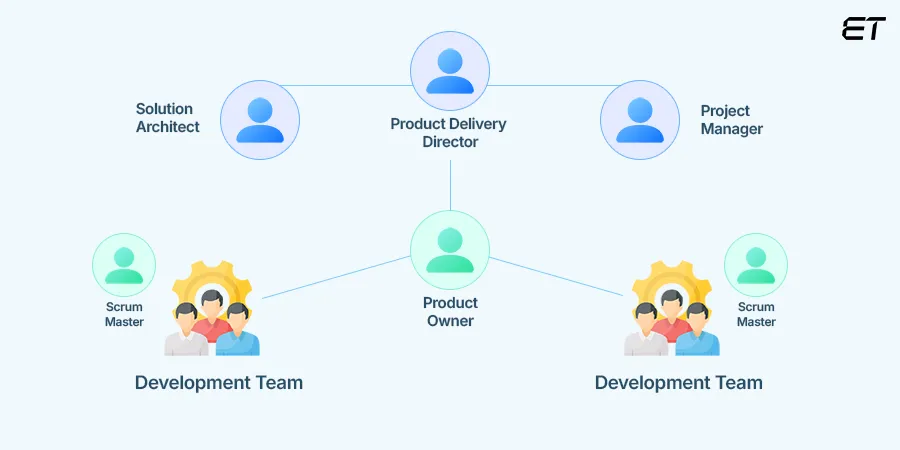
Many high-performing businesses opt for a modern software development team structure that combines centralized practices (like shared DevOps or security teams) with decentralized delivery squads.
This aspect balances autonomy with alignment, avoiding the need to reinvent the wheel every time a new feature team is spun up.
Need quick use case scenarios for each? Refer the table below:
| Your Scenario | Best Team Structure |
| One core platform, strict governance | Centralized |
| Multiple products or fast cycles | Decentralized |
| Startup-to-scaleup phase | Hybrid |
| Heavy technical debt or legacy code | Centralized (short-term), Hybrid (long-term) |
| Distributed remote teams | Hybrid with standardized tooling |
Your software development team structure should evolve with your business. You can start centralized if you need control, pivot to cross-functional when you need speed.
Scaling Your Software Development Team Without Breaking the Structure

Do you know the real issue of team building?
You go from a lean squad of five to a bloated team of 50. Suddenly, features take twice as long, bugs pile up, and no one knows who owns what. That’s not the best scenario.
Scaling your software development team is about protecting clarity, speed, and quality as the squad grows. Let’s talk about how to scale while maintaining the foundation.
Scale Roles, Not Just Numbers
Don’t fall for the trap of augmenting your current team 3x and calling it growth. Scaling smart means asking:
“Which functions are under stress? What’s actually slowing us down?”
All in all, scale intentionally, not reactively.
Know When to Split Teams
One development team to cover everything? Not for long.
Here are clear signs it’s time to split your software development team into parallel units:
- Releases are consistently blocked by unrelated features
- Code reviews are backlogged for days
- Product and engineering priorities start diverging
- No one knows who takes ownership of a specific feature
The solution?
Create clear ownership lines. One team per feature area, service, or product module. This is core to a modern software development team structure.
Add Structure at the Leadership Layer
Hiring several engineers without mid-level or senior leads is similar to binge eating junk food.
As you scale, you should layer in:
- Tech leads to maintain code quality and unblock developers
- Product leads to own vision and roadmap
- Engineering managers to coach your juniors
Simply put, you don’t need more managers. You need the right managers.
Manage the Remote Factor
Remote teams lead to freedom and flexibility. You want this aspect, but without structure, they’re inefficient.
To scale remote teams well, you need to:
- Standardize tools (GitHub, Jira, Slack, CI/CD)
- Create clear communication protocols
- Align on shared documentation
- Be timezone-conscious when forming pods
A hybrid or remote-first software development team organizational structure demands more intentionality.
Need remote talent fast? Staff augmentation can help.
Wrapping Up: Build a Software Development Team Structure That Delivers
Anyone can assemble a team of developers, declare victory, and hope for the best. But that’s not what you’re here for. You’re here to build a software development team structure that delivers on deadlines, quality, and business outcomes.
Throughout this guide, you’ve seen:
- The different types of structures and when each works best
- How to assign the right roles to keep the flow smooth and ownership clear
- Ways to scale your team without wrecking your delivery velocity
- Strategic signals to help you decide what structure fits your org stage and model
The best structure is the one that grows with you. So, whether you’re running lean with a centralized squad or going full agile with pod-based teams, clarity, communication, and alignment is vital. Choose wisely, adjust often, and never confuse team size with team strength.
Ready to build a team that delivers exceptional results?
Frequently Asked Questions
1. What is the ideal software development team structure for startups vs enterprises?
For startups, a generalist or hybrid team structure works best. There are fewer people, more flexibility, and rapid iteration. As you scale in enterprise settings, you’ll need a more layered software development team structure with dedicated roles, such as product owners, QA engineers, and DevOps engineers.
2. How does agile software development team structure differ from traditional models?
An agile software development team structure is cross-functional, self-organizing, and designed for iterative delivery. Unlike traditional top-down hierarchies, Agile teams comprise developers, designers, testers, and product leads who work together in sprints. The focus is on velocity, customer feedback, and quick pivots.
3. What roles are essential in a modern software development team structure?
In a modern software development team structure, must-have roles include frontend and backend developers, UI/UX designers, QA testers, DevOps engineers, product managers, and team leads. Depending on your product maturity and goals, you may also need specialists like data scientists, platform engineers, or security analysts.


RFQ Automation: The Smarter Way to Increase Sales and Reduce Manual Work
Here’s how you lose a prospect today. A request comes in, and someone from your sales team pulls product details…


How Enterprise Web Portal Development Supports Multi-Plant Operations
I once spoke with an operations leader at a US-based manufacturing firm. They had grown from two plants to seven…


