
 Book a Meeting
Staff Augmentation Pricing Models Before and After AI
How do we link pricing to business outcomes, not just billable hours? The answer to this question has notably changed due to the evolution of AI.
Onboarding superheroes when you are building a Lego castle yourself seems to be the right thing to do. It used to be a predictive lever in the executive playbook.
With an introduction to Artificial Intelligence, the conversation on staff augmentation pricing models have gone from hourly-based to value-based models.
Initially, linear cost was tied to billable hours; now, an AI-augmented productivity mode is tied to strategic value.
This blog outlines how staff augmentation pricing models have shifted before and after AI, while comparing its impact on the industry.
Staff Augmentation Pricing Models: Insights on Time & Material to Outcome-based Pricing
For years, staff augmentation has been a central part of hiring specialized talent without bearing long-term overhead and benefits. In this strategy, pricing models used to heavily depend on billable hours and monthly retainers.
However, beyond 2026, the metrics have shifted after AI impacted the way companies billed vendors.
Assessing third-party vendors for bringing external professionals has become significantly easier today. This closely refers to how talent is valued and billed in 2026.
Traditional Staff Augmentation Pricing Models
Before AI was in the picture, staff augmentation used to be highly human-dependent.
Even with this conventional approach, the catch was that all the labor was done by hiring companies. This meant that from carrying operational expenses to training the resources, they maintained most of the control.
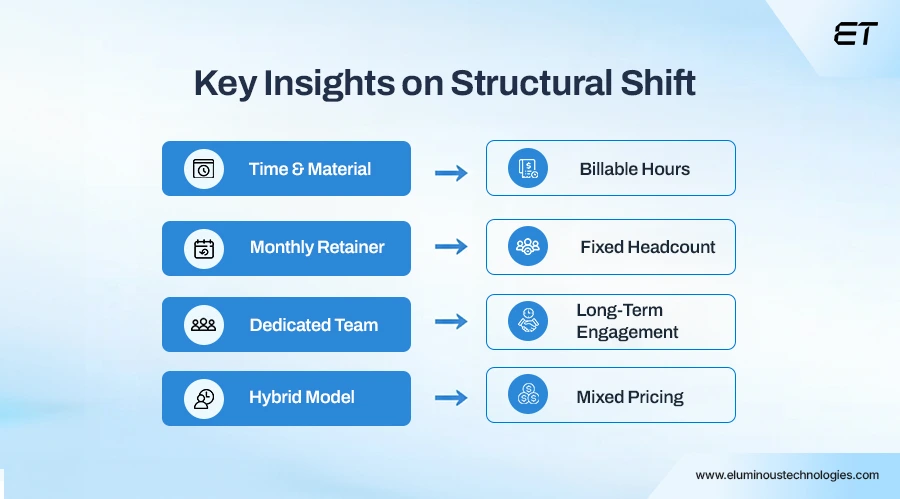
The key structural shift:
- Value-based Shifting: This change is moving towards hybrid models. This includes combining in-house teams and scaling quickly, while the costing is tied to specific outcomes.
- Geographic Refocus: Earlier, the hub used to be offshore (e.g., India, Southeast Asia), but now it is shifting towards onshore/nearshore or a reliable offshore exception.
- On-Demand Talent: Building through specialized roles with niche expertise leads to a unique pricing model.
- TCO: Total Cost of Ownership, this reveals what the true cost of the onboarding is, including training cost, recruitment fees, and management overhead. Identifying these expenses traditionally helped companies choose budget-friendly options over costlier lifecycles.
The Decisive Factors in Staff Augmentation
Staff augmentation pricing models relied heavily on consumer requirements. For them to decide what is going to work for their current project, these things were taken into consideration:
- Clear Goals: The scope of the project and deliverables needed to be clear. This helped in a controlled budget.
- Selecting the Right Partner: For onboarding a reliable team member, it was necessary to choose a reputable vendor. One should choose the right expertise that satisfies the intent and requirement.
- Managing and Adding to the Team: From onboarding professionals to outlining workflow, it all played a crucial role in deciding the scale and timeline of the project. Doing so contributed to the smooth completion of the project.
- Security and Compliance: Safeguarding client data through NDAs and strict access controls was essential, with shared accountability between both parties.
Considering all the factors mentioned, companies considered these factors not only for pricing decisions, but for governance decisions as well. From investing time to evaluate the right team members to managing team integration, this was a well-oiled machine for fewer project disruptions. Nevertheless, these criteria remain relevant in the era of AI, with specific additions like AI tooling maturity and their ability to measure productivity.
The Pre-AI Strategic Outsourcing Model
From an executive perspective, the model was straightforward. Outsourcing operates as a structured, process-driven model. It was built on long-established vendor–client relationships.
This approach emphasized process standardization and cost efficiency.
Here are some of the major highlights of this era:
- Transactional Relations: Before AI, outsourcing focused on reducing the in-house expenses.
- Geographic Dependency: The primary objective was to leverage lower labor costs in offshore locations.
- Slower Cycles: Because the model relied heavily on manual effort and training, project timelines were typically longer.
Key Limitations:
- High Errors: The possibility of making mistakes during the process or in the project was high, compared to AI–driven models.
- Slow Processing: Manual workflows and data entry extended turnaround times and increased the risk of human error.
In retrospect, the pre-AI scenario maintained its core promise of delivering labor but failed to measure the performance. It was based on the relationship of tenure rather than the scope of the value-based outcome.
What Traditionally Staff Augmentation Pricing Models Looked Like
Staff augmentation is a widely adopted talent acquisition approach that provides companies with access to skilled professionals for a defined period. It helps meet project deadlines by extending the capabilities of internal teams. While scaling the scope of the projects, staff augmentation also delivers structured pricing logic with cost controllability.
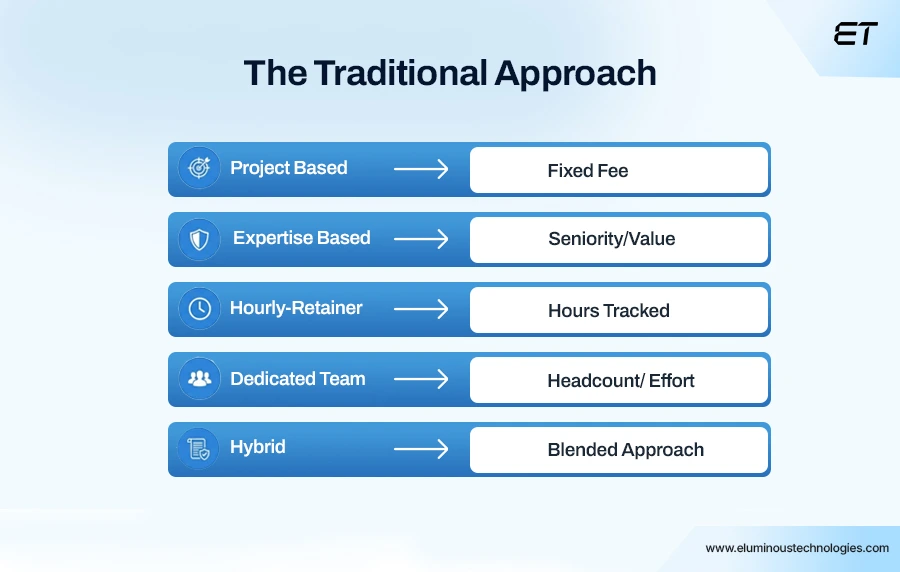
Traditionally, staff augmentation pricing models were structured in the following ways:
Project-Based
The outcome of the project determines the payment in this model. It works well for managing the budget. It is best suited for clearly defined short-term engagements.
Expertise-Based
This model adjusts according to the expertise and the years of experience a professional possesses. Senior professionals command higher rates but often speed up project delivery.
Hourly-Retainer
In this model, professionals are billed based on agreed hourly commitments or monthly retainers. It works well for projects with evolving or intermittent requirements.
Dedicated Team Model
This model typically operates on a fixed monthly fee. Here, the client is assigned a dedicated team managed by the vendor. Its cost often includes the infrastructure cost, management fees, and handling fees.
Hybrid Model
This model combines elements of hourly, performance-based, and expertise-driven pricing. It offers flexibility while maintaining cost control.
All the models mentioned above clearly state that their pricing philosophy is based on input-driven structures. These include hours, seniority tiers, and headcounts. While there are significant advantages to models, there is a common limitation that can’t be overlooked. This limitation is that pricing is inclined towards productivity being assumed rather than being verified. Significantly, the value delivered was directly proportional to the cost. The AI-era models are structured for filling these gaps.
Understanding Linear Labor Economics in Staff Augmentation
Before AI, staff augmentation pricing models operated on a simple economic principle: output scaled directly with labor input. This assumption shaped everything from pricing to contract structure to resource planning for decades.
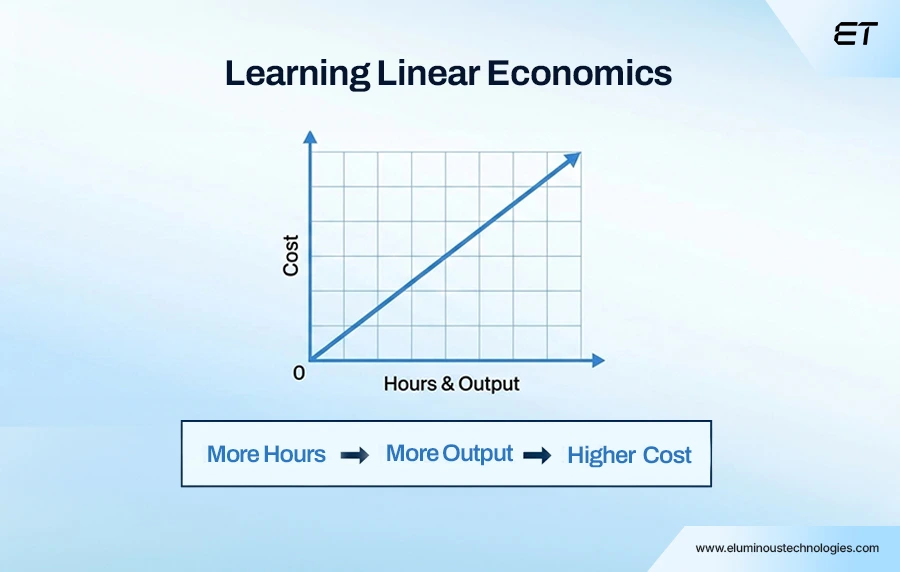
This model was rooted in classical production theory, where labor was treated as a variable with relatively constant marginal productivity.
Contracts were structured around billable hours rather than measurable productivity. In practice, this meant that revenue increased with time spent, not necessarily with efficiency or output quality.
The model persisted for years because it was simple, predictable, and easy for procurement teams to manage.
Now that AI is in the picture, the possibilities of pricing on the basis of hours have changed. It had shifted the light towards paying for the outcomes, talents, and time-efficient results.
AI-Driven Evolution in Staff Augmentation Pricing Models
AI is transforming staff augmentation by reshaping how talent is contracted and priced. One of the most significant shifts is performance-linked billing. Compared to the traditional structure, AI is able to compete as it automates most of the work within identical frameworks.
Vendors are increasingly positioning productivity as a billable value driver. They are using AI agents, automation tools, and advanced prompt engineering to boost team output.
This shift includes the implementation of no-code, low-code solutions to achieve smarter and more reliable outcomes. Since AI was established, the workflow and the process have become smoother, and the output has multiplied.
Top AI-Driven Staff -Augmentation Pricing Models
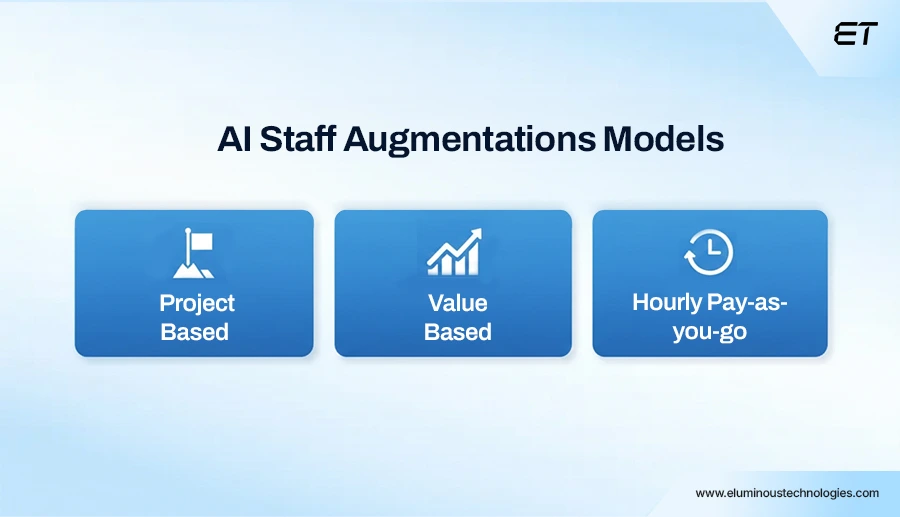
Project-Based Model
Project-based models refer to the setup where the cost is defined by the outcome of the project. This closely compares the work that was assigned to the results achieved. This clearly states the expectations for the client and is an ideal opportunity for startups.
This model works well for AI-driven initiatives such as model training, automation deployments, or data analytics projects. It provides cost-effectiveness and supports milestone-based execution.
The best use case of this project could be developing a customized chatbot or creating AI-driven analytical dashboards. The biggest advantage of this model is its cost-effectiveness. This becomes clear from its timeline and clarity from the outset.
But success depends on clear scope definition and strong vendor accountability. Scope creeping, changing AI requirements, or evolving compliance standards can increase costs and introduce risk.
Value-Based Model
The value-based model has gained traction as AI enhances measurable business outcomes. Instead of billing for time or resources, pricing is linked directly to business impact.
Clients pay based on performance metrics such as speedy delivery, operational cost reduction, automation efficiency, or revenue impact.
Focusing on value generated rather than just achieving the result, the key aspect of this model post AI looks something like this:
- Performance-Based Measurement: The payment made for specific results no longer depends on the hourly rates. Clients are specific about the results and are particular about the project’s milestones.
- Efficient Metrics: AI-driven workflows reduce idle time and increase measurable output per resource.
- Seat-Based Costs: This ratio has come down after AI. Companies can now avoid paying for the unused capacity and can finally scale up and customize according to the needs of the projects.
This model prioritizes tangible business impact over resource allocation, aligning vendor incentives directly with client success.
Hourly Model (Pay-as-you-go)
In staff augmentation, the hourly-based model refers to the flexible approach of paying only for the actual hours worked. This scenario works best for short-term projects and circumstances that need experts in a specific niche.
This model is perfect in case of urgent IT tasks. With the evolution of AI copilots, the output on projects has become impactful and time efficient. This states the strengthening of the cost-to-value ratio.
Here are a few advantages of following this model:
- Offers high flexibility
- Holds transparency for budget consumption
- Efficient risk management for service providers
- Best for short-term projects like Agile projects
Overall, spending by using this model reduces because of greater productivity levels with the use of AI. This model is common for software development, freelance services, and IT consulting. The aftermath clearly suggests that using AI is inclined towards reaping outcomes based on skills. It is linear to the value being generated rather than the time invested.
Staff Augmentation Pricing Models: Before vs. After AI
The introduction of AI has reshaped staff augmentation pricing models. Beyond faster execution, the shift has changed how value is measured, billed, and benchmarked.
The table below highlights structural changes in pricing dynamics.
| Metrics | Before AI | After AI |
| Pricing | On the basis of time and material. Can be fixed rate, monthly retainer. | Greater adoption of project-based, value-based, and flexible pay-as-you-go models. |
| Contract Metrics | It used to be long-term and had a fixed scope of work requirements. | Greater emphasis on milestone-based delivery and sprint-driven flexibility. |
| Billing Basis | Based on recorded billable hours. | Takes the scope of outcomes achieved into consideration. |
| Skill Valuation | Years of experience and seniority matter. | AI fluency, tool utilization, and productivity enablement matter more than tenure alone. |
| Vendor Criteria | Availability of billable headcounts. | AI capability, delivery velocity, and measurable outcome tracking. |
| Cost of Ownership | Overlooked hidden costs such as training and management overhead. | Integrated transparency on tooling costs, delivery benchmarks, and AI licensing. |
| Governing Performance | Weekly timesheet checks. | Real-time dashboards, automated reporting, and output benchmarking. |
| Cost Predictability | High – as the hours are billable. | Defined guardrails create variable costs tied directly to measurable outcomes. |
Overall, the shift is highly economic. AI compresses effort while expanding output, redefining how pricing aligns with business value.
Executive Scenarios: Before vs After AI
The given examples are a clear illustration of how AI is actively reshaping staff augmentation engagement models. This shift is visible based on pricing on accountability and outcomes.
Example 1
Consider a technology company building and deploying a product with three major features on a 90-day timeline. The internal team has expertise but lacks bandwidth.
The Pre-AI Scenario: In this case, they might have worked immediately onboarding 6 -7 developers who would work on a time & material contract. This model bills strictly on time and materials, with no direct linkage to output velocity.
After AI: Post-AI, the company may engage three AI-enabled engineers under a deliverable-based contract. Instead of paying hours logged, the company pays for defined outcomes.
Executive Takeaway: AI-augmented engagement compresses timelines while improving cost predictability. These two priorities directly impact executive decision-making.
Example 2
Let’s assume a financial services firm is in the middle of completing a data mitigation project across legacy systems. This project’s scope does require a dedicated team model. This team must typically include QA, engineers, and project management. The timeline is going to be approximately six to nine months.
Before AI: The project was billed on a fixed monthly fee for the dedicated team.
After AI: Post-AI, the engagement shifts to a hybrid model. Automation handles data validation and anomaly detection, reducing the manual workload of the five-member team.
Executive Takeaway: Hybrid AI-enabled models allow organizations to right-size teams while maintaining quality and improving measurable accountability.
Bottom line: In both scenarios, AI does not eliminate teams. It simply redefines how their productivity is priced.
The Final Verdict for Executives
Staff augmentation pricing has been fundamentally repriced. AI has shifted the model from labor-based billing to productivity-driven valuation, increasing transparency, accountability, and measurable output.
Executives evaluating vendors must now apply a different lens.
If pricing is still strictly hour-based, it may indicate a legacy operating model. In a post-AI environment, pricing should reflect productivity, automation leverage, and measurable outcomes.
Executives should assess how deeply AI is integrated into delivery of workflows and demand transparency in the total cost of ownership. Forward-looking firms are redesigning how value is created.
If you are one of them and are currently working on evaluating staff augmentation for your current projects, the eLuminous technologies team is dedicated to working with organizations at every step.
Connect with our team to explore a pricing model aligned with your business objectives.

Choosing a Software Development Partner: A Practical Evaluation Framework
You’ve started shortlisting multiple vendors, and suddenly, every option looks the same. Polished portfolios, bold claims, similar tech stacks. It’s…


Staff Augmentation Best Practices for High-Performance Teams
Do you have a clear vision, but lack the bandwidth or skills to execute fast enough? Then it might not…


